TVL Surpasses $3 Billion, DEGEN Rises Over 20x—What’s Next to Explore on Base?
TechFlow Selected TechFlow Selected
TVL Surpasses $3 Billion, DEGEN Rises Over 20x—What’s Next to Explore on Base?
Meme hype waves keep coming one after another—will Base chain explode?
 Navigating Web3 tides with focused insights
Text: Xiyu, ChainCatcher
Edited by: Marco, ChainCatcher
In the final two days of March, the meme coin mfercoin on Base created a sensation in the crypto community by surging over 100x within six hours of launch.
mfercoin is a meme token launched by Sartoshi, founder of the well-known NFT project Mfers. It opened at around $0.0015 and surged as high as $0.31—a cumulative increase exceeding 200x—before pulling back to $0.18.
Shortly after, Poopie, founder of Doodles, launched the meme coin POOP, which immediately surpassed a $50 million market cap at launch, making it a top priority for crypto users to join Base’s growing meme frenzy.
In fact, ever since Ethereum's Cancun upgrade, Base has experienced explosive growth in on-chain data. During the second week after the upgrade (March 25), Dune data showed that Base added approximately 850,000 new users in one week—the highest weekly user growth in its history.
Within 10 days, Total Value Locked (TVL) grew by over $1.5 billion. According to L2Beat, by April 1, the value of crypto assets locked on Base exceeded $3 billion (currently $3.2 billion), representing a 65.4% increase over the past seven days. Base’s TVL jumped to third place among Layer 2 networks, behind Arbitrum ($17.13 billion TVL) and OP Mainnet ($8.52 billion TVL).
Beyond TVL growth, token prices within the ecosystem have also risen sharply. For instance, DEGEN, a meme coin native to the social platform Farcaster, climbed from around $0.0014 on March 13 to a new all-time high above $0.06 on April 1—an increase of over 40x in just two weeks. Meanwhile, AERO, the token of DEX platform Aerodrome, rose more than 100% in the past seven days and is now trading at $1.40.
The explosive growth in both TVL and meme token prices has made Base one of the hottest topics in the current crypto market, drawing significant attention from KOLs worldwide toward Base and its ecosystem applications.
Based on previous public chain development patterns, once a blockchain gains momentum, its ecosystem tends to explode across various sectors—including native DEXs, lending, memes, NFTs, and social platforms—creating new opportunities. So what opportunities exist within the Base ecosystem? And why has Base drawn so much attention recently?
Why Is Base’s On-Chain Data Surging?
Two key factors may be driving Base’s recent surge in on-chain activity: first, the implementation of EIP-4844, which reduced gas fees and boosted transaction demand and ecosystem growth; second, ongoing support and integration from Coinbase.
Since EIP-4844 was adopted on March 16, Base’s gas fees briefly dropped from around $0.58 to as low as $0.07, while data submission costs to L1 data availability (DA) fell from tens of thousands of dollars per day to just a few thousand or even hundreds. This attracted massive user interest—on that day alone, active user addresses reached 850,000, with over 2.06 million transactions completed, setting a new record.
However, the surge in user activity quickly drove gas fees back up—even exceeding pre-Cancun levels. On March 26, gas fees spiked to as high as $9.90 per transaction.
In response, Jesse Pollak, a core contributor to Base, tweeted that although EIP-4844 lowered base costs, it unleashed over five times the previous transaction demand, causing gas spikes. The team is actively working to reduce network fees.
Roberto Bayardo, a member of the Base team, said they began increasing the target throughput by 50% starting March 27 and will monitor the impact. If successful, another increase—bringing total capacity to at least double the current level—is planned for the following week.
As of March 29, Base’s average gas fee stabilized around $0.50, roughly matching pre-Cancun levels.
As a Layer 2 network launched by Coinbase, Base benefits immensely from its parent company’s vast user base and deep financial resources, enabling strong synergies between Base, Coinbase Exchange, and its wallet ecosystem.
First, regarding interoperability between exchange and chain: on February 29, Base announced that smart wallets would be a major focus for 2024.
Coinbase’s new Account Abstraction (AA) wallet has already launched on the Base Sepolia testnet. Regular users no longer need seed phrases or browser extensions—accounts can be generated directly via mobile devices or Google accounts. Newcomers can use their Coinbase account balance to pay gas fees or purchase tokens directly, significantly lowering entry barriers and laying the foundation for large-scale user and capital inflow to Base.
Additionally, Coinbase plans to migrate some exchange operations onto Base. On March 27, Max Branzburg, Vice President of Consumer Products at Coinbase, stated that Coinbase will store more corporate and customer USDC balances on Base.
With the combined boost from EIP-4844 and Coinbase’s backing, Base has entered a new phase of opportunity, with applications and meme coins experiencing rapid growth.
According to DeFiLlama, as of April 1, there were 240 applications on Base with over $1.1 billion in TVL—a 149% increase in the past two weeks. Aerodrome, the leading DEX on Base, has captured over $2.61 million in fees, ranking among the top 15 in the entire crypto market.
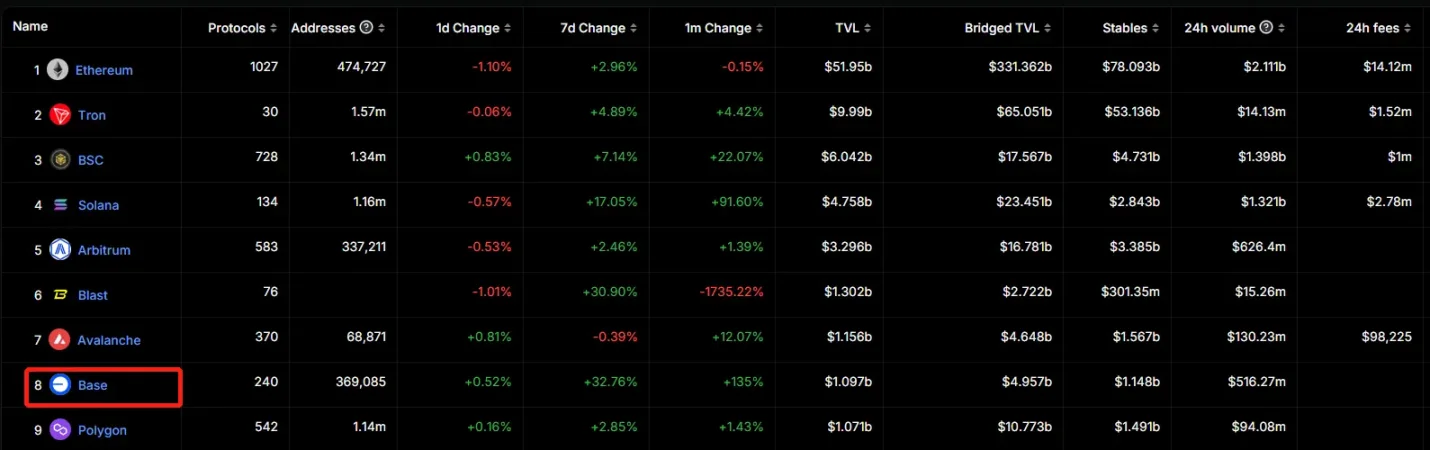
That said, it's important to note that the Base ecosystem is still in early stages and carries higher risks. Users should exercise caution when selecting projects—for example, the OVER and BACK betting meme coin pair that went viral on March 20 faded into silence within less than a day.
What Are the Key Applications in the Base Ecosystem?
1. Decentralized Social Protocol Farcaster and Its Ecosystem
Farcaster is a decentralized social media protocol founded by former Coinbase executives including Dan Romero. It serves as a foundational Web3 social infrastructure, allowing developers to build novel social apps while enabling users to freely move their identity and data across applications.
At the end of January this year, Farcaster introduced Frames—a feature that turns any Farcaster post into an interactive mini-app, similar to WeChat Mini Programs—allowing direct user engagement.
Warpcast, the official app developed by the Farcaster team, resembles Twitter in interface and functionality, enabling users to post, follow, comment, interact, and build communities.
To participate in Farcaster, users can download and use the Warpcast app. Account registration requires a $5 fee (approximately RMB 35).
Other applications built on Farcaster include Darkula, a decentralized video platform (similar to TikTok), and Jam, a social quoting tool.
On March 31, Bloomberg reported that Merkle Manufactory, the developer behind Farcaster, is closing a funding round led by Paradigm, valuing the company at around $1 billion.
Currently, the Farcaster protocol has not issued a token.
2. DEGEN
DEGEN was initially distributed as an airdrop reward to participants in the Farcaster DEGEN channel and started as a mere meme coin. Today, it has gained widespread adoption among developers, crypto content creators, and enthusiasts, emerging as the flagship token on Base and used for tipping within Farcaster’s ecosystem.
The genesis supply of DEGEN is 37 billion tokens, with 70% planned for eventual airdrops. During the initial distribution, 15% of the total supply was airdropped to active members of the Farcaster DEGEN channel. Points were calculated based on user interactions such as likes, reposts, followers, and ownership of relevant community NFTs.
On February 21, DEGEN announced a $1.47 million angel round (490.5 ETH at the time), led by 1confirmation, with participation from Farcaster OGs. The funds will support DEGEN ecosystem and community development.
DEGEN is now the most active channel on Farcaster, and the DEGEN token has been integrated into Drakula, a social video app in the Base ecosystem, supporting tipping via DEGEN.
As of April 1, DEGEN was trading at $0.06, with a market cap of $1.92 billion.
3. DEX Leader Aerodrome
Aerodrome is a ve(3,3)-model decentralized exchange forked from Velodrome in the Optimism ecosystem. It is currently the largest DEX on Base by trading volume.
In early February, Aerodrome’s native token AERO was listed on Coinbase. On February 27, it was announced that Aerodrome received investment from Coinbase Ventures-led Base Ecosystem Fund, though the amount was undisclosed. The investment was made through the purchase of AERO tokens.
On April 1, AERO traded at $1.40, with a fully diluted valuation (FDV) of $1.25 billion.
4. SocialFi App Friend.tech
Friend.tech is a SocialFi application built on Base, whose core idea is to turn Twitter influencers’ social clout into tradable “KEY” tokens.
Simply put, Twitter KOLs can link their accounts to Friend.tech and issue social tokens called KEY. Users who buy these KEYS gain special privileges, such as access to exclusive channels or content.
When launched in August last year, Friend.tech became a breakout hit on Base, gaining massive popularity.
On March 13, Friend.tech announced that its V2 version would launch one week after April 20, featuring new functions like Money Club, a revamped points program, and customizable bonding curves.
5. Presale Meme Coin ROOST
ROOST is a new memecoin on Base that began presales on March 22. Users could deposit ETH to receive ROOST tokens. Within 24 hours of launch, the presale raised $12.5 million, quickly becoming a new speculative darling in the crypto space. ROOST opened at $0.07 on March 26, peaked at $0.135, and is now trading at $0.05, with a market cap of $47.7 million.
6. NFT and Meme Project Base Gold
Base Gold is a meme project on Base, consisting primarily of Base Gold NFTs and the meme token TYBG.
The Base Gods NFT collection features comic-style avatars based on Coinbase founder Brian Armstrong. The series includes 809 NFTs, commemorating Base’s mainnet launch on August 9. The current floor price is 1.23 ETH.
The TYBG token has a total supply of 12.3 billion and is currently priced at $0.00045, with a circulating market cap of $55.39 million.
7. Meme Coin mfercoin by Mfers Founder
mfercoin is a meme token launched by Sartoshi, founder of the prominent NFT project Mfers, on Base. It has a fixed supply of 1 billion tokens, with no presale. Around 2% of the total supply was allocated for liquidity upon launch. Holders of mfers NFTs and artists who have collaborated with the mfers project are eligible for airdrops.
According to DexScreener, mfercoin saw explosive interest post-launch, with its price climbing from an opening of ~$0.0015 to a high of $0.31—a surge exceeding 200x—before settling at $0.18, with a market cap of $186 million.
8. Meme Coin POOP by Doodles Founder
The day after mfercoin caused a stir in the crypto market, Poopie, founder of Doodles, announced the launch of the meme coin POOP on Base, also with a total supply of 1 billion tokens. Its market cap briefly surpassed $50 million at launch.
However, POOP failed to gain sustained traction post-launch. After peaking at $0.03, the price steadily declined to $0.009, forming a "Christmas tree" pattern. Its market cap has shrunk to $8.9 million, down nearly 60% from its peak.
Join TechFlow official community to stay tuned
Telegram:https://t.me/TechFlowDaily
X (Twitter):https://x.com/TechFlowPost
X (Twitter) EN:https://x.com/BlockFlow_News
 ChainCatcher 链捕手