Vitalik: What else can meme coins do?
TechFlow Selected TechFlow Selected
Vitalik: What else can meme coins do?
Money is zero-sum, but fun can be positive-sum.
 Navigating Web3 tides with focused insights
Author: Vitalik Buterin
Compiled by: TechFlow
Meme coins are undoubtedly the stars of this crypto cycle.
Yet every day we see a flood of copy-paste meme coins, most of which offer no value beyond speculation. So what else could meme coins do?
Vitalik has been thinking about this very question and recently explored it in a blog post.
Vitalik openly stated that he has zero enthusiasm for tokens named after things that excite people in month N but make everyone uncomfortable in month N+1—highlighting how meme coins rely on names and concepts to grab attention, functioning economically as zero-sum games.
At the same time, he explores whether meme coins could be used for other purposes—such as redirecting that attention toward charity or gaming—and become public goods that benefit certain sectors of society.
Below is TechFlow’s translation of Vitalik’s latest article.
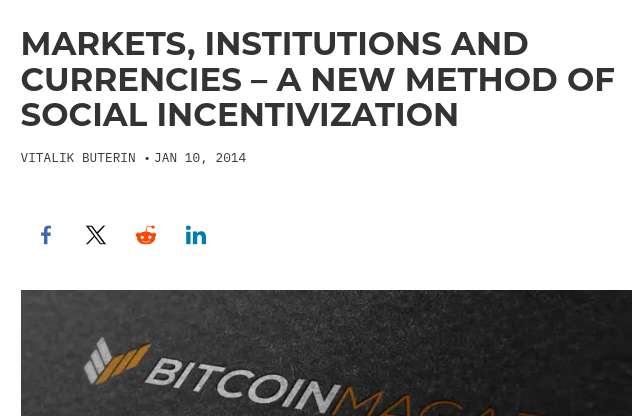
Ten years ago—just two weeks before the public announcement of Ethereum—I published an article in Bitcoin Magazine arguing that issuing tokens might be a new way to fund important public projects.
The idea was: society needs various ways to fund valuable large-scale projects. Markets and institutions (including companies and governments) are the main tools we have today—effective in some cases, failing in others. Issuing new coins seemed like a third category of mass funding technology, distinct from both markets and institutions, succeeding and failing in different places—and thus capable of filling some critical gaps.
People who care about cancer research could hold, accept, and trade AntiCancerCoin; those concerned with saving the environment would hold and use Climate Coin, and so on. The tokens people choose to use would determine which causes get funded.
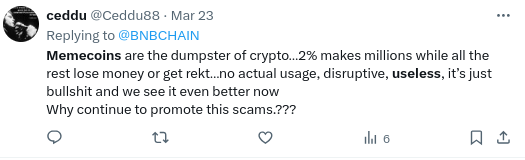
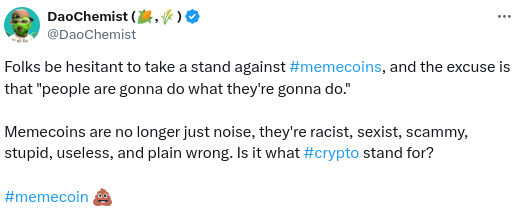
Today in 2024, a major topic within the "crypto space" seems to be meme coins. We've seen meme coins before—starting with Dogecoin in 2015, and "dog coins" were a central theme during the 2020–21 crypto season. Now they're back, but this time making many people uneasy because there's nothing particularly novel or interesting about them. In fact, the opposite is often true: a number of Solana-based meme coins have recently exhibited overtly racist content. Even non-racist meme coins often appear to just fluctuate in price without delivering any real value.
And people are frustrated by this phenomenon:
Even long-time Ethereum philosopher Polynya is extremely unhappy:
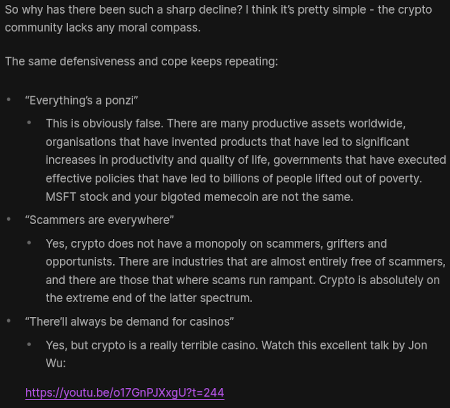
One response to this dilemma is to shake your head and send “virtue signals” about how much you despise such foolishness. To some extent, that’s the right move. But at the same time, we can ask another question: if people value fun, and financialized games seem to provide that at least sometimes, could the entire concept be reimagined into a more positive and constructive (positive-sum) version?
Charity Coins
The most interesting tokens I’ve seen are those where a significant portion of the token supply (or some ongoing fee mechanism) is dedicated to supporting charitable causes. A year and a half ago, there was a token called “GiveWell Inu” (now inactive) that donated proceeds to GiveWell. For nearly two years, there has also been a coin called “Fable of the Dragon Tyrant,” which supports cultural projects related to anti-aging research among other initiatives. Unfortunately, neither was perfect: GiveWell Inu appears to no longer be maintained, while the other coin had some extremely annoying core community members who persistently tried to involve me—making me currently reluctant to mention them repeatedly. More successful, however, was when I received half the Dogelon Mars token supply and immediately re-donated it to the Methuselah Foundation; since then, both the Methuselah Foundation and the Dogelon Mars community seem to have built a positive-sum relationship, transforming $ELON into a charity coin.
There feels like an unclaimed opportunity here—to try creating something more positive and more enduring. But ultimately, I think even this approach faces fundamental limitations, and we can do better.
Robin Hood Games
In principle, people participate in meme coins because (i) their value might go up, (ii) they feel democratic and open to anyone, and (iii) they’re fun. We could divert a large part of a memecoin’s supply to support public goods that people care about, but that doesn’t directly help participants—and actually comes at the expense of (i), and possibly (ii) if done poorly. Can we do something to improve both aspects for ordinary users?
The answer to (iii) is simple: don’t just create tokens—create games. But make a genuinely meaningful and fun game. Don’t think about making a blockchain version of Candy Crush; think about a blockchain version of World of Warcraft.
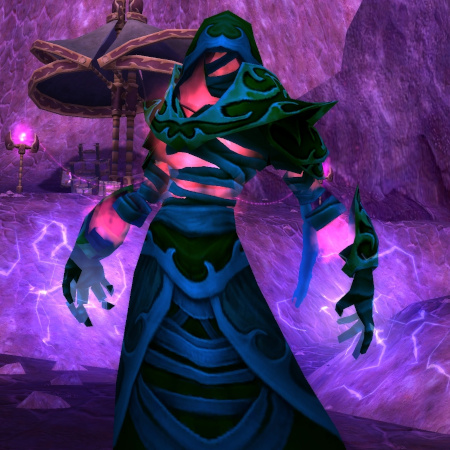
An "Ethereum Researcher" in World of Warcraft. If you kill it, you get 15 silver and 61 copper, and have a 0.16% chance of obtaining some "Ethereum relay data." Do not try this in real life.
Now, what about the Robin Hood aspect? When visiting low-income Southeast Asian countries, I often hear stories of individuals or their family members who were previously poor but became moderately well-off through Axie Infinity’s play-to-earn feature in 2021. Of course, Axie Infinity’s position deteriorated somewhat in 2022. Nevertheless, my impression is that, considering the game’s play-to-earn mechanics, high-income users likely had a net negative financial outcome on average, whereas low-income users may (emphasize: may!) have experienced a net positive gain. This seems like a desirable property: if you must be economically harsh on someone, be harsh on those who can afford it, while providing a safety net to protect low-income users—and even try to leave them better off than when they started.
Regardless of how well Axie Infinity achieved this, intuitively it feels (i) that if the goal is fulfilling people’s desire for enjoyment, we shouldn’t build simple copy-paste tokens but rather more complex and engaging games, and (ii) that games which especially improve the economic situation of low-income players are more likely to leave their communities better off overall. Charity coins and games could even be combined: one feature of the game could be a mechanism allowing players who successfully complete tasks to vote on which charities should receive newly issued funds.
That said, building a truly fun game is challenging—consider Axie’s mixed reception regarding gameplay quality and how they’ve improved since. Personally, the team I’m most confident in creating fun crypto games is 0xPARC, as they’ve already succeeded twice (!!) with crypto games (first Dark Forest, then FrogCrypto) that players are willing to engage with purely for fun, not for profit. Ideally, the goal is to create a co-creative environment where all players are satisfied: money is zero-sum, but fun can be positive-sum.
Conclusion
One of my personal moral principles is: “If there’s a group or category of people you dislike, make an effort to acknowledge at least some individuals within it who best align with your values.” If you dislike governments for infringing on people’s freedoms, perhaps you can still find room in your heart to praise the Swiss government. If you dislike social media platforms for their extractive behavior and encouragement of bad conduct, but believe Reddit is half as bad, then say something good about Reddit. The opposite approach—shouting “yes, all X are part of the problem”—feels good in the moment, but it alienates people and pushes them further into their own bubbles, where they will eventually become completely insulated from any moral appeal you might have.
I apply the same thinking to the “Degen” part of the crypto space. I have zero enthusiasm for tokens named after authoritarian political movements, scams, pump-and-dumps, or anything that excites people in month N but makes everyone uncomfortable in month N+1. At the same time, I value people’s desire for fun, and I’d rather see the crypto space work with that current than against it. Therefore, I hope to see higher-quality, fun projects that make positive contributions—not just “bring in users”—to the ecosystem and the wider world receive more attention. At minimum, let there be more good meme coins than bad ones, and ideally, meme coins that support public goods rather than merely enriching insiders and creators. But ideally, let’s create games instead of tokens—projects that people genuinely enjoy participating in.
Join TechFlow official community to stay tuned
Telegram:https://t.me/TechFlowDaily
X (Twitter):https://x.com/TechFlowPost
X (Twitter) EN:https://x.com/BlockFlow_News
 @VitalikButerin