









Forbes: Worth Billions, Zombie Firms Wander the Crypto World
TechFlow Selected TechFlow Selected
Forbes: Worth Billions, Zombie Firms Wander the Crypto World
Zombie blockchains fall into two main categories: either they are derivatives of early blockchains such as Bitcoin and Ethereum, or they are direct competitors to them.
 Navigating Web3 tides with focused insights
By Steven Ehrlich, Maria Gracia Santillana Linares and Nina Bambysheva, Forbes Staff
Translated by Luffy, Foresight News
In 2012, blockchain pioneers Jed McCaleb, Arthur Britto and David Schwartz founded Ripple Labs and created the cryptocurrency XRP, envisioning a new global financial standard that would enable banks to transfer money quickly with minimal fees. In the first decade after Ripple’s founding, dozens of financial institutions—including Bank of America and Santander—signed on to test its new network. To support this ambitious project, Ripple executives created 100 billion XRP tokens and sold $1.4 billion worth to the public. By early 2018, at the peak of the crypto mania, XRP reached a market capitalization of $132 billion, and co-founder and executive chairman Chris Larsen was worth $8 billion.

When it comes to moving money globally, however, Ripple Labs has made little progress, and few believe it will disrupt SWIFT, the Belgian banking cooperative that facilitates $5 trillion in interbank transfers daily. Despite failing to fulfill its core mission, the Ripple blockchain (the XRP Ledger) continues to operate. It is essentially useless, yet the XRP token still boasts a market cap of $36 billion, making it the sixth-largest cryptocurrency. Larsen remains a billionaire, worth approximately $3.2 billion. According to Messari data, last year the Ripple blockchain generated only $583,000 in transaction fees. By Wall Street standards, this gives XRP a “price-to-sales” ratio of 61,689. Nvidia, one of the hottest stocks on the market, has a market value of over $2 trillion and generates $61 billion in revenue, giving it a price-to-sales ratio of just 37.
Ripple Labs is a crypto zombie company. Its XRP token remains actively traded, with around $2 billion changing hands daily, but it serves no purpose beyond speculation. Not only is SWIFT still thriving, but better ways of conducting international payments via blockchain now exist—such as Tether, a dollar-pegged stablecoin with $100 billion in circulation.
Ripple is not alone. A Forbes investigation reveals that while only a handful of blockchains besides Bitcoin and Ethereum have gained significant traction, there are at least 50 blockchains valued above $1 billion today, with at least 20 being functional zombie networks. After the U.S. Securities and Exchange Commission approved spot Bitcoin ETFs, the crypto market surged. The 20 blockchains analyzed by Forbes—whose grand ambitions range from universal world computers to untraceable payment networks—collectively have a market cap of $116 billion, yet most see very little actual use.
But don’t expect cryptocurrencies like XRP to shut down anytime soon. These companies hold billions in funding and can persist for many years. Ripple currently holds $24 billion worth of XRP tokens that it can sell over the next four years. The San Francisco-based firm employs 900 people and regularly issues press releases announcing recent acquisitions, such as its purchase of digital asset custodian Standard Custody & Trust. More than a decade after its founding, it continues running pilot cryptocurrency programs with central banks in places like Georgia and the Republic of Palau in the South Pacific.
“It’s like an early-stage venture fund or company raised too much money, doesn’t know how to spend it all effectively, and has no way to return capital to investors,” said Matt Hougan, chief information officer at Bitwise Asset Management.
Moreover, in the bizarre world of crypto assets, wealthy zombie blockchains do not face the same pressures as traditional companies. There are no shareholders or regulators demanding financial disclosures, and shorting their tokens is relatively difficult. As long as enough speculators are willing to trade them, rich zombie blockchains will continue to roam the crypto landscape.
“There’s no clear liquidation process for a dead crypto protocol,” said one venture capitalist who requested anonymity.
The following 20 blockchains have a combined market cap exceeding $100 billion, yet they are nearly useless beyond speculative cryptocurrency trading. Most of these blockchain projects are well-funded but answer neither to shareholders nor regulators.
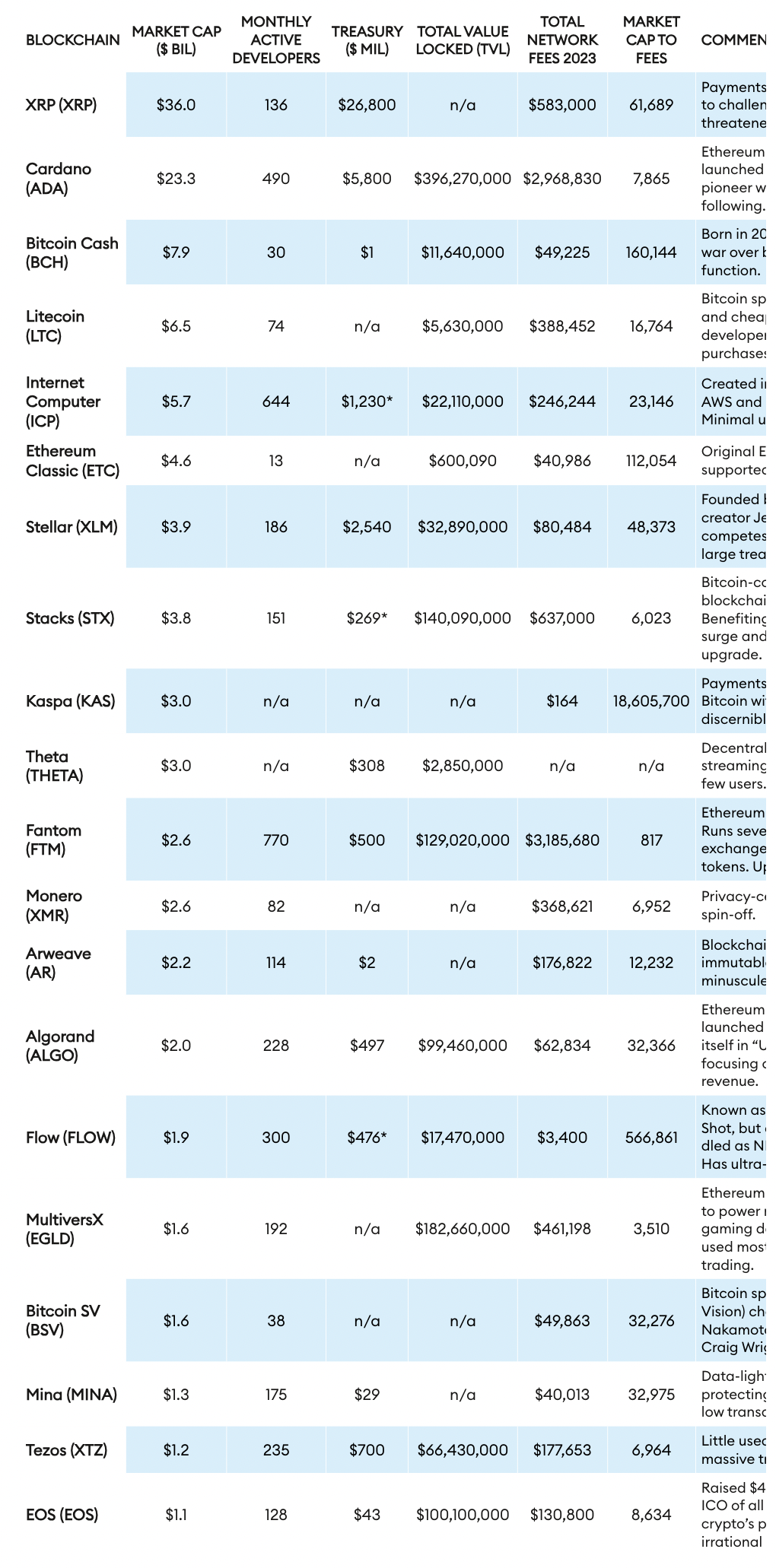
Zombie blockchains generally fall into two categories: either they are derivatives of early blockchains like Bitcoin and Ethereum, or direct competitors. Derivative—or “hard fork”—zombies include Bitcoin Cash, Litecoin, Monero, BSV, and Ethereum Classic. These five blockchains currently have a total valuation of $23 billion. They largely stem from disagreements among programmers about how Bitcoin or Ethereum should function. Because the underlying code of these blockchains is open-source, anyone can repurpose it for any reason. When disputes arise, some developers split off and create a new network—a so-called hard fork. Each time a new chain is created this way, it shares the same transaction history as the original chain. Like stock derivatives, this means that at the time of the fork, all token holders receive an equal number of tokens on the new chain as they held on the original.
Litecoin is an early offshoot of Bitcoin. Launched in 2011, it was designed as a faster, cheaper version for payments. It generates blocks four times faster than Bitcoin—every 2.5 minutes on average compared to Bitcoin’s 10 minutes. Like Bitcoin, Litecoin processes transactions through proof-of-work, meaning many computers spin uselessly (and consume electricity) solving meaningless math problems. Litecoin also has a strict supply cap of 84 million tokens, compared to Bitcoin’s 21 million. Today, Litecoin has a market cap of $6.5 billion, but last year it collected only $389,000 in transaction fees, versus $800 million for Bitcoin. Users pay fees to miners to incentivize them to include transactions in the next block. The minuscule fees generated by zombie blockchains like Litecoin indicate weak demand for the platform. These blockchains also struggle to attract developers. According to Electric Capital’s developer report, as of the end of 2023, Litecoin had only 74 monthly active open-source developers, compared to over 1,000 for Bitcoin and more than 7,000 for Ethereum.
Bitcoin Cash has an even higher market cap than Litecoin—$7.9 billion—but only 30 monthly active developers supporting it and earned just $49,000 in fees in 2023. Bitcoin Cash emerged after a heated 2017 debate over whether Bitcoin should increase its block size. The dispute was highly technical. Essentially, Bitcoin Cash supporters believed cryptocurrency should primarily serve as a medium of exchange (in other words, you should be able to buy things with it), while others in the community prioritized its role as a store of value.
Bitcoin SV (BSV) is even more controversial due to its promoter, Australian computer scientist Craig Wright, who has long claimed to be Satoshi Nakamoto, Bitcoin’s inventor. “I created Bitcoin,” he told Forbes in a 2023 interview. But the UK High Court rejected this claim in March, ruling there was “overwhelming” evidence that Wright did not write Bitcoin’s original white paper, is not Satoshi, and did not create the “Bitcoin system.” BSV was delisted by Coinbase in January but still maintains a $1.6 billion market cap.
Among blockchain zombie networks, Ethereum Classic (ETC) is unique—it is actually the original Ethereum chain. What is widely known today as Ethereum is in fact a fork of ETC, created in 2016 to recover $60 million worth of stolen funds (worth $1.15 billion today). A significant portion of the Ethereum community feared that altering the ledger’s history to recover funds posed moral hazards, so they chose to keep ETC as the original, unaltered codebase. One of ETC’s biggest supporters is Grayscale Investments of Connecticut, the world’s largest crypto asset manager, whose billionaire founder Barry Silbert is a vocal bull on ETC. ETC has a market cap of $4.6 billion but generated less than $41,000 in transaction fees in 2023.
Of the five derivative blockchains analyzed by Forbes, none of the industry insiders or data firms we consulted could point to any serious use cases for these platforms beyond simply trading their tokens.
“What keeps these zombie entities alive is liquidity,” said one venture capitalist. “Litecoin was one of the first tokens supported by Coinbase, and many people already hold it.”
Bob Summerwill, executive director of the Ethereum Classic Cooperative, added: “ETC is listed on almost every exchange because of its history, which generates substantial trading volume—much of it speculative.”
ETC’s price has risen 31% since a year ago, while ETH is up 77%. Bitcoin Cash has outperformed Bitcoin, rising 164% over the past 12 months—compared to Bitcoin’s 121% gain—and hit an all-time high in mid-March.
The largest group of zombie networks consists of potential challengers to Ethereum. Most claim to offer technical improvements over the Ethereum platform launched by Vitalik Buterin in 2014, arguing that Ethereum can handle only a dozen transactions per second and suffers from high fees during peak usage. Tezos, founded later in 2014, was one of the first blockchains to adopt proof-of-stake (instead of proof-of-work) for creating new tokens. The details are complex, but proof-of-stake appeals to many crypto enthusiasts because it doesn’t require the energy-intensive computing power needed for Bitcoin mining.
Tezos raised $230 million in its 2017 initial coin offering (ICO), and its XTZ token currently has a market cap of $1.2 billion. However, it processes around 130,000 transactions per day, compared to Ethereum’s 1.2 million, and its total value locked (TVL) across the network is just $66 million. For blockchains like Ethereum that aim to host various applications—from decentralized exchanges to video games and NFTs—TVL is widely used as a health metric. Ethereum hosts over 4,500 applications and has a TVL of $48 billion.
In terms of “baking” (the term used by the Tezos community) fees, revenue was $5,640 in February 2024 and $177,653 for all of 2023. Co-founder Arthur Breitman, who launched Tezos with his wife Kathleen, insists this figure is far below the true total. According to Breitman, 75% of fees paid to the network are paid in XTZ tokens, which are typically removed from circulation (or “burned”) and thus not counted in published fee figures. Breitman estimates Tezos’ treasury holds $700 million and insists only 20% of that is held in XTZ tokens. “Mostly Bitcoin, the rest is a diversified portfolio of stocks and bonds,” he said.
His claims cannot be independently verified. Development of Tezos is funded by the Tezos Foundation, a Swiss-based nonprofit organization whose mission is “to promote the Tezos protocol through grants and other capital deployment tools.” In the first half of 2023, the Tezos Foundation awarded up to $18 million in grants to 31 recipients.
Then there’s Algorand, valued at $2 billion and well-capitalized. Once hailed as an “Ethereum killer” for its ability to process 7,500 transactions per second, Algorand generated only $63,000 in blockchain fees in 2023. “Their technology may be on par with other blockchains, but there’s not much activity on-chain because, aside from the founders, they lack a notable community and talent,” said a prominent crypto strategist.
Eric Wragge, who leads business development at Singapore’s Algorand Foundation, counters: “We’re in Uber mode—every rider we pick up costs us money.” Their executive team has been rapidly shrinking. Over the past two years, the Algorand Foundation has hired a new CEO and completely overhauled its entire leadership team.
Some zombie blockchains appear to survive solely on the popularity of their creators. Cardano, another rival to Ethereum, launched in 2017 after its co-founder Charles Hoskinson fell out with Ethereum co-founder Buterin. Cardano has a market cap of $23 billion and a total value locked of $396 million. Although the Cardano Foundation itself says development is not yet complete, it generated $3 million in transaction fees last year.
Hoskinson himself is a major draw. He owns an 11,000-acre ranch in Wyoming, funds self-proclaimed alien hunters, and recently opened an anti-aging and regenerative medicine center in Gillette, Wyoming. He isn’t always a reliable narrator. He claims to have dropped out of a math Ph.D. program at the University of Colorado Boulder, but the university says Hoskinson was an undergraduate who never completed his degree. For years, he has hinted at working for DARPA, the Pentagon’s famed research arm. But mostly, he uses his 980,000 followers on X to promote Cardano.
“Is Cardano a blockchain that hasn’t turned a profit and is still building its architecture, or just a future pilot that will never materialize?” asked Bitwise’s Matt Hougan.
The 20 zombie blockchains we’ve listed represent only the most visible examples in digital asset trading—entirely detached from the utility or viability of their underlying projects. There are many more zombie blockchains wandering the ecosystem. According to CoinGecko, over 13,000 cryptocurrencies are listed across exchanges, most exhibiting characteristics of speculative penny stocks—except they don’t represent ownership in anything. Fueled by Bitcoin’s surge, the total value of all cryptocurrencies today stands at approximately $2.5 trillion.
This might seem like a perfect short-selling opportunity, but according to crypto trading firms, it’s difficult to bet against zombie blockchain tokens because borrowing large quantities of the underlying tokens to short is not easy. Additionally, given crypto’s irrational and volatile trading history, shorting carries extremely high risk. Any token could turn into a meme coin based on nothing more than a late-night tweet from Elon Musk.
Take Ethereum Classic as an example. In August 2020, when ETC was trading around $6 per token, it suffered three so-called 51% attacks within a month. This occurs when a single token holder controls more than half of the network’s computing power, which is used to create blocks and “manage” the platform. If such “malicious takeovers” were permanent (though they weren’t), they could allow the blockchain’s supposedly immutable ledger to be altered. In other words, anyone with 51% of the hash power could reverse previously settled transactions or mint unlimited tokens for themselves. Despite being exposed to security flaws three times in one month, ETC survived the summer of 2020 and now trades at $31.
The Department of Justice and the SEC have focused on cracking down on crypto fraud and theft by targeting major crypto exchanges. FTX has been shut down and its founder Sam Bankman-Fried is in prison. Binance founder Changpeng Zhao was forced out of his company, and last year admitted to violating anti-money laundering and sanctions rules, resulting in his exchange paying a $4.3 billion fine.
Two other major exchanges, Coinbase and Kraken, are being sued by the SEC for operating as unregistered securities brokers and exchanges. Several zombie blockchain tokens, including Cardano and Algorand, are considered securities.
Can token holders access the billions of dollars stored in the treasuries of these zombie blockchain enterprises? Unfortunately, that seems unlikely. “That would require a legal standing and actual damages like fraud,” said Yesha Yadav, deputy dean at Vanderbilt Law School. She noted that past cases have been divided on whether decentralized organizations or foundations should be held liable.
In September 2022, the federal government sued participants in a decentralized autonomous organization (DAO) called Ooki DAO, accusing them of selling unregistered commodity futures. In June, a California court ordered the group to pay $644,000 in penalties. That money was supposed to come from its “decentralized” treasury, but the government is still waiting for payment. Two months later, a federal judge in New York dismissed a lawsuit against Uniswap, a decentralized crypto exchange, ruling there was no centralized entity serving as a “recognizable defendant.”
Don’t expect any well-funded, inactive blockchains to die off anytime soon. They’re busy spending money on projects with little promise. In March, the Stellar Development Foundation announced it would invest $100 million in companies planning to use its new smart contract platform—the nonprofit overseeing Stellar’s $2.5 billion treasury seeking to diversify beyond its nearly nonexistent payment business.
Join TechFlow official community to stay tuned
Telegram:https://t.me/TechFlowDaily
X (Twitter):https://x.com/TechFlowPost
X (Twitter) EN:https://x.com/BlockFlow_News
 Forbes











