








Bankless: One-Week Review of Ethereum's Dencun Upgrade
TechFlow Selected TechFlow Selected
Bankless: One-Week Review of Ethereum's Dencun Upgrade
To address potential scalability issues in the future, Ethereum developers are working on full Danksharding, but it will take several years to implement.
 Navigating Web3 tides with focused insights
Author: Jack Inabinet
Translation: Kate, Mars Finance
Did blobs live up to the hype?
After years of planning, Ethereum successfully implemented its Dencun upgrade last week!
While this hard fork brought nine changes to the network, the most anticipated was EIP-4844 (aka Proto-Danksharding), which promises to reduce gas fees on Ethereum Layer 2 (L2) by introducing "blobs"—a more gas-efficient way to publish L2 transaction data.
Today, we turn to data to analyze whether Dencun lived up to the hype and explore how the upgrade has transformed Ethereum!
🧐 Impact of Dencun
In the weeks leading up to the upgrade, increasing network activity drove up transaction fees, making multi-dollar gas costs the norm for the most popular L2s on the network. This sparked strong user backlash and highlighted the urgent need for lower fees.
While it was impossible to accurately predict post-Dencun L2 fees beforehand—since they depend on variable demand for block space—early estimates provided optimistic projections suggesting L2 users could expect up to a 90% reduction in fees at similar activity levels.
Since L2s needed to modify how they publish data to take advantage of blobs, there was some lag between Dencun going live and users experiencing lower fees. However, shortly after Dencun’s activation on March 13, theory became practice—every major L2 published their first blob the very next day.
As L2s began using blobs, the benefits of Dencun became immediately apparent, with their data publishing costs dropping to near-zero. Transaction fees on Base were initially so cheap that wallets couldn’t even properly display the penny required to transfer tokens!
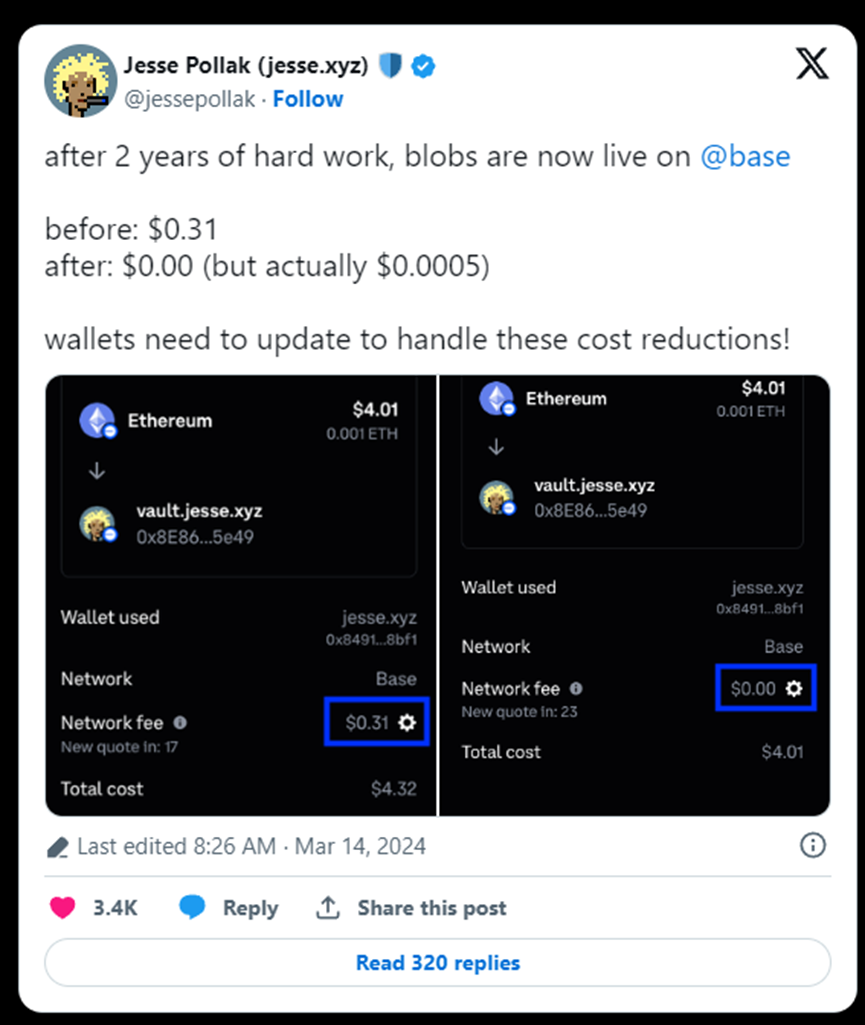
https://x.com/jessepollak/status/1768071129854562698?s=20
Compared to pre-Dencun levels, ZkSync saw an 89% drop in data costs. Arbitrum achieved a 93% reduction, while OP Stack chains (Base, Mode, Optimism, and Zora) saw cost reductions exceeding 98%!
With lower fees, more transactions became economically viable on L2s, increasing demand for block space and driving higher transaction volumes across many chains.
The most dramatic growth came from Base, which set a new all-time high of 2.1 million transactions on March 16—an increase of 300% compared to pre-Dencun levels.
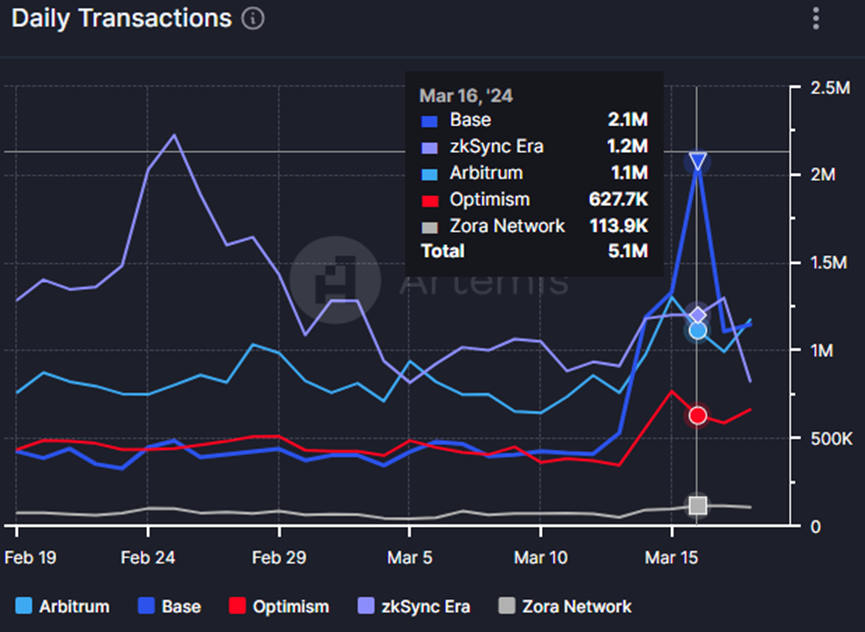
Source: Artemis
More transactions increased computation-related costs on L2s, but the total gas fees paid for L2 transactions—comprising both the cost of posting data to Ethereum and native L2 fees—plummeted sharply. This allows users to enjoy much cheaper transactions than before, while also improving the net profitability of operating L2s.
🎯 A New Paradigm
Even with blobs enabled, rollups can still save significant costs by publishing data to dedicated data availability layers (e.g., Celestia) instead of Ethereum. Nevertheless, the monumental achievement of Dencun must be emphasized.
Unlike monolithic alt-L1s, which are forced to subsidize low transaction fees through increased token issuance to secure their networks, Ethereum—powered by its rollup-centric roadmap now supercharged by Dencun—enables L2s to offer similarly low fees while maintaining maximum security and keeping ETH deflationary!
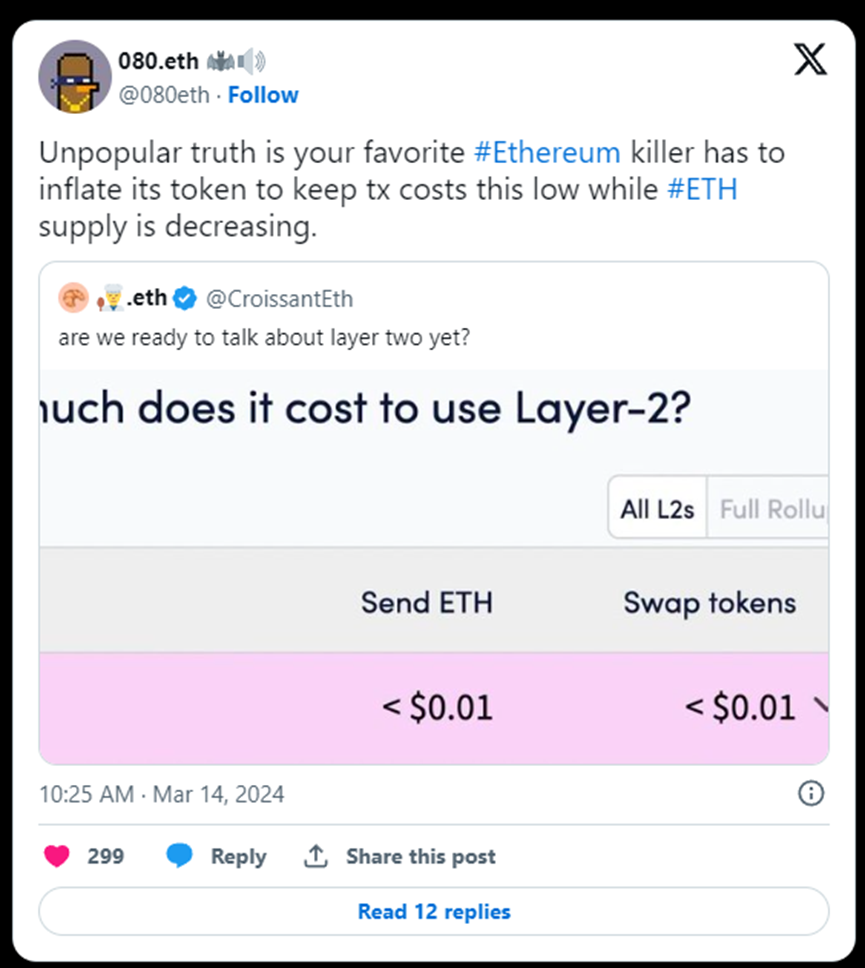
https://x.com/080eth/status/1768101135213318414?s=20
Given that transactions on L2s are now extremely cheap, it's safe to conclude that EIP-4844 is the near-term solution to Ethereum’s scalability challenge. However, it's important to note that significant development work remains before reaching the final state of rollup scaling.
Although current block space demand enables very low fees, future increases in on-chain activity will exert upward pressure on transaction costs, potentially leading to new L2 scalability issues that frustrate users.
To address this inevitable issue, Ethereum developers are working on full Danksharding, which will increase the number of blobs attachable to each block from 6 to 64. This will bring vast dedicated L2 capacity to Ethereum, enabling the network to easily support hundreds of independent rollups and make millions of transactions per second a reality.
Unfortunately, unlocking Danksharding requires numerous complex upgrades—including proposer-builder separation and stateless client development—meaning this enhancement may still be years away.
Until then, we’ll keep our fingers crossed that a few blobs per block continue to provide sufficient scale for Ethereum’s rollups and their users🤞.
Join TechFlow official community to stay tuned
Telegram:https://t.me/TechFlowDaily
X (Twitter):https://x.com/TechFlowPost
X (Twitter) EN:https://x.com/BlockFlow_News
 Bankless











