








66x Surge, So What? Why the Telegram Bot Boom Is Hard to Sustain
TechFlow Selected TechFlow Selected
66x Surge, So What? Why the Telegram Bot Boom Is Hard to Sustain
Is the TG bot token still worth investing in now?
 Navigating Web3 tides with focused insights
Author: JZ
Recently, numerous Telegram bots have emerged in the market, offering various DeFi trading tools that allow users to execute token swaps, copy trades, conduct analysis, automatically farm airdrops, and perform cross-chain asset transfers directly within Telegram chatrooms.
Unibot, the leading project in this sector, has seen its platform token $UNIBOT surge 66x from $3 to $199 over the past two months, with total market capitalization skyrocketing to $150 million. Its explosive growth has drawn significant market attention to the TG bot sector.
Are TG bot tokens still worth investing in? Before FOMOing, read this article first!
This article will summarize:
-
Why has the Telegram Bot sector suddenly gained attention?
-
Pros and cons of the Telegram Bot sector
-
Future improvement directions
Let’s get started!
What's Driving the Hype Around Telegram Bots?
First, let’s revisit the two key features that made Unibot go viral:
1. "Mirror sniper": On-chain copy trading. By entering a specific wallet address, users can replicate that address’s transactions on Uniswap.
2. "Method sniper": Sniping new tokens. By inputting a token contract address, Unibot automatically buys the token immediately upon launch, capturing short-term price surges during initial listings.
Unibot’s “copy trading” and “sniping new tokens” functions have recently delivered substantial profits for many users, attracting massive adoption.
Amid FOMO-fueled trading volume spikes, Unibot’s 24-hour fee revenue peaked at 73.32k, ranking 7th among all protocols. Since $UNIBOT holders receive a share of platform fees, this triggered widespread buying of $UNIBOT, sharply driving up its price.
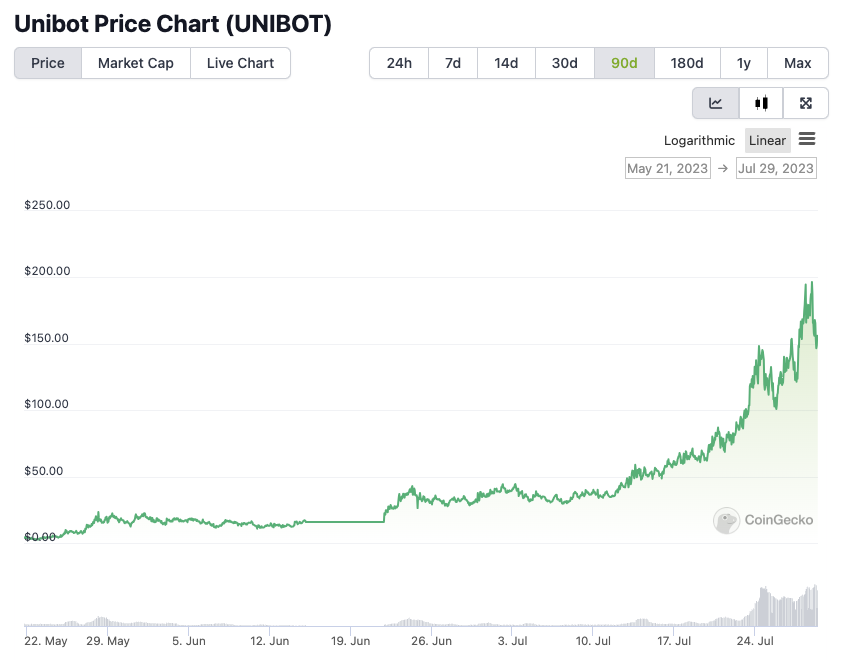
$UNIBOT surged 66x from $3 two months ago to $199.
Copy trading isn’t new—what makes Unibot special?
The key lies in the assets traded. Unibot operates on Uniswap, enabling users to snipe many small-cap tokens that experience explosive growth shortly after listing.
With the broader market relatively flat over recent months, meme coins and small-cap tokens have been flying high. As a result, many users who “copied the right wallets” achieved returns of several times—or even tens of times—their initial investment within days.
Beyond trading-focused bots, “airdrop farming bots” like Lootbot have also become popular.
After depositing ETH into a wallet provided by the bot, the bot automatically performs low-gas-cost on-chain interactions during optimal time windows to maximize airdrop farming opportunities—saving users significant manual effort.
Pros and Cons of the Telegram Bot Sector
Telegram is practically essential for crypto enthusiasts. The ability to trade and farm airdrops directly within a messaging app undoubtedly brings great convenience. However, we must ask: does this “convenience” come with greater opportunity costs or risks?
All these TG bots share one major underlying concern: wallet security. Whether creating a new wallet through the bot or importing an existing wallet’s private key, the bot gains full access to your wallet. If compromised by hackers, you could lose all your funds. Even without direct attacks, who else might have access to your private keys?
While TG bots connect to DeFi protocols and emphasize mobile accessibility, most do not open-source their code or undergo third-party audits, making their operations less transparent than even centralized exchanges (CEXs).
Such highly centralized mechanisms effectively undermine the core principles of “DeFi”. Therefore, I believe they will struggle to achieve mass adoption within a crypto community that values privacy and decentralization.
Lowering entry barriers is a key narrative for TG bots. Yet, most CEXs already offer beginner-friendly interface modes. For crypto newcomers, the learning curve between using a TG bot and a CEX “lite mode” is likely similar—but the latter offers far better stability and security guarantees than unproven bots.
Current bots primarily rely on transaction fees and premium services for revenue, which limits income potential. Token utility is also limited—mainly used to pay for services or earn fee-sharing rewards. Without discovering better business models, long-term sustainability and token value may face serious challenges.
Crypto trends rotate with where the money flows. When these TG bots’ copy-trading functions stop generating profits, will they remain popular tools? As users gradually leave, fee revenues will drop significantly—will anyone still buy $UNIBOT just for fee-sharing then?
Conclusion
I believe the current state of this sector still has significant room for improvement. Nevertheless, the rise of TG bots has indeed prompted us to rethink the potential of Telegram as a platform. If the following issues can be addressed, these bots could help overcome the usability barriers of DeFi and leverage Telegram’s vast user base to accelerate cryptocurrency adoption.
Future Improvement Directions
-
Increase operational transparency
-
Improve wallet security
-
Integrate with other narratives beyond just convenience
-
Launch their own DEX?
-
Expand token utility
-
Develop sustainable protocol revenue models
However, even if the current TG bot narrative appears unsustainable in the long run, this trend won’t disappear anytime soon. Here’s why:
-
Fee-sharing incentives remain attractive
-
The CEX token listing boom hasn’t even begun
-
Unibot’s success will inspire imitation by other projects
-
Some bots have recently open-sourced their code
Join TechFlow official community to stay tuned
Telegram:https://t.me/TechFlowDaily
X (Twitter):https://x.com/TechFlowPost
X (Twitter) EN:https://x.com/BlockFlow_News
 @jzinvest_xyz









