









The long-awaited Cancun upgrade has finally arrived—what assets will benefit?
TechFlow Selected TechFlow Selected
The long-awaited Cancun upgrade has finally arrived—what assets will benefit?
Ethereum enters a new era.
 Navigating Web3 tides with focused insights
Author: Azuma, Odaily Planet Daily
Later today, Ethereum is expected to officially activate the Dencun hard fork upgrade at Beacon Slot 8626176.
The so-called Dencun upgrade is actually a combination of two upgrades: Deneb and Cancun. The former targets the consensus layer, while the latter targets the execution layer. "Cancun," part of this name, refers to the long-anticipated "Kanquen Upgrade" within the Ethereum community.
Before its mainnet launch, over recent months Ethereum core developers and major client teams have successively deployed the Dencun upgrade on Devnet, Goerli testnet, Sepolia testnet, and Holesky testnet to test and observe the network performance during and after the upgrade.
Upgrade Content: Nine EIPs in Total, with Focus on EIP-4844
According to curation by the Ethereum Foundation, this Dencun upgrade will implement nine Ethereum Improvement Proposals (EIPs), specifically:
-
EIP-1153: Transient storage opcodes;
-
EIP-4788: Beacon block roots in the EVM;
-
EIP-4844: Shard Blob transactions;
-
EIP-5656: MCOPY – memory copying instruction;
-
EIP-6780: SELFDESTRUCT only within the same transaction;
-
EIP-7044: Permanent validity for voluntary exit signatures;
-
EIP-7045: Maximum slot inclusion for attestations;
-
EIP-7514: Maximum epoch churn limit;
-
EIP-7516: BLOBBASEFEE opcode.
For readers unfamiliar with Ethereum development terminology, you don't need to understand each EIP in detail—simply focus your attention on the most critical update in this Dencun upgrade: EIP-4844.
EIP-4844, also known as Proto-Danksharding, is a precursor to Danksharding—the current mainstream sharding approach embraced by the Ethereum community. The key feature of EIP-4844 (Proto-Danksharding) is introducing a new type of transaction called "Blob transactions." By adding an additional temporary data space called "Blob" to Ethereum blocks, it will be dedicated to handling Layer 2-related transactions, thereby significantly reducing Layer 2 transaction fees.
Microscopic Analysis: How Do Blobs Impact Layer 2 Transaction Costs?
Earlier this week, Ethereum core developer eric.eth posted on X stating that the implementation of EIP-4844 would "reduce Ethereum transaction fees to $0.01"—though he later admitted this was misleading. What he actually meant was that gas costs for Ethereum-based Layer 2 transactions would drop to around $0.01.
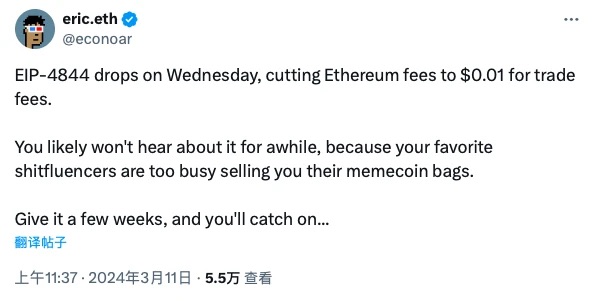
So how exactly do "Blob transactions" help Layer 2 networks reduce costs and improve efficiency? After the upgrade, will Layer 2 transaction costs truly fall to such an ultra-low level as $0.01?
To answer these questions, we must first examine how Layer 2 works. Whether Optimistic Rollups or ZK Rollups, any Layer 2 that relies narrowly on Ethereum's mainnet as its data availability (DA) layer follows this model: Layer 2 submits its transactions, proofs, and execution results into the calldata field of Ethereum blocks, thereby anchoring its history onto Ethereum and relying on Ethereum for decentralization and security.
This calldata-based data synchronization method has operated stably for years but suffers from one serious issue: Layer 2's calldata submission transactions compete in the same fee market as all other Ethereum mainnet transactions. As a result, Layer 2 transaction costs are heavily influenced by congestion and gas prices on Ethereum’s mainnet.
To ensure their calldata submissions execute successfully on Ethereum, Layer 2 networks pass these costs directly to end users transacting on Layer 2. Currently, calldata submission costs constitute the vast majority of total Layer 2 transaction fees, which is why many users still perceive Layer 2 fees as relatively high.
With EIP-4844, Ethereum will add a new dedicated data space—Blob—to its blocks, specifically designed for Layer 2 transactions. Layer 2 networks will no longer write data into calldata; instead, they’ll use the Blob space for data publication. Furthermore, Layer 2 transactions and mainnet transactions will operate in separate fee markets, eliminating interference between them.
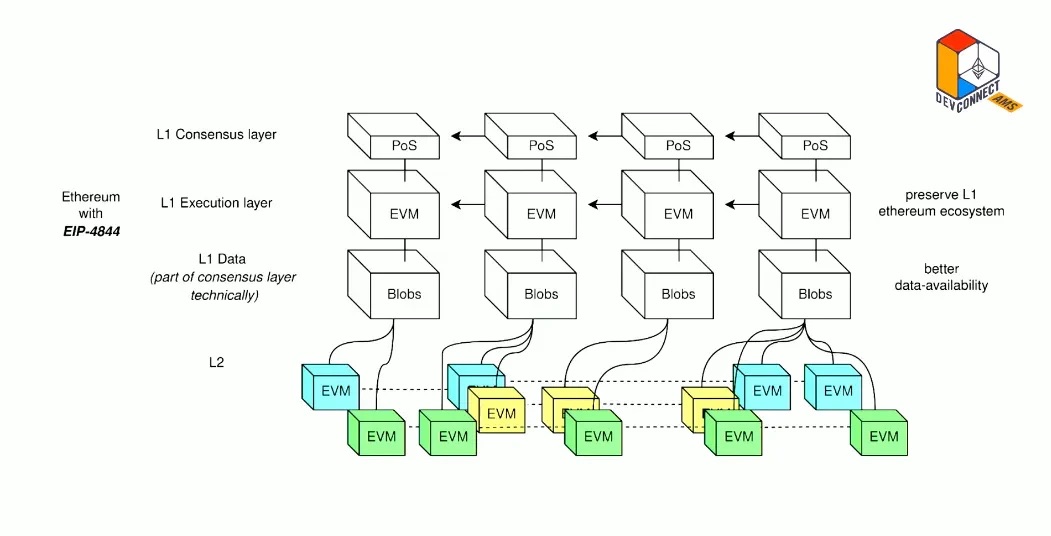
Notably, to prevent excessive burden on Ethereum nodes, data within Blobs will be periodically pruned. This implies future changes to Layer 2 historical data storage mechanisms.
Based on the above analysis, we can expect that once EIP-4844 is implemented, Layer 2 data publication costs will drop significantly, indirectly lowering user transaction fees on Layer 2. Additionally, as block space previously consumed by Layer 2 calldata gets freed up (shifted to Blob space), competition in the mainnet fee market will ease, meaning EIP-4844 will also moderately reduce transaction fees on Ethereum’s mainnet.
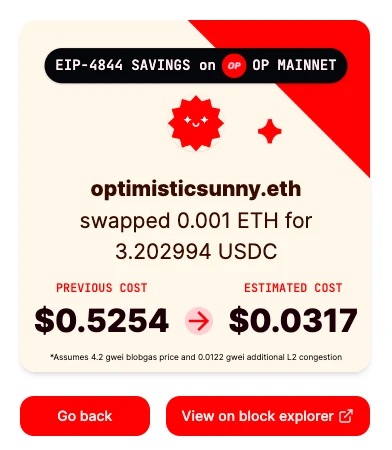
As for how much Layer 2 transaction fees will decrease post-upgrade, Optimism has launched a website called welovetheblobs to visually track cost changes across various operations. For example, a swap transaction on Velodrome is projected to drop from the current $0.52 to just $0.03.
Beneficiaries: Beyond Layer 2, Who Else Gains?
For investors, beyond understanding the content and impact of the Dencun upgrade, the most interesting question is which potential assets stand to benefit.
First, the Dencun upgrade will directly benefit the entire Layer 2 ecosystem. According to L2 BEAT data, there are currently 45 active Layer 2 networks, with another 34 awaiting mainnet launch. These include well-known projects like Optimism (OP), Arbitrum (ARB), Starknet (STRK), Metis (METIS), Manta Pacific (MANTA), and others that have issued tokens, as well as non-tokenized projects such as zkSync, Blast, Linea, and Scroll.
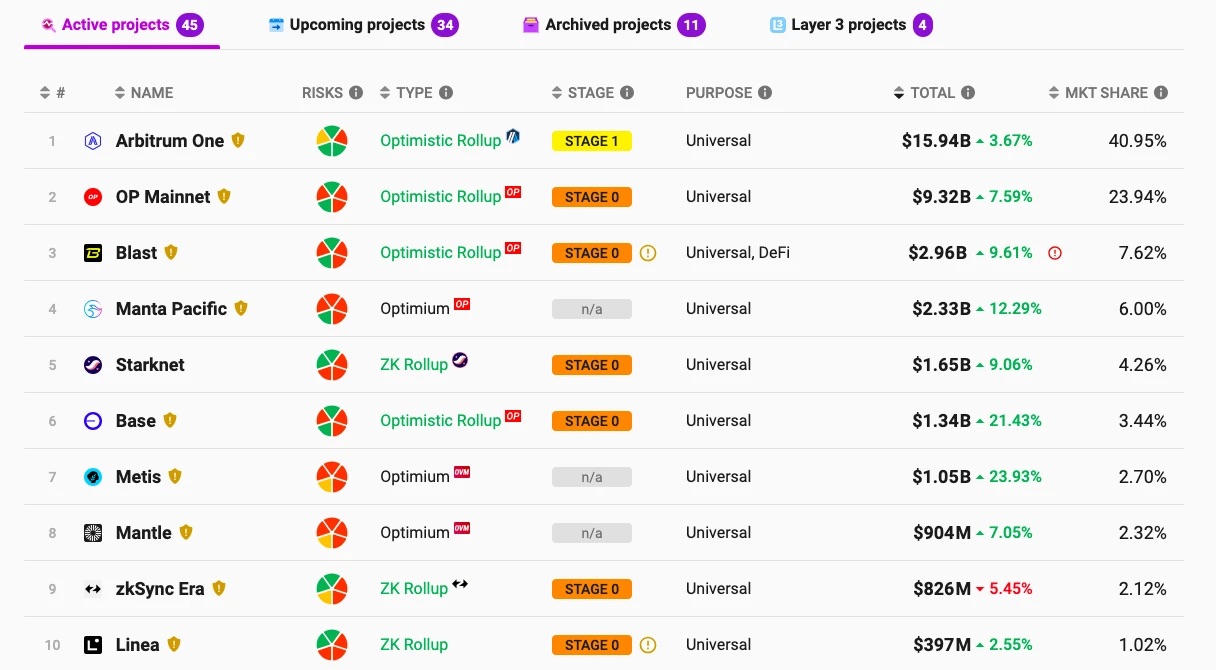
With the Dencun upgrade—especially EIP-4844—these projects and many more Layer 2s will achieve significant cost reductions and improved efficiency. This enables Layer 2 networks to close the gap in transaction cost competitiveness compared to low-fee Layer 1 chains like Solana. In the long term, reduced friction costs will help attract and retain more users, encourage broader developer experimentation, and sustainably enhance ecosystem vitality.
Among these Layer 2s, zkSync deserves special mention. Its founder, Alex Gluchowski, has indicated that a new scaling solution called zkPorter will launch following EIP-4844. zkPorter depends on zkSync’s native token to ensure data availability, suggesting that zkSync’s token launch may be imminent.
Beyond direct benefits to Layer 2, the Dencun upgrade will also indirectly benefit other related sectors and verticals.
For instance, applications on Layer 2 involving gaming, social platforms, and other use cases characterized by "high concurrency" and "low individual value" may experience accelerated growth. Currently, due to persistently high fees, dominant applications on Layer 2 remain largely DeFi-focused projects that exhibit "low concurrency" and "high individual value," as only such applications can maintain viable economics under high fee conditions. With the arrival of the Dencun upgrade, this dynamic may shift.
Additionally, storage-focused projects may find new opportunities arising from changing Layer 2 requirements for long-term transaction history storage. Since Blob data isn’t permanently stored like calldata, Layer 2 networks will need alternative solutions for archiving historical data—creating new demand and thus new opportunities.
Moreover, if Layer 2 networks gain broader market adoption through lower transaction costs, services in the Rollup-as-a-Service (RaaS) category—"water carriers" enabling easy rollup deployment—may see increased demand, though this remains a longer-term prospect.
In summary, as the Dencun upgrade becomes reality, the fundamental health of the Ethereum ecosystem will clearly improve, with benefits radiating across all components within the ecosystem.
In the short term after the upgrade, users may only notice lower Layer 2 fees without other immediate perceptible changes. But in the long run, the potential for renewed ecosystem vitality driven by Dencun—and its role as foundational infrastructure for future upgrades—will undoubtedly propel Ethereum into a new phase of development.
Join TechFlow official community to stay tuned
Telegram:https://t.me/TechFlowDaily
X (Twitter):https://x.com/TechFlowPost
X (Twitter) EN:https://x.com/BlockFlow_News
 Odaily











