
a16z: Digital Unincorporated Nonprofit Association (DUNA), an Oasis for DAOs
TechFlow Selected TechFlow Selected
a16z: Digital Unincorporated Nonprofit Association (DUNA), an Oasis for DAOs
DUNA's purpose is to protect and support the underlying blockchain network.
 Navigating Web3 tides with focused insights
Written by: a16z
Translated by: TechFlow
Everyone active in web3 has heard the term "DAO," short for decentralized autonomous organization. DAOs are essential tools for keeping blockchain networks open, yet they have struggled to succeed within Web3 and have become targets of legal and regulatory actions.
This week, Wyoming passed new legislation recognizing DAOs as legal entities, enabling blockchain networks to operate within a defined legal framework without compromising their decentralization. This is a major breakthrough, as it will provide DAOs with much-needed protections and empower them to maintain open blockchain networks.
Wyoming has long supported innovative legal entity structures. It was the first state to adopt the limited liability company (LLC), the first to adopt unincorporated nonprofit associations (UNAs), and the first to introduce a subset of LLC regulations tailored for DAOs. Wyoming’s new law incorporates many provisions from the model legislation we published earlier.
This new entity structure is likely to become the industry standard for blockchain networks created in the United States. Here is everything you need to know about Wyoming’s Decentralized Unincorporated Nonprofit Association (DUNA).
1. What is a DUNA?
On March 7, 2024, the Wyoming Decentralized Unincorporated Nonprofit Association Act (SF50) was signed into law, effective July 1, 2024. The bill draws heavily from Wyoming’s existing unincorporated nonprofit association statute but is specifically designed for decentralized organizations.
Just as Wyoming’s prior DAO law (W.S. 17-31, the DAO Supplement) could be viewed as a “digital LLC,” SF50 can be seen as a “digital UNA.”
Additionally, one might think of it as a Web3 version of a municipal government. A city government exists to protect the standards and operations of a town by enforcing community rules and conventions, ultimately serving the interests of its citizens, homes, and businesses.
Similarly, the purpose of a DUNA is to protect and support an underlying blockchain network—but like a city government, it is not itself a business enterprise.
2. Why is it necessary?
Entrepreneurs around the world are using blockchain technology to build a better internet—one that restores the internet to its original foundation as an open network. But if we allow corporations to own these networks, we will end up in the same place we are today, where our entire digital world is controlled by a handful of massive companies.
Blockchain technology offers a compelling solution to this problem. It enables the creation of open blockchain networks that resemble public infrastructure rather than proprietary technology—anyone can build on them, just as anyone can use the open internet to build businesses such as email or websites.
DAOs, composed of community members, manage the affairs of an open blockchain network. They are critical tools for ensuring that the network remains open, non-discriminatory, and does not extract value unfairly. DUNA helps DAOs achieve this by addressing three key challenges: it grants them legal existence, allowing them to enter contracts and appear in court; enables them to pay taxes; and provides members with limited liability protection from the actions of other members. All of this aligns with traditional legal entity forms.
DUNA addresses these challenges without introducing additional consumer risk. DUNAs can be used for decentralized governance of decentralized blockchain networks, but anyone building consumer-facing applications on these open networks—such as social media apps, ride-sharing services, or music streaming platforms—will continue to use traditional entity forms like corporations or LLCs. Even though this paradigm may include companies, the fundamental difference is that companies no longer control the underlying network—they only control user-facing applications. This distinction greatly reduces their ability to extract value like Web2 companies do.
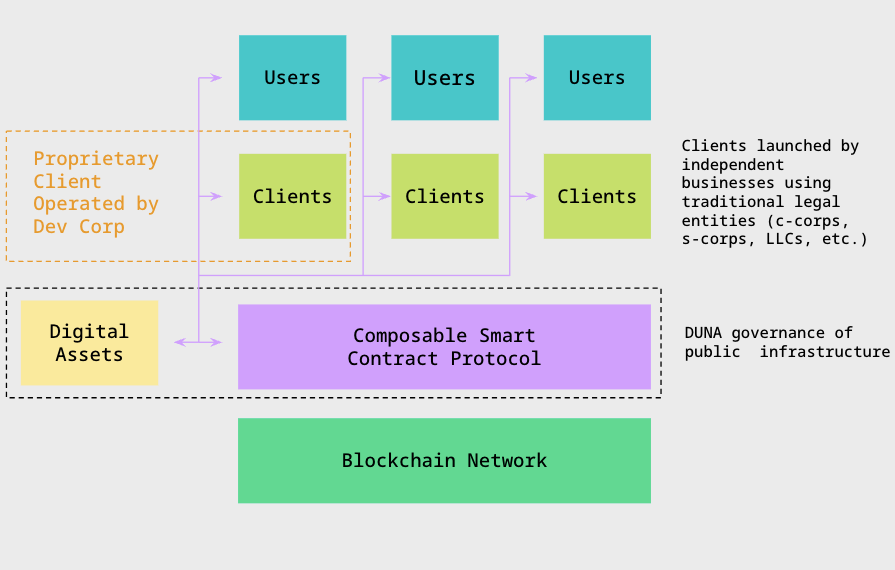
The future of Web3: proprietary clients operating as regular internet businesses, but built atop smart contract protocols and blockchain networks operated by DAOs
3. Why should DAOs use DUNA?
Currently, participation in DAOs is fraught with danger. DAOs that do not organize under a legal entity lack legal existence, cannot pay taxes, and face potential liability. The absence of a legal entity also threatens the privacy of DAO members. Due to these risks, the lack of formal structure has already hindered the decentralization of blockchain networks, constrained their growth, and obstructed the development of sustainable economic models for such systems.
If DAOs remain unincorporated, the situation may worsen before it improves. Regulatory actions and class-action lawsuits in the U.S. claim that without a legal entity, a DAO is merely a general partnership. While there are viable arguments challenging these claims, such classification would be catastrophic for DAO members, exposing them to unmanageable tax and legal liabilities. Currently, regulators and plaintiff attorneys hold the upper hand. If their theories gain traction and succeed, it could sound the death knell for decentralized governance.
DUNA completely blocks this line of attack, resolves the key challenges facing DAOs, and significantly reduces the risks borne by DAO members. It grants DAOs legal existence, enabling them to enter contracts with third parties, open bank accounts, and receive legal process through a simple service mechanism. It allows DAOs to pay taxes and meet information reporting requirements. It protects the privacy of DAO members from federal overreach. And it provides liability protection for DAO members.
It achieves all this without interfering with how DAOs currently launch and operate, preserving decentralization while enabling DAOs to effectively grow the ecosystems of their underlying blockchain networks.
4. If DUNAs are nonprofit, can they engage in profit-making activities?
Yes. Under Wyoming law, both unincorporated nonprofit associations (UNAs) and DUNAs can engage in profit-making activities. This includes operating decentralized exchange protocols, decentralized social media protocols, and more.
Wyoming’s DUNA legislation also explicitly permits reasonable compensation for any services provided to the DUNA ecosystem. This feature is expected to enable DUNAs to reward members who help drive growth, without extracting value from users. This is crucial because it ensures blockchain networks can operate in a decentralized manner and compete with centralized corporate networks.
Using this provision, a DAO could, for example, compensate members for participating in governance. In such cases, the rationale for DUNA rewarding voting or delegation might be that, under the statute, the DUNA lacks centralized management and thus relies on its members to manage all its affairs. Therefore, significant participation is required to ensure proper governance, and the DUNA may compensate members accordingly.
While Wyoming courts will ultimately determine what constitutes “reasonable” compensation, many real-world nonprofit organizations offer useful precedents. Moreover, the unique characteristics of blockchain networks provide strong arguments regarding the reasonableness of member compensation. For instance, because blockchain networks are typically open-source and can be “forked” (copied) by anyone, the continued existence of a particular network—including its fee collection and member compensation—is an implicit endorsement by users that the compensation paid is reasonable. If it were not, another network would emerge.
Nevertheless, the qualifier “reasonable” does impose an upper limit on how much value a network can extract from users and redistribute to members. Those seeking to design vertically integrated, centralized blockchain products and services may object to this constraint, but this principle aligns with, rather than contradicts, the ethos of blockchain networks. If Web3 blockchain networks ultimately extract value from users the way Web2 corporate networks do today, then Web3 will have failed. Wyoming’s approach supports the ideals of Web3 while still enabling cash flows for digital asset holders. This is a major breakthrough.
5. What are the initial implications of using DUNA for securities laws?
Under the Howey test—the U.S. legal framework determining whether securities laws apply to digital asset transactions—three elements must be satisfied:
-
An investment of money
-
In a common enterprise
-
With a reasonable expectation of profits derived primarily from the efforts of others
Supporters of blockchain technology have long argued that these conditions are not met in most digital asset transactions. Most of these arguments remain valid—or may even be strengthened—when a DAO adopts the DUNA legal entity form.
For example, using DUNA significantly strengthens the argument that a digital asset transaction related to the DUNA fails the third prong of the Howey test. First, DUNA is an inherently decentralized entity form whose basic structure excludes managerial functions—there are no officers or directors. Second, DUNA members have no legal obligation or right to maximize the organization’s profits. Together, these features strongly suggest that members acquiring digital assets cannot reasonably expect profits “derived primarily from the efforts of others.” Finally, as discussed above, the nonprofit nature limits DUNA’s ability to distribute organizational profits to members, while permitting compensation to contributors. Thus, any compensated member necessarily profits not from the efforts of others, but from their own contributions.
That said, the SEC might argue that DUNA satisfies the Howey “common enterprise” requirement because members join the DUNA via ownership of the DAO’s digital assets. However, there are numerous counterarguments based on DUNA’s decentralized structure. Moreover, regulators have previously attempted to classify DAOs as ordinary partnerships or unincorporated associations under common law—all of which raise similar questions about the appropriateness of establishing a “common enterprise.” Finally, DUNA members’ rights largely stem from the governance principles of the DUNA, typically codified in foundational governance documents and protocol smart contracts—rights that exist regardless of whether the DAO formally adopts the DUNA structure. Therefore, if the underlying governance smart contract does not establish a “common enterprise,” there is no basis to believe that adopting DUNA changes that conclusion.
Although the SEC’s theories on the applicability of U.S. securities laws to digital asset transactions remain vague and evolving, the fact remains that they are bound by Howey and its progeny. Under this precedent, a DAO’s adoption of DUNA can strengthen community arguments against the application of securities laws to DAO digital assets.
6. What are the tax implications of using DUNA?
For anyone who has consulted a tax advisor about DAO taxation, the specific facts and circumstances of a project are the most critical factors in forming answers—general concepts cannot substitute for project-specific advice.
Like LLCs and UNAs, DUNAs can eliminate the complexity surrounding how DAOs are treated under U.S. tax law, as they may be taxed as corporations. Corporate tax treatment allows UNAs and DUNAs to fulfill tax obligations without disclosing individual members, avoiding the complexities of pass-through taxation—a common issue for blockchain network DAOs. Additionally, the U.S. has extensive tax treaties with countries where DAO members may reside, offering clarity when using a domestic entity to define tax responsibilities.
To be clear, the above means that the tax obligations arising from a DAO’s activities may differ from current norms, but ultimately, these obligations will greatly reduce membership-related risks and bring clarity to an otherwise uncertain tax environment. By paying taxes somewhere, and being taxed by the U.S. domestically, DAOs can resolve a major unanswered question surrounding their operations and member risks.
7. Why haven’t more DAOs adopted the UNA entity form?
Since the DUNA structure is newly introduced, it hasn’t yet faced comprehensive criticism. However, several arguments have been raised against the use of UNAs—the statutory predecessor to DUNAs. Below is a summary of those arguments and their rebuttals following Wyoming’s passage of the DUNA bill.
In short, objections to using UNAs are either resolved by DUNA or unconvincing. Although DAOs will still face some uncertainty after adopting DUNA, it is undeniable that uncertainty surrounding DAOs will be greatly reduced. While some may desire a perfect legal entity structure granting DAOs and blockchain technology special legal status, such an approach is unrealistic and hinders tangible progress.
-
Nonprofit status limits flexibility: Some argue UNAs are unsuitable for DAOs due to their nonprofit designation. This reflects a fundamental misunderstanding of the term “nonprofit.” Legally, both UNAs and DUNAs can engage in profit-making activities. Furthermore, they permit member compensation. Wyoming’s DUNA law explicitly allows reasonable compensation—including for participation in DUNA governance.
-
Undermines decentralization: Some claim UNAs introduce centralization risks. While UNAs typically rely on a “manager” for day-to-day operations, DAOs can easily outsource these functions to managerless smart contracts. Using a UNA does not require a hierarchical structure—it allows community members to govern via voting or agreement. Thus, UNAs introduce no centralizing elements but instead offer a mechanism for communities to manage affairs transparently and decentrally.
-
Jurisdiction selection: Some argue that DAOs exist outside any jurisdiction and therefore should not adopt an entity in any jurisdiction, including UNA. This view has serious flaws—put simply, it is a fantasy that ignores its practical consequences. Not leveraging any jurisdiction’s laws means potentially being subject to all jurisdictions’ laws. This approach favors attackers—whether individual plaintiffs or governments—who can file suits in the most favorable venue. This is not theoretical. It is already evident in regulatory actions against Ooki DAO and class-action lawsuits against Compound DAO, Lido DAO, and others—mostly filed in California under the theory that these DAOs are general partnerships. The Ooki DAO court has already ruled it is a general partnership; if this precedent spreads widely, it could doom decentralized governance in web3.
-
Undermines permissionlessness: Some argue that using a legal entity undermines DAO permissionlessness because it requires members to join a legal entity. With DUNA, this is incorrect. Holders of DAO digital assets do not need to join the DUNA and are free to opt out. Ultimately, DUNA membership terms are determined by the DAO according to its governance principles.
-
Unclear use case / untested in court: Some argue that since existing UNA legislation wasn’t designed with blockchain networks in mind, state legislatures didn’t intend for such structures to be used this way, and blockchain use of UNAs hasn’t been tested in court. These arguments are now obsolete—DUNA was specifically designed for decentralized organizations with blockchain networks in mind. Moreover, DAOs’ use of unincorporated structures has already led courts to apply general partnership law, which should strongly discourage DAOs from remaining unincorporated.
8. How does a16z plan to support DUNA adoption?
a16z crypto intends to promote widespread adoption of DUNA in Web3, making it the industry standard. These efforts include:
-
Creating decentralized governance proposals to encourage existing DAOs to adopt DUNA
-
Assisting current portfolio companies in adopting the DUNA structure to support their decentralization goals
-
Requiring, where appropriate, potential U.S.-based portfolio companies to commit to adopting DUNA upon achieving decentralization and implementing decentralized governance
-
Additionally, a16z crypto plans to dedicate significant resources to supporting entrepreneurs, law firms, accounting firms, and other advisors in adopting the DUNA structure
Adopting the DUNA entity structure resolves much of the uncertainty DAO members currently face when participating in DAO activities. As a result, we expect DAO adoption to empower members to contribute more and advance decentralization. For a16z crypto, this means unlocking the full potential of our engineering and research teams in service of DAOs.
Join TechFlow official community to stay tuned
Telegram:https://t.me/TechFlowDaily
X (Twitter):https://x.com/TechFlowPost
X (Twitter) EN:https://x.com/BlockFlow_News
 a16z
a16z