









Next-Gen Web3 Traffic Gateway TON: Ecosystem Landscape and Sector Opportunities
TechFlow Selected TechFlow Selected
Next-Gen Web3 Traffic Gateway TON: Ecosystem Landscape and Sector Opportunities
In a bull market, greater opportunities lie in how to leap beyond the internal competition of existing markets.
 Navigating Web3 tides with focused insights
Author: Sherry, Future3 Campus Research Institute
Abstract
Backed by Telegram’s 900 million monthly active users, TON stands out in today's competitive Layer 1 landscape with significant traffic advantages and several killer features: 1) Wallet embedded natively within Telegram, offering a seamless native wallet experience that facilitates asset onboarding; 2) Mini apps providing user-friendly application entry points and experiences, driving mobile dApp innovation; 3) The Telegram advertising platform, which uses Toncoin for payments and ad rewards, significantly increasing on-chain assets and their use cases. Therefore, this article believes TON has the potential to break beyond internal market competition, leverage the current bull market cycle, and achieve mainstream breakthroughs, unlocking larger-scale market development opportunities.
For developers looking to enter the TON ecosystem, we recommend two strategic approaches: first, focusing on sectors that can best utilize TON’s ecosystem strengths, such as gaming and social-traffic tools; second, positioning themselves at core points within the ecosystem to capture early-mover advantages, such as DeFi and Telegram-based infrastructure tools.
Focusing on these high-potential sectors, TON Bootcamp has selected 12 outstanding teams who will receive dedicated support from both Future3 Campus and the TON Foundation, positioning them to become central players in the future TON ecosystem.
I. Introduction
In recent months, with the emergence of multiple hot topics and the official approval of Bitcoin spot ETFs, market sentiment has strongly rebounded, marking the beginning of a new bull market cycle.
From the surge of interest in the Bitcoin ordinals ecosystem, to Solana’s resurgence and its thriving DePIN and meme coin scenes, to Blast’s staking airdrop and EigenLayer’s restaking attracting massive TVL, Layer 1 ecosystems have once again become focal points in the crypto space.
It is clear that competition among L1s and L2s is extremely intense. Especially as one-click chain deployment tools for L2s continue to mature, new L2s are emerging rapidly. In this context, differentiating oneself and establishing unique competitive advantages is crucial during this bull market phase.
Following the approval of BTC ETFs, not only will substantial new capital flow into the market, but traditional finance users will also begin paying attention. Thus, the greatest opportunity during this bull market lies in transcending existing internal crypto market competition—leveraging this momentum to break into the mainstream and attract more Web2 users, thereby unlocking much broader market potential.
II. TON: The Next-Generation Web3 Gateway
From the perspective of building breakout applications and attracting Web2 users, we believe TON is one of the most promising L1 ecosystems in this bull market. As an official technology partner of Telegram, TON possesses unique competitive advantages and key innovations that could open pathways to traditional markets, bringing in new assets and traffic at scale.
1. Traffic Empowerment via Telegram
TON’s biggest advantage lies in being backed by Telegram—a killer app with massive user base and high engagement. Currently, Telegram boasts over 900 million monthly active users, primarily concentrated in Asia, Europe, and the Middle East, with a strong retail user profile. This user group remains largely untapped yet highly suitable for Web3 adoption. By targeting Telegram’s user traffic, projects can strategically differentiate themselves from U.S.-based institutional-centric competitors.
Secondly, as a social product, Telegram naturally supports viral growth. In the Web2 world, evolving user behaviors have shifted traffic concentration and monetization channels toward social platforms such as instant messaging (IM), short videos, and live streaming. Social products benefit from high user stickiness and frequent usage, enabling efficient user acquisition through referrals, shares, and content feeds—resulting in better ad performance, higher efficiency, and lower costs.
Over the past year, Telegram has made significant progress in feature development, expanding from a simple IM tool to include content formats like Channels, Stories, and live streams. It has also launched an advertising platform and raffle systems, allowing promotion of apps, Channels, and Groups—making it a powerful platform for acquiring new users.

Additionally, the TON Foundation provides ecosystem projects with traffic support, including Channel promotions and Telegram ad subsidies.
Therefore, the TON ecosystem inherently benefits from access to a vast pool of high-quality potential traffic, giving it a stronger foundation and advantage in onboarding Web2 users.
2. Mini Apps Provide Friendly Application Entry Points and User Experience
We all know that user acquisition and conversion follow a funnel model. While reaching a large number of potential users is essential, the key lies in converting them into actual participants within the ecosystem. At the heart of this conversion process is the entry point.
Currently, there remains a significant gap between Web3 and Web2 users, primarily due to poor product experiences at the entry level, making smooth transitions difficult. This challenge is effectively addressed within the TON ecosystem.
First, for novice users, Telegram itself offers a far more intuitive experience than typical Web3 products, serving as both an information aggregator and traffic gateway. The popularity of Telegram bots last year validates this point. Data shows that overall Telegram bot transaction volume continues to grow, with peak daily volumes approaching $100 million across all bots. Top bots like Banana Gun and BonkBot, fueled by the Solana market boom, achieved daily trading volumes exceeding $30 million—surpassing SushiSwap.
This demonstrates that users demand low-barrier, functionally integrated, and mobile-first applications—not the fragmented desktop experiences currently targeted mainly at crypto degens.

Data Source: Dune @whale_hunter
Furthermore, building on bots, Telegram introduced mini apps—HTML-based lightweight applications. Compared to command-driven bots, mini apps offer frontends and interactive interfaces, delivering a much smoother user experience, similar to WeChat mini programs. They integrate seamlessly with Telegram accounts and can be launched directly within the app, representing the ultimate form of mobile-native applications. For users, the entire journey happens within Telegram, enabling Web3 interactions with a Web2-like experience, resulting in higher user acquisition and retention rates.
Mini apps are a flagship product jointly promoted by Telegram and TON. Our collaboration with TON at Future3 Campus focuses heavily on incubating more mini app development teams to build a robust mini app ecosystem on Telegram.
3. Wallet and Ads Drive New Asset Inflows
Despite TON’s strong traffic advantages, we must acknowledge that Web3 is fundamentally built on assets—finance remains the core of Web3. A critical component of TON’s ecosystem development is how to convert potential users into active on-chain participants through assets and transactions.
In this regard, TON has two killer applications.
The first is the Telegram-integrated Wallet, expected to drive significant inflows of new assets into TON. On one hand, it allows one-click creation of recoverable, non-custodial wallet accounts using familiar identifiers like usernames or email addresses—eliminating the complexity of private key management. It also supports direct credit card deposits, freeing new users from concerns about gas fees.
On the other hand, the TON Wallet is deeply integrated into Telegram’s interface and linked to Telegram accounts, allowing seamless access within the app for all payment and transfer functions—delivering an experience akin to using WeChat Pay inside WeChat.
Currently, the TON Wallet supports interactions with BTC and TON chain assets, with stablecoins expected to launch later this year, addressing user concerns around payments and financial operations. As of end-2023, the TON Wallet had over 1 million monthly active users and more than 320,000 monthly active financial users. Given the strategic importance of WeChat Pay within WeChat, we can anticipate similarly strong growth potential for the TON Wallet.
The second is the newly launched ad revenue-sharing program, which significantly increases Toncoin circulation on TON. On February 28, TON announced that starting in March, the Telegram ad platform would officially expand to nearly 100 new countries, accepting Toncoin as payment. Channel owners will receive 50% of ad revenue generated on their channels, paid in Toncoin. This initiative creates a high-potential application market on the TON blockchain—effectively functioning as a form of Toncoin airdrop—and will substantially increase on-chain assets while incentivizing creators to build higher-quality Channels on Telegram.
III. How Developers Can Strategically Enter and Position Themselves in the TON Ecosystem
With abundant potential user resources and increasingly robust traffic infrastructure, the TON ecosystem holds immense growth potential—making it a compelling destination for both users and developers seeking early-mover advantages and long-term explosive growth. But which specific sectors within TON are most promising? And how can developers best position themselves within the ecosystem?
Users and developers can approach this decision from two angles.
1. Leverage Telegram and TON’s Core Strengths
As the saying goes, success often comes from aligning with timing, location, and people. Most successful projects thrive because they ride favorable macro trends and market momentum. Recognizing these trends and leveraging inherent advantages is crucial. So what are TON’s core strengths? From our analysis above, TON’s primary advantages lie in traffic reserves and social attributes.
Based on this, we identify two directions particularly well-suited for success on TON:
1) Gaming
Gaming is a highly interactive sector. The core of Web2 gaming lies in traffic acquisition and monetization, whereas Web3 gaming emphasizes transactions and participation. Overall, TON’s traffic advantage can be powerfully leveraged by gaming projects.
Indeed, Web3 gaming has long been viewed favorably by investors and developers alike, largely due to its ability to attract large numbers of highly engaged users. Moreover, gaming is one of the three major monetization channels in the Web2 world, with a clear business logic. However, in practice, Web3 games have faced persistent challenges—low quality and short lifespans. This is closely tied to the size and nature of the Web3 market. Top-tier game developers don’t need Web3 incentives to attract loyal fans, and given the relatively small size of the Web3 market, they lack strong motivation to participate. Meanwhile, most crypto users prioritize asset appreciation and profit-making over gameplay, partly due to the nature of crypto markets and partly due to the lack of high-quality games in Web3. Additionally, successful Web3 games in recent years have mostly been GameFi projects where “Fi” outweighs “game,” reinforcing a survival model centered on financial incentives—leading to a vicious cycle. Players enter games calculating payback periods and profit margins; spending is aimed at earning more, turning player interactions into zero-sum games. Without external revenue sources, GameFi projects typically face rapid declines in token price and user count.
Thus, perhaps the future of Web3 gaming should evolve toward the Web2 model—balancing profit generation with genuine consumer engagement, including direct spending or monetizing traffic via ads to generate external income. Only then can Web3 games achieve sustainable vitality and become true breakout applications. Such applications need to reach both Web2 and Web3 audiences and incorporate design elements appealing to both.
In this regard, the TON ecosystem holds unparalleled advantages. Telegram brings massive traffic, predominantly Web2 users, while TON’s wallet and other infrastructure enable Web3 participation and gradually introduce Web3 concepts to Web2 users. Game developers on TON don’t need to rely on airdrops or price pumps to attract users—they can organically grow based on gameplay, then monetize user engagement or traffic. Additionally, games often include strong social features that align perfectly with Telegram, enabling natural integration of game recommendations, team invitations, and friend-versus-friend modes. Furthermore, unlike traditional Web3 games that face high review barriers when listing on App Store, Telegram mini apps can be deployed at near-zero cost and still benefit from a platform equivalent to an app store—the Tapp Center—for visibility and user acquisition.
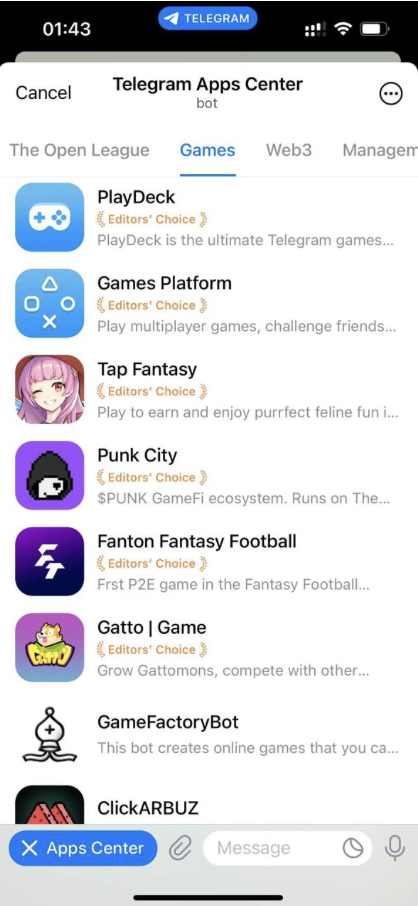
Currently, standout projects in Telegram’s Tapp Center earn the “Editor’s Choice” badge. Representative Web3 games like Tap Fantasy, Fanton, and Egg Fight Club report over 400K, 570K, and 1.5M MAUs respectively.
2) Social-Traffic Tools
As mentioned earlier, Telegram combines traffic strength with social characteristics—making it a fertile ground for monetization in the Web2 world, ideal for advertising, e-commerce, and gaming. Gaming has been discussed; e-commerce requires extensive real-world resources and thus faces a longer development path. Advertising, however, offers a direct and natural monetization route.
However, Telegram is privacy-focused and cannot access key user data, limiting its ability to run highly effective ad campaigns despite having traffic. This presents a major opportunity for ecosystem developers: leveraging Telegram’s rich traffic base and combining it with blockchain’s transparent data to build advanced social-traffic tools—emerging as next-generation ad-support systems within the TON ecosystem.
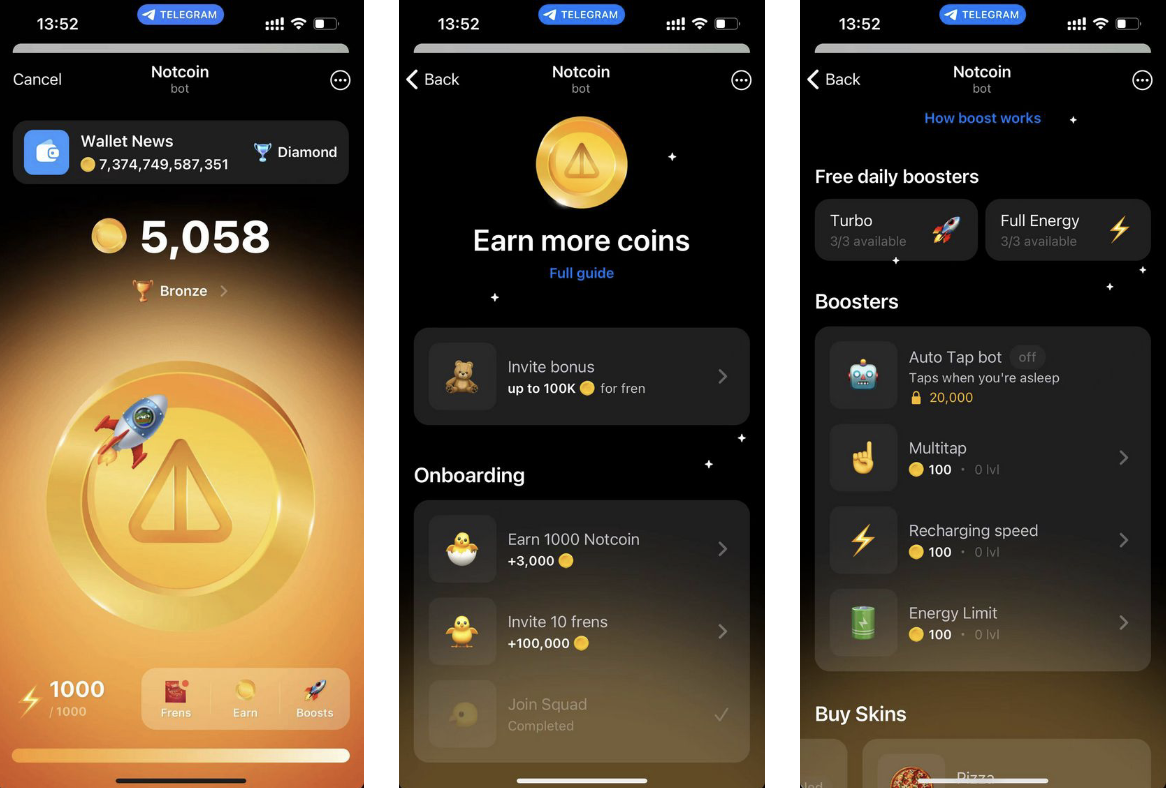
A representative project in this space is Notcoin. Although categorized as a game in the Tapp Center, its functionality is so minimalistic that we prefer to view it as an advertising tool—or a gamified traffic referral mechanism.
Within two months of launch, Notcoin attracted over 21 million users and 3–5 million DAUs. It rewards users with Notcoin points simply for tapping buttons, and incentivizes referrals or traffic redirection to other apps through tasks and team-based invites to various channels—offering bonus points. Notably, 95% of Notcoin’s users come from referrals, demonstrating the power of social virality.
Today, Notcoin already generates substantial ad revenue through its referral system. Despite its simplicity, its low barrier to entry enables exceptional traffic metrics. Hence, we expect many more sophisticated and effective traffic tools to emerge in the TON ecosystem, enhancing Telegram’s overall traffic and advertising infrastructure through innovative social mechanics.
2. Capture Early-Mover Advantages in the TON Ecosystem
Undeniably, despite being backed by Telegram’s 900 million active users, the TON ecosystem remains in its early stages when measured by on-chain activity and application maturity. This is partly due to its relatively complex programming language and underdeveloped infrastructure compared to EVM-compatible chains, presenting certain entry barriers. It’s also because the ecosystem has only recently begun formal development. For developers who believe in TON’s long-term potential, entering now allows them to secure key positions during the early phase—becoming core contributors and reaping exponential returns as the ecosystem matures.
We believe the following sectors are worth early investment in the TON ecosystem:
1) DeFi Infrastructure
DeFi applications and mechanisms are now highly mature, with few novel narratives emerging. Yet, almost every chain eventually produces one or two dominant projects—such as DEXs or lending protocols. These are highly homogenized, but once established, they’re hard to displace due to liquidity moats created by accumulated assets and users.
From an ecosystem development standpoint, DeFi infrastructure helps retain user assets through high yields. Users must first hold assets on your chain before engaging with other dApps—since cross-chain transfers are costly and time-consuming. Thus, DeFi serves as foundational infrastructure for nearly all general-purpose blockchains.
TON is no exception. While it emphasizes traffic advantages, TVL remains directly tied to commercialization and is a key monetization channel. Whether for ecosystem growth or foundation priorities, DeFi remains one of the most critical sectors.
Due to TON’s higher technical barrier and lack of EVM compatibility, top-tier native DeFi applications have yet to emerge, meaning competitive dynamics are still fluid.
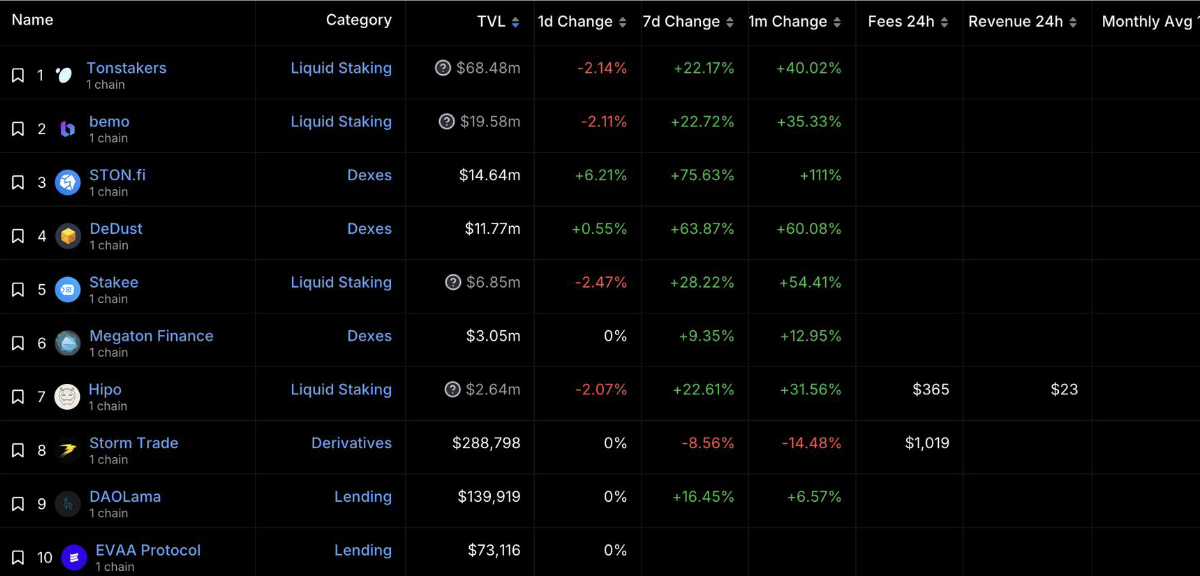
Overview of DeFi on TON (Data source: defiLlama)
Therefore, the TON Foundation is actively supporting DeFi projects—native DeFi applications on TON have a high likelihood of receiving funding and resources. An official liquidity incentive program for TON is expected in April, encouraging user participation in top DeFi apps within the ecosystem.
Hence, TON’s DeFi space is ideal for technically strong teams seeking official backing.
Among various DeFi applications, I personally see the most potential in Lending, Perp DEX, and Yield aggregators.
-
Lending: Offers baseline yield for asset holders without impermanent loss risks associated with DEXs, and can compound returns when combined with other DeFi strategies. For borrowers, it enhances leverage and capital efficiency. For the ecosystem, it acts as force-multiplier for total asset value—making it a fundamental DeFi infrastructure. Currently, lending projects on TON are scarce, leaving ample room for new entrants.
-
Perp DEX: Combines financial utility with high-frequency trading appeal, attracting retail traders and degens. Compared to spot DEXs, perp DEXs tend to draw larger user bases more easily. Currently, very few perp DEXs exist on TON.
-
Yield: Low user threshold makes yield-focused projects highly compatible with Telegram’s user demographics, aiding asset attraction and retention.
Beyond choosing the right direction, product experience matters greatly. Projects should minimize user friction and simplify workflows to fully capitalize on Telegram’s traffic edge.
2. Tools Supporting Telegram
Another critical ecosystem role is infrastructure. Building core chain-level infrastructure on TON is technically challenging, so lighter-weight tool-based applications are more advisable.
In the short term, since Telegram is a social app where Groups and Channels are core features, practical tools around these functionalities have clear market demand—such as group management tools, analytics for groups and channels, and information aggregation tools. Tool-based projects have low entry barriers but strong market needs and high user stickiness—once they gain traction, they can build durable moats.
Such tools have previously grown organically within Telegram—popular Telegram bots, for example, often serve as management or aggregation tools—but face intense competition. By integrating with TON, these tools can introduce data- and behavior-based incentives and governance models, gaining an edge over traditional Web2 tools, while also benefiting from official support to accelerate customer acquisition and strengthen their competitive position.
Long term, as Telegram evolves into a bridge between Web2 and Web3, it will expand beyond social functions into diversified areas like finance and e-commerce, attracting traditional businesses and non-developers. Mini-apps will play a central role here. Given the massive scale of traditional enterprise markets, tools serving these mini-apps—such as SaaS platforms for digitization and blockchain integration, analytics tools, etc.—will unlock unprecedented growth opportunities. Of course, this depends on Telegram’s own strategic roadmap and ecosystem evolution.
Recently, Future3 Campus partnered with the TON Foundation to launch TON Bootcamp—an initiative aimed at fostering a Web3 ecosystem built on Telegram Messenger. By identifying and refining entrepreneurial projects focused on payments and gaming, the program helps them seamlessly integrate into the growing TON Web3 ecosystem, building bridges between Web2 and Web3.
This edition of TON Bootcamp focused on the aforementioned high-potential sectors, selecting 12 competitively positioned projects:
-
Anome: An innovative NFT asset issuance and lending protocol aiming to become the world’s largest NFT collateralized lending platform.
-
Boom Up: A lightweight, socially driven, profit-oriented GameFi mini app on Telegram powered by the TON chain.
-
Bounty Bay: A Telegram-native social virality product enabling sellers and brands to leverage TG-native mini apps and TON Space wallet payments.
-
DAOBOT: A decentralized community management bot for Telegram, providing decentralized governance for online communities, on-chain contract-controlled group rules, and DAO self-governance infrastructure.
-
HypeSaints: A handheld console-style entertainment app integrating tokenomics.
-
TONIX: An online ticketing service built on Telegram and TON, connecting offline cinemas, concerts, events, and venues with digital content and ticketing resources.
-
TonsofFriends: A dynamic directory enabling users to easily buy and sell access to premium Telegram communities, simplifying group discovery in an enjoyable and rewarding way.
-
TON Solutions: Telemetree is the first analytics service purpose-built for the TON and Telegram Mini App ecosystem.
-
Tradoor: A next-generation decentralized derivatives exchange leveraging TON’s scalability to deliver optimal trading experiences across web, mobile, and Telegram mini apps.
-
WowFish: A social casual game built on Telegram Mini App, allowing players to team up in groups and compete on weekly and seasonal leaderboards for rich rewards.
-
Xircus: The first no-code platform for building, developing, deploying, and managing cross-chain smart contracts, dApps, and TON-Telegram/mobile-compatible mini apps for both Web3 and Web2 businesses.
Selected teams will receive dedicated support from both Future3 Campus and the TON Foundation, positioning them to become core pillars of the TON ecosystem.
Join TechFlow official community to stay tuned
Telegram:https://t.me/TechFlowDaily
X (Twitter):https://x.com/TechFlowPost
X (Twitter) EN:https://x.com/BlockFlow_News






