








Wall Street Bets on Bitcoin: Fair-Weather Bull or True Crypto Believer?
TechFlow Selected TechFlow Selected
Wall Street Bets on Bitcoin: Fair-Weather Bull or True Crypto Believer?
Wall Street will chase anything that can make money.
 Navigating Web3 tides with focused insights
Source: Bloomberg
Translated by: BitpushNews Yanan
Traditional finance has now married the crypto world, forming a shared-interest community—for better or worse.
For JPMorgan CEO Jamie Dimon, cryptocurrencies are nothing more than "pet rocks"—a reference to Pet Rock, a novelty toy popular in the U.S. during the 1970s consisting of an ordinary stone marketed as a low-maintenance pet—and thus inherently valueless. To Charlie Munger, longtime partner of investing legend Warren Buffett, crypto is simply "profoundly dumb." U.S. Senator Elizabeth Warren believes only terrorists, drug dealers, and fraudsters could possibly favor cryptocurrency.
They may be right. But there's one thing you need to understand about Bitcoin: it’s not going away anytime soon. On the contrary, Wall Street’s resistance to it has been steadily fading over time.
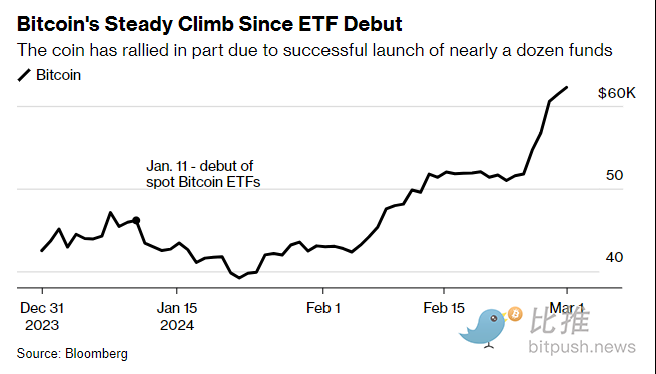
Recently, the crypto market staged a strong rebound, with Bitcoin prices surging past $40,000, then $50,000, and eventually $60,000—surprising many seasoned financial professionals who had previously expressed skepticism. This powerful rally has ignited renewed optimism, with numerous experts convinced that underlying demand for Bitcoin remains robust and enduring. Broad participation across all demographics—young enthusiasts, older investors, deep-pocketed institutional players, and even retail traders—is seen as providing solid support for Bitcoin’s market outlook. Even rising U.S. interest rate expectations, once viewed as Bitcoin’s biggest threat, have failed to dampen investor enthusiasm.
"Regardless of what Jamie Dimon or his friend Elizabeth Warren say," said Michael Novogratz, founder and CEO of crypto investment firm Galaxy, in an interview, "many people still believe Bitcoin has value." Novogratz is one of Bitcoin’s most steadfast advocates.
This persistent demand for Bitcoin presents the investment industry with a pressing dilemma. Even though Bitcoin now comes wrapped in the regulatory-friendly packaging of ETFs, traditional financial giants can still choose to avoid this asset class, long known for its volatility and susceptibility to scandals. For example, the ultra-conservative Vanguard Group (the world’s largest mutual fund company) has taken precisely this approach, steering clear of Bitcoin-related assets.
The alternative is to accommodate clients’ growing appetite for crypto—even if doing so means taking on various risks. Companies like Bank of America Merrill Lynch and Wells Fargo have recently joined this camp, allowing certain brokerage clients to invest in new Bitcoin exchange-traded funds (ETFs), while simultaneously prohibiting financial advisors from recommending such products.
Bitcoin’s Rise Since ETF Launch
Bitcoin’s recent price surge has been partly fueled by the successful launch of nearly ten related funds.
"Wall Street will chase anything that makes money—but that doesn’t mean it’s good or bad," said Michael Rosen, chief investment officer at multi-asset investment firm Angeles Investments. He added that he views faith in cryptocurrencies as bordering on delusion.
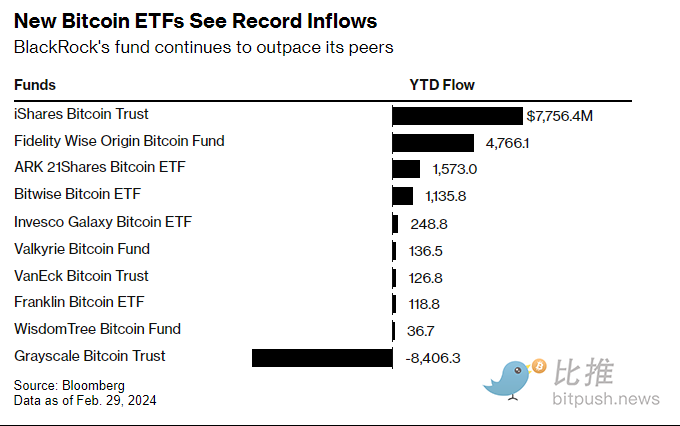
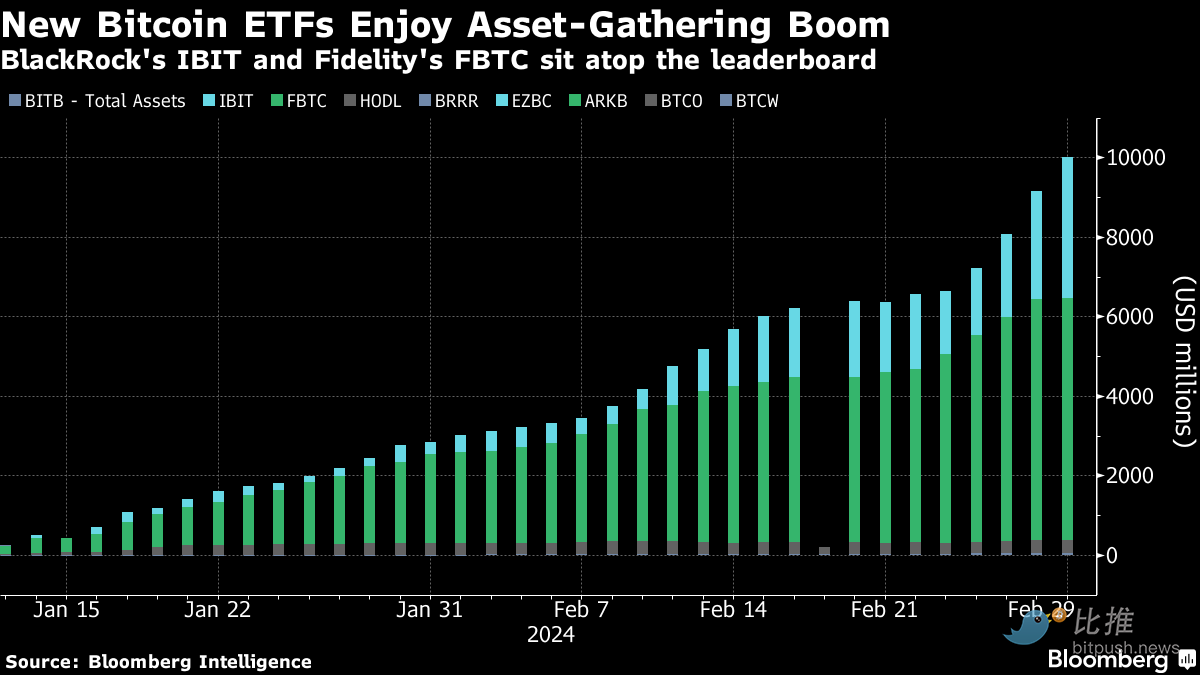
Yet the flood of capital cannot be ignored. The ten spot Bitcoin ETFs currently trading in the U.S. market have collectively attracted around $8 billion in net inflows, led primarily by funds managed by investment titans Fidelity and BlackRock. According to Bloomberg Intelligence data, BlackRock’s iShares Bitcoin Trust accumulated $10 billion in assets within just seven weeks—a pace unprecedented in ETF history and faster than the first gold ETF, which took two years after its 2004 debut to reach the same milestone. This underscores Bitcoin’s appeal and market potential as a novel investment vehicle.
Record Inflows into Newly Launched Bitcoin ETFs
BlackRock’s Bitcoin ETF continues to lead the pack among its peers, with inflows far outpacing other funds.
However, this massive influx into ETFs requires buying Bitcoin in a market famously known for "holding" (HODLing). These hodlers tend to hoard Bitcoin and wait for prices to rise. Of course, everyone has a price point, and the sudden surge in Bitcoin demand has reactivated retail traders in the crypto space. As prices climbed, trading activity surged, causing a series of outages last Wednesday on Coinbase, the largest U.S. cryptocurrency exchange, where some user account balances briefly displayed $0.
Yet this broad-based rally driven by new capital may also amplify the inherent risks of crypto assets—risks that could now spill over to reputable investment firms. Jimmy Su, Binance’s chief security officer, warned that bullish sentiment could lead to a spike in "rug pulls," scams in which developers heavily promote a crypto project to attract funding before the entire team absconds with the money.
Equally significant as Bitcoin’s price rise is a seemingly mundane but critical factor: market risk. Traders who identify as "degens"—slang for degenerate gamblers who engage in high-risk, speculative crypto trades without proper research or due diligence—are borrowing heavily to leverage their positions and amplify profits. Although leveraged trading nearly collapsed two years ago following the downfall of crypto lending platforms like Celsius, these traders appear undeterred and are instead aggressively seeking ways to magnify returns.
According to the latest data from CCData, the total open interest in Bitcoin derivatives on centralized exchanges—with leverage reaching up to 100x—has increased nearly 90% since October last year, hitting its highest level since the previous crypto bull market crash in early 2022. Data shows that open interest on major crypto exchanges including Binance, OKX, and Bybit has soared to levels last seen during the 2021 bull run peak. Mauricio Di Bartolomeo, co-founder of Ledn, said the company’s loan business backed by Bitcoin collateral has returned to pre-FTX-collapse levels seen at the end of 2022.
As a result, many predict this recent rally will eventually see a partial pullback—it’s not a question of *if*, but *when*. Meanwhile, as Wall Street investors seek traditional risk-hedging tools, CME Group’s crypto asset products are experiencing unprecedented trading volumes. (CME Group operates global derivatives markets for futures and options contracts across multiple asset classes.)
Be Prepared to Lose Everything
"Investors holding highly leveraged and risky crypto positions should realize that an inevitable correction is coming," said Campbell Harvey, Duke University finance professor and expert in crypto asset markets. "When using leverage, you must be prepared to lose everything."
Only time will tell whether holders of the new ETFs are truly prepared for a potential market downturn. As an asset class without revenue streams or widespread real-world use cases, Bitcoin remains inherently volatile and highly susceptible to shifts in industry sentiment.
While debate rages over whether Bitcoin’s next key level will be $70,000 or $50,000, many believe the opening of the ETF market has fundamentally changed the game, with profound implications for both traditional finance and the crypto world.
"This is undoubtedly putting Bitcoin on the path to legitimacy," said Stephane Ouellette, CEO of digital asset platform FRNT Financial. "Now, when you talk to hedge funds, they say, 'I used to worry about adding Bitcoin to my tradable instruments list, but if BlackRock is in, then it’s fine.' It’s like 'keeping up with the Joneses,'" he added, noting that last Wednesday’s rally was so intense he couldn’t leave his desk due to constant calls and messages.
The newly launched Bitcoin ETFs make this crypto bull market fundamentally different from previous boom-and-bust cycles. Past cycles were often driven by risk-loving speculators and ultimately collapsing crypto ventures—such as unsecured crypto lending and the chaotic ICO craze.
Today, the investor base driving this rally has shifted, with individual investors increasingly buying ETFs. "We’re seeing a whole new army of buyers," said Novogratz in a Bloomberg Television interview last Thursday. In another interview, he elaborated: "This is huge because, in my 11 years in this space, baby boomers and older investors are now able to access crypto easily for the first time."
Of course, hope and hype have always been key drivers of crypto bull markets. Now, there’s hope that this new wave of crypto investors marks a fresh beginning. As financial advisors and asset managers channel more deep-pocketed clients—be they individuals, institutions, or sovereign wealth funds—into this suddenly investable asset class, Bitcoin’s future looks brighter than ever.
"I think Wall Street has only completed about 10% of its transformation, because traditional financial institutions are naturally resistant to change and slow-moving," said Edward Chin, co-founder of Parataxis Capital, whose clients include pension funds and other institutional investors. "Given the massive profit opportunities that asset management presents for Wall Street, I believe every major institution will eventually have to develop a crypto investment strategy or launch related products—simply to meet client demand. Not offering them means losing market share and revenue."
Still, it’s hard not to notice the many ironies of this new crypto era, raising questions about how this might shape the future of crypto assets.
On one hand, Sam Bankman-Fried, former head of the fallen FTX empire, has been convicted on fraud charges related to the collapse of his exchange and is awaiting sentencing. His former rival, Zhao Changpeng, formerly CEO of Binance, pleaded guilty to violations of anti-money laundering regulations and is set to be sentenced next month.
Another irony lies in the fact that this bull market owes its arrival almost entirely to Gary Gensler, chairman of the U.S. Securities and Exchange Commission (SEC). Previously seen as crypto’s archenemy due to the SEC’s aggressive enforcement actions against crypto firms and years-long rejection of spot Bitcoin ETFs, Gensler made a pivotal move in January by casting the deciding vote in favor of approving Bitcoin ETFs.
What Would Satoshi Think?
Beneath all the excitement and uncertainty, perhaps the most thought-provoking question concerns the essence and future of the crypto industry itself. Bitcoin was created in 2008 by the anonymous figure Satoshi Nakamoto with the original intent of offering an alternative to the Wall Street- and government-dominated financial system.
"The whole idea behind Bitcoin was to serve as an alternative to mainstream finance—free from central oversight and regulation," said Michael O’Riordan, founder of ETF consultancy Blackwater. "But with Bitcoin ETFs, the opposite is happening. Satoshi might be spinning in his grave."
Indeed, the irony runs deep: it has been 15 years since Satoshi created Bitcoin, yet no one truly knows who he—or she—is, or even whether Satoshi is still alive. But regardless, Satoshi’s invention—Bitcoin—remains very much alive.
Join TechFlow official community to stay tuned
Telegram:https://t.me/TechFlowDaily
X (Twitter):https://x.com/TechFlowPost
X (Twitter) EN:https://x.com/BlockFlow_News
 @Bloomberg











