Deep Dive into Orion: Aggregating Ultimate Liquidity, Driving a New Era of Crypto Trading
TechFlow Selected TechFlow Selected
Deep Dive into Orion: Aggregating Ultimate Liquidity, Driving a New Era of Crypto Trading
Orion Protocol aims to enhance trading efficiency, reduce costs, and deliver a seamless user experience by integrating highly secure cross-chain bridges and virtual order books.
 Navigating Web3 tides with focused insights
Written by: @yelsanwong
Advisor: @CryptoScott_ETH
TL;DR
-
Orion simplifies trading by aggregating liquidity from fragmented DEXs and CEXs into a single access point through liquidity aggregation, virtual order books, and a high-security cross-chain bridge, delivering seamless user experience.
-
Recently, Orion launched its Refer&Earn campaign to incentivize influencers and loyal users to refer new users, offering $ORN rewards and trading fee discounts. This reward-based referral mechanism accelerates user growth and organically expands Orion’s brand through community-driven networks.
-
Orion recently introduced its BRC20 cross-chain bridge, significantly expanding the protocol's functionality by enabling token creation and exchange on the Bitcoin network—laying a critical foundation for BTCFi ecosystem development. This advancement not only enriches Bitcoin’s use cases and value but also uniquely positions Orion to connect BTCFi with the broader DeFi landscape. Given the rapid expansion of Bitcoin’s ecosystem last year, BTCFi is expected to become a high-growth sector, where Orion’s cross-chain solution could drive substantial growth.
1. Project Overview
Founded in 2018, Orion Protocol was initially designed to provide a unified, decentralized trading solution by connecting via a liquidity aggregator to all major centralized (CEXs) and decentralized exchanges (DEXs). This allows users to access full market liquidity directly through its decentralized platform, securing the best possible price for any token across markets.
By integrating high-security cross-chain bridges and virtual order books, Orion aims to improve trading efficiency, reduce costs, and deliver a seamless user experience. At its core, the platform consolidates fragmented market liquidity into one access point, streamlining the trading process while maintaining key DeFi attributes such as transparency, security, and non-custodianship.
In November 2023, Orion Protocol announced the rebranding from “Orion Protocol” to simply “Orion,” revitalizing the protocol with a clearer, more focused value proposition and expanding the utility and potential of the ORN token.
2. Background
2.1 Team Background
Alexey Koloskov (Founder & CEO)
Prior to leading Orion Protocol, Alexey served as Chief Architect at Waves, where he led the architecture and development of the Waves decentralized exchange. Since June 2017, as Founder and CEO of Orion Protocol, he has led the project for over six years, overseeing strategic direction, product development, and driving innovation and growth within the blockchain industry.
Kal Ali (Co-Founder & COO)
As an early strategic advisor and co-founder of Orion Protocol, Kal Ali is currently also a Limited Partner at Dominance Ventures, a venture firm that participated in early investments in projects such as Cosmos, Gunzilla Games, and Avalanche.
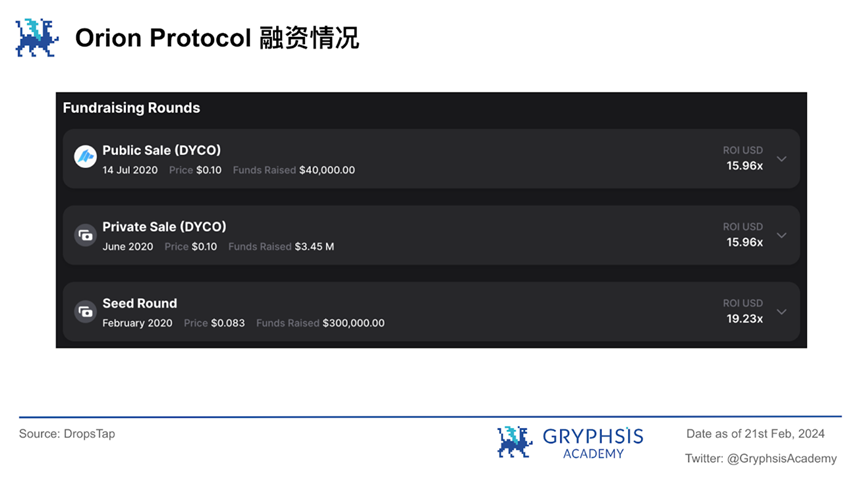
2.2 Funding Status
3. Products and Services
3.1 Orion Terminal
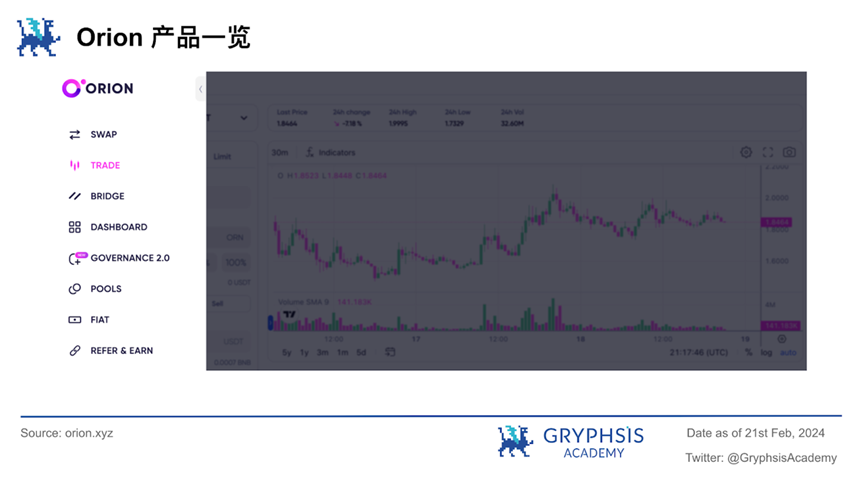
Orion Terminal, the flagship product of Orion Protocol, leverages a unique liquidity aggregation mechanism to access and integrate order books from multiple exchanges in real time. Covering both centralized and decentralized platforms, it ensures users can obtain optimal pricing and depth across the entire market from a single interface.
This innovation not only enhances trade execution and pricing strategies but also reduces transaction costs and improves overall market efficiency. Below is how this mechanism works.
3.1.1 deCEX Trading: Using CEXs in a Decentralized Way
Through Orion Terminal, users do not need to create individual accounts on centralized exchanges or undergo KYC procedures. Instead, when users initiate trades, their requests are sent via atomic swaps (smart contract-executed transactions completed in one step, ensuring either full success or complete failure with no intermediate state) to liquidity nodes—accounts established by Orion on CEXs—which execute the trades on the respective CEXs and return tokens immediately. Unlike traditional DEXs using AMM mechanisms, deCEX provides real-time order books, offering more precise and immediate trading data.
Safety Deviation (SD) Mechanism:
While atomic swaps ensure capital safety and ideal price submission, how does Orion guarantee best-price execution? To address this, Orion implements a Safety Deviation (SD) parameter for each trade.
Simply put, SD is an automated preset slippage tolerance. For USDT pairs on CEXs with sufficient liquidity, SD is set to 0%. For non-USDT CEX pairs (e.g., ETH/BTC), SD is 0.4%. On DEXs, a single swap applies 0.15% SD, while multi-step swaps multiply 0.15% by the number of steps. Orion charges no additional fees beyond volume-based commissions and network costs.
Unlike user-defined slippage settings, SD acts as a fixed, predefined mechanism, providing greater transparency and predictability in price fluctuations.
Even under extreme market conditions, the system automatically takes measures to finalize trades. Additionally, SD may dynamically adjust based on market conditions like pair liquidity and volatility—offering flexibility beyond manual slippage settings, especially during periods of sharp price movement.
However, the SD mechanism has limitations—for example, large trades in low-liquidity pools may drastically shift prices, making a 0.15% preset insufficient and potentially causing trade failures.
Liquidity Nodes / Liquidity Providers:
During trade execution, Orion assigns orders to specific liquidity nodes via its virtual order book. To maintain decentralization and efficiency, Orion employs a Proof-of-Liquidity (DPoL) mechanism.
Under DPoL, nodes must stake ORN tokens to participate. Nodes with higher stakes have a greater chance of being selected, though selection also considers factors such as token types offered, underlying blockchain, and reserve levels to ensure smooth execution.
DPoL also enables users to delegate ORN tokens to preferred nodes, influencing node selection. This balances interests between users and nodes, enhancing decentralization and participation by allowing nodes to set fees and share revenue with delegators.
Asset Security and User Control:
Regarding asset security and control, Orion Terminal enables direct trading from user wallets. Through the liquidity aggregator, users act as order originators—their orders are created via Orion and then interacted with liquidity nodes for fulfillment. Information such as order address, exchange, and amount is publicly viewable and verifiable.
This model strengthens security by keeping funds under direct user control, reducing risks of theft or misuse associated with traditional CEXs. Even if Orion Terminal fails, the liquidity node network and smart contracts continue operating, allowing users to keep accessing Orion’s liquidity and economic services.
This design embodies the core principle of decentralization: users can transact securely and freely without trusting third parties.
3.1.2 Transmuted AMM Price Curves: Using DEXs Like CEXs
Traditionally, decentralized exchanges (DEXs) like Uniswap V3 use Automated Market Maker (AMM) models with price curves to determine prices, differing from the transparent bid/ask listings in CEX order books. The AMM price curve makes direct comparison with CEX order book liquidity challenging.
Orion innovates by converting AMM price curves into traditional order book formats, allowing AMM liquidity such as Uniswap V3 to be displayed and compared just like on centralized exchanges such as Binance or OKX.
This conversion not only simplifies price comparisons but also enables limit orders on AMMs, expanding trading capabilities. Furthermore, by transforming AMM curves into order books, Orion seamlessly integrates and compares AMM and CEX liquidity, creating a unified trading environment.
3.1.3 Virtual Order Books: Combining DEX and CEX Order Books to Find Optimal Paths
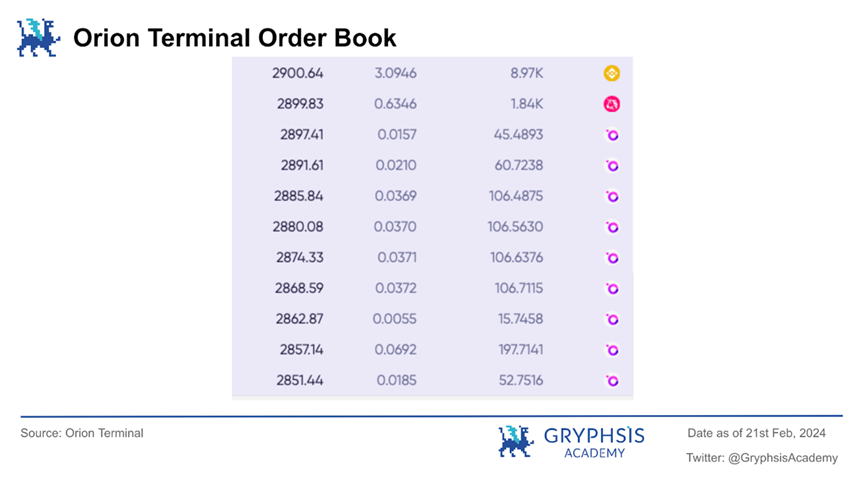
Virtual Order Books (VOBs) combine the direct trading approach of traditional order books (OOB) with the liquidity model of AMMs, creating a unified trading platform. VOBs not only display direct trade information but also reveal potential deeper liquidity through multi-step swaps.
For example, swapping Token A to Token C via an intermediary Token B. Continuously calculating complex swaps allows Orion to constantly update and optimize trading opportunities, offering traders competitive prices and previously undiscovered arbitrage possibilities.
Together, these three core technologies make Orion Terminal a promising prototype for liquidity aggregation platforms. However, its actual reliability and price discovery effectiveness still require market validation.
3.2 Orion Bridge
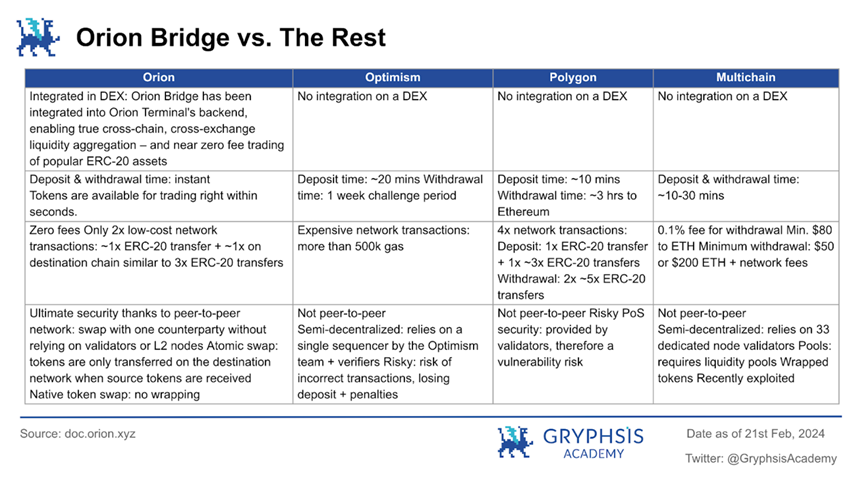
Orion Bridge addresses challenges in cross-chain trading across the cryptocurrency market, delivering a truly efficient decentralized cross-chain bridge. Its key innovation lies in integration—for the first time, cross-chain and cross-exchange liquidity aggregation is embedded directly into the backend of Orion Terminal, providing users with a seamless, fast, and secure trading experience. Compared to existing bridges, Orion Bridge offers a frictionless experience—no restrictions, no delays, no rejected orders, no locked funds, and no exploit risks—significantly resolving many issues prevalent in current cross-chain solutions.
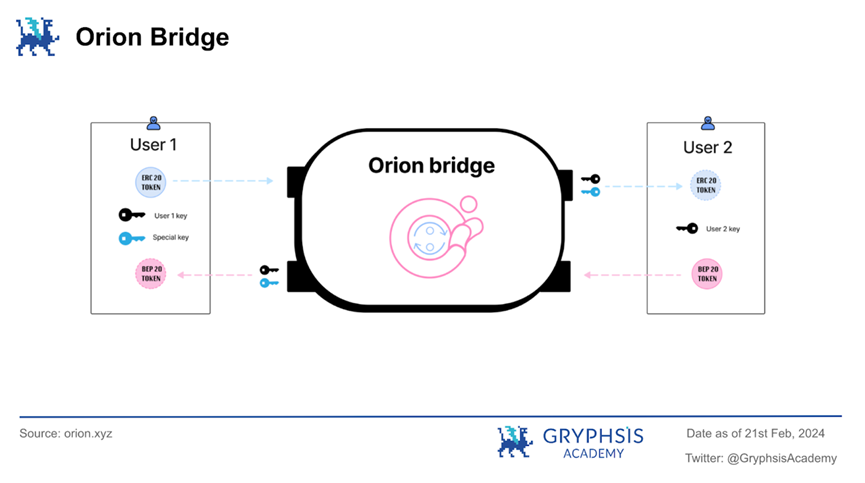
Orion Bridge is powered by three core technologies: Atomic Swaps, Peer-to-Peer Network (P2P), and Broker Network. Atomic Swaps enable instant asset exchanges across different blockchains without wrapped assets or delays. P2P technology enables true decentralization, allowing peer-to-peer transfers without central intermediaries. The Broker Network ensures immediacy and smoothness regardless of transaction size.
In its first iteration, Orion Bridge has already enabled seamless connectivity between Ethereum and BSC, and will soon launch the BRC20 cross-chain bridge, enabling BRC20 tokens to trade with EVM-compatible chains like MATIC and BSC. Notably, ORN is the only BTCfi-concept token listed on Binance.
3.3 Orion Pools
Orion Pools is a decentralized liquidity pool platform built on the Uniswap V2 model. It allows users not only to contribute liquidity and create new pools but also to personalize their experience with custom branding, fostering an active and vibrant trading environment.
The design philosophy behind Orion Pools emphasizes user empowerment, giving users the ability to create, contribute to, and customize liquidity pools through a simplified interface and workflow.
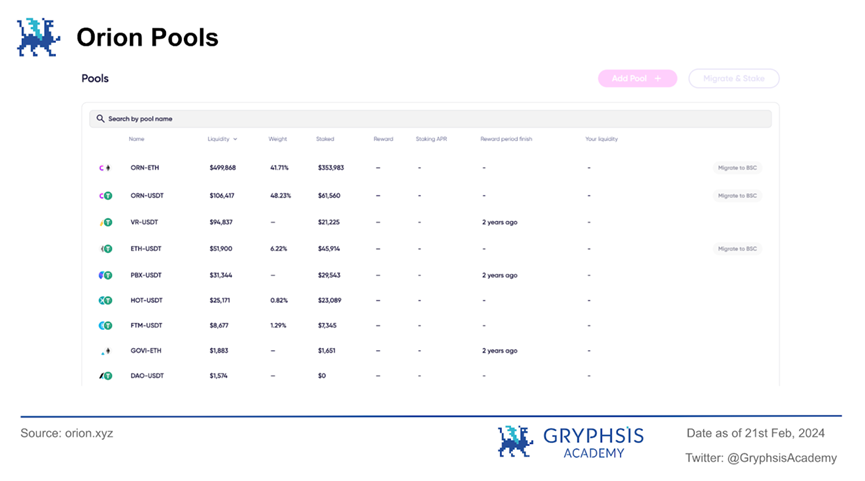
Operationally, Orion Pools provides intuitive guidance for easily creating new pools or adding liquidity to existing ones. Creating a new pool involves selecting or adding a new token, suggesting pairing with USDT for cross-platform integration, uploading a token icon (for new tokens), and confirming the transaction. Contributing liquidity includes choosing a preferred pool, entering the contribution amount, and confirming via wallet. These processes are both user-friendly and enhance platform liquidity and trading efficiency.
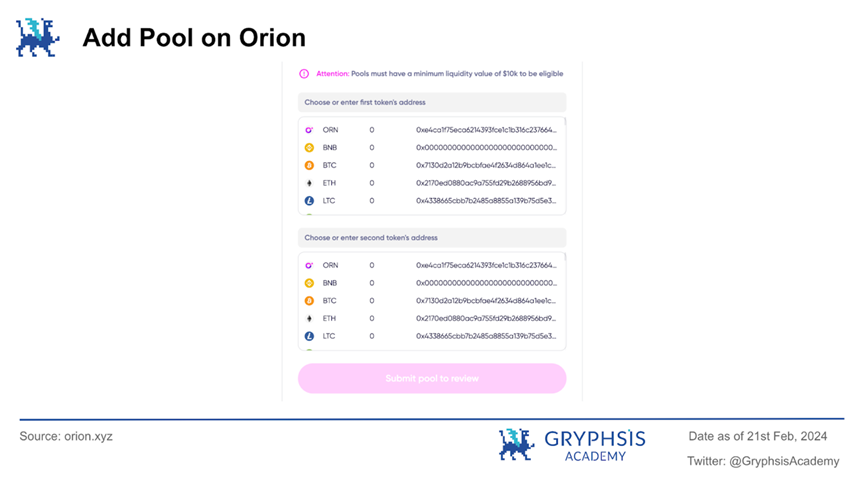
By contributing assets to liquidity pools, users facilitate seamless trading on the platform and earn a portion of trading fees as rewards—creating a mutually beneficial relationship. Orion Pools not only offers yield opportunities but also allows users to become part of a broader trading ecosystem, increasing engagement and sense of belonging.
With the activation of new governance and liquidity mining systems, Orion Pools is transitioning toward a more sustainable, growth-oriented model. Effective since December 5, 2023, the new system emphasizes support for protocol growth and sustainability while aligning incentives with user interests. This shift not only increases platform appeal but is also expected to attract more participants into the Orion ecosystem.
3.4 Orion Widget
Orion Widget, introduced by Orion Protocol, is an innovative application designed specifically for crypto trading platforms and decentralized app (dApp) developers. It enables quick integration of token trading functionality into any website or app through a simplified setup. Leveraging liquidity from both centralized and decentralized exchanges (CEXs and DEXs), the widget allows users to trade directly by connecting their wallets, improving convenience and user experience.
The core advantage of Orion Widget lies in its high customizability and ease of integration. Developers can tailor the widget’s appearance and functionality using predefined parameters such as theme, default tradable assets, asset list, initial trade amount, and fee token—meeting diverse platform and user needs. This flexibility ensures seamless integration across various environments while maintaining brand consistency and usability.
Moreover, integrating Orion Widget is extremely simple, supporting both script and iframe methods with minimal coding required. This dramatically lowers technical barriers, enabling even non-technical developers to deploy trading features effortlessly. This accelerates development cycles, reduces costs, and enhances project flexibility and scalability.
In terms of token listing, Orion Widget supports hundreds of tokens already listed on Orion Protocol and ensures support for unlisted tokens through broad liquidity sources, further expanding user trading options. This feature is particularly valuable for projects aiming to offer specific token trading on their platforms without worrying about liquidity or compatibility issues.
4. Growth Drivers
4.1 Refer & Earn Driving Rapid User Growth
Orion Protocol’s Refer & Earn campaign is designed to expand its user base. Through this program, Orion incentivizes influencers and loyal users to refer new users, rewarding them with $ORN tokens. Participants can apply via Telegram at @TradeOnOrion.
Referrers share referral links; referred users enjoy a 10% discount on trading fees when trading via @TradeOnOrion, while referrers earn over 70% of the generated trading fees as rewards. Rewards are distributed in real time via $ORN on the BNB Chain. As the program progresses, more users will gain access to become referrers.
Additionally, active referrers with strong networks and high trading volumes not only receive base rewards but also qualify for extra $ORN rewards on leaderboards. Rankings are based on 14-day network trading volume and ORN holdings. Orion adjusts leaderboard budgets monthly to temporarily boost referral rewards, with hourly distributions claimable on the BNB chain.
This reward-based referral model rapidly grows the user base and spreads Orion’s brand organically through community social networks. Community members benefit directly from referrals, strengthening loyalty and engagement.
Meanwhile, the Refer & Earn campaign incentivizes users who trade via referral links with fee discounts, directly lowering trading costs and attracting more trading activity to Orion. As volume increases, platform liquidity improves, drawing more users and traders—creating a positive feedback loop. Increased trading activity also boosts Orion’s competitiveness, attracting more projects and partners to join the ecosystem.
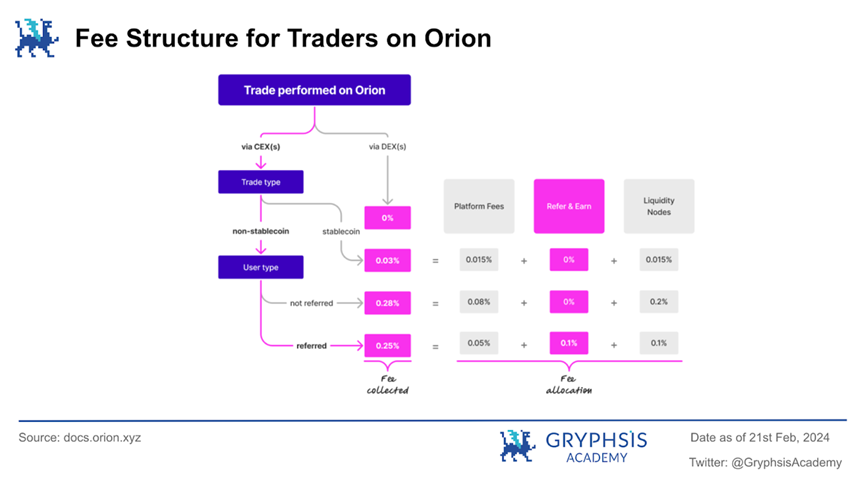
Through a multi-tiered reward structure, Orion encourages chain referrals, promoting long-term community activity and engagement. Real-time reward distribution and leaderboard incentives further enhance attractiveness, driving active participation. Sustained user involvement and community building are crucial for stable platform growth and long-term success.
4.2 BRC Cross-Chain Bridge and Pioneer in BTCFi
According to OrdSpace data, BRC20 already hosts tens of thousands of tokens with a total market cap exceeding $2 billion, demonstrating strong market demand. As one of the few infrastructures supporting the BRC20 standard and bridging Bitcoin with other blockchains (e.g., Ethereum, BNB Smart Chain), Orion enjoys a first-mover advantage, helping attract early adopters and investors.
Furthermore, by supporting the BRC20 cross-chain bridge, Orion attracts users and developers interested in exploring new financial products and services on the Bitcoin network. This cross-chain functionality will significantly increase liquidity and trading volume on the Orion platform.
The introduction of the BRC20 cross-chain bridge enables Orion to support the creation and transfer of fungible tokens on the Bitcoin network, laying a foundational pillar for BTCFi ecosystem development. This not only expands Bitcoin’s use cases and value but also uniquely positions Orion to bridge BTCFi with the broader DeFi ecosystem.
Given the rapid growth of the Bitcoin ecosystem last year, BTCFi is expected to emerge as a high-growth sector, and Orion stands to achieve strong growth through its cross-chain bridge offering.
4.3 Anticipated Airdrop from Orion Terminal
In September 2020, Uniswap announced an airdrop of its governance token UNI. All Ethereum addresses that interacted with Uniswap V1 or V2 before the snapshot date qualified for at least 400 UNI.
Drawing from Uniswap’s successful airdrop history, if Orion Protocol were to implement a similar strategy, several growth benefits could be anticipated—including attracting new users, boosting community governance and veteran engagement, increasing visibility, acquiring new partners, gathering valuable user feedback, and driving technological improvements.
5. Tokenomics
5.1 Token Distribution
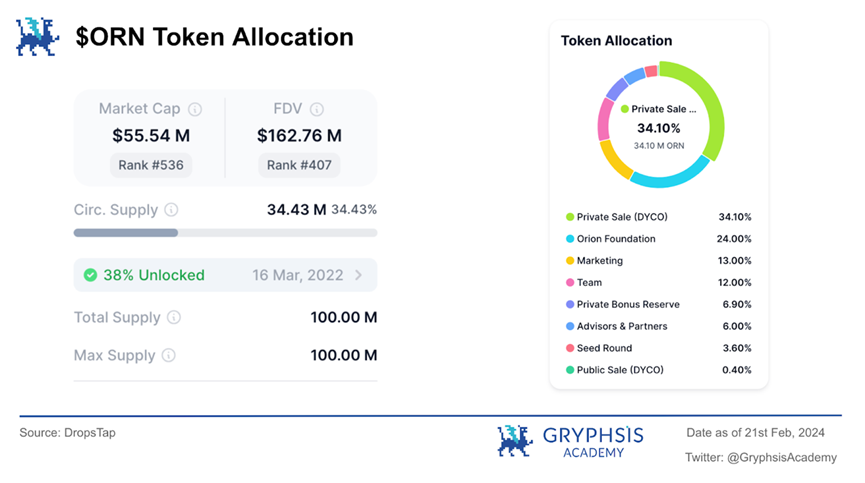
5.2 Token Utility
5.2.1 Staking & Governance
Orion Protocol’s Governance 2.0 represents a fundamental evolution in its governance model, aiming to build a resilient future by enhancing community interaction and influence, rewarding commitment, and ensuring every participant contributes to Orion’s long-term success. At the heart of Governance 2.0 is veORN (vote-escrowed ORN), a non-transferable token representing locked ORN and equivalent to voting power and influence within Orion.
Initially, veORN is primarily used for voting on liquidity pools, but its flexible design allows expansion into new governance functions as the ecosystem evolves. The veORN mechanism encourages users to deepen their governance participation by locking ORN long-term, thereby strengthening community control over platform direction.
Users earn veORN by staking ORN and selecting a lock-up duration, becoming active participants in Orion governance. The chosen duration reflects their level of commitment—longer locks yield more veORN and greater influence in decisions. This mechanism rewards users deeply committed to the Orion ecosystem through a carefully designed incentive system aligned with participation and dedication.
Additionally, the veORN decay mechanism in Governance 2.0 incentivizes ongoing participation. Over time, veORN gradually decreases unless users extend their lock or add more ORN, requiring continuous engagement to maintain or grow governance influence. This design sustains vitality and fairness in Orion’s governance, encouraging new entrants while rewarding long-term, active contributors.
5.2.2 Reward Mechanism
As incentives in the Refer & Earn program: calculated based on referrer-generated fees (70% weight) and user ORN balance (30% weight). Higher ORN balances significantly increase earned rewards.
6. Risks
6.1 Cross-Chain Bridge Security Risks
Cross-chain bridge projects carry high risks in the DeFi space, including security vulnerabilities and operational risks. As a cross-chain bridge project, Orion must prioritize these risks and implement robust security measures and risk management strategies to protect user assets and strengthen community trust.
6.2 System Integration Risks
Orion Protocol delivers its unique liquidity aggregation service by integrating multiple decentralized and centralized exchanges—a complex system integration effort. While this integration offers users broad liquidity access and optimized trading experiences, it also introduces integration risks.
These risks include technical compatibility issues—different platforms may have varying APIs and data formats, requiring careful adaptation for seamless integration. Additionally, maintaining stability and reliability is challenging, as updates or outages on any connected platform could impact the entire system. This heavy reliance on external platforms makes Orion vulnerable to policy changes or service disruptions.
Therefore, while system integration brings Orion significant advantages—such as richer liquidity and better user experience—it also demands continuous effort to manage and mitigate integration risks, ensuring platform stability and security to protect user interests.
Join TechFlow official community to stay tuned
Telegram:https://t.me/TechFlowDaily
X (Twitter):https://x.com/TechFlowPost
X (Twitter) EN:https://x.com/BlockFlow_News
 @gryphsisacademy