








Nvidia beats Q4 revenue, profit, and Q1 guidance expectations, shares rise 10% after hours
TechFlow Selected TechFlow Selected
Nvidia beats Q4 revenue, profit, and Q1 guidance expectations, shares rise 10% after hours
Huang Renxun says generative AI has reached the "tipping point."
 Navigating Web3 tides with focused insights
By Zhao Yuhe
Source: Wall Street Horizon
Nvidia's much-anticipated Q4 earnings report was released after Wednesday's market close. Despite extremely high market expectations, the company's revenue and profit surged both year-over-year and exceeded analyst forecasts, marking the third consecutive quarter of record-breaking performance. Jensen Huang declared generative AI has reached an "inflection point," while CFO Colette Kress stated that demand for next-generation products far exceeds supply levels. Nvidia's stock rose as much as 10% in after-hours trading.
Revenue Jumps 265%, Profit Soars 769%
According to the earnings report, driven by surging demand for AI chips in servers, Nvidia achieved $22.1 billion in Q4 revenue, up 22% sequentially and soaring 265% year-over-year—significantly surpassing the $20.41 billion expected by analysts. The single-quarter revenue even exceeded the company's full-year revenue in 2021.
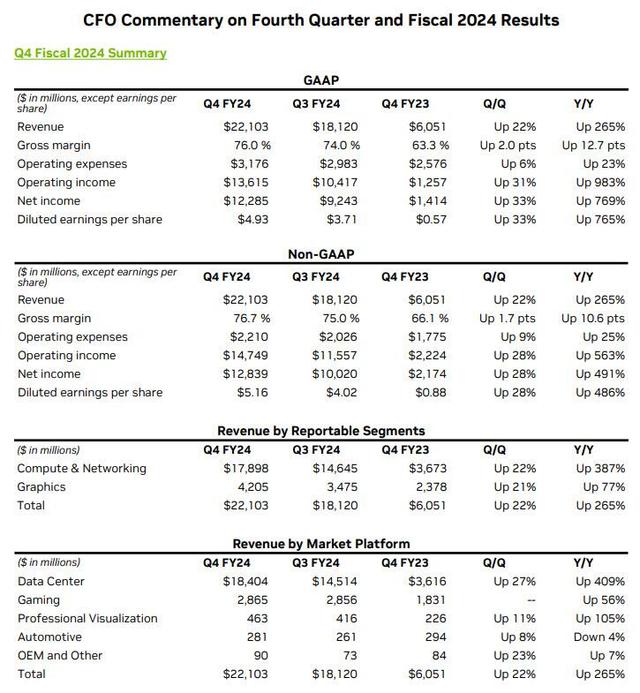
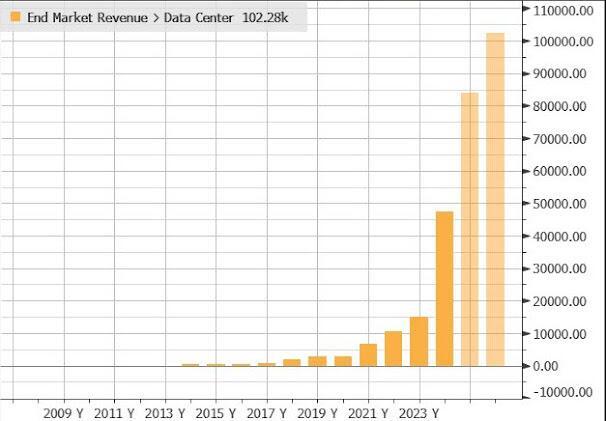
Data center operations—the largest revenue contributor for Nvidia—generated $18.4 billion in Q4, a staggering 409% increase year-over-year and above the $17.21 billion expected by analysts.
Net profit reached $12.3 billion in Q4, a remarkable 769% year-over-year surge. Adjusted EPS came in at $5.16, beating the $4.59 forecast. Adjusted gross margin stood at 76.7%, exceeding the expected 75.4%.
For the entire fiscal year 2024, Nvidia's revenue grew 126% to $60.9 billion. Additionally, the company projected Q1 revenue at $24 billion, with a fluctuation range no greater than 2%, significantly higher than the market expectation of $21.9 billion.
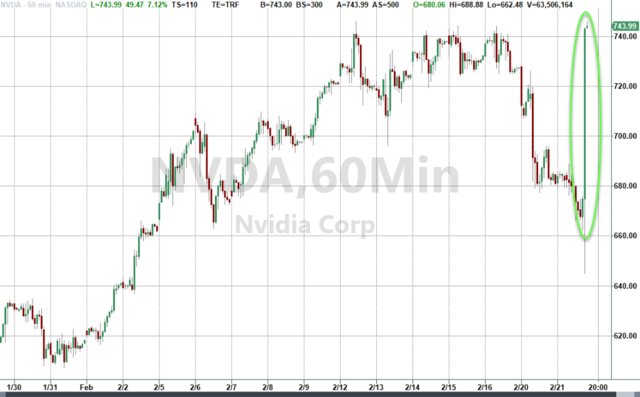
Nvidia’s stock dipped as much as 4% during Wednesday’s session but climbed up to 10% in after-hours trading following the earnings release. Fueled by surging demand for AI chips, the company’s shares have risen 36% this year alone, adding over $400 billion in market value to reach $1.67 trillion. As of February 20, over the past 30 trading days, Nvidia’s average daily trading volume was approximately $30 billion, surpassing electric vehicle maker Tesla (TSLA.O), which had an average daily trading volume of $22 billion during the same period.
Generative AI Reaches Inflection Point; Demand for Next-Gen Products Will Far Exceed Supply
“Accelerated computing and generative AI have reached an inflection point. Demand from companies, industries, and nations around the world is surging,” said Jensen Huang, founder and CEO of Nvidia. “Our data center platform is being driven by increasingly diverse factors—whether it’s data processing, training, and inference needs from large cloud service providers and dedicated GPU suppliers, or demand from enterprise software and consumer internet companies. Vertical industries such as automotive, financial services, and healthcare have now reached multibillion-dollar scales.”
Investors are closely watching Nvidia’s data center business, which includes its H100 GPUs widely used to power generative AI applications like OpenAI’s ChatGPT. These chips are currently in such high demand among major tech giants that supply cannot keep up.
Since OpenAI launched ChatGPT in November 2022, companies including Alphabet and Meta, as well as prominent startups like Anthropic and Cohere, have increasingly rolled out more powerful versions of large language models requiring massive computational power. Nvidia’s chips have become the backbone of the AI boom. It is estimated that Nvidia holds over 80% share of the AI computing market. Data shows Amazon, Meta, Microsoft, and Google are Nvidia’s biggest customers, collectively accounting for nearly 40% of its revenue, as these tech giants rush to invest in AI computing hardware.
“NVIDIA RTX, introduced less than six years ago, is now a massive PC platform used by 100 million gamers and creators for generative AI,” said Huang. “Over the coming year, we will deliver significant new product cycles and exceptional innovations to help advance our industry. Join us next month at GTC, where we and our rich ecosystem will unveil an exciting future.”
During the earnings call, CFO Colette Kress said demand for the company’s next-generation products greatly exceeds supply, as “building and deploying AI solutions has touched almost every industry.”
Huang added that overall supply conditions are improving but shortages persist, and supply constraints will continue throughout the year. He said demand for Nvidia’s GPUs will remain strong due to the shift toward generative AI and across-the-board industry demand moving from CPUs to accelerators made by Nvidia.
“Fundamentally, the conditions for sustained growth beyond 2025 are very favorable.”
However, some analysts expect TSMC, Nvidia’s key supplier, to improve its advanced packaging capacity in the first half of this year, allowing Nvidia to overcome supply bottlenecks and deliver more chips to customers.
“The Most Important Stock on Earth”—Still Facing Risks
Goldman Sachs’ trading desk referred to Nvidia as “the most important stock on earth” in a report published Tuesday. Options positioning suggests the stock could swing roughly 11% in either direction. Given Nvidia’s heavy weighting in major indices and concentrated long positions, the company has the potential to shake financial markets. Nvidia alone has contributed one-third of the Nasdaq 100 Index’s gains so far this year.
Currently, Nvidia is working hard to expand its AI technology beyond large data center operators. The 61-year-old Huang has embarked on a global campaign advocating that governments and enterprises need their own AI systems—for both data protection and competitive advantage.
Earlier this month, Nvidia announced a partnership with Cisco, creating a new distribution channel. Under the agreement, Cisco, the world’s largest networking equipment provider, will help Nvidia sell complete AI systems to enterprises.
But some investors worry such explosive growth cannot last forever. Media reports suggest Nvidia faces risks, including intensifying competition and some customers beginning to develop their own AI chips. AMD, Nvidia’s competitor, recently started selling a series of accelerators called MI300, with expected revenue of $3.5 billion this year—up from a previous estimate of $2 billion.
Yet Nvidia is not standing still. Analysts expect the company to soon launch even more powerful accelerators. And even amid rising competition, analysts estimate Nvidia still accounts for about 70% of total AI chip sales.
Many analysts believe Nvidia still has substantial room to grow. Some say Nvidia’s outlook remains positive because AI chip competition from Intel, AMD, Meta, and Microsoft may still take months to materialize, while demand for Nvidia’s chips continues to rise.
In addition, the company’s gaming business—including sales of graphics cards for laptops and PCs—grew only 56% year-over-year to $2.87 billion. Meanwhile, Nvidia’s smaller business segments did not show similarly explosive growth: automotive revenue declined 4% to $281 million, while its OEM and other segment—including cryptocurrency chips—rose 7% to $90 million. Revenue from professional visualization, which produces graphics hardware for specialized applications, jumped 105% to $463 million.
Join TechFlow official community to stay tuned
Telegram:https://t.me/TechFlowDaily
X (Twitter):https://x.com/TechFlowPost
X (Twitter) EN:https://x.com/BlockFlow_News












