








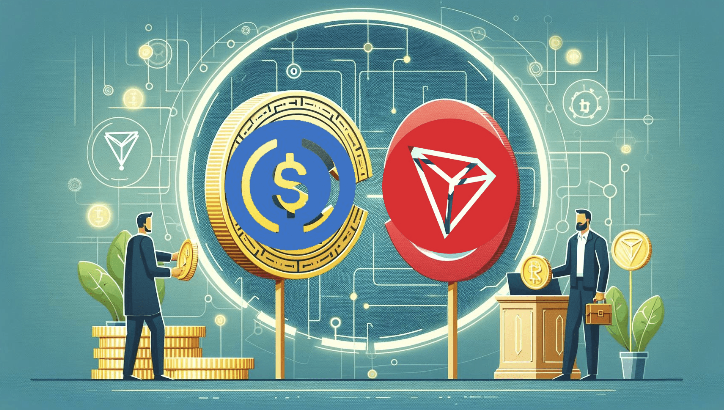
Why Circle's USDC Is Cutting Ties With TRON: A Move To Preserve Itself?
TechFlow Selected TechFlow Selected
Why Circle's USDC Is Cutting Ties With TRON: A Move To Preserve Itself?
The split between Circle and Tron may be the latest sign of a growing divide between regulated cryptocurrency firms and crypto transactions in black/gray markets.
 Navigating Web3 tides with focused insights
By Daniel Kuhn
Translated by Mary Liu, Bitpush News
You go your way, I'll go mine.
Circle clearly thinks TRON isn't "qualified" enough. On Wednesday, the mainstream stablecoin issuer announced it would immediately halt USDC minting on the Layer 1 blockchain Tron—a first step in a "phased transition." USDC aims to fully exit the network created by Justin Sun, who faces potential legal challenges in the United States.
In a statement, Circle said: "As part of our risk management framework, Circle continuously evaluates the suitability of all blockchains supporting USDC." It added that the decision followed enterprise-wide efforts to "ensure USDC remains trusted, transparent, and secure."
Given that Tron is known for its relatively low fees and fast settlement times—and has been one of the pillars of a booming stablecoin business—this move might surprise some in the community.
Since at least 2021, the amount of Tether (USDT) on Tron has exceeded that on Ethereum, driven by the popularity of using Tron-based USDT to transfer funds between exchanges and increasing adoption among users in emerging markets.
Circle hasn't revealed many details about its company-wide review, which likely involved compliance and corporate divisions. For example, it's unclear whether this is a reactive measure related to security concerns involving Tron or a preemptive move to avoid entanglement with Tron and its 33-year-old celebrity founder, Sun.
The split between Circle and Tron could be the latest sign of an expanding divide between regulated cryptocurrency firms (or at least those positioning themselves as compliance-friendly) and gray- or black-market crypto transactions. For instance, Binance, which is now under indictment by the U.S. Department of Justice, delisted USDC years ago without clear explanation.
The lines between white, gray, and black market uses are not entirely clear and constantly shifting. But such signs are not uncommon—examples include Coinbase and Kraken’s voluntary delisting of privacy coins, or the growing number of “know your customer” (KYC) requirements aimed at improving monitoring of cryptocurrency flows.
Justin Sun himself is a controversial figure. In March 2023, the U.S. Securities and Exchange Commission (SEC) accused him of securities fraud by allegedly fraudulently inflating TRON trading volume and misleading investors through undisclosed celebrity endorsements—allegations Sun dismissed as baseless. There’s also his brief tenure as Grenada’s ambassador to the World Trade Organization, which became tabloid fodder after high-profile publicity.
But the focus isn’t really on Tron—the move by Circle may reflect more about USDC’s strategy. Until last year, Circle’s stablecoin USDC was accelerating in growth and appeared poised to overtake its main rival, USDT. However, due to a combination of factors—including rising interest rates benefiting USDT more than USDC, and an unstable (though brief) depegging event in early 2023—Circle has consistently trailed behind.
Circle has long prided itself on being a more regulated, compliant, and transparent alternative to Tether, which has been shrouded in "conspiracy" since its inception. In January, Circle filed preliminary documents for a second attempt at an initial public offering (IPO), suggesting it is likely engaged in active dialogue with the SEC during the review process.
This isn’t the first time Circle has distanced itself from Tron, one of the 11 blockchain networks supporting USDC. In a letter last fall responding to allegations that USDC had been used for terrorist financing, Chief Strategy Officer Dante Disparte claimed Circle terminated Sun’s and his company’s accounts several months earlier—in February 2023.
It remains unclear why Circle cut ties with Sun at that time. However, Disparte’s statement was in response to a November 9 letter from the nonprofit ethics group Campaign for Accountability, which alleged Circle had extensive links with the Tron Foundation and the cross-chain protocol SunSwap, accusing them of facilitating money laundering. That same month, Reuters reported that Tron had replaced Bitcoin as the platform of choice for terrorist organizations.
Tron remains the preferred chain for USDT, with over $50 billion worth of USDT currently circulating on Tron. Even without USDC, the Tron blockchain won’t be significantly impacted.
More importantly, the steadily growing share of USDC in stablecoin transaction volume hasn’t dented Tether’s market dominance. While USDC’s circulation is under $30 billion, its rival’s market capitalization approaches $100 billion.
Ultimately, as long as most USDT remains on Tron, it will continue to play a central role in the stablecoin ecosystem.
Is Circle being overly cautious? Is it trying to distance itself from some of the more unsavory players in the crypto industry to protect its reputation? How well does the world really know Sun? Is this part of a broader realignment in the crypto space, where certain "regulation-forward" organizations align closely, regardless of fairness or logic?
After all, convicted fraudster Sam Bankman-Fried (SBF) taught us a lesson—pretending to care about compliance while deceiving the world. And Circle’s cost of cutting ties is manageable: only $335 million of the $28 billion USDC currently in circulation is on the Tron network.
Join TechFlow official community to stay tuned
Telegram:https://t.me/TechFlowDaily
X (Twitter):https://x.com/TechFlowPost
X (Twitter) EN:https://x.com/BlockFlow_News
 CoinDesk











