









From the team's community interactions, uncovering clues about the zkSync airdrop
TechFlow Selected TechFlow Selected
From the team's community interactions, uncovering clues about the zkSync airdrop
How should we view witchcraft behavior? Whose design is worth emulating? Is equal sharing better or detailed accounting better...
 Navigating Web3 tides with focused insights
Author: Azuma, Odaily Planet Daily
Starknet's airdrop plan has once again ignited community enthusiasm surrounding expectations for top-tier Layer 2 airdrops. With Starknet’s “shoe dropping,” attention has naturally shifted toward other Layer 2 projects that have yet to confirm their airdrop plans. Among them, zkSync—an established zk-Rollup network once hailed alongside Arbitrum, Optimism, and Starknet as one of the "Four Greats"—is undoubtedly at the center of community focus.
In the days following Starknet’s official airdrop announcement, several zkSync team members unusually became active on social media, frequently discussing potential airdrop designs. Participants even included Sebastien, a key figure responsible for DeFi initiatives within the zkSync team.
While these individual discussions do not represent the collective stance of the entire zkSync team, they nonetheless offer us a window into zkSync’s potential airdrop approach.
On February 16, frogmonkee—whose LinkedIn profile identifies them as a member of the zkSync team—published a lengthy post on X summarizing observations of community sentiment (both positive and negative) in the days following Starknet’s airdrop. The community comments highlighted by frogmonkee include: Starknet did well in rewarding stakers and developers, but its eligibility and allocation design remain debatable; the community truly loved Arbitrum’s airdrop but disliked Paraswap’s (which, like Starknet, imposed minimum balance requirements); poor anti-Sybil measures could result in “throwing the baby out with the bathwater”; projects need better PR skills and clearer communication with the community…
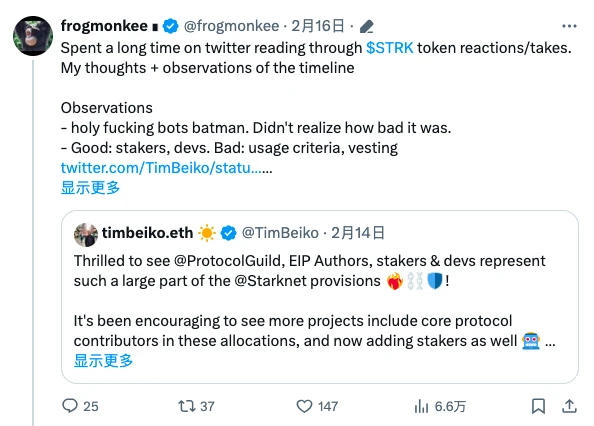
After frogmonkee’s post, Sebastien shared it and promptly launched multiple community polls on X to gather feedback.
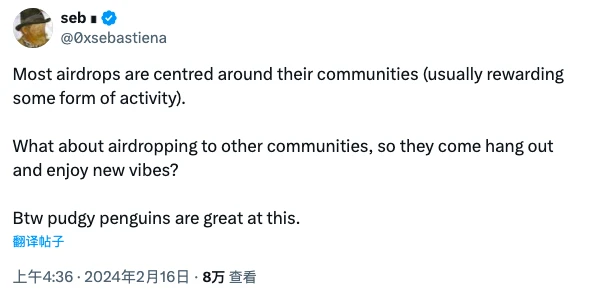
On February 16, Sebastien asked on X what would happen if airdrop tokens were distributed beyond one’s own community to attract fresh participants?
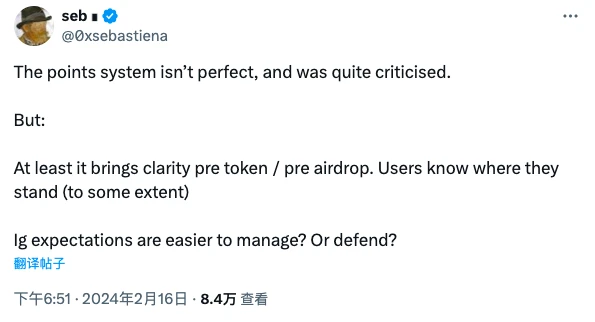
On the same day, Sebastien also commented that points-based airdrops are imperfect and have drawn criticism, but at least they provide users with some clarity and help manage expectations.
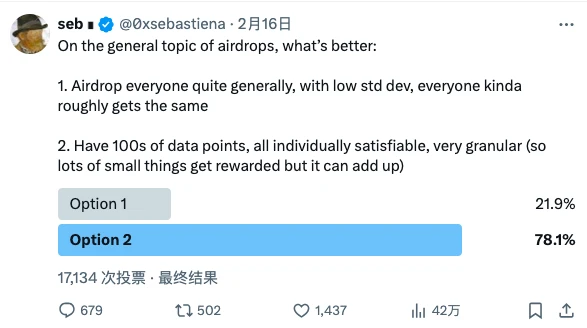
Subsequently, Sebastien launched a poll asking whether the community prefers an “equal-split airdrop” (low thresholds, roughly equal allocations for everyone) or a “fine-grained airdrop” (involving hundreds of detailed criteria, each checked and cumulatively weighted, leading to potentially large differences in individual allocations). Ultimately, 78.1% of respondents favored the “fine-grained airdrop.”
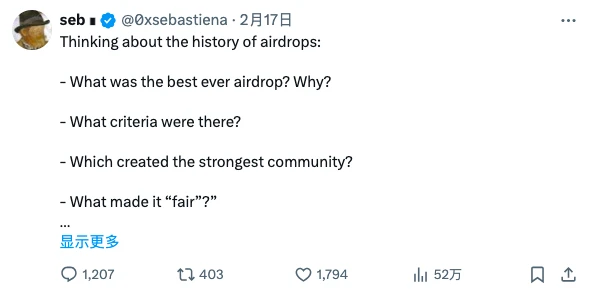
On February 17, Sebastien posted several more questions, soliciting community opinions on what constitutes the “best airdrop” and what qualifies as “fairness.”
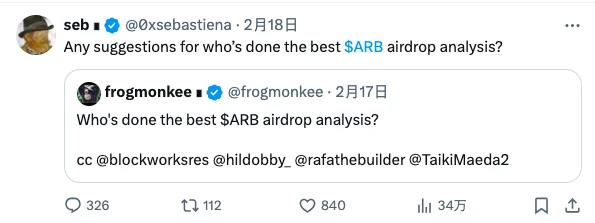
Given how often Arbitrum’s airdrop design was referenced, both frogmonkee and Sebastien later specifically asked the community to share high-quality analyses of Arbitrum’s airdrop.
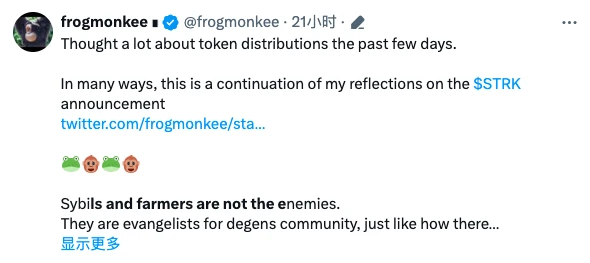
On February 19, frogmonkee published another summary article. He emphasized that “Sybils” and “farmers” (users mining rewards) are not enemies—they are community evangelists who bring liquidity, provide usage feedback, and generate organic promotion. The community favors simple, reasonable, and inclusive airdrop criteria. Arbitrum’s airdrop is remembered because it flexibly adjusted allocations based on time, frequency, and volume.
frogmonkee also noted that designing “hundreds” of granular criteria—as mentioned by Sebastien—might be excessive. He personally prefers using simple criteria to determine base allocations, then applying multipliers based on refined metrics. For addresses suspected of being Sybils, he suggested reducing allocations via multipliers rather than outright disqualification, avoiding widespread false positives.
Taking together the statements from Sebastien and frogmonkee, we can reasonably infer that zkSync’s airdrop criteria are still under development. The team may be seeking a fairer design to avoid the backlash experienced by Starknet, where many legitimate users felt unfairly excluded.
Notably, given how frequently Arbitrum’s airdrop design was brought up in community discussions, it’s possible zkSync might take inspiration from it—adjusting allocations based on multiple nuanced criteria, which could widen the gap between “minimum-effort accounts” and “high-engagement accounts.”
Finally, it must be emphasized that the above analysis is based solely on interpretations of statements made by Sebastien and frogmonkee. Their views do not necessarily reflect the official position of the entire zkSync team, and the final decision will be announced through official channels.
Join TechFlow official community to stay tuned
Telegram:https://t.me/TechFlowDaily
X (Twitter):https://x.com/TechFlowPost
X (Twitter) EN:https://x.com/BlockFlow_News
 Odaily











