








Rollup: The Cornerstone of Mass Adoption for DePIN Utilities?
TechFlow Selected TechFlow Selected
Rollup: The Cornerstone of Mass Adoption for DePIN Utilities?
Modular blockchain technology, particularly the Rollup solution, effectively addresses blockchain scalability challenges, paving the way for widespread adoption of DePIN projects.
 Navigating Web3 tides with focused insights
Author: Arkreen
Translation: Baihua Blockchain
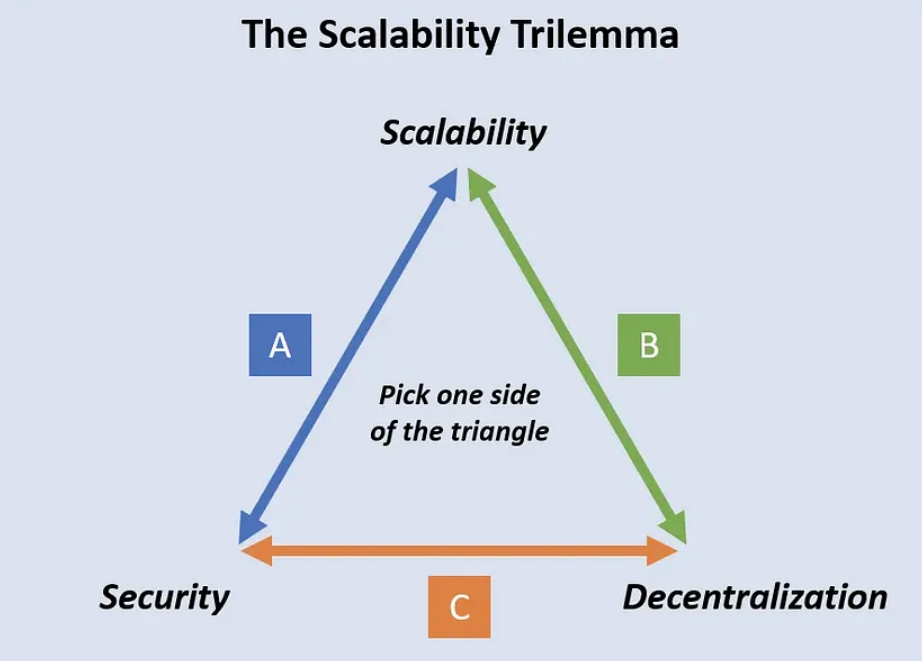
Bitcoin successfully addressed the challenge of achieving consensus in decentralized systems through innovations in blockchain technology. Subsequently, engineers began tackling the complex task of enhancing scalability—a formidable challenge due to the inherent trade-off among scalability, security, and decentralization, commonly known as the blockchain trilemma. The scalability dilemma has proven to be a major obstacle hindering widespread blockchain adoption. Striking a balance between ensuring security and decentralization—both critical for blockchain integrity—remains an ongoing challenge. Failure to maintain this delicate equilibrium risks transforming blockchains into systems resembling centralized architectures. Additionally, low scalability increases the cost of using blockchain networks. Consequently, despite its potential, large-scale blockchain adoption has been constrained in recent years.
1. What is Modular Blockchain?
In recent years, engineers have been working to overcome the challenges posed by the blockchain trilemma, and a viable solution has now emerged: modular blockchains. This innovative approach involves dividing the blockchain into distinct modules and layers, with each layer specializing in handling specific functions. Typically, security and decentralization are prioritized at Layer 1 (L1), while scalability is addressed at Layer 2 (L2).
Conceptually, L1 and L2 can be viewed as interconnected yet separate blockchains. L1 ensures the security and decentralization of L2, with node states ultimately settled on L1. L1 primarily executes transactions and stores state data, essentially serving as the backbone. Notably, even if all L2 nodes go offline, the community can recover the L2 network using information stored on L1, thereby enhancing the resilience of this modular blockchain architecture.
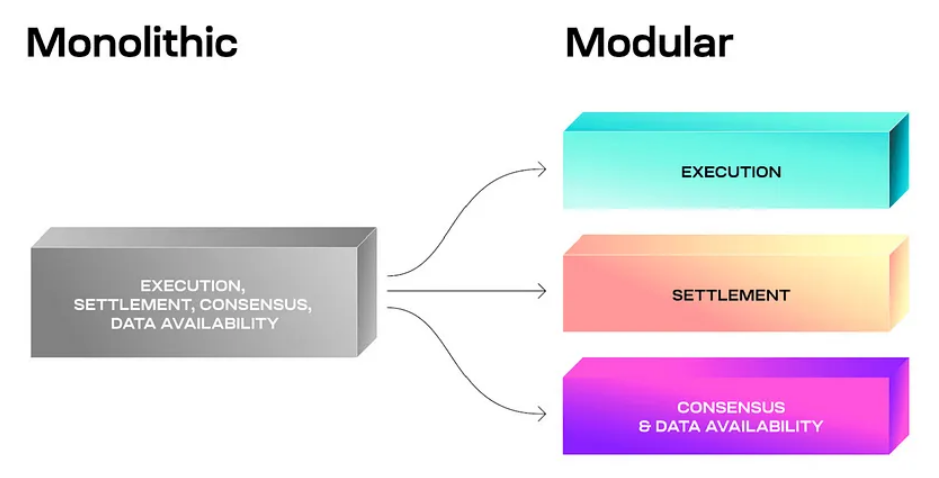
In a typical modular blockchain, key modules drive functionality:
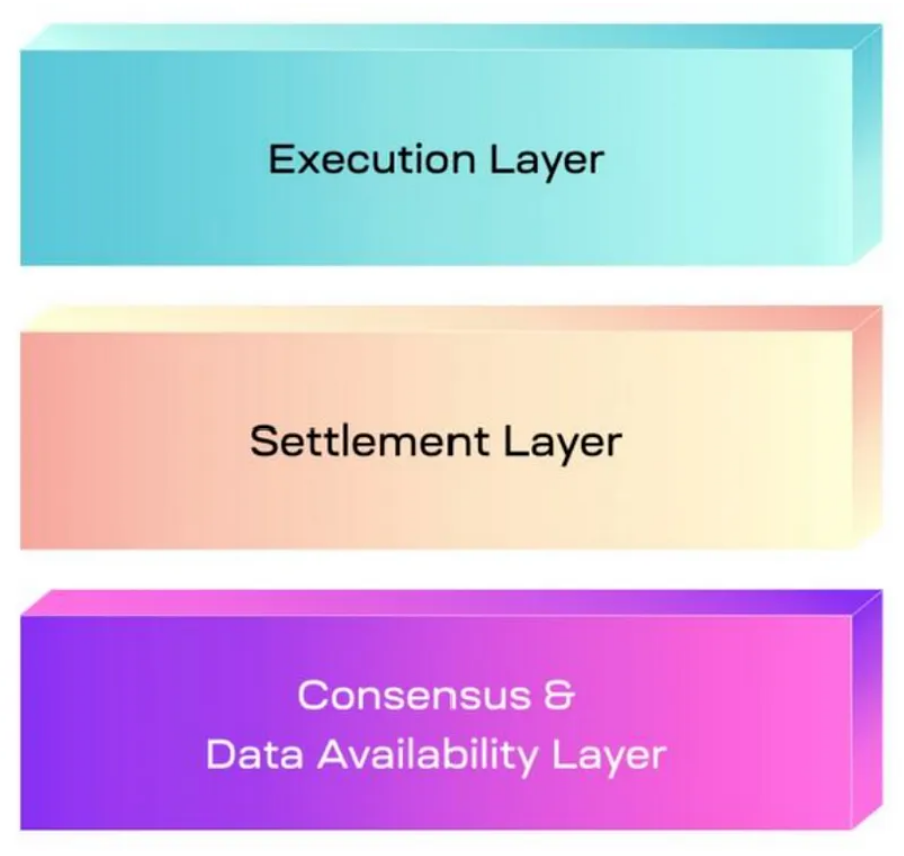
1) Consensus: This module is crucial as it determines which transactions are included in the blockchain and establishes their order.
2) Execution: Responsible for executing transactions and obtaining the resulting state.
3) Settlement: Determines the consensus state. This module intervenes when state disagreements occur, facilitating resolution.
4) Data Availability (DA): Ensures broad community access to transaction history. This module is vital for settlement procedures and blockchain recovery.
2. What is Layer 2 (L2), and Why Does Ethereum Need It?
Layer 2 (L2) is a concept in blockchain technology referring to protocols and solutions built atop a primary blockchain (typically Layer 1, or L1) to improve scalability and efficiency. As one of the leading blockchain platforms, Ethereum requires Layer 2 solutions to address its limitations in scalability and high transaction fees.
Here’s why Ethereum needs Layer 2:
1) Task One: Clarifying Transaction Details and Order
As the Ethereum network grows, increased transaction volume leads to congestion and higher fees. Layer 2 solutions alleviate this issue by processing transactions off the main Ethereum chain. These transactions are then batched and periodically settled on the main chain, reducing congestion and gas fees while maintaining security.
2) Task Two: Communicating the Latest State After Transaction Execution, and Whether There Is a Method to Verify Its Accuracy
After transactions are executed on Layer 2, Ethereum needs a mechanism to relay the latest state back to the main chain (Layer 1). This typically involves using cryptographic proofs or commitments to ensure that state transitions are valid and verifiable. Verification mechanisms such as fraud proofs or zk-rollups help confirm transaction accuracy without compromising security.
3) Task Three: Whether There Is a Designated Mechanism to Facilitate Cross-Chain Calls
To enable seamless interaction between Ethereum and other blockchains or Layer 2 solutions, a designated mechanism is needed to facilitate cross-chain calls. Interoperability protocols such as bridges or cross-chain communication standards allow assets and data to flow securely and efficiently across different chains, expanding Ethereum's capabilities and ecosystem.
In summary, Layer 2 solutions are essential for Ethereum to address scalability challenges, increase transaction throughput, reduce fees, and maintain interoperability and security with other blockchains.
3. Exploring How Rollups Complete These Three Tasks
Rollups are referred to as L2; let’s examine how they operate to complete the three tasks above.
1) Task One: Data Availability (DA)
First, the process begins by sending a specified amount of ETH to the Layer-2 (L2) network to pay gas fees. This step is performed via an L1→L2 bridge and is called a "deposit." Typically, the L2 network also runs L1 nodes; it simply waits for final confirmation of the L1 block containing the deposit transaction. Once confirmed, the deposit is securely recorded.
Next, a transaction is sent to the L2 sequencer. The L2 sequencer node efficiently manages these transactions. Think of it as a standard blockchain process: the sequencer builds blocks containing transactions, executes them, and maintains the latest state of the chain. Usually, every two minutes or once enough transactions are collected, the L2 sequencer compresses the transactions and securely submits them to the L1 chain. This strategic approach ensures L1 has full visibility into L2 transactions and their exact order. After completing Task One, we refer to the entire process as "Data Availability (DA)."
2) Task Two: Optimistic (OP) and Zero-Knowledge (ZK) Rollups
Now, both L1 and L2 nodes can observe the transactions executed by the L2 sequencer. These transactions are significantly compressed and stored only in calldata, resulting in minimal gas costs. Other L2 nodes prefer to obtain DA (data availability) data from L1 as a trusted source rather than relying solely on the L2 peer-to-peer network, although they do receive blocks from L2 (without fully trusting them). Typically, for example hourly, the L2 sequencer node submits the Merkle root of the L2 state to the L1 Rollup contract. This operation ensures synchronization between L1 and the latest L2 state. However, at this point, L1 does not automatically trust this information. L2 employs two approaches—OP and ZK—to convince L1 of its accuracy—details of which will be discussed shortly. Upon completion of Task Two, let’s celebrate!
3) Task Three: Withdrawing from Layer 2
Once you’ve completed activities on L2 and decide to withdraw your ETH back to L1, this process is called a "withdrawal." While it may resemble cross-chain operations in other contexts, the key difference lies in the origin: withdrawals originate from L2, resulting in distinct security considerations compared to other cross-chain operations. On the L1 side, withdrawal operations must be handled with care. Since they originate from an external world outside L1, initiating this action triggers an L1 transaction (e.g., transferring tokens). If this transaction is executed incorrectly, it could lead to unintended changes in the L1 state.
The withdrawal process includes the following steps:
1) Initiate a withdrawal transaction on L2, similar to other cross-chain scenarios.
2) Wait for the transaction to be rolled up to L1, covering both data availability (DA) and state. Use either OP or ZK methods to verify the accuracy of the state.
3) Execute the withdrawal transaction on L1, similar to other cross-chain scenarios.
4. OP and ZK Rollups
Let’s delve deeper into OP and ZK to understand how L2 ensures the accuracy of the state submitted to L1—an essential foundation for Rollup security.
OP stands for Optimistic. L1 optimistically assumes that the L2 sequencer node is honest but does not blindly trust it. Instead, it opens a challenge window, typically lasting seven days. During this period, any L2 node can challenge the correctness of the claimed state root. The disputed transaction is then replayed on L1 to determine which party—the sequencer or challenger—is correct. A successful challenge results in penalties for the sequencer node, and the challenger receives the sequencer’s staked funds on L1. The state is adjusted based on the correct value, though note that only the state root is modified—not the transaction list itself.
In a typical setup, operators of L2 dApps run their own L2 nodes, opening opportunities for potential challengers. From a challenger’s perspective, if the sequencer provides inaccurate information, a successful challenge could yield significant rewards from the sequencer’s stake on L1. Therefore, challenging incorrect states is crucial. Conversely, from the sequencer’s standpoint, submitting an incorrect state root inevitably invites challenges, resulting in penalties, loss of staked funds on L1, and reversion of the incorrect state root. This mechanism discourages submission of inaccurate state roots and ensures the secure operation of optimistic rollups.
However, OP solutions have a drawback: the 7-day challenge window. This means that if you plan to withdraw tokens to L1 via the official OP bridge, you must wait seven days after initiating the withdrawal on L2. Nevertheless, users withdrawing fungible tokens (e.g., ERC20 tokens) can use third-party dApps to accelerate the process at minimal cost.
On the other hand, ZK (Zero-Knowledge) relies on a cryptographic technique called zero-knowledge proofs. The sequencer node runs zk-EVM on L2 and generates a ZK proof verifying the transition of the L2 state from pre-state to post-state after applying a set of transactions. This proof can be verified within an L1 contract, allowing L1 to trust the correctness of the state transition. Generating a ZK proof can be computationally intensive and may take several hours. However, the verification process is simple, involving only a straightforward transaction on the EVM. Compared to OP, ZK-based withdrawals typically involve delays measured in hours, offering a more efficient alternative. Moreover, with more powerful hardware, this delay can be further reduced.
A close examination of OP and ZK reveals that both enable L1 scalability by requiring trust only in L1 transactions, eliminating the need to trust anything within L2. When considering a Rollup system composed of L1 and L2, security and decentralization align closely with L1, while scalability extends through the combined potential of L1 and L2. Rolling multiple L2s onto the same L1 significantly enhances scalability.
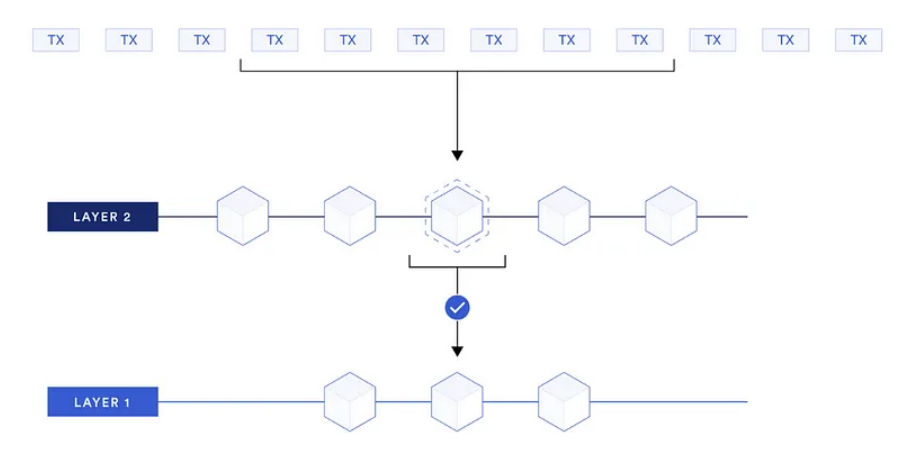
ZK-Rollups bundle transactions into batches, Chainlink
5. Paving the Way for Mass Adoption: The Role of Rollups in DePIN Utility
Typically, leveraging Rollups allows Ethereum to achieve thousands of TPS. However, the current bottleneck lies in data availability (DA). Although L2 transactions are effectively compressed before being submitted to L1, rising transaction volumes still lead to increasing gas costs. An alternative approach involves submitting transactions to third-party decentralized storage services, enabling substantial gas savings within L1 blocks. Combined with other solutions, this may offer near-infinite scalability. However, this comes with trade-offs, as the impact of third-party decentralized storage services on system security must be carefully considered. In conclusion, blockchains can achieve tremendous scalability while maintaining security and decentralization. The blockchain trilemma has been solved. This breakthrough unlocks the potential for mass adoption. Thus, Rollups represent a key milestone toward the widespread utility of DePIN.
DePIN, or Decentralized Physical Infrastructure Networks, leverages blockchain-based rewards to incentivize the development of physical infrastructure networks. Take Arkreen as an example: it uses blockchain rewards to motivate individuals to contribute to building clean energy networks. In this case, miners install solar systems, collect power generation data, and submit it to the Arkreen network. The Arkreen network identifies and filters honest and valuable data, rewarding miners with tokens accordingly. Operating in a decentralized manner, Arkreen currently has over 12,000 miners and is expected to grow to millions in the near future. Therefore, it requires a highly scalable blockchain infrastructure to support this vast miner base. In the past, achieving such scalability was technically and economically challenging. However, with the enhanced scalability introduced by modular blockchains like Rollups, this becomes feasible.
Imagine DePIN projects built on modular blockchains (such as Rollups) achieving high scalability at minimal cost, while still benefiting from the security and decentralization of underlying blockchains like Ethereum. Tokens issued by DePIN projects, known as RWA (Real World Assets), derive their value from tangible real-world assets. These assets, with on-chain liquidity, generate funding for miners, incentivizing their contributions to the growth of the DePIN network, thus creating a virtuous cycle of value. Multiple DePIN projects can collaborate in the real world and form a DePIN ecosystem on-chain, further amplifying overall value. Such collaboration enables blockchain to serve the real-world economy, driving new growth in the blockchain sector.
6. Conclusion
Modular blockchains (such as Rollups) effectively solve the blockchain trilemma, delivering enhanced scalability and paving the way for widespread adoption. Within the context of DePIN projects, the demand for high-performance, cost-effective blockchain services finds an ideal match in modular blockchains. Supported by modular blockchain infrastructure, DePIN projects are poised to realize significant value.
Join TechFlow official community to stay tuned
Telegram:https://t.me/TechFlowDaily
X (Twitter):https://x.com/TechFlowPost
X (Twitter) EN:https://x.com/BlockFlow_News
 @arkreen_network











