








Polkadot 2024 Outlook: Technical Iteration and Governance Model Analysis
TechFlow Selected TechFlow Selected
Polkadot 2024 Outlook: Technical Iteration and Governance Model Analysis
A Deep Dive into Polkadot's Decentralized Upgrade Journey
 Navigating Web3 tides with focused insights
Author: Coin Bureau
Translation: OneBlock+
When Polkadot's initial development and proof-of-concept (PoC) design first emerged in 2016, the project attracted little attention from crypto enthusiasts or institutional investors. Since then, however, it has proven to be a project worth watching. From 2016 onward, Polkadot has built an incredibly credible ecosystem of top developers, architects, and project leaders, designed a sophisticated roadmap for the future, and achieved exponential growth in its ecosystem, successfully becoming one of the top ten most valuable cryptocurrencies by 2021. A 2021 report from CoinShares highlighted that Polkadot is among the most attractive cryptocurrency assets for institutional investors.
In 2021, the Polkadot community and ecosystem looked very promising. However, by 2022–2023, the crypto industry plunged into an unprecedented winter, experiencing what proved to be one of the harshest bear markets in crypto history.
Yet, like many blockchain projects, Polkadot’s builders and contributor DAO remained humble and continued building during the bear market, achieving several exciting developments. Polkadot demonstrated remarkable resilience amid adversity, showing that the project is ready to continue the momentum it displayed before this crypto winter.
The community has thrown around slogans attempting to describe what Polkadot aims to achieve—such as “mother of blockchains,” “ultimate layer zero,” and of course, “Ethereum killer.” Some of these characterizations are more accurate than others, and even Polkadot’s founder insists that Polkadot is not a competitor to Ethereum. As we will dissect in this article, we believe Polkadot is not seeking to compete with Ethereum, yet this does not prevent it from potentially transforming the blockchain world forever.
History of Polkadot
Polkadot's history begins with Ethereum, specifically through the contributions of Dr. Gavin Wood (Ph.D. in software engineering), one of Ethereum’s co-founders. Dr. Gavin Wood has over 20 years of experience as a software developer both inside and outside the crypto industry.

Dr. Gavin Wood, co-founder of Polkadot and Ethereum, image via Parity
Gavin Wood wrote the first functional implementation of Ethereum and even authored the Ethereum Yellow Paper. Dr. Gavin Wood is perhaps best known for creating Solidity, the programming language used to build smart contracts on Ethereum.
In January 2016, Gavin Wood stepped down from his role as Chief Technology Officer and core developer at Ethereum, primarily due to disappointment over Ethereum 2.0 stalling in development.
In the second half of 2016, Wood developed a new cryptocurrency that would “deliver on promises Ethereum could not fulfill.” The first draft of the Polkadot whitepaper was completed by the end of 2016.
Key milestones in Polkadot’s ecosystem development:
-
Whitepaper and Initial Concept (2016): The Polkadot whitepaper was released by Gavin Wood in 2016, outlining a novel multi-chain framework.
-
Launch of Web3 Foundation (2017): The Web3 Foundation was established to promote fully functional and user-friendly decentralized networks. It played a key role in funding and guiding Polkadot’s development.
-
ICO and Fundraising (2017): Polkadot’s 2017 initial coin offering (ICO) was one of the most successful at the time, raising over $140 million. However, a significant portion of funds was frozen due to a Parity wallet vulnerability.
-
Development Milestones (2018–2019): Polkadot underwent various stages of testing and development, launching the experimental canary network—Kusama.
-
Mainnet Launch (2020): The Polkadot mainnet launched in 2020 with limited functionality in its first phase. Subsequent phases introduced full features, including governance, staking, and bonding capabilities.
-
Parachain Rollout and Auctions (2021–2022): The introduction of parachains—a key feature of Polkadot—began with slot auctions, marking a major step toward realizing Polkadot’s multi-chain architecture.
-
Web3 Foundation Announces DOT Token Is Not a Security (2022): After years of discussions with the SEC, Polkadot declared DOT as software, not a security.
-
Polkadot 2.0 (2023): A major technical upgrade marked the end of fixed-term parachain slot auctions—one of the most important events in the crypto space—enabling a more dynamic parachain market.
-
Cardano Announces Adoption of Polkadot Technology (2023): At the 2023 Cardano Summit, Hoskinson announced that Cardano would use the Polkadot SDK for its partner chains.
Other Founders:
In addition to Gavin Wood, the central figure behind Polkadot’s development and co-founder of Ethereum, the Polkadot founding team includes several other notable individuals:
-
Robert Habermeier: A significant contributor to the Rust and blockchain communities, actively involved in the technical development and conceptualization of Polkadot.
-
Peter Czaban: Former Technical Director of the Web3 Foundation, playing a crucial role in guiding the foundation’s mission and overseeing the technical development of Polkadot.
These founders brought unique technical strengths and visions to the project, contributing to Polkadot’s evolution into a scalable, interoperable, and secure multi-chain ecosystem. Their efforts have been instrumental in driving Polkadot’s sustained development within the blockchain space.
DOT Token ICO and Funding Rounds
The initial token sale of Polkadot’s DOT utility token remains etched in the memories of many veterans in the crypto asset space—and certainly for the Polkadot team as well. The DOT ICO took place in October 2017, raising over $145 million on Ethereum.
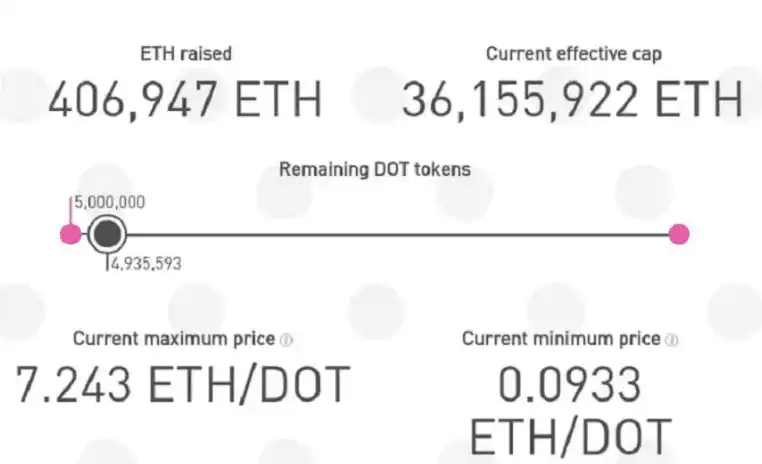
Screenshot from Polkadot ICO, image via Trustnodes
The initial supply of DOT was 10 million, with half sold in two rounds at an initial price of $28.80 to public and private investors (2.25 million and 2.75 million respectively).
However, in August 2020, following a community vote, DOT underwent a redenomination, effectively increasing the number of DOT tokens held by each holder by a factor of 100. This re-denomination resulted in the actual ICO price being adjusted to $0.29.
Shortly after the ICO price adjustment, over $90 million raised was permanently frozen due to an exploited vulnerability in the Polkadot multisig wallet code. A week after the incident, the Polkadot team confirmed that despite the freeze, sufficient funds remained to develop Polkadot. Despite recovery efforts, over 500,000 ETH remained locked.

The first Polkadot wallet hack, image via Steemit
The ICO collapse marked the second time the team’s wallet was hacked due to a code vulnerability. The first hack occurred in July 2017, when over $33 million in Ethereum was stolen prior to the attack. In both incidents, the Polkadot team released follow-up documentation detailing the hacks and how to prevent recurrence.
In January 2019, Polkadot conducted a second private fundraising round to compensate for the lost (frozen) funds from the DOT ICO, selling 500,000 DOT and raising over $60 million.
In July 2020, a third private fundraising round sold fewer than 350,000 DOT tokens, raising another $43 million; in 2022, they raised an additional $4 million.
According to Crunchbase and Cryptorank data, Polkadot has conducted a total of 12 funding rounds, raising $327,130,000, while Alpha Growth reports that Polkadot has raised $665,400,000.
What Is Polkadot?
Polkadot is a blockchain project aimed at powering the decentralized future of the internet (Web3). Polkadot is often referred to as a Layer 0 blockchain, contrasting with Layer 1 networks such as Bitcoin, Ethereum, and Solana, and Layer 2 solutions such as Arbitrum, Lightning Network, and Optimism. Here’s some technical background:
-
Layer 0 provides shared security and interoperability—Polkadot is the only Layer 0 that offers full shared security across its entire ecosystem.
-
Layer 1 refers to application-focused chains, such as Bitcoin, Ethereum, Solana, and other mainnets.
-
Layer 2 typically refers to scalability solutions built on top of Layer 1, notable examples being Arbitrum and Optimism for Ethereum, and the Lightning Network for Bitcoin.
Polkadot’s core utility is to serve as a secure and sustainable foundation for general-purpose computing. In short, Polkadot provides shared security and interoperability, enabling multiple interoperable blockchains to run in parallel. The term “Layer 0” refers to the deliberate limitation of Polkadot’s main chain (the relay chain) to providing security and finality to Layer 1 chains, which in turn host applications such as smart contracts. I’ve heard people describe Polkadot as a massive shopping mall, providing space and security for different stores, allowing them to be close together and easily communicate within the same building.
A common misconception is that Polkadot can directly connect multiple networks such as Bitcoin and Ethereum—which is slightly inaccurate. Polkadot achieves interoperability by using bridges that can be built on parachains. Rather than connecting independent blockchain networks directly, Polkadot connects parachains, providing them with necessary infrastructure so they can focus on applicability and utility.
The parachain system may serve as a utility enabling interoperability with other networks, expected to grow over time. A practical example already in existence is the Moonbeam network—a parachain compatible with the EVM that supports cross-chain interoperability with Ethereum, allowing developers to build DApps and NFTs on Moonbeam. Another example is Snowbridge: an Ethereum-Polkadot bridge parachain enabling interoperability between the two networks.
How the Polkadot network and parachains achieve interoperability, image via Twitter
Polkadot parachains allow for the creation of smart contracts, and the relay chain supports new blockchains (and tokens), enabling blockchains to exchange information. Notably, Polkadot can upgrade without hard forks—the protocol is governed by holders of Polkadot’s native cryptocurrency, DOT. Upgrading to Polkadot 2.0 may introduce entirely new smart contract capabilities on the relay chain.
Polkadot is a project of the Web3 Foundation, a non-profit organization based in Zug, Switzerland’s “Crypto Valley,” which commissioned UK-based Parity Technologies to develop and maintain the initial implementation of the Polkadot network, which is now maintained by Polkadot’s on-chain governance system.
Gavin Wood is a co-founder of both the Web3 Foundation and Parity Technologies, and remains Polkadot’s chief architect, working alongside hundreds of developers. Polkadot is built using Substrate, a blockchain-building toolkit developed by Parity Technologies.
How Does Polkadot Work?
Polkadot is undoubtedly one of the most technologically advanced blockchains in existence today. We aim to explain blockchain and cryptocurrency concepts in plain language, distilling complex blockchain stacks for our readers.
The Polkadot whitepaper describes the Polkadot network as a scalable heterogeneous multi-chain. In contrast, Layer 1 blockchains like Bitcoin and Ethereum are designed to perform all blockchain functions under a single layer.
These functions are primarily divided into three categories:
-
Data Availability: Blockchain networks maintain a distributed ledger storing records of all transactions or data entries. Data availability refers to the concept that this ledger should be accessible to all participants in the network. On public chains, anyone can join the network, download a copy of the entire blockchain, and verify transactions. This ensures transparency and trust in the system, as participants can independently verify the existence and integrity of data.
-
Consensus: Consensus mechanisms are protocols that enable blockchain participants to agree on the validity of transactions and their order of inclusion in the blockchain. Consensus is critical for preventing double-spending and maintaining the integrity of the blockchain. Common consensus mechanisms include Proof of Work (PoW), Proof of Stake (PoS), and others, differing in how agreement is reached among participants.
-
Execution: Execution refers to the process of validating and executing smart contracts or transactions on the blockchain. Smart contracts are self-executing agreements with terms directly written into code. When conditions specified in the smart contract are met, the code automatically executes the terms without intermediaries. Smart contract execution is a key feature of many blockchain platforms, such as Ethereum.
These three functions work together to create a secure, decentralized, and tamper-proof system where data can be recorded, transactions agreed upon, and smart contracts executed automatically. Traditional blockchain networks like Ethereum use a single global blockchain network to handle all three core tasks within a monolithic framework—this is the root cause of their scalability issues, stemming from network nodes becoming bogged down by processing all functions themselves.
Polkadot is a heterogeneous multi-chain that abstracts these functions into two separate layers: the relay chain and parachains:
-
Parachains are several Layer 1 networks running in parallel within the Polkadot network. Smart contract or transaction execution is also handled by individual parachains. Each parachain can have its own set of rules, logic, and execution environment, allowing flexibility and innovation at the parachain level. Parachains can implement their own consensus mechanisms and execution environments—for example, an Ethereum-compatible environment for executing smart contracts. Unlike Ethereum Layer 1, parachains do not bear the burden of consensus, allowing them to achieve the desired scalability. All parachains share essential block data with the Polkadot mainnet (the relay chain) to achieve consensus and inherit its security and finality.
-
The relay chain forms the backbone of the Polkadot network. It is responsible for achieving consensus among parachains and ensuring the overall network’s security and validity. Polkadot uses a unique consensus mechanism called Nominated Proof of Stake (NPoS) to achieve this; validators on the relay chain generate blocks and secure the network by staking DOT tokens.
Data availability for individual parachains is primarily the responsibility of the parachains themselves—each parachain has its own set of validators and maintains its own data and state. The relay chain indirectly ensures data availability by coordinating the network and providing security, but specific data availability for each parachain is managed within that parachain’s network.
Polkadot Architecture
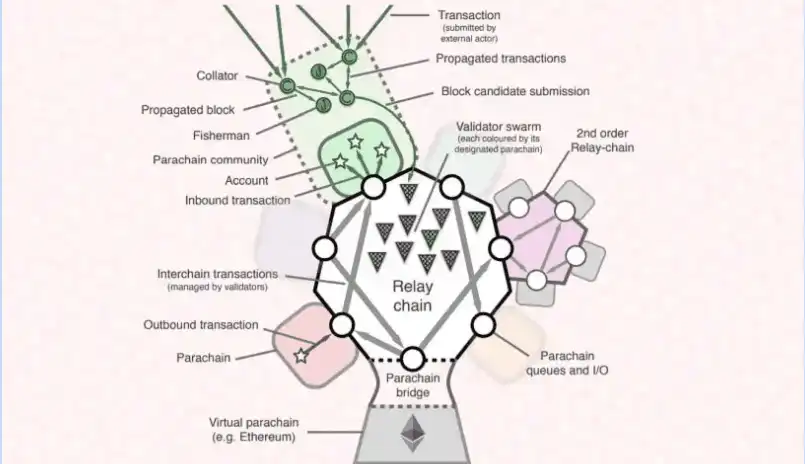
Polkadot architecture, image source: substrate.stackexchange
The Polkadot network consists of the following three roles:
Validators
Validators are full nodes of the Polkadot relay chain that participate in its consensus process to protect the Polkadot network, including parachains. Note that parachains focus solely on execution and rely on the relay chain to achieve consensus and finality—they accomplish this with the help of validators.
Each parachain is assigned a subgroup of validators. These subgroups accept parachain blocks and perform necessary validity checks to ensure the blocks are constructed according to the parachain’s consensus rules. Once all new parachain blocks are accurately validated, validators include them in relay chain blocks. Validators then need to validate the relay chain block itself—they do so by processing all transactions on the relay chain and including the finalized changes from the parachain blocks.
The number of DOT required to become a validator depends on network participation and may change over time. This depends not only on the amount of stake each validator commits but also on the size of the active validator set and the number of validators waiting in the queue. Additionally, the validator list changes with each data update—every 24 hours.

Staked validators on Polkadot.js, image via Js.org
Polkadot started with 20 open validator slots and gradually increased availability. The ultimate upper limit on validator count has not been determined—it should only be constrained by network bandwidth pressure caused by peer-to-peer messaging—but Polkadot’s end goal is to have 1,000 validators verifying transactions on its network.
When validators on the relay chain generate new blocks containing parachain transactions, 20% of the block reward is distributed among validators based on the number of “points” they accumulate. Validators are responsible for more infrastructure-oriented tasks for network maintenance. The more tasks they perform, the more points they earn.
Nominators
Nominators are network participants who delegate DOT to validators to participate in Polkadot’s consensus. Aside from committing risk capital to signal their trust that a specific validator will honestly build the Polkadot network, they have no other role.
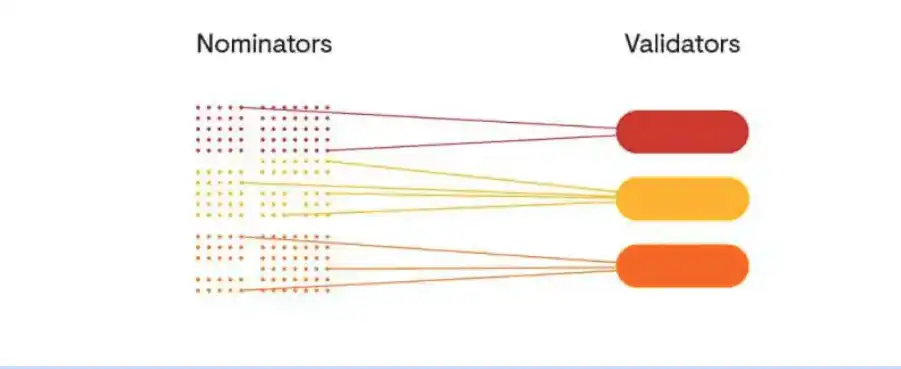
Relationship between nominators and validators, image via Polkadot
Collators
Collators assist validators in reaching consensus by constructing parachain blocks. Collators maintain full nodes of a specific parachain and the relay chain. As full nodes of the parachain, they retain all necessary information—such as transaction data, signatures, and state transitions—to build parachain blocks. They compile and execute parachain transactions to create blocks, then provide these blocks along with zero-knowledge proofs of transaction validity to one or more proposing validators.
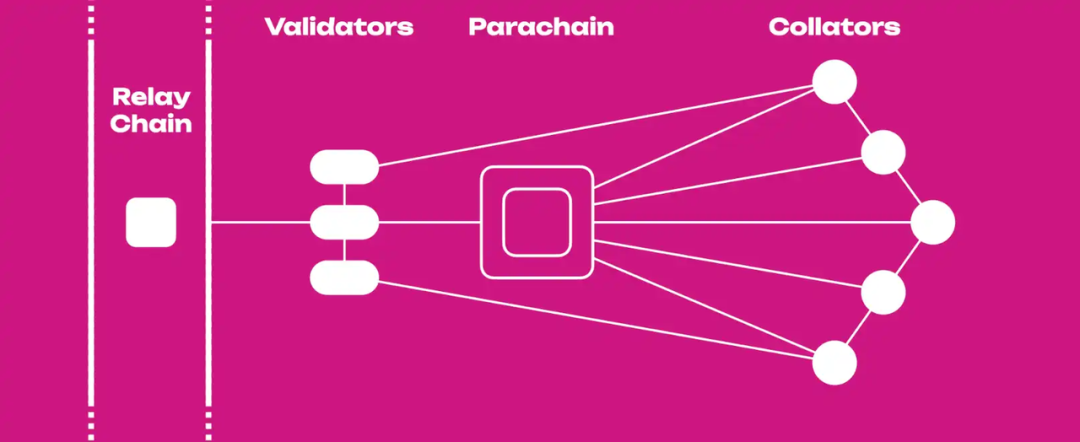
Position of collators in the Polkadot network, image via Polkadot Wiki
Polkadot Consensus
The Polkadot relay chain employs a novel Nominated Proof of Stake (NPoS) consensus process to secure blocks, designed to optimize network security and efficiency. Here’s how it works:
-
Roles: NPoS involves two primary roles:
-
Validators: Responsible for validating transactions and maintaining the blockchain.
-
Nominators: Help secure the network by staking tokens and supporting trustworthy validators.
-
Nominating Validators: Token holders can nominate trusted validators. This process involves staking Polkadot’s native DOT token.
-
Validator Election: An election mechanism selects validators from the pool of nominated candidates. This process considers the amount of stake backing each validator to ensure balanced and secure network representation.
-
Staking Rewards and Risks: Both validators and nominators receive staking rewards proportional to their staked amounts. However, they also share risks: any malicious behavior by a validator can result in slashing—losing part of their staked DOT.
-
Security and Efficiency: NPoS aims to maximize the total staked amount securing the network, enhancing its security. Validators are incentivized to act efficiently and honestly due to their economic stake.
In summary, Polkadot’s NPoS is a sophisticated consensus model that aligns incentives across various network participants to maintain a secure, efficient, and decentralized ecosystem.
Polkadot XCM (Cross-Chain Message Passing)
The Polkadot relay chain uses a novel Nominated Proof of Stake (NPoS) consensus process to secure blocks, designed to optimize network security and efficiency. Here’s how it works:
Within the Polkadot ecosystem, XCM stands for Cross-Consensus Message Passing. It is a protocol specifically designed for communication between different blockchains (parachains) inside and outside the Polkadot and Kusama networks. XCM enables these distinct blockchains to send messages to each other, even if they have different consensus mechanisms or state transition functions. Here’s how XCM facilitates cross-chain communication:
-
Protocol Design: XCM is the language and format of the message. It is designed to be as generic and abstract as possible to accommodate a wide range of potential use cases and blockchain designs.
-
Message Sending and Receiving: Parachains can send XCM messages to another parachain without storing these messages on the relay chain.
-
Cross-Consensus Compatibility: XCM is designed to be compatible across different consensus systems. This means a blockchain using one consensus mechanism can communicate with another using a different mechanism.
-
Use Cases: XCM has diverse applications, including transferring tokens between parachains, calling smart contracts located on another parachain, or any other type of information or command requiring communication in a multi-chain environment.
-
Decentralization and Security: XCM leverages Polkadot’s shared security model, ensuring cross-chain communication is as secure as internal operations within a single parachain.
In summary, XCM in Polkadot is a powerful tool enabling interoperability between different blockchains in a secure, efficient, and decentralized manner—a cornerstone upon which Polkadot is built. XCMP is the transport layer for delivering XCM messages, providing the conveyance and secure route, but not the framework constraining the protocol.
Process of XCM Cross-Chain Messaging
In Polkadot, cross-chain messaging via XCM involves multiple steps.
Here’s a detailed breakdown:
-
Message Creation: A user or application on a parachain initiates a cross-chain operation, creating an XCM message. This message is formatted to be universally understood across different parachains with varying consensus mechanisms and state transition functions.
-
Submission to Local Parachain: The XCM message is first submitted to the local parachain. It is processed according to the parachain’s rules and prepared for transmission to another parachain.
-
Relay Chain Involvement: The local parachain forwards the XCM message to the Polkadot relay chain. The relay chain plays a central role in the Polkadot architecture, interconnecting all parachains and facilitating communication between them.
-
Message Routing: The relay chain routes the message to the target parachain, based on information contained within the XCM message specifying the destination parachain and intended operation.
-
Destination Parachain Reception: The target parachain receives the XCM message from the relay chain, interprets it according to its logic, and executes the requested operation.
-
Execution and Response: The target parachain performs the operation requested in the XCM message, which may involve token transfers, smart contract executions, or other blockchain operations.
-
Feedback Loop: Depending on the nature of the cross-chain operation, the target parachain may generate a response or confirmation and send it back to the original parachain using the same XCM protocol.
-
Finalization: The operation completes, and any changes are finalized on both the source and target parachains.
Throughout this process, Polkadot’s security and consensus mechanisms ensure safe and reliable cross-chain communication. The design of the XCM protocol as a universal and abstract messaging format allows for diverse cross-chain interactions within the Polkadot ecosystem.
How Are Parachains Selected?
The Ethereum network is fully permissionless, meaning anyone can perform any action on the network as long as they follow Ethereum’s consensus protocol. Therefore, developers have complete autonomy in deploying any smart contract they wish (including smart contract rollups) on the Ethereum mainnet.
The Polkadot network operates slightly differently. The project’s original vision was simply to allow high-quality, well-developed parachains to connect to the relay chain and benefit from its security. Thus, Polkadot introduced a slot auction mechanism to regulate the number of parachains on Polkadot at any given time. Below is how the auction worked prior to the Polkadot 2.0 upgrade.
1. Purpose: Slot auctions determine which parachains will connect to the Polkadot relay chain. Connecting to the relay chain allows parachains to benefit from Polkadot’s shared security and interoperability features.
2. Parachain Slots: These are available positions on the relay chain for parachains to connect. Each slot has a limited duration, typically ranging from several months to a few years.
3. Auction Process:
-
Auction Format: Polkadot uses a version of a candle auction, a historical mechanism used for sales. The end of the auction is determined retroactively after it concludes, making it difficult to game the system with last-minute bids.
-
Bidding: Bids for slots are made by locking DOT tokens, with the number of DOT locked and lease duration being factors in the bidding process.
-
Random End: Participants do not know the exact end time of the auction, discouraging last-minute bidding strategies.
4. Winning the Auction:
-
Winner Determination: The winner is the project with the highest bid at the randomly selected endpoint of the auction.
-
Leasing the Slot: The winning project leases the parachain slot for the bid period; during this time, their parachain will be connected to the relay chain.
-
Locked DOT: DOT tokens bid in the auction are locked for the duration of the slot lease. They are not spent but held as collateral to secure the parachain’s position on the relay chain.
5. Locked DOT:
DOT tokens bid in the auction are locked for the duration of the slot lease. They are not spent but held as collateral to secure the parachain’s position on the relay chain.
6. Crowdlending:
-
To gather enough DOT for bidding, projects often use crowdlending to raise DOT from their community.
-
If the bid succeeds, crowdlending contributors may receive rewards from the project, such as tokens or project shares.
7. Lease Expiration: After the lease period ends, the parachain slot becomes available for auction again, and the locked DOT is returned to the project or its crowdlending contributors.
Slot auctions are a fundamental part of Polkadot’s governance and economic model, ensuring fair and transparent allocation of limited resources (parachain slots) within the network.
Coretime in Polkadot
Polkadot validators are dynamically assigned to validate different parachain blocks. Polkadot cryptographically randomly splits the set of validators into subsets for each parachain, providing strong guarantees that these subsets differ in every block.
Coretime refers to the availability of these validator subsets as allocated computational resources (cores). Polkadot currently supports 50 such cores. Each core can host a single parachain utilizing all resources, or multiple parathreads using partial available resources. Cores run in parallel, simultaneously handling multiple complex tasks. Polkadot is sometimes referred to as the “Polkadot Supercomputer,” representing its collective ability to process large volumes of tasks.
Polkadot OpenGov Democratic Governance Structure
Polkadot has recently overhauled its governance mechanism. It has abandoned Governance V1 in favor of OpenGov, a more democratic and equitable governance model that reduces privileges and gives the DOT community greater voice. We recommend reading about Governance V1 here to understand the changes introduced by OpenGov.
Saying Goodbye to Governance V1
Polkadot’s first governance system included three main components: the Technical Committee, the Council, and the public (all token holders). The Technical Committee managed the upgrade timeline, while the Council—an elected body—handled proposals related to parameters, treasury management, and spending. While the public (token holders) played a critical role in the governance process, the Council would carefully review their proposals before they entered the voting phase.
Although Governance V1 was effective in managing treasury funds and facilitating upgrades, it had limitations. It allowed voting on only one referendum at a time (except for emergency proposals), and voting periods lasted weeks. The system favored careful consideration of a small number of proposals rather than broader ideas, potentially limiting the network’s ability to adapt and evolve quickly. V1 also restricted public influence by implementing a Council and requiring approvals. The demand for greater decentralization and democracy led to the adoption of OpenGov.
Polkadot OpenGov
Polkadot OpenGov introduces significant improvements addressing the shortcomings of Governance V1. The new system aims to further decentralize decision-making and increase the number of possible collective decisions at any given time. Key changes include:
-
Dissolution of Council and Technical Committee: The Council is collectively dissolved, and the Technical Committee is replaced by a broader Polkadot technical team.
-
Direct Democratic Voting: Council responsibilities are transferred to the public, who can now directly initiate new proposals.
-
Enhanced Representative Delegation Options: Users can delegate voting power to community members in diverse ways, enabling more nuanced representation of stakeholder interests.
-
Multiple Origins and Tracks: Proposals are now initiated by the public and enter different tracks based on their nature, each track having a dedicated origin. This system allows simultaneous voting on multiple referenda, increasing the flexibility and responsiveness of the governance process.
Note: For those wanting to learn more, you can also dive deeper into how OpenGov works.
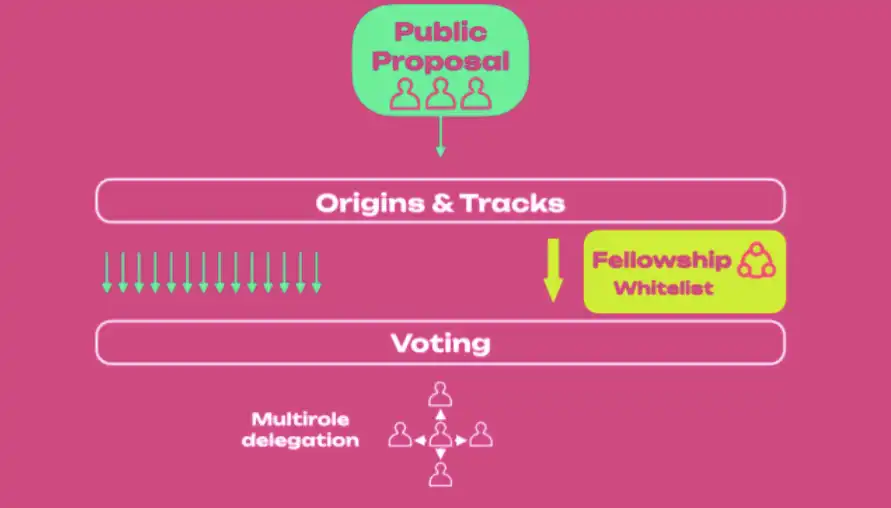
OpenGov architecture as described in Polkadot Docs
Under OpenGov, all proposals are initiated by DOT holders. Unlike Governance V1, OpenGov allows the community to process multiple proposals in parallel. OpenGov categorizes proposals into 15 different origin types based on their intended goals. Each origin follows a specially designed “track” with preset configurations to manage the voting process. The origin and track system ensures each proposal receives adequate community time and resources.
Some governance proposals are time-sensitive and require decisive action, while others are more foundational and resource-intensive, requiring more thought and testing. OpenGov is a platform where all these different proposals can develop fully without competing for community attention.
Main benefits of OpenGov:
-
Decentralization: OpenGov shifts governance power from a centralized council to a more direct democratic model. By dissolving the Council and Technical Committee and transferring responsibilities to the public, OpenGov fosters a decentralized decision-making approach.
-
Inclusivity and Community Empowerment: OpenGov introduces more granular delegation options, encouraging broader participation in governance. Stakeholders can contribute to decisions in areas they understand or care about most.
-
Adaptability and Evolution: The introduction of multiple origins and proposal tracks under OpenGov establishes a more flexible and responsive governance system capable of adapting to different proposal types, ensuring the process remains efficient and effective.
-
Transparency and Accountability: The inclusion of the technical team and the ability to fast-track proposals onto whitelists enhances the network’s capacity to respond quickly to critical updates or improvements.
-
Scalability and Efficiency: OpenGov is designed to allow simultaneous voting on multiple referenda, improving the governance system’s efficiency. This scalability is crucial for the dynamic coretime management system in Polkadot 2.0.
Polkadot 2.0 proposes a new direction for the network, abandoning its previous fixed-term auction model in favor of a dynamic “pay-as-you-go” model for integrating parachains into the Polkadot network. At the same time, the new vision highlights certain limitations of the original slot auction model, as outlined below:
-
Rigid Resource Allocation: The original slot auction model allocated parachain slots for fixed durations, lacking flexibility to adapt to varying project needs or changing network conditions.
-
High Barrier to Entry for New Projects: Required substantial locked capital.
Join TechFlow official community to stay tuned
Telegram:https://t.me/TechFlowDaily
X (Twitter):https://x.com/TechFlowPost
X (Twitter) EN:https://x.com/BlockFlow_News
 @OneBlock_











