








Understanding Ondo Finance: Successful Transformation, TVL Rises to Top Three in RWA Sector
TechFlow Selected TechFlow Selected
Understanding Ondo Finance: Successful Transformation, TVL Rises to Top Three in RWA Sector
Betting on RWA succeeded, but the future utility of the token remains unclear.
 Navigating Web3 tides with focused insights
Author: Fu Heru
RWA (Real World Assets) is hailed as the key to unlocking DeFi 2.0, yet it remains relatively "distant" for most retail investors. After all, purchasing RWA products typically requires KYC and meeting certain asset thresholds, which are often too high for average retail participants.
How can investors gain early exposure in the RWA sector before it fully takes off and capture a share of the opportunity? There are two main approaches: one is investing in tokens of RWA projects; the other is purchasing RWA products with lower entry barriers.
The first method requires investors to understand the project's fundamentals, its product design, and risk management mechanisms. Most RWA products use an SPV (Special Purpose Vehicle) as a fund custodian to achieve risk isolation. It’s crucial to verify whether such entities comply with local regulations to avoid unforeseen project risks. Buying project tokens remains the primary investment method for most crypto investors and generally offers the highest potential returns.
The second method involves RWA products that tokenize real-world assets such as U.S. dollars or U.S. Treasury bonds. If investors meet the eligibility criteria, these products offer relatively stable returns with lower risk. However, currently available RWA products are limited, and their KYC requirements and asset thresholds often exclude typical crypto investors.
Considering both options, Odaily Planet Daily has identified Ondo Finance as a suitable candidate within the RWA space. This article will examine Ondo Finance’s history, products, and tokenomics, aiming to provide readers with a viable RWA investment option.
One-Year Transformation: Ondo Finance Successfully Pivots
Founded in 2021, Ondo Finance initially focused on the Laas (Liquidity-as-a-Service) sector. However, as the market entered a bear phase and DeFi market capitalization along with on-chain liquidity shrank, the project hit development bottlenecks. In January 2023, it pivoted to the RWA sector, completing this transition over the course of a year. As of now, according to DefiLlama data, Ondo Finance ranks third in TVL among RWA protocols, with a total value locked of $183 million.
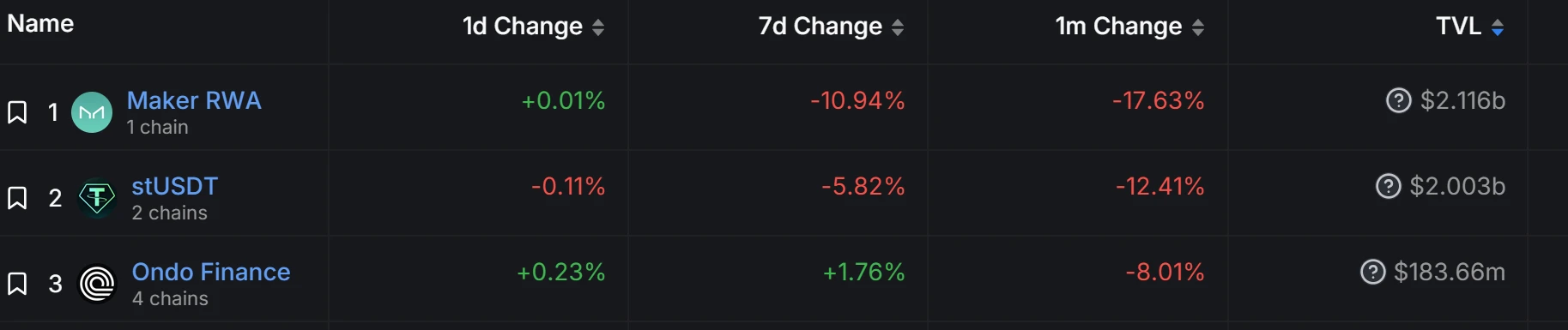
Ondo Finance’s strong TVL ranking can be attributed to its thoughtful product design. While RWA products do not inherently require complex structures—since they essentially involve tokenizing traditional financial instruments—the challenge lies in securely bridging the real and digital worlds. Ensuring safe and compliant processes for users to purchase or redeem RWA assets is central to effective product design.
Ondo Finance currently offers three RWA products: OUSG, USDY, and OMMF.
OUSG (U.S. Treasuries)
OUSG is the largest contributor to Ondo Finance’s TVL, accounting for $117 million. The underlying assets of OUSG primarily consist of shares in BlackRock’s short-term U.S. Treasury ETF: iShares Short Treasury Bond ETF (NASDAQ: SHV), supplemented by small amounts of USDC and USD for liquidity purposes.
Launched in 2007, the SHV ETF invests in U.S. Treasury securities with maturities under one year, tracking the ICE U.S. Treasury Short Bond Index. According to Yahoo Finance, SHV currently trades at $110.42 per share, manages approximately $18.4 billion in assets, offers an annualized yield of 5.17%, and holds an AA credit rating from S&P.
Currently, OUSG trades at $104.66 with an annualized yield of 4.69%. It is available for purchase on Ethereum, Polygon, and Solana blockchains. Notably, Ondo I LP acts as the fund manager responsible for holding the SHV ETF shares purchased by investors. As a U.S.-based entity serving as the SPV for OUSG, Ondo I LP enables risk isolation, allowing investors to redeem their shares even in exceptional circumstances such as project insolvency.
In terms of fees, OUSG charges a 0.15% fund management fee, up to an additional 0.15% to cover service providers like auditors, and the underlying ETF issuer BlackRock also charges its own 0.15% management fee.
However, OUSG has high entry barriers. KYC verification is mandatory, and investors must qualify as “Qualified Purchasers,” requiring a minimum investment portfolio of $5 million. Additionally, the minimum purchase amount for OUSG is 100,000 USDT.
Despite volatile prices during bear markets, investing in RWA products like OUSG that generate around 5% annual returns from short-term U.S. Treasury ETFs presents a compelling opportunity. Over the past year, OUSG has experienced rapid growth in TVL and has become Ondo Finance’s flagship product.
USDY (U.S. Dollar Yield)
USDY is a tokenized note backed by short-term U.S. Treasuries and bank demand deposits. Targeted at retail investors, USDY allows purchases starting at $500 and can be minted and transferred on-chain after 40–50 days. Currently, USDY trades at $1.02 with an annualized return of 5.10%, and its TVL stands at $66.2 million.
Compared to commonly used stablecoins like USDT and USDC in the crypto world, USDY functions more like an interest-bearing stablecoin and can be categorized under yield-generating stablecoins. However, unlike other yield-bearing stablecoins, USDY is backed by traditional banking instruments and, according to its official website, complies with U.S. regulatory standards.
Since USDY can eventually be minted and circulated on-chain, operating similarly to a stablecoin, its structural design and risk controls are critical. Below are key aspects of USDY’s design and oversight:
-
Structural Design: USDY is issued by Ondo USDY LLC, which serves as the SPV. Assets are managed separately from Ondo Finance, maintaining independent books and accounts. This structure ensures that USDY collateral assets are isolated from any potential financial risks associated with Ondo Finance;
-
Overcollateralization: USDY employs overcollateralization as a risk mitigation measure. A minimum first-loss position of 3% cushions against short-term fluctuations in Treasury prices. Currently, USDY is overcollateralized with a 4.64% first-loss buffer;
-
First Priority Claim: USDY investors hold a “first priority” claim over the underlying bank deposits and Treasuries. Ankura Trust acts as the collateral agent, overseeing the security interests of USDY holders. Control agreements with banks and custodians grant Ankura Trust legal rights and obligations to take control of assets and repay token holders in cases of default or upon voting by USDY holders;
-
Daily Transparency Reports: Ankura Trust serves as the verifying authority, issuing daily transparency reports detailing reserve holdings. These independently verified reports enhance accountability and reliability;
-
Asset Allocation: USDY follows a conservative investment strategy aimed at preserving safety and liquidity. Its target allocation is 65% in bank deposits and 35% in short-term U.S. Treasuries. This cautious approach minimizes risk exposure by focusing exclusively on highly secure and liquid instruments;
-
Asset Custody: The U.S. Treasuries backing USDY are held in “cash custody” accounts at Morgan Stanley and StoneX, ensuring asset security. These assets are not re-pledged. Ankura Trust verifies their existence daily.
Through these mechanisms, USDY effectively isolates assets from the broader crypto project, reducing rug-pull risks; uses overcollateralization to absorb interest rate volatility; appoints Ankura Trust as supervisor to safeguard investor funds; and stores collateral in traditional bank custody accounts to prevent reuse.
Compared to other RWA products, USDY has relatively low entry barriers and supports both on-chain USDC purchases and wire transfers.
To some extent, USDY operates under legal constraints and offers yield advantages over conventional stablecoins. However, its current adoption rate remains relatively low.
OMMF (U.S. Government Money Market Fund)
OMMF is an RWA token based on a U.S. government money market fund (MMF). This product has not yet been officially launched. Further details will be provided upon release.
Flux Finance (Lending Platform)
In February 2023, Ondo Finance launched Flux Finance, a lending platform built on Compound V2. According to official disclosures, the platform currently maintains a fund utilization rate above 85%.
As one of three official channels offered by the project for redeeming RWA products, Flux Finance addresses time delays inherent in direct redemptions via official channels. Official redemptions cannot be processed directly on-chain and require the RWA product’s SPV to first sell the assets before processing withdrawals, resulting in a 1–5 day waiting period. Flux Finance provides an alternative liquidity solution.
Currently, Flux Finance supports borrowing against OUSG. As for USDY, since it can be transferred via DEXs on-chain after minting, no separate borrowing mechanism is needed.
Successful Bet on RWA, But Token Utility Remains Unclear
Prior to its pivot, Ondo Finance issued the ONDO token through a public sale on CoinList. Tokens were subject to a one-year lock-up period followed by monthly vesting and were originally intended for governance voting within Flux Finance.
Following a community vote, the ONDO token was unlocked and began circulating on January 18 this year. The current price of ONDO is $0.27 USDT, representing nearly a 2.5x increase since unlocking.
Meanwhile, Coinbase has added Ondo Finance (ONDO) to its asset listing roadmap. Coinbase is not only an investor in Ondo Finance but also serves as the sole channel for converting USDC into USD within Ondo’s RWA products.
However, over the past two days, multiple ONDO token transfers from project-owned addresses to exchanges have raised concerns about possible market-making activities or team dumping, warranting caution among investors.
According to official documentation, the ONDO token serves as the governance token for both Ondo DAO and Flux Finance. Currently, there is no clear utility linking ONDO directly to RWA products, although future integration—for example, using ONDO as an incentive mechanism for products like USDY—cannot be ruled out. Of the total token supply, only 16% has been allocated to investors and the CoinList public sale, while the remaining 84% has not yet been distributed.
If ONDO can be meaningfully integrated with RWA products—using Flux Finance as a platform to incentivize on-chain liquidity for RWA assets—it could significantly accelerate the mainstream adoption of RWA products among crypto investors.
Join TechFlow official community to stay tuned
Telegram:https://t.me/TechFlowDaily
X (Twitter):https://x.com/TechFlowPost
X (Twitter) EN:https://x.com/BlockFlow_News
 Odaily







