








The History of Ethereum and the Dencun Upgrade, Along with Other Developments
TechFlow Selected TechFlow Selected
The History of Ethereum and the Dencun Upgrade, Along with Other Developments
After the Ethereum merge, the most important thing is to improve performance (TPS) and reduce gas fees, making Ethereum closer to a perfect application.
 Navigating Web3 tides with focused insights
Author: Steven, E2M Researcher
Introduction
Why is this relevant recently?
After the approval of Bitcoin spot ETFs, the next narrative immediately shifted to Ethereum-centric themes: Ethereum spot ETFs in May, the Cancun upgrade, restaking, and more.
Early Insights into Ethereum's Development Pattern
Before The Merge, Ethereum resembled a startup’s growth model—PoW served as an early marketing tool by rewarding miners, with little concern for token value. The tokenomics experienced rapid inflation, prioritizing value accumulation over user experience.
The purpose of The Merge was not to improve Ethereum’s performance but to reduce blockchain generation costs (transitioning from PoW to PoS). In Web2 terms, it’s akin to improving efficiency at the upstream end of an industrial chain, laying the foundation for sustainable development. Tokenomics shifted toward deflation, greater focus on user experience emerged, miner rewards were gradually converted into staking rewards, and gas fees were reduced.
The Cancun upgrade corresponds to The Surge phase, placing user experience first—such as increasing transaction speed and lowering gas fees.
Future upgrade cycles will be relatively short. In a sense, after the Shanghai upgrade replaced PoW consensus with PoS, Ethereum entered a mature phase. Although several major upgrades remain, their core goals are clear: enhancing scalability, simplifying block validation, reducing costs, and achieving stronger, more stable performance.
Some Reflections
Ethereum’s development is complex and multifaceted. While studying its overall trajectory, many unresolved issues remain.
Vitalik has played a highly influential role in Ethereum’s evolution. From a corporate perspective, having a strong CEO leading the charge is an excellent development model. Ultimately, all ecosystem developments led by Vitalik benefit ETH in the long run.
Projects like Layer2 solutions (Arb, OP, ZKsync, Metis), DeFi protocols (Aave, Compound, Uniswap), and others with sky-high valuations depend heavily on Ethereum. When these become popular narratives, Ethereum benefits to some extent.
Rather than comparing Ethereum to Microsoft or Apple, the closest analogy might be NVIDIA. Whether it’s AI, VR/AR, Web3.0, cloud computing, or data centers—any cutting-edge tech relies on computational power, and thus indirectly on NVIDIA.
Web3.0 appears similarly dependent—almost every advancement ties back to Ethereum. Even when Ethereum’s narrative quieted down temporarily, developments like the Cancun upgrade and spot ETF speculation reignited momentum, driving up both Layer2 and ETH prices. Past booms such as DeFi Summer and NFT Summer also boosted Ethereum’s price, and longer-lasting projects require substantial integration with Ethereum.
Many chains attempting to break away from Ethereum often follow the so-called “Ethereum killer” logic. Take TON, for example—once it stopped positioning itself against Ethereum, it faded into obscurity.
Ethereum’s development is highly centralized, while the Ethereum chain itself remains decentralized. At times, Ethereum’s centralization in development resembles that of Uniswap’s team—not as decentralized as protocols like Aave or MakerDAO. This suggests that perhaps, fundamentally, successful project development still requires centralization.
Perhaps one day Ethereum could reach such maturity that fully decentralized governance becomes feasible. But as long as Vitalik remains active, that day seems far off. That said, Ethereum is only 11 years old—a young company by any standard, far from mature.
1. Big Picture – A Brief History of Ethereum
1.1 History and Forks
The following content framework is referenced from: https://ethereum.org/zh/history, and other public information. For more details, please click the link for reference.
2013 – Phase 0: The Birth of Ethereum
White Paper Released, Ethereum Born
-
November 27, 2013: Vitalik Buterin published the "Ethereum White Paper"
-
Ethereum founder Vitalik Buterin released the first version of the Ethereum white paper, introducing the platform’s token system.
-
Summary
The white paper defined smart contracts and introduced the concept of ether (ETH) for the first time. It explained that ETH serves as fuel (gas) on the Ethereum network. Users must pay gas fees for transactions, deploying smart contracts, etc. Part of the fee goes to block validators (miners). If insufficient gas is provided, the transaction fails; excess gas is refunded.
2014 – Phase 0.5: Ethereum Sale
Ethereum Crowdsale
-
July 22, 2014, 00:00:00 +UTC
-
The presale lasted 42 days and accepted Bitcoin payments.
-
Summary
The initial exchange rate was 1 BTC = 2,000 ETH, fixed for 14 days, then linearly declining to 1 BTC = 1,337 ETH. The sale ended on September 2, 2014, raising approximately $18 million and distributing over 60 million ETH. Purchased ETH could only be transferred after the genesis block launch.
Besides the 60+ million pre-sold ETH, two additional allocations were made: one to early contributors and another to long-term research initiatives, each equal to 9.9% of the pre-sale amount.
Thus, upon official issuance, a total of 72,002,454.768 ETH were allocated.
2015 – Phase One: Frontier
On March 3, 2015, Ethereum announced four key phases on its official blog. According to the blog, Vitalik’s original thinking included:
-
Frontier: Primarily enabled mining operations and ETH trading, allowing the community to set up mining equipment and establish a “live” environment where users could test DApps and acquire ETH to deploy software. Aimed to stabilize Ethereum among core developers and auditors.
-
Homestead: Frontier was like a closed beta; Homestead marked the public beta.
-
Metropolis: A full-featured, mature user interface focused on user experience.
-
Serenity: Transition from PoW to PoS.
Frontier Launch
-
July 30, 2015, 03:26:13 +UTC
-
Summary
Frontier was Ethereum’s initial version, offering limited functionality. Launched after the Olympic testnet succeeded, it targeted technical users and developers. Blocks had a 5,000 gas limit. This “thaw” period allowed miners to begin operations and early adopters time to install clients.
Similar to many Web3 cold starts, miners received a 5 ETH reward for each block mined on the Frontier mainnet.
Frontier Thaw Fork
-
September 7, 2015, 09:33:09 +UTC
-
Block Number: 200,000
-
ETH Price: $1.24
-
Summary
The Frontier Thaw fork increased the per-block gas limit beyond 5,000 units and set the default gas price at 51 gwei, enabling transactions requiring 21,000 gas.
To ensure future hard forks toward proof-of-stake, the concept of a difficulty bomb was introduced.
The difficulty bomb, also known as TTD (Total Terminal Difficulty), refers to the cumulative difficulty of all previous blocks. When the network’s total mining difficulty reaches TTD, the ETH mainnet triggers the “difficulty bomb.” This mechanism acts as a backdoor function adjusting mining difficulty dynamically based on network hash rate to maintain consistent block intervals. The difficulty bomb drastically increases mining difficulty via a hidden function, making it impossible for miners to produce blocks under such conditions, thereby pushing them to abandon PoW. The PoW-to-PoS transition wasn’t tied to a specific block height but rather to reaching TTD, partly to prevent deliberate sabotage of the merge process.
This indirectly proves Ethereum had long-standing intentions to transition from PoW to PoS.
2016 – Phase Two: Homestead
Ethereum’s first hard fork, gradually refining smart contract standards after multiple security incidents.
Homestead Fork
-
March 14, 2016, 06:49:53 +UTC
-
Block Number: 1,150,000
-
ETH Price: $12.50
-
Summary
The Homestead fork optimized the smart contract creation process.
DAO Fork
-
July 20, 2016, 01:20:40 +UTC
-
Block Number: 1,920,000
-
ETH Price: $12.54
-
Summary
This fork was an unplanned, reactive split triggered by a major attack on Ethereum.
The DAO was a crowdfunding initiative launched by blockchain company Slock.it, aiming to provide community-driven funding for projects. Users exchanged ETH for DAO tokens to vote and share profits if funded successfully. The project raised over 12 million ETH in a 28-day campaign in April 2016—nearly 14% of all ETH at the time. However, two months later, hackers exploited a vulnerability in The DAO’s code to steal 3.6 million ETH.
The fork decision was made via community voting. All ETH holders could vote through transactions on a voting platform. Over 85% voted in favor. The fork rolled back the theft, restoring the stolen funds.
The fork transferred funds from the compromised contract to a new one with only one function: withdrawals. Affected users could withdraw 1 ETH per 100 DAO tokens.
Some miners rejected the fork, arguing the DAO incident wasn’t a protocol flaw. They went on to form Ethereum Classic (ETC).
Tangerine Whistle Fork
-
October 18, 2016, 01:19:31 +UTC
-
Block Number: 2,463,000
-
ETH Price: $12.50
-
Summary
The Tangerine Whistle fork addressed severe transaction delays caused by a denial-of-service (DoS) attack on the Ethereum network on September 18, 2016, primarily resolving urgent network health issues related to undervalued opcodes.
Spurious Dragon Fork
-
November 22, 2016, 04:15:44 +UTC
-
Block Number: 2,675,000
-
ETH Price: $9.84
-
Summary
The Spurious Dragon fork further mitigated DoS attacks by:
-
Adjusting opcode pricing to prevent future attacks.
-
Enabling blockchain state “stateless” compression.
-
Adding replay attack protection.
2017 – Phase Three: Metropolis
Metropolis primarily focused on fixing existing network issues and preparing for ZK-SNARKS integration.
The most impactful event during this phase was the two-stage halving of block rewards—from 5 ETH to 3 ETH, then to 2 ETH—marking a transitional phase from PoW to PoS.
User experience began receiving attention, along with planning for a smooth PoW-to-PoS transition.
Byzantium Upgrade
-
October 16, 2017, 05:22:11 +UTC
-
Block Number: 4,370,000
-
ETH Price: $334.23
-
Summary
The Byzantium fork laid groundwork for ZK-Snark integration, emphasizing user privacy and experience.
-
Reduced block mining rewards from 5 ETH to 3 ETH.
-
Delayed the difficulty bomb by one year.
-
Enabled calling other contracts without changing state.
-
Added cryptographic methods supporting Layer2.
2019 – Phase Four: Serenity
Ethereum matured gradually, transitioning consensus from PoW to PoS. User experience, security, decentralization, and scalability became Ethereum’s top priorities.
Constantinople Fork
-
February 28, 2019, 07:52:04 +UTC
-
Block Number: 7,280,000
-
ETH Price: $136.29
-
Summary
Reduced block mining rewards from 3 ETH to 2 ETH.
-
December 8, 2019, 12:25:09 +UTC
-
Block Number: 9,069,000
-
ETH Price: $151.06
-
Summary
-
Optimized gas costs for specific operations in the Ethereum Virtual Machine.
-
Improved recovery capability after DoS attacks.
-
Enhanced performance for Layer2 solutions based on “zero-knowledge succinct non-interactive arguments of knowledge” (ZK-SNARKs) and “zero-knowledge scalable transparent arguments of knowledge” (ZK-STARKs).
-
Enabled contracts to incorporate more creative functionalities.
2020
Muir Glacier Upgrade
-
January 2, 2020, 08:30:49 +UTC
-
Block Number: 9,200,000
-
ETH Price: $127.18
-
Summary
The Muir Glacier fork delayed the difficulty bomb. Increasing PoW block difficulty could lengthen transaction confirmation times and degrade dApp usability, reducing Ethereum’s accessibility.
Staking Deposit Contract Deployment
-
October 14, 2020, 09:22:52 +UTC
-
Block Number: 11,052,984
-
ETH Price: $379.04
-
Summary
The staking deposit contract introduced staking to Ethereum’s ecosystem. Though a mainnet contract, it directly influenced the Beacon Chain’s launch timeline, a critical part of Ethereum’s upgrade path.
Beacon Chain Genesis Block
-
December 1, 2020, 12:00:35 +UTC
-
Beacon Chain Block Number: 1
-
ETH Price: $586.23
-
Summary
The Beacon Chain required 16,384 accounts, each depositing 32 ETH, to ensure secure launch. This threshold was reached on November 27, 2020, meaning the Beacon Chain began producing blocks on December 1, 2020.
The Beacon Chain managed and supervised the blockchain network. It randomly selected validators—those who validated correctly earned rewards, while malicious actors faced penalties.
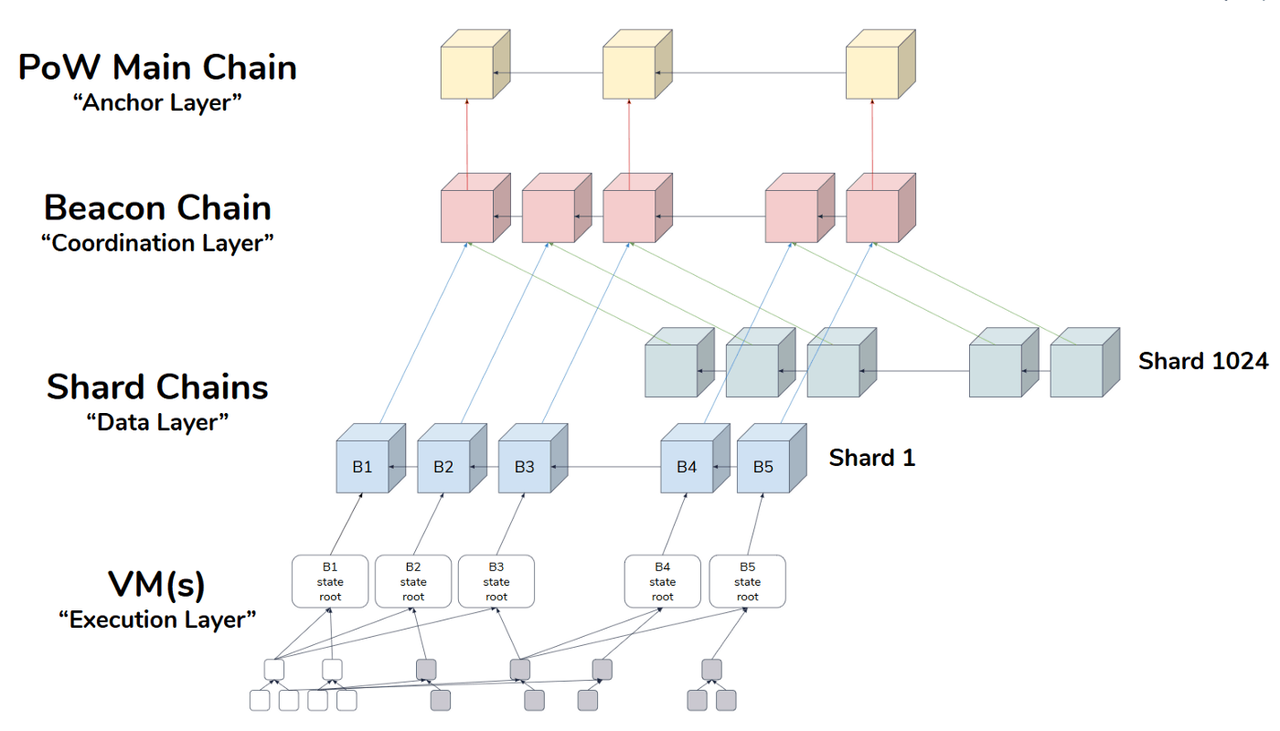
After the merge, block timing adopted slots and epochs. A slot was created every 12 seconds, and each epoch consisted of 32 slots. At the end of each epoch, validators were reassigned.
To become a validator and gain voting rights, users must stake at least 32 ETH.
According to Ethereum rules, validators are randomly assigned to 32 committees per epoch, each committee containing at least 128 validators. The system uses the RANDAO random algorithm to assign one proposer per slot and randomly select a committee. The proposer creates the block, and the committee verifies and votes. If approved, the block is finalized and the proposer rewarded; otherwise, no reward is given, and the stake may be slashed. Regular validators face similar rules: correct behavior earns rewards, misconduct results in penalties. A validator’s status is terminated if their 32 ETH stake drops below 16 ETH.
2021
Berlin Upgrade
-
April 15, 2021, 10:07:03 +UTC
-
Block Number: 12,244,000
-
ETH Price: $2,454.00
-
Summary
The Berlin upgrade optimized gas costs for certain EVM operations and added support for multiple transaction types.
London Upgrade
-
August 5, 2021, 12:33:42 +UTC
-
Block Number: 12,965,000
-
ETH Price: $2,621.00
-
Summary
The London upgrade introduced EIP-1559, reforming the transaction fee market. It further delayed the difficulty bomb until December 1, 2021.
Athens Upgrade
-
October 27, 2021, 10:56:23 +UTC
-
Epoch Number: 74,240
-
ETH Price: $4,024.00
-
Summary
The Athens upgrade was the first planned Beacon Chain upgrade. It added support for “sync committees,” enabling light clients, and increased penalties for validator laziness and slashable behaviors during the path toward the merge.
Arrow Glacier Upgrade
-
December 9, 2021, 07:55:23 +UTC
-
Block Number: 13,773,000
-
ETH Price: $4,111.00
-
Summary
The difficulty bomb was delayed by 10,700,000 blocks, pushing it to June 2022.
2022
Gray Glacier Upgrade
-
June 30, 2022, 10:54:04 +UTC
-
Block Number: 15,050,000
-
ETH Price: $1,069.00
-
Summary
The Gray Glacier upgrade delayed the difficulty bomb by three months. This was the only change introduced, similar in nature to Arrow Glacier and Muir Glacier upgrades. Previous upgrades like Byzantium, Constantinople, and London also implemented similar delays.
Bellatrix Upgrade
-
September 6, 2022, 11:34:47 +UTC
-
Epoch Number: 144,896
-
ETH Price: $1,558.00
-
Summary
The Bellatrix upgrade was the second planned Beacon Chain upgrade, preparing the chain for the merge. It increased penalties for lazy or slashable validators to their full stake value. It also updated fork choice rules, preparing the Beacon Chain for the transition from the last PoW block to the first PoS block, including making consensus clients aware of the terminal total difficulty of 58750000000000000000000.
Paris Upgrade (The Merge)
-
September 15, 2022, 06:42:42 +UTC
-
Block Number: 15,537,394
-
ETH Price: $1,472.00
-
Summary
The Paris upgrade was triggered when the PoW blockchain exceeded the terminal total difficulty of 58750000000000000000000. This occurred at block 15,537,393 on September 15, 2022, triggering the Paris upgrade at the next block. The Paris upgrade marked the merge transition—Ethereum completed the shift from PoW mining algorithms and associated consensus logic to PoS. The Paris upgrade itself was an execution client update (equivalent to the Bellatrix upgrade on the consensus layer), enabling execution clients to receive instructions from connected consensus clients.
2023
Capella Upgrade
-
April 12, 2023, 22:27:35 +UTC
-
Epoch Number: 194,048
-
Beacon Chain Block Number: 6,209,536
-
ETH Price: $1,917.00
-
Summary
The Capella upgrade was the third major consensus layer (Beacon Chain) upgrade, enabling staking withdrawals. Capella synchronized with the Shanghai upgrade on the execution layer to activate withdrawal functionality.
This consensus layer upgrade allowed validators who hadn't initially provided withdrawal credentials to submit them, enabling withdrawals.
It also introduced automatic account scanning to continuously process available reward payouts or full withdrawals.
Shanghai Upgrade
-
April 12, 2023, 22:27:35 +UTC
-
Block Number: 17,034,870
-
ETH Price: $1,917.00
-
Summary
The Shanghai upgrade introduced staking withdrawals at the execution layer. Conducted simultaneously with the Capella upgrade, it enabled blocks to accept withdrawal operations, allowing validators to transfer ETH from the Beacon Chain back to the execution layer.
1.2 Why Has Ethereum Become Deflationary?
PoW was more like an early-stage marketing tactic for a startup—providing stable subsidies (miner rewards)—with little regard for token value. PoS is more akin to equity, affecting net ETH issuance.
The Merge significantly altered Ethereum’s monetary policy. By eliminating miner rewards and switching to staking rewards, it drastically reduced new ETH issuance—by about 88.7% daily, equivalent to a 0.52% annualized issuance rate. Combined with gas fee burning under EIP-1559, net issuance turned deflationary.
Two key changes:
1.2.1 EIP-1559 Introduced in the London Upgrade: Implemented Fee Burning Mechanism
Reference: Gas and Fees
Old protocol formula: Gas fee = Gas units (limit) × Gas price per unit
For simple on-chain transfers, gas limit is fixed at 21,000 regardless of network congestion. Thus, knowing gas price and gas limit determines total ETH cost. Gas price fluctuates with network demand; gas limit stays constant.
Suppose Alice sends Bob 1 ETH. Transaction gas limit: 21,000 units, gas price: 200 gwei.
Total fee: 21,000 × 200 = 4,200,000 gwei or 0.0042 ETH.
To prioritize transactions, users often set excessively high gas fees, leading to chaotic and unpredictable user experiences.
New protocol formula: Gas fee = (Base fee + Priority fee) × Gas limit, with base fee increasing by up to 12.5% per block.
Base fee is set by protocol and burned; priority fee is a user-set tip paid to validators.
Example: Jordan sends Taylor 1 ETH. Transfer requires 21,000 gas units. Base fee: 10 gwei. Jordan adds a 2 gwei tip.
Fee: 21,000 × (10 + 2) = 252,000 gwei (0.000252 ETH).
When Jordan sends, 1.000252 ETH is deducted from his account. Taylor receives 1.0000 ETH. Validator receives 0.000042 ETH as tip. 0.00021 ETH base fee is burned.
1.2.2 Paris Upgrade
First, the Constantinople hard fork reduced block rewards from 3 ETH to 2 ETH per block. Then, The Merge transitioned PoW to PoS, eliminating mining rewards (~160,000 ETH/day) and replacing them with staking rewards (~1,600 ETH/day), cutting issuance by ~99%.
On September 15, 2022, after the Paris upgrade, Ethereum officially entered deflation.
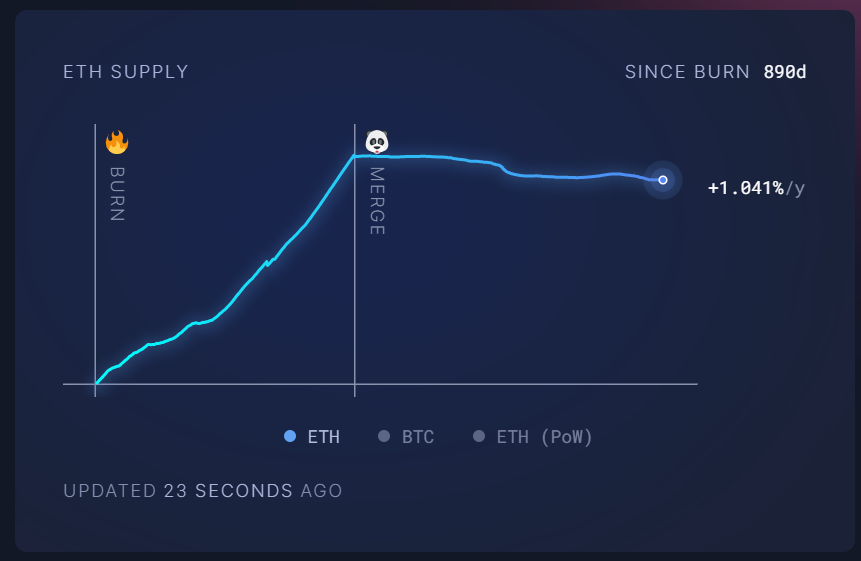
Since The Merge, total supply has decreased by over 300,000 ETH. Annually, ~981k ETH are burned, ~723k ETH issued—deflating at ~0.21% per year.
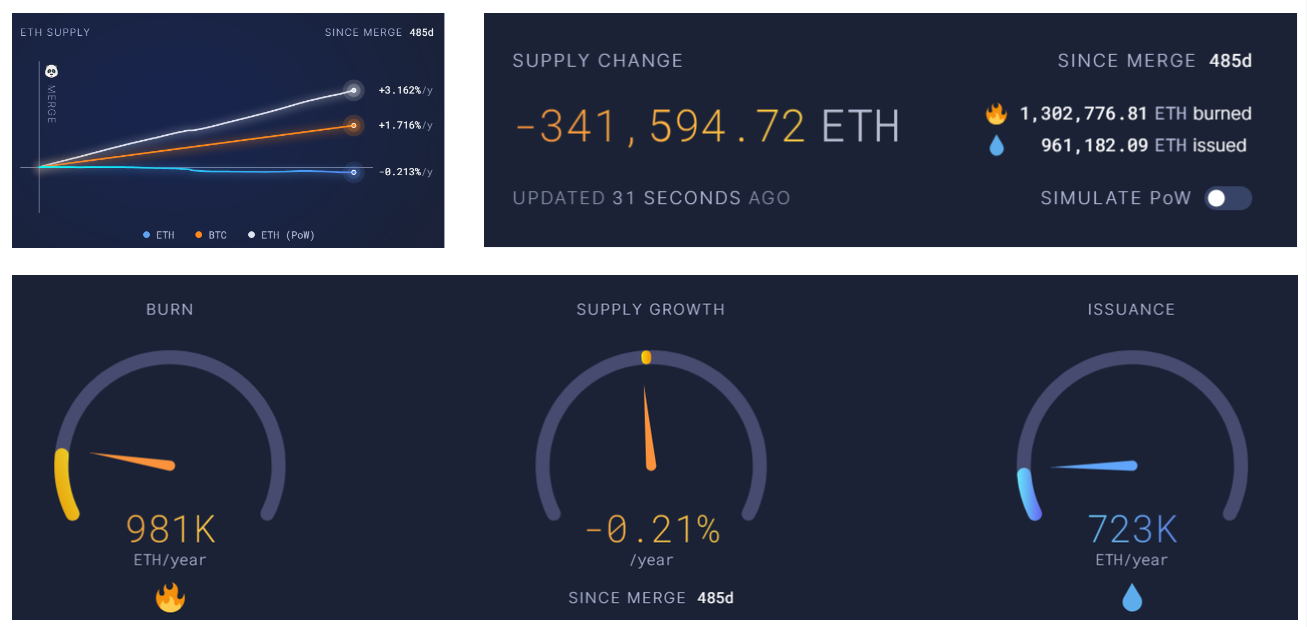
After The Merge, Ethereum solved the high energy consumption issue of mining and focused on performance and fees. Layer2 solutions address both issues, becoming the most watched sector in Ethereum’s ecosystem post-Merge.
1.3 Ethereum’s Future Upgrade
Join TechFlow official community to stay tuned
Telegram:https://t.me/TechFlowDaily
X (Twitter):https://x.com/TechFlowPost
X (Twitter) EN:https://x.com/BlockFlow_News
 @E2mResearch











