








Understanding Zest: 100% Capital-Efficient Stablecoins on Blast
TechFlow Selected TechFlow Selected
Understanding Zest: 100% Capital-Efficient Stablecoins on Blast
How to better attract and leverage the over one billion dollars in liquidity currently on Blast has become a critical question for every ambitious crypto development team, and Zest has provided their answer.
 Navigating Web3 tides with focused insights
Author: Go2Mars Research
Introduction
With Blast announcing the launch of its testnet and distributing 50% of its airdrop to developers, its ecosystem will inevitably face challenges regarding liquidity optimization. In existing stablecoin models, under a typical 150% collateralization ratio, users must deposit over $150 worth of collateral to mint $100 in stablecoins, leaving $50 underutilized. This represents significant inefficiency.
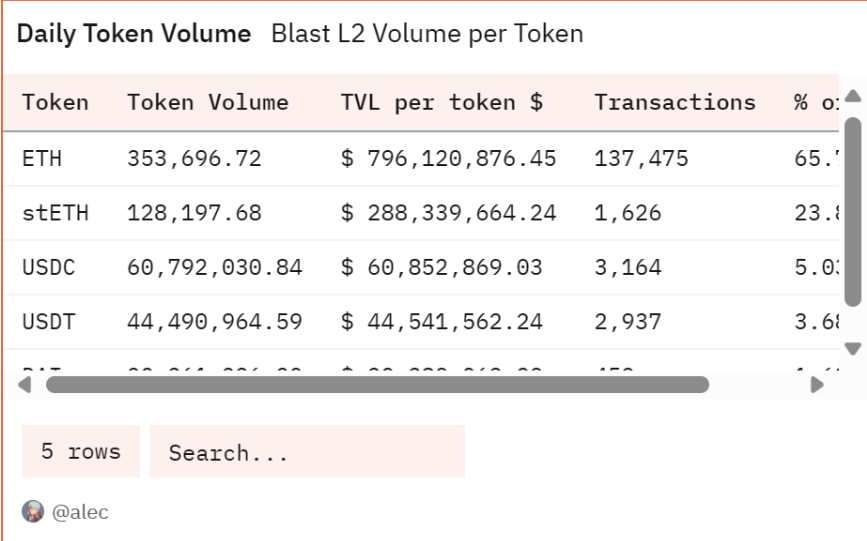
How to better attract and utilize the over one billion dollars in liquidity currently on the Blast chain has become a critical question for every ambitious crypto development team. Zest offers its own solution.
Introducing Zest
Unlike other blockchains, the abundant liquidity on Blast presents a new challenge—“how to maximize capital efficiency,” or more simply, how to help users leverage more effectively.
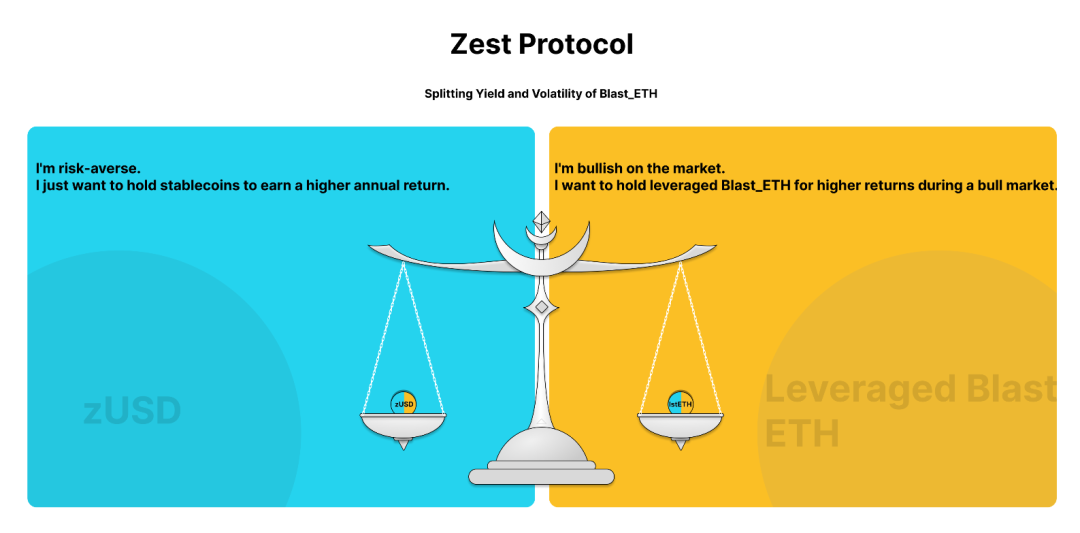
To address this, Zest proposes decomposing yield and volatility to achieve a stablecoin with 100% capital efficiency.
Core Mechanism
One of Blast's innovations is that all ETH on the Blast network accrues native yield, enabling various protocol-level applications such as LSDFi.
When a user deposits $150 worth of Blast_ETH into Zest, they receive $100 in zUSD and $50 in Leveraged Blast_ETH. The yield from Blast_ETH is passed to zUSD, while the volatility is absorbed by Leveraged Blast_ETH. This process can be described by the following formula:
$$1*BlastETH=k*zUSD+1*lBETHk$$
In the above equation, one Blast_ETH mints k units of zUSD and one lBETH_k. When the ETH price drops to $k, lBETH_k becomes subject to liquidation. Post-launch, to accommodate varying risk appetites, the protocol will introduce multiple k values.
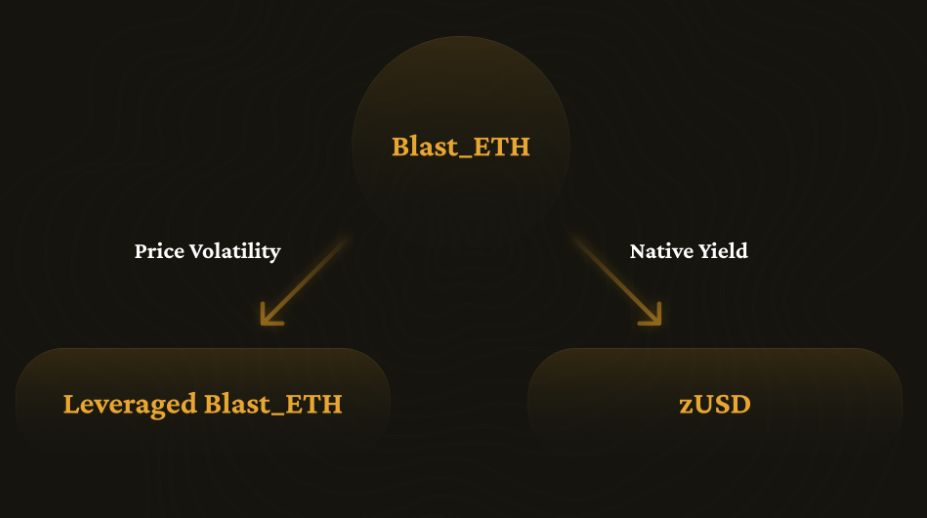
By decoupling volatility and yield, the Zest protocol can simultaneously serve two types of users:
Risk-averse users seeking farming yields
Since all volatility of Blast_ETH is absorbed by Leveraged Blast_ETH, zUSD offers risk-free leveraged yield.
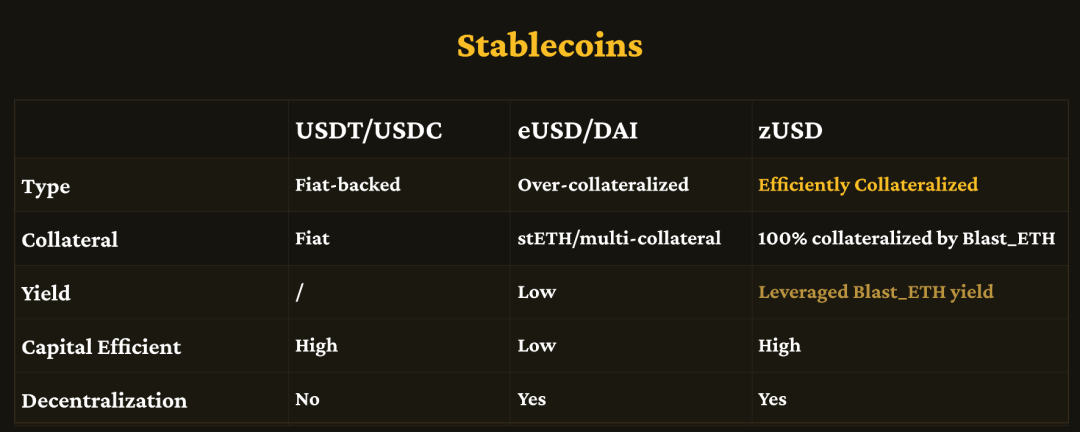
Assume K=1000, ETH price rises from 1800 to 3000, and Blast_ETH APR is 4.5%. Then zUSD Stake APR = (3000 * 4.5%) / (1000 * 0.5) = 27%, six times the native APR (27%/4.5%).
Leveraged users
Similarly, if ETH price increases from 1300 to 3000 and K=1000, then the value of lBETH would rise from (1300-1000) to (3000-1000), achieving nearly 7x return.
Zest has not yet released specific token design details; this aspect will be discussed later.
Conclusion
Given Blast’s uniquely abundant liquidity, protocols like this can focus more intently on product mechanisms and economic model design to achieve higher leverage and greater capital efficiency. As a result, we can expect to see more innovative designs emerge.
Join TechFlow official community to stay tuned
Telegram:https://t.me/TechFlowDaily
X (Twitter):https://x.com/TechFlowPost
X (Twitter) EN:https://x.com/BlockFlow_News
 Go2Mars Capital











