









Bitcoin Spot ETF Approved: Plunges at Launch, Institutions Clash, Coinbase Sparks Controversy
TechFlow Selected TechFlow Selected
Bitcoin Spot ETF Approved: Plunges at Launch, Institutions Clash, Coinbase Sparks Controversy
The catfish effect of Bitcoin spot ETFs.
 Navigating Web3 tides with focused insights
Author: Tuoluo Finance

The approval of spot Bitcoin ETFs has been finalized, yet market reactions have been mixed.
On one hand, after the news confirmation, Bitcoin dropped instead of rising—falling rapidly from above 46,000 USD on the second day of ETF listing, briefly dipping below 42,000 USD with a single-day decline exceeding 8.3%. It has since continued to fluctuate around 42,000 USD. This sharp drop sparked widespread discussion in the industry, shifting market focus from anticipated bull runs to potential major corrections. Previously bullish institutions forecasting $50,000 now suggest a possible crash in March.
On the other hand, all 11 spot Bitcoin ETFs received strong initial demand post-launch, showing clear capital inflows. On their first trading day, these 11 approved ETF products completed over 700,000 individual buy/sell transactions, with daily trading volume surpassing 4.6 billion USD. Observations indicate existing crypto assets are rapidly migrating into ETFs.
Thus, the launch of spot Bitcoin ETFs seems, at least in the short term, to bring both winners and losers.
01 News Confirmed: Is Bitcoin Facing a Major Correction?
On January 11, following approval by the U.S. Securities and Exchange Commission (SEC), 11 spot Bitcoin ETFs officially began trading. Grayscale and Bitwise listed on NYSE Arca; ARK21Shares, Invesco Galaxy, VanEck, WisdomTree, Fidelity, and Franklin on Cboe BZX; while BlackRock and Valkyrie listed on Nasdaq.
Initially, many expected this historic positive development to propel Bitcoin toward a new high of $50,000. Instead, Bitcoin sharply declined post-listing, remaining highly volatile over the next two days.
On the first day, Bitcoin briefly surged to 49,000 USD—a yearly high—before plunging to 46,000 USD. The following day, prices continued falling, dropping below 42,000 USD, with a 24-hour decline exceeding 8.3%. It currently trades at 42,669 USD. According to CoinGlass data, over 100,000 investors were liquidated across the entire crypto market within 24 hours, with total liquidation reaching 342 million USD. Affected by this, Bitcoin ETFs broadly declined, with DEFI, FBTC, HODL, and BRRR each dropping more than 6%.
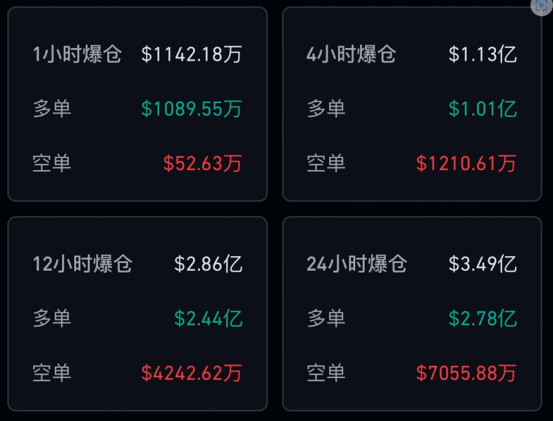
Over 100,000 long positions liquidated on the second day of ETF listing. Source: CoinGlass
The market widely attributes this sharp drop to the common financial strategy of "buy the rumor, sell the news." From a technical perspective, Bitcoin had already risen over 60% in Q4 of last year—rapid appreciation that likely priced in anticipated利好. With speculation resolved and profit-taking realized, investors exited their positions, ending FOMO-driven buying. Capital flows support this view: as of January 15, USDT’s market cap increased by only 1.8 billion USD during the first week, down to 1.4 billion USD—an 23% decrease. Meanwhile, USDC, representing traditional dollar liquidity, saw its market cap shrink by as much as 90% compared to the first week of January. These outflows align with price trends.
Against this backdrop, short-term Bitcoin price corrections have become a focal market topic. Besides Arthur Hayes, who warned before ETF approval that macro-level liquidity adjustments and declining reverse repo rates could trigger a March crash, other institutions have begun echoing similar concerns. Analysts from Japanese crypto exchange bitBank believe the psychological level of 40,000 USD is near-term support for Bitcoin, while 10x Research forecasts a drop to 38,000 USD.
02 ETFs Off to a Strong Start, Fee Wars Reveal Hype
Conversely, newly approved spot Bitcoin ETFs kicked off formal trading with a strong debut.
According to data compiled by Bloomberg, the 11 approved ETF products recorded over 4.6 billion USD in trading volume on their first day. GrayScale's Bitcoin Trust Fund (GBTC), leveraging its scale advantage and conversion from an existing trust, led the pack with approximately 2.3 billion USD in volume. BlackRock followed closely, with iShares Bitcoin Trust (IBIT) exceeding 1 billion USD in volume, and Fidelity’s FBTC surpassing 680 million USD. Although much of the initial volume came from seed funds of major players, Bloomberg analyst Eric Balchunas noted retail investors also showed strong trading interest.
Meanwhile, a fee war among ETFs has quietly begun, with capital gradually shifting from high-fee to low-fee products.
As of the afternoon of January 13, net inflows into ETF products totaled 819 million USD. Despite GrayScale’s 2.3 billion USD in trading volume, it experienced net outflows—GBTC lost about 579 million USD—while all other ETFs recorded net inflows. BlackRock’s iShares Bitcoin Trust (IBIT) ranked first with 497.7 million USD in net inflow, followed by Fidelity with 422.3 million USD. Bitwise (BITB), with the lowest fee at 0.2%, attracted 237.9 million USD in investments.
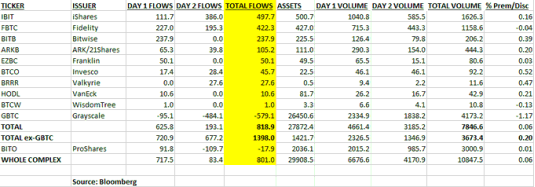
ETF capital inflow statistics. Source: Bloomberg
In response, JPMorgan questioned GrayScale’s high 1.5% fee, suggesting it faces dual challenges of profit-taking and capital outflows. First, investors who previously bought GBTC at a discount on secondary markets are cashing out, potentially withdrawing around 3 billion USD from GBTC to migrate into new spot ETFs. Second, due to uncompetitive fees, institutional investors holding crypto via funds may shift from futures-based ETFs and GBTC to cheaper spot ETFs.
Currently, given poor underlying price performance, all spot Bitcoin ETFs are in decline. Among the 11 ETFs, according to Yahoo Finance data as of January 12, IBIT fell the most—by 6.23%—with most others down around 6%. In terms of asset management value, GrayScale’s GBTC still dominates with over 26.9 billion USD in total assets. Bitwise’s BITB ranks second with 242 million USD, BlackRock’s IBIT stands at 114 million USD, while Franklin EZBC, Fidelity FBTC, Valkyrie BRRR, and VanEck HODL remain under 100 million USD.
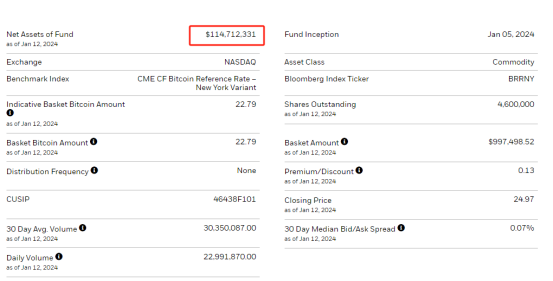
BlackRock IBIT ETF net assets. Source: iShares official website
Despite heated discussions around ETFs, not all institutions welcome them. Due to Bitcoin’s extreme volatility and investor protection concerns, four Wall Street firms have explicitly stated they will not offer Bitcoin-related products to clients. Vanguard, the world’s second-largest asset manager overseeing about 8 trillion USD in assets, said Bitcoin products are inconsistent with long-term portfolio categories like stocks, bonds, and cash, and thus will not allow clients to purchase any of the recently launched 11 spot Bitcoin ETFs. Financial advisors Merrill Lynch, Edward Jones, and Northwestern Mutual have similarly informed clients such investments are currently prohibited under policy.
In the long run, there remains strong consensus that Bitcoin ETFs will attract massive institutional inflows. But in the short term, internal digestion of existing crypto capital may become a key trend. JPMorgan anticipates exactly this—suggesting even without new external capital, the shift from existing crypto products into new ETFs could funnel up to 36 billion USD into these ETFs.
This redirection of existing capital clearly signals intensifying competition among ETFs. Ark Invest CEO Cathie Wood bluntly stated she expects only 3–4 of the 11 spot Bitcoin ETFs to remain operational five years from now.
03 Coinbase Sparks Controversy: Centralization Risk Emerges
Beyond ETF issuers, Coinbase—quietly profiting—has drawn fresh scrutiny. Among the 11 ETF products, 8 have selected Coinbase as custodian, fueling a 220% surge in Coinbase stock. However, this heavy reliance on a single custodian raises concerns about centralization risk.
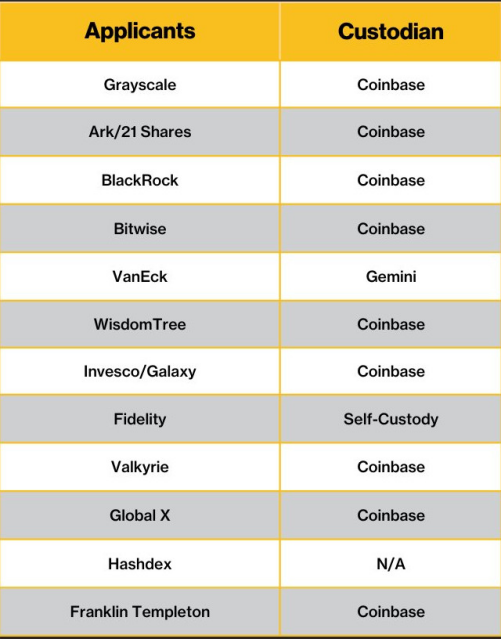
Eight out of 11 ETFs chose Coinbase as custodian. Source: X platform
To clarify, here is a brief overview of how spot Bitcoin ETFs operate and their key roles. In a simplified ETF model, five main participants exist: first, the ETF issuer (management company), such as BlackRock or Grayscale; second, market investors (retail and institutional); third, the custodian; and finally, market makers and authorized participants (APs). Typically, the latter two roles are held by separate entities, though overlap does occur in practice.
ETF issuers earn solely through management fees. Their primary function is creating ETF shares linked to the price of physical BTC, which they then deposit with a registered custodian in secure digital vaults—or directly into digital wallets. Once created, shares are handed to authorized participants (APs), who introduce them into the market, enabling retail investors and traders to buy and sell via brokers or exchanges.
APs are arguably the most critical market participants. While issuers handle product creation, APs manage share creation and redemption. Their income comes from selling products, providing liquidity, and arbitrage. Therefore, issuers typically select APs with sufficient expertise and operational capacity. Currently, all 11 ETFs have chosen Jane Street—a powerful, established ETF-focused firm—as their designated AP. BlackRock and Invesco additionally include JPMorgan Chase, while GBTC adds Virtu Americas.
Returning to custodians: as asset holders and managers, custodians bear responsibility for safeguarding vaults. Their revenue model is simple—charging a percentage-based custody fee on managed assets. Issuers require three things from custodians: regulatory compliance, security and stability, and—given crypto-specific needs—experience in the crypto space. Under strict U.S. regulation, few firms meet all three criteria, making Coinbase a preferred choice.
However, Coinbase itself faces significant challenges.
First, compliance concerns: Coinbase is currently embroiled in litigation with the SEC over allegations of operating as an unregistered exchange and broker-dealer. This alone casts doubt on its compliance status. Although CFO Alesia Haas stated the custody business is unrelated to the ongoing SEC case and that custodial funds are legally segregated from other operations, the market remains skeptical. Second, concentration risk: Coinbase serves as custodian for eight ETFs. Any corporate issue could severely impact these ETFs. Given that transaction revenue accounts for as much as 43% of Coinbase’s total income, if the SEC’s claims about unregistered securities are upheld, Coinbase’s core business would face massive disruption—potentially triggering cascading effects. This is precisely why Coinbase must stand firm against the SEC. Mizuho Securities analyst Dan Dolev emphasized that nearly one-third of Coinbase’s revenue is “at risk,” as adverse outcomes could force separation of its services.
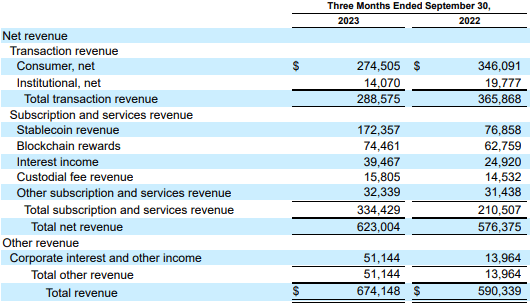
Transaction revenue is Coinbase’s primary income source. Source: Coinbase earnings report
Additionally, ETF approval brings both opportunities and risks for Coinbase in the short term. On one hand, new capital inflows could boost trading volumes. On the other, it pressures Coinbase to reduce trading fees to compete with lower-cost spot ETF products.
Overall, spot Bitcoin ETFs have been live for less than a week but are already impacting the crypto market across capital flows, price movements, and ecosystem competition. While it remains uncertain whether billions in new capital will actually flow in, one thing is clear: the “catfish effect” triggered by ETFs will persist for a considerable time.
Join TechFlow official community to stay tuned
Telegram:https://t.me/TechFlowDaily
X (Twitter):https://x.com/TechFlowPost
X (Twitter) EN:https://x.com/BlockFlow_News












