









Bitcoin falls below $43,000, facing further short-term selling pressure
TechFlow Selected TechFlow Selected
Bitcoin falls below $43,000, facing further short-term selling pressure
Given institutional participants' demand for ETFs, the long-term outlook for Bitcoin remains fundamentally bullish.
 Navigating Web3 tides with focused insights
By Mary Liu, BitpushNews
Following the debut of the U.S.'s first spot Bitcoin ETFs last Thursday, Bitcoin briefly hit a two-year high above $49,000 before rapidly pulling back. By early Monday, it had dipped to a local low of $41,500 and was consolidating around $42,600, confirming CryptoQuant analysts' "sell the news" warning issued in December last year.
"Sell the news" is a term used in capital markets referring to situations where asset prices, leverage, and sentiment rise ahead of a bullish event but quickly plunge afterward.
At the time, CryptoQuant wrote in its report: "The unrealized profit margin for short-term Bitcoin holders is as high as 30%, which historically precedes price corrections (red circles in chart below). Additionally, short-term holders are still realizing profits through selling, while rebounds typically occur after short-term losses have been realized."
Analysts at Bitfinex believe this sell-off was primarily driven by short-term holders—those with an average purchase cost of around $38,000—taking profits.
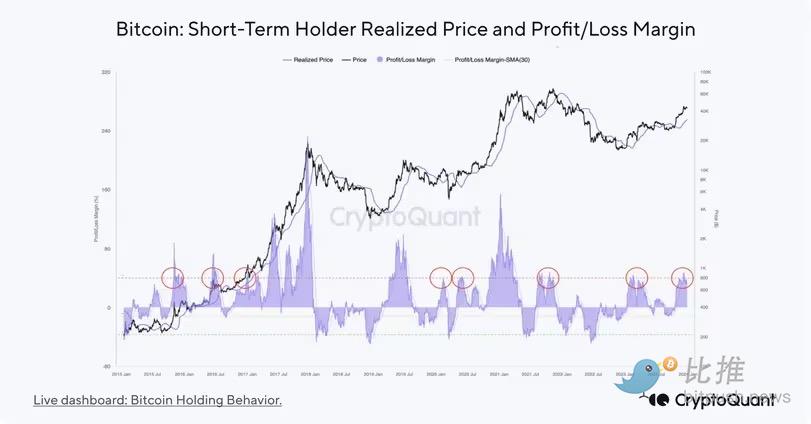
Historically, such "sell the news" events are common. After CME launched BTC futures in 2017, Bitcoin reached a local peak near $20,000. In 2021, BTC surged again, peaking at $65,000 following Coinbase's IPO, before entering another downturn.
Alex Saunders, analyst at Citi, explained in a report to clients: "The crypto market has already moved on to the next narrative, with growing attention now focused on the potential approval of spot Ethereum ETFs."
Some experts say Bitcoin’s recent weakness stems from redemption pressure by Grayscale investors. Bernstein analysts Gautam Chhugani and Mahika Sapra stated in a Monday report that the market may need to absorb outflows from GBTC.
GBTC recorded over $2.3 billion in trading volume on its first day. So far, Grayscale has seen $579 million in total outflows, though exact figures won’t be available until tomorrow due to settlement delays. Bernstein noted: "It’s reasonable to assume new ETFs will continue absorbing GBTC redemptions. As a result, meaningful net inflows into these new products—and their impact on underlying Bitcoin demand and price momentum—may take longer to materialize."
One Month Away From a Bitcoin Crash?
Looking ahead, well-known trader and analyst Rekt Capital outlined a potential BTC price trajectory leading up to the April halving. He said any final upward move would likely show signs about two months before the event—giving bearish traders enough time to “dump” the market. Rekt Capital predicts that if Bitcoin undergoes a deeper pullback during the pre-halving period (orange zone in chart), it should happen within the next ~30 days.
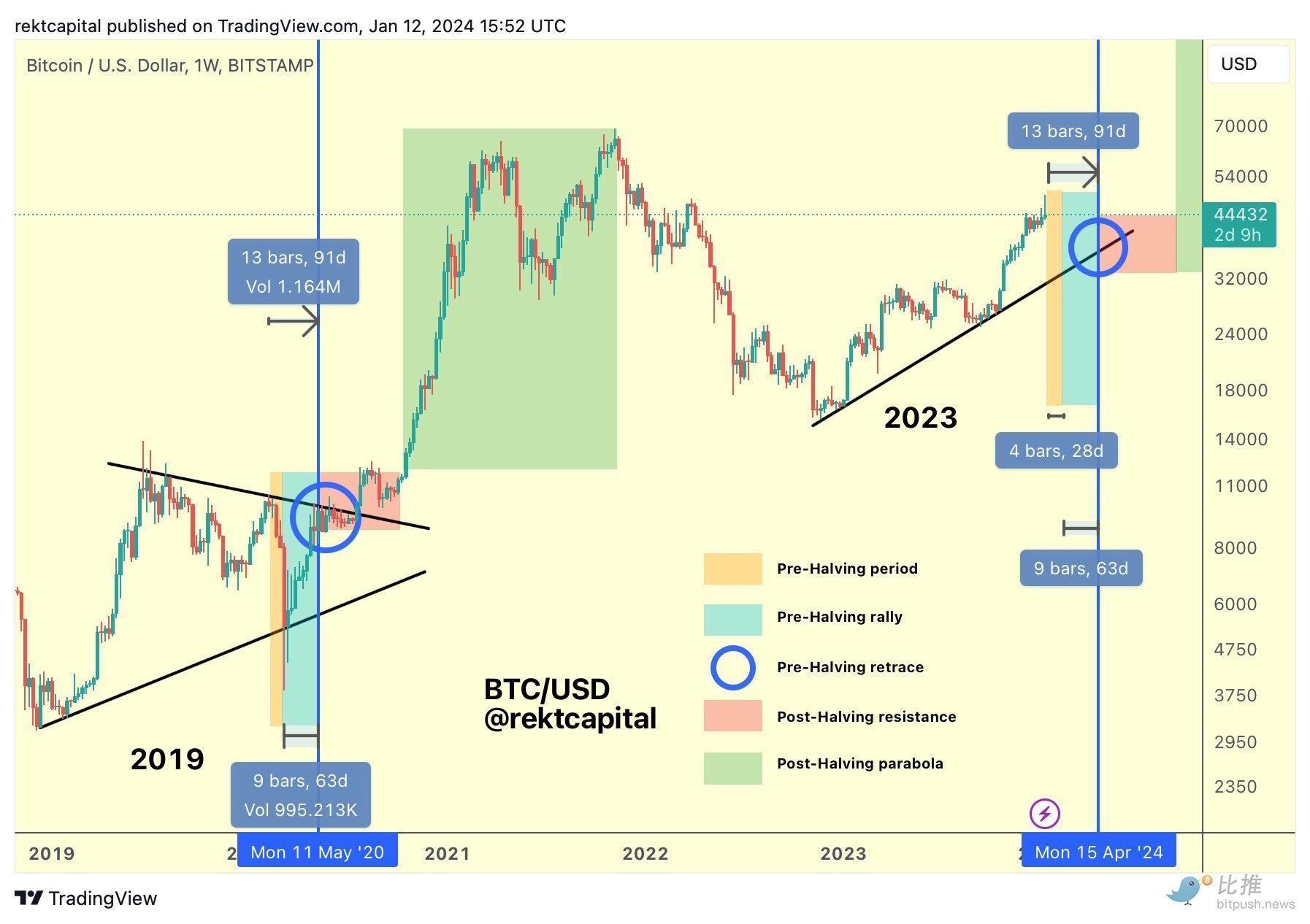
Analyst Matthew Hyland believes spot markets generally lack sufficient depth to ensure short-term stability. Meanwhile, given how long it might take for BTC/USD to regain support after last week’s 15% drop, recovery could take more than a month. He said: "Bitcoin may trade sideways for some time. The past four times we saw such heavy bearish volume on weekly charts, prices entered a consolidation phase lasting at least 3–4 weeks. If this dominance breaks, the environment could favor Ethereum and altcoins."
Analysts at Japanese crypto exchange bitBank said in an email: 'Bitcoin may remain vulnerable to profit-taking sell-offs in the short term, but downside risks appear limited given low U.S. Treasury yields and optimistic market expectations for earlier Fed rate cuts.'
bitBank believes the psychological $40,000 level will act as near-term support for Bitcoin. On the other hand, analysts at 10x Research led by Markus Thielen said in a Monday report they expect support at the lower level of $38,000.
Meanwhile, FxPro market analyst Alex Kuptsikevich believes that given Bitcoin’s gains of over 150% in 2023, $40,000 represents 'a typical range for a correction'.
CryptoQuant analysts added that Bitcoin could fall further to $32,000—the realized price level for short-term holders.
Long-Term Outlook Remains Fundamentally Bullish
Despite short-term volatility, long-term expectations for Bitcoin remain broadly positive, fueled by institutional demand for ETFs.
Henry Robinson, founder of crypto fund Decimal Digital Group, said: 'Bitcoin ETFs will transform the industry and open new opportunities for traditional wealth management—bringing fresh investment avenues for pensions, endowments, insurers, sovereign wealth funds, retirement plans, trusts, and more.'
Bitfinex analysts believe the market may still experience adjustments and pullbacks in the first half of this year. Nevertheless, three factors will continue supporting Bitcoin’s price. First, a significant increase in ERC-20 stablecoins on exchanges signals rising market speculation and investor confidence. Historically, stablecoin expansions lead to higher buying volumes.
Second, open interest in CME Bitcoin futures contracts remains elevated, hitting a year-to-date high even before the ETF approval announcement and staying strong afterward. This indicates sustained institutional interest in Bitcoin, albeit through derivatives rather than direct holdings.
The third support pillar is the steadfast positioning of long-term holders, highlighting market resilience despite vulnerability to short-term fluctuations.
Join TechFlow official community to stay tuned
Telegram:https://t.me/TechFlowDaily
X (Twitter):https://x.com/TechFlowPost
X (Twitter) EN:https://x.com/BlockFlow_News
 比推 BitpushNews











