









Data Availability Solutions and Sector Project Overview
TechFlow Selected TechFlow Selected
Data Availability Solutions and Sector Project Overview
After the Cancun upgrade is officially completed, the DA public chain may face direct business competition with Ethereum.
 Navigating Web3 tides with focused insights
Author: Uncle Jian
Overview of DA Solutions
In the previous article on data availability, "Web3 Explained | Why Is Data Availability So Important for Layer 2? (Part 1)", we discussed how the main challenge L2s face regarding data availability (DA) is a trade-off between security and cost. This trade-off has led to two types of solutions—on-chain and off-chain DA approaches—which we will now examine in detail.
On-Chain Solution: Proto-Danksharding
An on-chain solution means that L2 continues to use Ethereum as its DA layer while relying on Ethereum to reduce data availability costs.
Proto-Danksharding (also known as EIP-4844) is Ethereum's approach to lowering DA costs. It introduces a new transaction format called "blob," where L2-uploaded transaction data is temporarily stored in the Ethereum consensus layer in blob format, offering cheaper data availability for L2.
This implies that in the future, Ethereum will function like a temporary bulletin board—the posted data will be deleted after a certain period, so L2s must independently back up all their data.
Proto-Danksharding is expected to launch with Ethereum’s upcoming Cancun upgrade by the end of this year.
Off-Chain Solutions
Simply put, off-chain solutions no longer rely on Ethereum for data availability but instead seek more cost-effective alternatives. Based on varying degrees of decentralization and security, these solutions can be categorized into four types: Validium, Data Availability Committee (DAC), Volition, and general-purpose DA solutions.
Validium
In Ethereum's early exploration of scaling solutions, using validity proofs with on-chain data publication was called ZK Rollup; the same method with off-chain data publication was referred to as Validium. Similarly, fraud-proof-based systems with on-chain data were called OP Rollup, while those publishing data off-chain became Plasma.
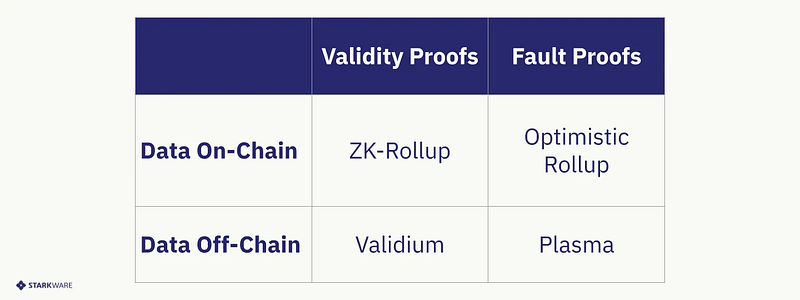
Plasma has since been abandoned by Ethereum, and after declaring its rollup-centric roadmap, Validium also fell out of favor. However, because Validium stores transaction data off-chain managed by a centralized operator, it is now specifically recognized as a highly centralized DA solution.
While this model offers strong privacy protection and minimizes DA costs, it carries the highest risk—if the off-chain operator fails or acts maliciously, users’ funds may become irrecoverable.
Data Availability Committee (DAC)
To mitigate single-point-of-failure risks from a sole operator, most current Validium implementations are paired with a Data Availability Committee (DAC). A DAC functions similarly to a consortium chain, composed of multiple trusted or authoritative nodes that store copies of transaction data and can release it publicly if the operator malfunctions or behaves maliciously, enabling users to withdraw their funds.
DACs have relatively low operating costs, but from a security standpoint, a small DAC (8–10 members) remains vulnerable to private key theft or coordinated malicious actions, potentially leading to frozen or stolen on-chain assets.
Volition
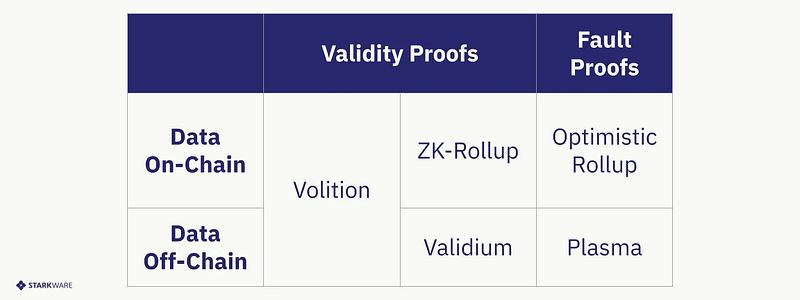
Volition is a hybrid model allowing users to choose whether individual transaction data is published on-chain or off-chain. For example, on a DEX using this model, users can manage multiple accounts—transferring assets to an off-chain data account for frequent, low-cost transactions, then moving them back to an on-chain data account afterward.
Therefore, compared to pure Validium, Volition inherits part of Ethereum’s security.
General-Purpose DA Solutions
The above-discussed off-chain DA solutions are primarily framed within the context of Ethereum. There is another category—general-purpose DA solutions—that can serve not only Ethereum L2s but also other chains and projects. Examples include EigenDA, Celestia, and Avail, which will be detailed in the following section.
Although these general-purpose DA solutions differ technically, they share a common goal: enhancing data availability security to achieve public blockchain-grade safety. As such, they each feature their own validator nodes, block producers, and consensus mechanisms—but without smart contract functionality.
Introduction to DA Layer Projects
Under the modular blockchain paradigm, Ethereum dominates nearly 90% of the consensus and settlement layers, while the execution layer has evolved into a "four-way rivalry" among Optimism, Arbitrum, Starknet, and zkSync. In contrast, the data availability (DA) layer remains in its infancy. Below, we introduce several popular DA layer projects for reference.
StarkEx
Developed by StarkWare, StarkEx is a framework designed to provide scalability solutions tailored to specific applications. Since it also offers data availability solutions, it is classified as a DA layer project. StarkEx supports three DA modes: on-chain, Validium, and Volition. Unlike pure Validium, StarkEx integrates DAC into its Validium implementation to enhance security.
Projects currently using StarkEx for data availability include dYdX v3, Immutable, Sorare, and DeversiFi.
zkPorter
zkPorter is an off-chain DA solution proposed in April 2021 by Matter Labs, the team behind zkSync. zkPorter is a dedicated chain exclusively for L2 transaction data publication, secured via a PoS consensus mechanism. zkSync token holders can stake their tokens to become Guardians of zkPorter, responsible for verifying and signing blocks. This is one reason why the community speculates that zkSync will issue and airdrop its token—because zkPorter’s consensus mechanism involves a governance token.
Additionally, according to Matter Labs’ vision, accounts on zkPorter will seamlessly interact with accounts or contracts on ZK Rollup (zkSync Era). From the user’s perspective, the most noticeable difference might simply be that zkPorter accounts offer significantly lower fees.
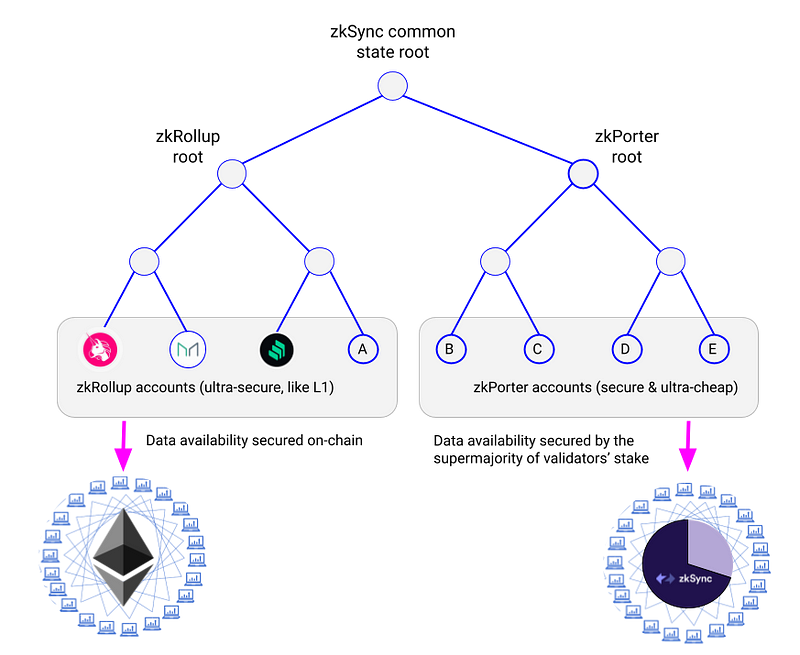
ZK Rollup and zkPorter offer strong interoperability
However, it’s worth noting that despite being proposed years ago, zkPorter has seen no recent progress, and Matter Labs has not disclosed any information about a testnet or development timeline.
EigenDA
EigenDA is a DA layer project built on EigenLayer. However, fundamentally, unlike general-purpose DA projects such as Celestia and Avail, EigenDA is middleware—it does not have its own consensus mechanism. Instead, its security derives from EigenLayer’s restaking model using Ethereum validators.
EigenDA is also EigenLayer’s first Active Validation Service (AVS). Restakers re-stake ETH into EigenDA to perform data validation and earn rewards, while buyers (L2s) publish data to EigenDA to achieve lower transaction costs and higher TPS.
Although EigenDA has not yet launched a testnet, many teams—including Mantle, Layer N, and Offshore—have announced plans to integrate it into their L2 solutions.
Celestia
Celestia is a general-purpose DA blockchain with its own validator nodes and PoS consensus mechanism. While more expensive than other off-chain DA solutions, it offers significantly higher security.
A Celestium is an Ethereum L2 that uses Celestia as its DA layer while relying on Ethereum for settlement and consensus.
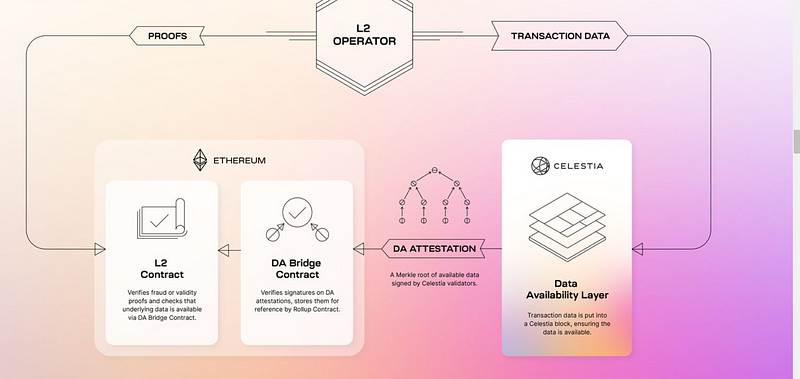
The way Celestium achieves data availability is illustrated below:
-
Celestium uploads proof data to Ethereum as usual, but publishes transaction data to Celestia;
-
Celestia’s validators sign data availability proofs and send them to a DA Bridge Contract deployed on Ethereum for verification and storage;
-
Ethereum-based L2 contracts can access this data at any time.
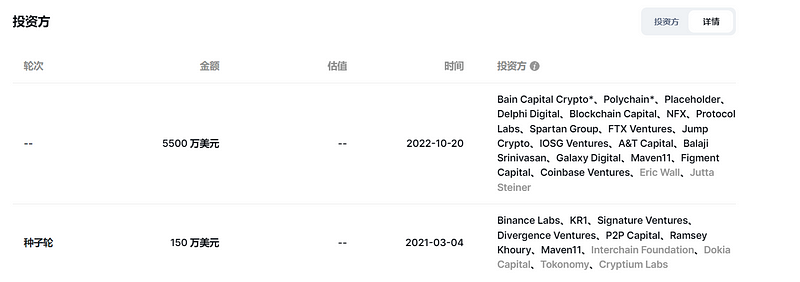
Celestia has completed two funding rounds: $1.5 million in a seed round in March 2021 and $55 million in a second round in October 2022, attracting investment from multiple prominent VCs.
Moreover, Celestia’s airdrop announcement on September 26 reignited attention toward modular blockchains and the DA layer sector.
According to official statements, Celestia will airdrop TIA (its native token) to 7,579 developers and 576,653 on-chain addresses. Developers eligible include contributors to public goods and critical protocol infrastructure, Eth Research, and open-source contributors to DA layer projects (e.g., Avail, EigenLayer, and Solana). On-chain addresses include active users of Ethereum rollups, stakers on Cosmos Hub and Osmosis, and IBC relayers.
Avail

Originally launched in 2020 by Polygon Labs as a project addressing data availability issues, Avail separated from Polygon in March this year to operate as an independent DA blockchain, no longer limited to Polygon or Ethereum.
Technically, Avail is slightly more complex than Celestia. Its mainnet is expected to launch in Q1 2024, though currently only the testnet is live. The Avail testnet has entered its second phase, offering multiple participation options:
-
Token acquisition: Users can obtain AVL testnet tokens to explore staking and nomination features;
-
Blockchain development: Users can freely develop modular blockchain apps or chains integrated with Avail;
-
Network roles: Users can join the testnet as validators or light clients to help advance the data validation process.
Clearly, interacting with DA layer projects presents a higher barrier than engaging with L2s. However, given Celestia’s announced airdrop, interested users should consider exploring early interactions. Avail currently runs a testnet incentive campaign called “Clash of Nodes Challenges,” but the verdict is clear: merely running a node isn’t enough to earn points—you need to apply as a validator, which is challenging. Regular users should wait for new tasks and stay updated.
Conclusion and Reflection
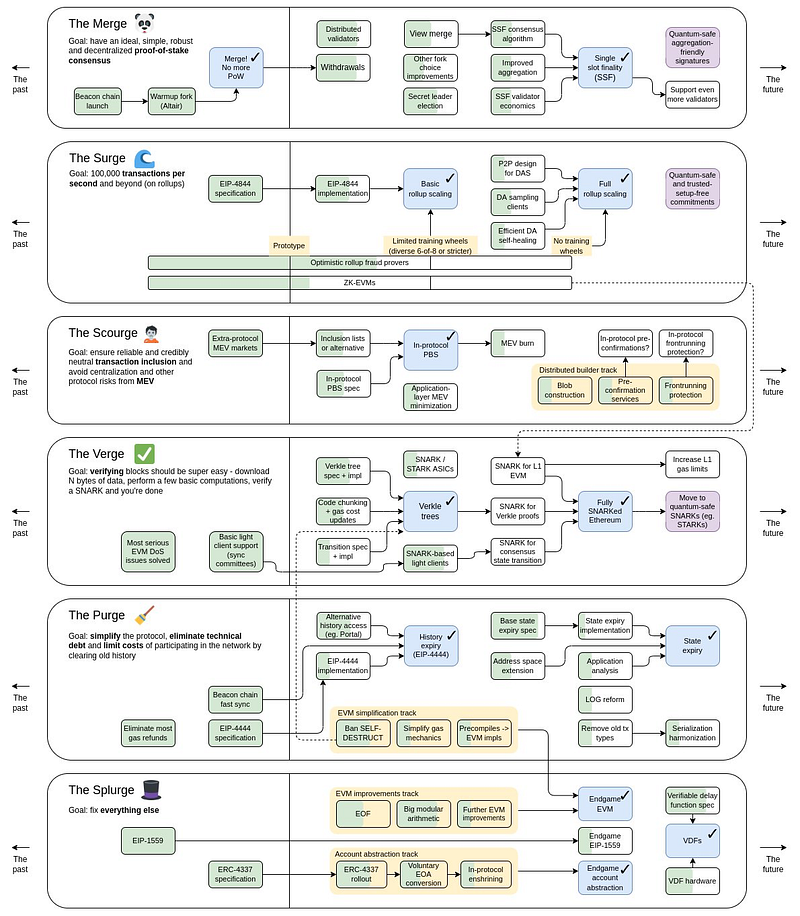
In Vitalik’s 2022 vision of Ethereum’s future roadmap, it was clearly shown that after The Merge, the next stage—The Surge—focuses on further reducing data publishing costs for L2s through EIP-4844. This indicates that Ethereum intends to separate only the execution layer while retaining control over the DA, settlement, and consensus layers.
Thus, it’s understandable why proponents of EIP-4844 and platforms like L2BEAT are reluctant to classify scaling projects using off-chain DA solutions as true L2s.
Once the Cancun upgrade is complete, off-chain DA layer projects—especially DA blockchains—may face direct competition with Ethereum itself. Beyond claiming lower costs, how will they strengthen their competitiveness?
Celestia’s decision to launch its token and incentivize developers and active on-chain addresses at this moment likely reflects strategic considerations to gain early traction and build community support. Meanwhile, users may look forward to whether major opportunities—similar to those seen with Optimism or Arbitrum—will emerge from the evolving competition in the DA layer space.
Join TechFlow official community to stay tuned
Telegram:https://t.me/TechFlowDaily
X (Twitter):https://x.com/TechFlowPost
X (Twitter) EN:https://x.com/BlockFlow_News
 @jianshubiji











