








What exactly are people "minting" when they inscribe Bitcoin?
TechFlow Selected TechFlow Selected
What exactly are people "minting" when they inscribe Bitcoin?
Will it be zeroed out as a vulnerability by core developers?
 Navigating Web3 tides with focused insights
Author: Mu Mu
The recent surge in "inscriptions" has left many people somewhat bewildered. Why are seemingly valueless "air" items being so enthusiastically embraced? Every day in online communities, people chant "mint inscriptions," yet many still don't fully understand what "minting inscriptions" actually means. It feels like another wave might quickly pass by. Can these highly controversial creations really last? Today, we'll explore the essence and value logic of Bitcoin inscriptions, examine the criticisms they face, and discuss exactly what it means to 'mint' Bitcoin inscriptions.
The Nature of Inscriptions and BRC20
As early as January 3, 2009, the genesis block of Bitcoin recorded the first inscription on the network. Satoshi Nakamoto embedded the headline from that day's edition of The Times in hexadecimal format on-chain —— "The Times 03/Jan/2009 Chancellor on brink of second bailout for banks."
The terms "inscription" and "engraving" are used because information recorded on a decentralized, antifragile blockchain is akin to carving into solid stone — permanent and indestructible. In the past, people have inscribed messages onto the Bitcoin chain — declarations of eternal love like "1314," or other meaningful personal data. Today, by assigning serial numbers to satoshis (the smallest unit of Bitcoin), we can now track token issuance and circulation. Interestingly, today’s BRC20 tokens bear striking resemblance to the ancient stone money of Yap Island.
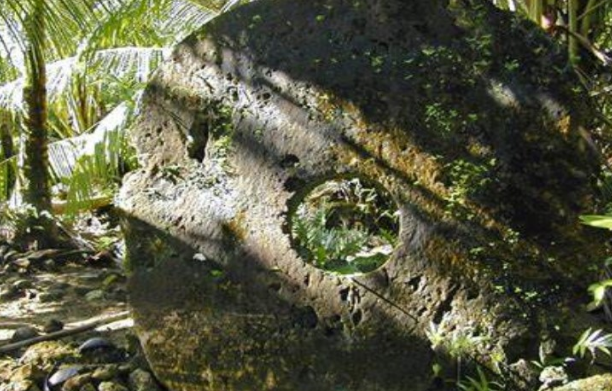
Stone money of Yap Island
There are also numerous modern parallels that help explain inscriptions and BRC20:
In 1990 and 1991, Disney dollar bills were submitted to the U.S. government for approval as legal tender to commemorate their release. A special one-dollar bill was issued featuring a first-day cover with a Walt Disney commemorative stamp and an image of Mickey Mouse.
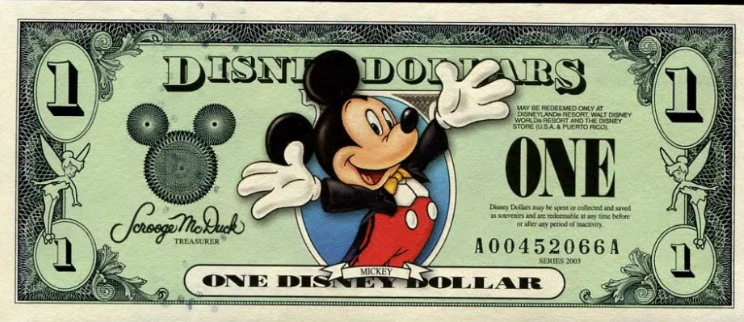
One-dollar Disney Mickey commemorative banknote
Similarly, within China, there’s a current frenzy over limited-edition “dragon notes” — collectible bills printed on various denominations of currency. Leveraging the strong anti-counterfeiting features, unique serial numbers, and tradability of fiat currency, these commemorative notes have become distinctive collectibles. Clearly, a one-dollar commemorative note holds far more than just one dollar in value.
The medium for inscriptions replaces paper bills with the smallest denomination of Bitcoin: the satoshi. When certain satoshis are inscribed with NFT images or scripts related to BRC20 token issuance and transactions, Bitcoin confers upon them properties such as anti-counterfeiting and immutability. With these attributes, NFTs and BRC20 tokens inscribed on Bitcoin inherit the strongest network security in the crypto industry as their "backbone," maximizing antifragility. Combined with meme-driven FOMO, the Bitcoin inscription craze isn’t just a fleeting trend but shows real staying power, with BRC20 even exhibiting a spiral upward trajectory. Of course, the driving forces behind the inscription boom go beyond just this...
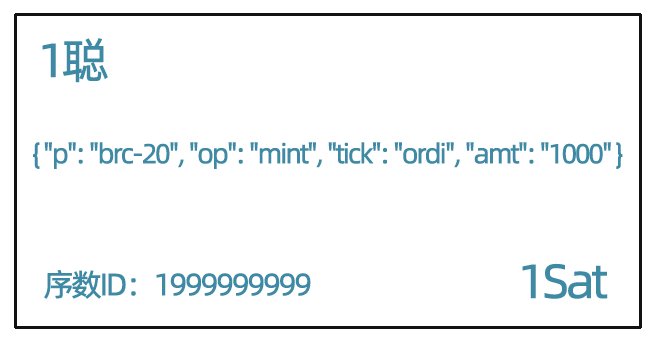
An analogy using commemorative notes to represent BRC20
Driving Forces Behind the Inscription Boom
Explaining the phenomenon of the inscription boom isn't straightforward — it may be more complex than it appears, driven by several interrelated factors:
1) Memes: An inexplicable mysterious force
Memes are an enigmatic and hard-to-explain force, primarily fueled by FOMO (fear of missing out). Most memes are often dismissed as mere "air." Yet perhaps precisely because they are "air," they transcend detailed roadmaps and rigid definitions, opening up unlimited imagination. They’re no longer confined by whitepapers but instead derive value through collective consensus. Whether early Bitcoin or BRC20, they are both "air" and not "air" — at this moment, they function more as vehicles for emotional speculation.
This phenomenon has long existed in other markets. Thus, we see extraordinary events or figures — such as the Spring Festival Gala, suddenly viral celebrities, or Elon Musk tweeting — quickly spawn memes that channel public sentiment. Whether driven by FOMO or curiosity, as long as there's market demand, these memes will emerge. Behind the scenes, capital and institutions often amplify this momentum.
2) BRC20 introduces innovative assets to the market
BRC20 resembles NFTs but isn't quite an NFT; it's similar to fungible tokens but not entirely the same.
Compared to ERC20 (Ethereum’s dominant fungible token standard), BRC20 appears more open and fair, backed by the strongest asset consensus in crypto. During the 2017 ERC20 boom, Ethereum’s position wasn’t yet firmly established.
Compared to ERC721 (Ethereum’s primary NFT standard), BRC20 allows minting individual units like NFTs, yet enables easier liquidity provisioning, simplifies fungible accounting, and can be directly listed on major trading platforms — avoiding the liquidity drought issues common with traditional NFTs.
3) Expectations around the Bitcoin ecosystem
Memes have already wielded significant influence over the past few years. Now, they’ve latched onto the emerging Bitcoin ecosystem, making things even more explosive. Bitcoin’s status as the elder statesman remains rock-solid. As a symbol of consensus within the crypto community, initiatives like BitcoinFi and Bitcoin NFTs have been brewing for some time. As early as 2013, voices called for expanding Bitcoin’s digital gold functionality, but progress stalled due to the blockchain trilemma — scalability remained unsolved, leaving pioneers to experiment without clear direction.
Ethereum itself originated from Vitalik Buterin’s proposal, initially developed within the Bitcoin community, aiming to extend smart contract capabilities. In recent years, Ethereum’s ecosystem explosion and Layer2 rollouts have indirectly stimulated development in the Bitcoin ecosystem. The proven paths and successful models pioneered by Ethereum serve as blueprints, giving Bitcoin developers confidence and direction.
Thus, building upon existing Bitcoin scaling solutions like SegWit, the Ordinals protocol and BRC20 successfully delivered a powerful one-two punch...
4) Halving pressure and internal momentum within the Bitcoin community
Although previous Bitcoin halvings were followed by bull markets, most in the Bitcoin community recognize that block rewards are dwindling. Miners relying solely on block subsidies cannot sustainably maintain operations indefinitely. Therefore, both the broader Bitcoin community and miners urgently desire a thriving Bitcoin ecosystem to address sustainability concerns well before the next halving.
On January 12, according to Dune Analytics, cumulative fees from Bitcoin Ordinals inscription mints exceeded 5,506 BTC (~$254 million at $46,032/BTC). Clearly, inscriptions are already generating substantial revenue for block producers, making miners key beneficiaries of Bitcoin inscriptions, particularly BRC20.
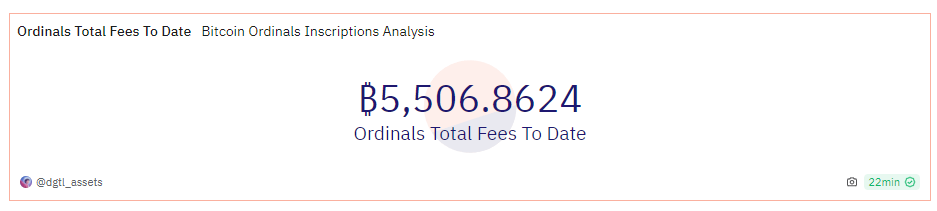
Cumulative inscription minting fees, source: Dune Analytics
5) Bitcoin ETFs and macroeconomic conditions
The biggest expectation this year is undoubtedly the widely anticipated spot Bitcoin ETF, while outside the crypto space, the end of the U.S. interest rate hiking cycle looms large.
We've covered the significance of the spot Bitcoin ETF extensively before, and its importance needs little explanation. On the macro front, the expected conclusion of the Fed’s rate-hiking cycle in 2024 — possibly transitioning into rate cuts — signals enhanced dollar liquidity and increased capital inflows into markets. With the Bitcoin halving approaching, these overlapping positive catalysts further elevate expectations for the Bitcoin ecosystem. This foundation of anticipation brings greater certainty for investors, reinforcing the sustainability of the inscription boom.
Viewed by core developers as a bug — will it go to zero?
Bitcoin inscription memes, bolstered by Bitcoin’s consensus, seem to have found ideal conditions for growth. Yet they remain controversial, drawing sharp criticism from skeptics.
The most notable recent concern stems from attitudes among some Bitcoin core developers, such as Luke Dashjr, a Bitcoin core developer and founder of Eligius mining pool. Luke has repeatedly denounced inscriptions and BRC20 on social media, arguing they exploit a vulnerability in Bitcoin Core to flood the blockchain with spam. In short, Luke and others want to patch and block these protocols as bugs. He later submitted a formal proposal — sparking massive controversy!
Since core developers hold the authority to modify the Bitcoin client, many feared the end of inscriptions — if the alleged "bug" were patched, all NFTs built on the Ordinals protocol and every BRC-20 token could be erased, instantly reduced to zero.
However, the "bug" argument and resulting panic failed to trigger major market disruption. After sorting through the noise, some BRC20 tokens continued rising as if nothing had happened.
So why are people so calm despite opposition from core developers?
In reality, Bitcoin core developers form a large, decentralized group. Luke is merely one member — his objections alone won’t lead to immediate changes. Even if most core developers agreed, client upgrades aren’t guaranteed, since the power to upgrade lies with block producers. Within the Bitcoin community, roles often overlap: many developers are also miners. Inscriptions are already deeply tied to their interests. Maintaining stable and sustainable inscription protocols benefits the broader Bitcoin ecosystem and majority of participants.
Most believe Luke and other opponents won’t succeed. Even though Luke controls a mining pool, the largest hashpower pools — representing the true interests of block producers — actively support BRC20.
Recent news confirms this: Luke’s proposal to ban inscriptions was rejected by multiple core developers. Bitcoin Core developer Ava Chow summarized that the proposal sparked huge controversy and wasn’t even worth further discussion.
Existence implies legitimacy. Given the strong incentives and broad consensus, inscriptions are likely here to stay.
Summary
Clearly, the inscription boom is no accident. The Bitcoin community and ecosystem were prepared. This bottom-up innovation caught institutional capital off guard — from aloof skepticism to full participation. While BRC20 may not be a perfect protocol, and future alternatives might eventually replace it, one thing is certain: it has opened the door to the Bitcoin ecosystem. The rise of Bitcoin’s ecosystem is now inevitable.
Join TechFlow official community to stay tuned
Telegram:https://t.me/TechFlowDaily
X (Twitter):https://x.com/TechFlowPost
X (Twitter) EN:https://x.com/BlockFlow_News
 白话区块链
白话区块链











