









Bitcoin's first trading day: a crucial watershed moment
TechFlow Selected TechFlow Selected
Bitcoin's first trading day: a crucial watershed moment
Bitcoin spot ETFs have gained regulatory approval and entered Wall Street, and they will continue to evolve and grow.
 Navigating Web3 tides with focused insights
Author: Qin Jin
If calculated by U.S. Eastern Time, today marks the first day of trading for spot Bitcoin ETFs. It is also a historically significant day. Yesterday, the U.S. Securities and Exchange Commission (SEC) officially approved 11 spot Bitcoin ETFs to begin trading on securities exchanges. This is an important "watershed" moment between crypto finance and traditional finance.
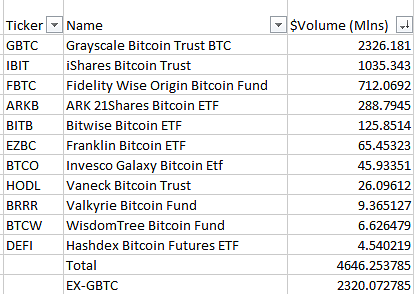
Within the first few minutes of market opening, trading volume led by BlackRock's IBIT reached $2.3 billion. Affected by this, Bitcoin surged past $48,000 last night—the first time since March 2022—rising 4.64% during the session.
According to the latest disclosed data from Eric Balchunas, senior ETF analyst at Bloomberg: On its first trading day, there were a total of 700,000 individual transactions in Bitcoin ETFs—twice as many as Invesco QQQ Trust. Total daily trading volume reached $4.6 billion. Grayscale’s GBTC accounted for over $2.3 billion in volume, half of the total. BlackRock’s IBIT exceeded $1 billion, Fidelity’s FBTC surpassed $710 million, ARK 21Shares exceeded $286 million, and Bitwise exceeded $124 million. Compared to institutional buying, this represents grassroots power.
Gabor, a strategic advisor at VanEck, is someone who enjoys thinking deeply and expressing himself clearly. He said this is the first time in history that "Main Street" has beaten Wall Street. That is the spirit of Bitcoin. The first batch of U.S. Bitcoin ETFs officially started trading after market open today. To some extent, it can be seen as the initial public offering (IPO) of institutional Bitcoin. I hope to see large institutions, investors, and traders deploying capital. We made ETFs a reality.
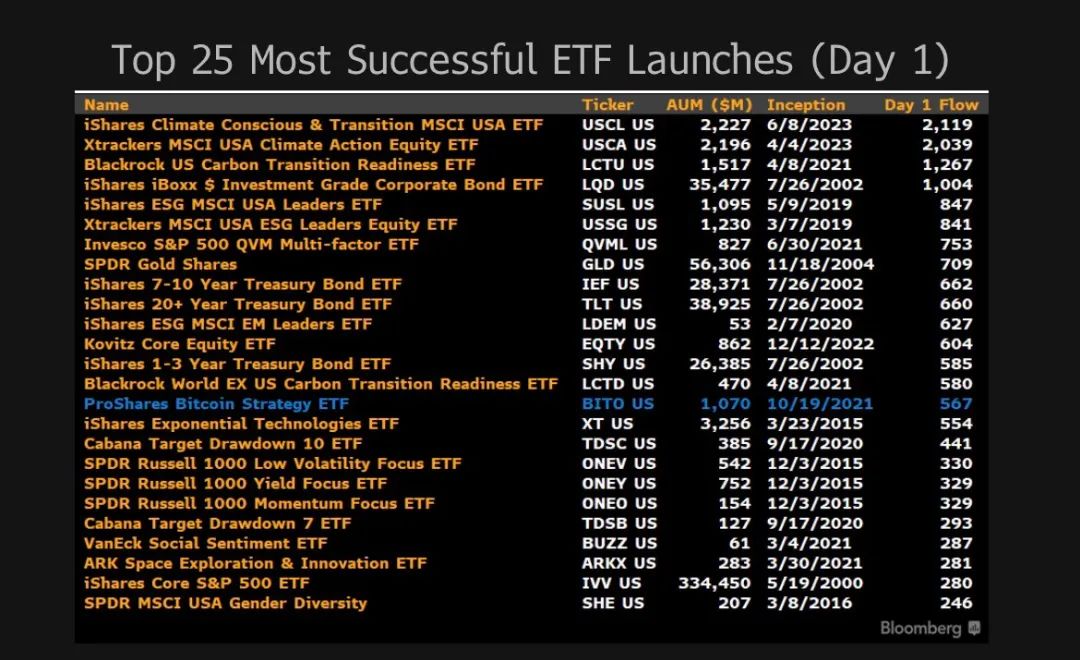
Eric Balchunas said if Bitcoin ETFs surpass ESG climate ETFs to become the top performer, it would carry symbolic significance for the era—just like how Nirvana’s *Nevermind* beat Michael Jackson’s *Dangerous* in 1991.
According to previously shared screenshots from Eric Balchunas, ESG climate ETFs have been among the most successful 25 ETFs ever launched. BlackRock alone accounts for 10 of them. Notably, the single-day trading volume of the ESG climate ETF “iShares Climate Conscious & Transition MSCI USA ETF” reached $2.2 billion upon launch.
As previously reported by Bloomberg, ESG-focused funds have seen record growth in recent years, with BlackRock capturing half of these inflows. Among them, iShares ESG Aware MSCI USA ETF (ESGU), launched at the end of 2016, is BlackRock’s flagship ESG fund and the world’s largest ESG index fund. As of March 31, 2022, the fund had $24.88 billion in assets under management, tracking the MSCI USA Extended ESG Focus Index.
In Dan McArdle’s view, co-founder of Case4Bitcoin, if listing spot Bitcoin ETFs is likened to Bitcoin conducting an IPO at a $900 billion market cap, then the first ETF application was submitted on July 1, 2023, when BTC’s market cap was only about $1.6 billion. But unlike stocks, governments haven’t restricted non-wealthy individuals from buying BTC due to "qualified investor" rules. In other words, most ordinary people have gained access to a piece of Bitcoin’s $900 billion valuation.
Currently, there are two ways to think about Bitcoin. One perspective is: before 2011 we were seed investors, in 2012 we were Series A investors, in 2015 Series B, in 2019 Series C, in 2023 Series D, and now Bitcoin is about to go public.
Much like the mid-1990s, we can observe both retail and institutional demand. Back then, the days immediately before and after an actual IPO were strange—prices often corrected or pulled back as people took profits on allocated shares, then surged again as new demand arrived from those who hadn't participated pre-IPO.
Raoul Pal, former Goldman Sachs executive and founder of RealVision, said viewing revolutionary things like Bitcoin through this first lens feels odd. Such commentary focuses more on the process of mass adoption rather than believing it truly needs approval from authorities. Regardless, adoption will continue.
He believes ETFs are more like trade agreements between the fiat world and the cryptocurrency world. For example, the WTO allowed China’s influence to attract massive global capital, transforming China from an emerging market into the world’s second-largest economy. Bitcoin has just joined the WTO, and we’re only at the very beginning of the first phase.
Gabor discussed Bitcoin from a financial hedging perspective. He said Bitcoin is doomsday technology. In the event of a major market crash or systemic collapse, Bitcoin could not only preserve fiat savings but also support the entire capital markets infrastructure. The integration of Bitcoin with major capital markets is the greatest hedging tool in history.
Paolo Ardoino, CEO of Tether—the company behind USDT—may also feel slightly excited as spot Bitcoin ETFs make history by launching trading on stock exchanges. He directly posed a question on social media: How long will it take for Bitcoin to become the world’s most traded asset?
Everything in the world has two sides. For every cheerleader of spot Bitcoin ETFs, there is a critic.
Vanguard, the asset manager second only to BlackRock, has barred retail investors on its platform from purchasing spot Bitcoin ETFs, citing misalignment with its own investment philosophy. Fox Business journalist Eleanor Terrett stated on X that skepticism toward cryptocurrencies still exists on Wall Street.
A self-described 37-year trader, Oliver L. Velez, posted on X tagging Vanguard, saying Vanguard is losing customers in droves simply because it won’t let clients use their own money to buy spot Bitcoin ETFs. Can you imagine the scale? You need their permission to spend your own money. If they disagree with what you want to buy, you can’t do it. #Bitcoin fixes this.
Look at Vanguard’s logo—that’s literally a picture of their clients taking all their money and sailing away elsewhere. A ship called 'Opportunity' is setting sail, leaving the baby boomer generation behind. This path leads nowhere good.
One investor claimed he switched from Vanguard to Fidelity within an hour of spot Bitcoin ETFs opening today. He completely fails to understand Vanguard’s logic, and said he is almost allergic to institutions imposing their investment philosophies onto him.
Peter Schiff, New York Times bestselling author and prominent gold advocate, said: If directly buying Bitcoin is so complex, difficult, and expensive that new investors require third-party custodians to offer them spot ETFs, then what value does Bitcoin itself actually have? Bitcoin’s so-called breakthrough innovation was precisely that it doesn’t need third-party intermediaries or storage fees.
In his view, CNBC went all out today promoting newly approved spot Bitcoin ETFs to viewers. It was an endless parade of crypto industry shills pushing Bitcoin without any host pushing back or inviting bearish voices to defend the opposing case live on air.
Since its inception, Bitcoin has continuously evolved and strengthened amid criticism and praise. Now entering Wall Street under the compliant identity of “spot Bitcoin ETF,” I believe it will continue evolving and growing at the same pace. Perhaps this is exactly why grassroots investors are so obsessed with Bitcoin.
Join TechFlow official community to stay tuned
Telegram:https://t.me/TechFlowDaily
X (Twitter):https://x.com/TechFlowPost
X (Twitter) EN:https://x.com/BlockFlow_News












