









What are the criminal risks of using virtual currency and digital RMB for "money splitting"?
TechFlow Selected TechFlow Selected
What are the criminal risks of using virtual currency and digital RMB for "money splitting"?
The most likely criminal charges associated with "running scores" are aiding and abetting information network criminal activities (Helping Information Network Crime Activities罪) and concealing or disguising criminal proceeds.
 Navigating Web3 tides with focused insights
Author: Liu Zhengyao
Two days ago, the Yangpu District Court in Shanghai published an article titled "Shanghai's First Case of Digital RMB 'Money Muling' Sentenced!" introducing a case involving the use of digital RMB for money muling activities. After reading the article, Lawyer Liu noted that the specific model in this case combined digital RMB with virtual currency for money muling—akin to “betel nut plus cigarettes, unstoppable power.” Whether the combination of virtual currency and digital RMB creates new synergies or significantly increases the speed of these muling operations remains unknown. However, it appears that criminal legal risks have not notably decreased.
Case Overview
In May 2023, at an ATM in Yangpu District, Shanghai, Wang Mou withdrew cash 30 times within two hours using over ten different phone numbers registered under digital RMB accounts, totaling 123,000 yuan. This clearly suspicious behavior was detected by bank staff who then reported it to the police, leading to the case’s exposure.
Ultimately, the court found that a money muling gang led by Xiao Mou knowingly withdrew funds from digital RMB accounts provided by upstream parties aware that the money originated from illegal activities, profiting from handling fees. Specifically, after Xiao Mou agreed on withdrawal amounts with the upstream party, employees would purchase virtual currency from OTC traders (U Merchants) and transfer it to the upstream party’s wallet. In return, the upstream party would send Xiao Mou the account details and passwords of equivalent digital RMB balances, allowing Xiao Mou to dispatch runners like Wang Mou to withdraw the digital RMB in cash.
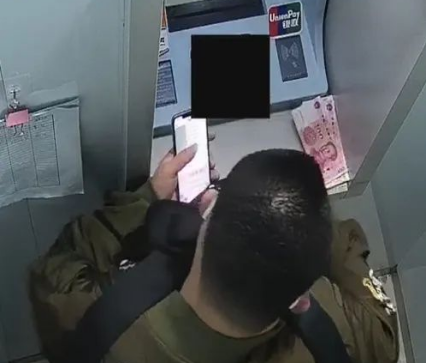
Illustration of the cash withdrawal process. Source: Official WeChat account of Yangpu District Court, Shanghai
According to judicial audit findings, Xiao Mou’s money muling gang withdrew over 10 million yuan in total from more than 900 digital RMB accounts, including over 800,000 yuan traced back to victims of telecom fraud.
In the end, Xiao Mou and others were convicted of concealing or disguising proceeds of crime, receiving prison sentences ranging from four years and six months down to seven months. The U Merchant involved was sentenced to one year and four months in prison for aiding information network criminal activities.
The Role of Digital RMB and Virtual Currency in Money Muling
Since its pilot launch in 2019, digital RMB has seen increasing application scenarios. During the promotion phase, some banks have introduced convenience measures—such as allowing cash withdrawals via just a “phone number + verification code + payment password”—to boost user adoption. This eliminates reliance on physical cards and facilitates easier offline cash withdrawals, as seen in this case.
As for virtual currency, there’s no need for Lawyer Liu to elaborate much further. Decentralized financial tools are indeed double-edged swords. While Lawyer Liu is optimistic about their future development, we must also acknowledge the central role virtual currencies currently play in cybercrime—large-scale laundering of illicit funds related to fraud, gambling (including operating illegal casinos), pyramid schemes, and even bribery. This reality is precisely why regulators launched the “Coin Disruption Campaign” following the earlier “Card Disruption Campaign.”
Criminal Risks in Money Muling
“Money muling” is industry jargon referring simply to money laundering—where muling platforms exploit third- or fourth-party payment systems, as well as virtual currency transfers, to launder proceeds from illegal activities. The most common criminal charges associated with money muling are aiding information network criminal activities (“Helping Information Network Crime Activities,” or “HINC”) and concealing or disguising criminal proceeds (“Concealment of Criminal Proceeds”). If muling personnel clearly know that the upstream party is engaged in specific crimes (e.g., fraud, operating gambling sites, pyramid schemes) and provide fund-transfer assistance before those crimes conclude, they may be deemed accomplices to those specific offenses.
Regarding widely known charges such as HINC and Concealment of Criminal Proceeds, many people focus on how prosecutors determine subjective “knowledge.” Both crimes under Chinese criminal law explicitly require proof of “knowingly providing payment settlement or other support for others’ use of information networks to commit crimes” or “knowingly hiding, transferring, or otherwise disposing of criminal proceeds.”
At this point, many might wonder: if during police interrogation I firmly claim I didn’t know the upstream party was committing cybercrimes or that the money was illicit, could that prove lack of subjective knowledge—and thus avoid criminal liability?
In reality, things are never that simple. Individuals involved in muling operations face at least two major challenges once apprehended: First, confronting seasoned investigators—can a novice, handcuffed and entering the interrogation room for the first time, withstand intense psychological pressure and fabricate a flawless narrative? Most cannot. Second, law enforcement does not rely solely on verbal statements from suspects; they also examine objective behaviors to infer true subjective intent. In practice, judicial authorities typically conduct comprehensive assessments based on various subjective and objective factors—including the suspect’s cognitive ability, prior experiences, frequency and methods of actions, relationships with others, profit levels, history of penalties related to telecom or internet fraud, and whether efforts were made to deliberately evade investigation.
Conclusion
Since its emergence, money muling has struggled to shed its identity as a major player in the underground gray economy. In recent years, Lawyer Liu frequently encounters stories of young talents—often born in the 1990s or mid-90s—who assemble muling gangs and earn hundreds of thousands, even millions, per day. Yet once such operations reach scale, getting caught becomes merely a matter of time. Ultimately, no matter what kind of business one runs, entrepreneurs must prioritize legal compliance—especially criminal compliance. Once investigated and arrested, regret comes too late; no amount of money returned can buy back a clean record.
Join TechFlow official community to stay tuned
Telegram:https://t.me/TechFlowDaily
X (Twitter):https://x.com/TechFlowPost
X (Twitter) EN:https://x.com/BlockFlow_News












