Interview with HashKey Exchange's New CEO Weng Xiaoqi: ETFs and RWAs Represent the Opportunity for Licensed Crypto Exchanges to Overtake Competitors
TechFlow Selected TechFlow Selected
Interview with HashKey Exchange's New CEO Weng Xiaoqi: ETFs and RWAs Represent the Opportunity for Licensed Crypto Exchanges to Overtake Competitors
HashKey is attempting to reshape the current crypto industry landscape, which is dominated by unlicensed crypto exchanges.
 Navigating Web3 tides with focused insights
Article by: Zhou Zhou, Foresight News
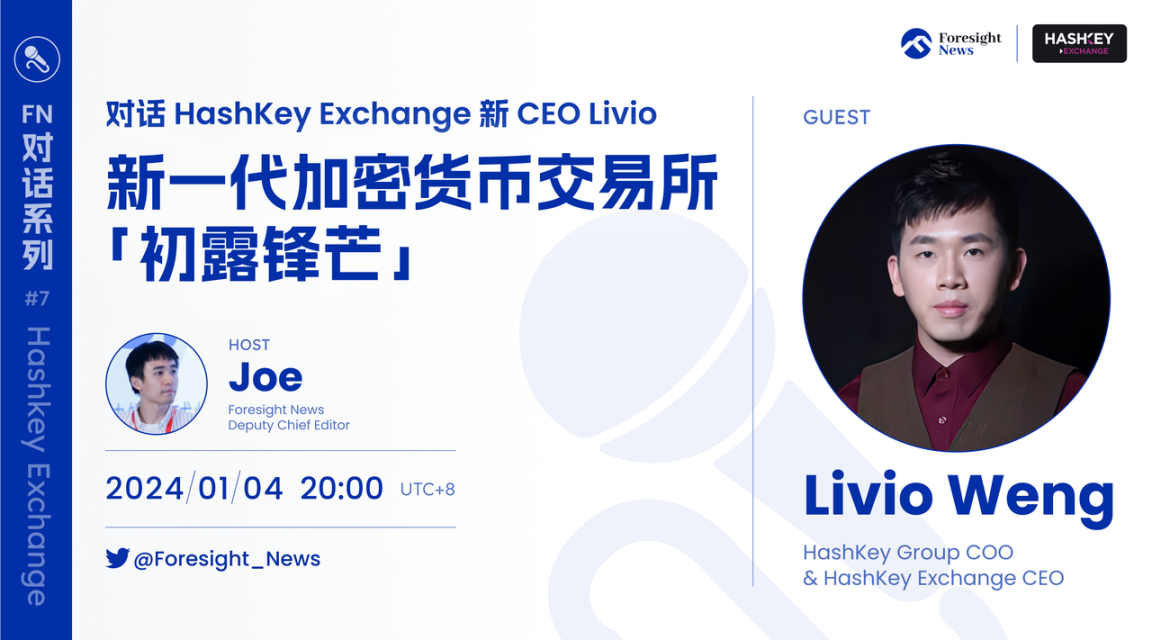
"I found out I had been appointed the new CEO only after seeing an internal email," said Livio (Weng Xiaoqi), CEO of HashKey Exchange.
On January 3, 2024, an internal letter from HashKey officially announced Livio as the new CEO of HashKey Exchange. Following this announcement, Foresight News reached out to Livio and conducted a public interview with him via Twitter Space.
During the interview, Livio provided a comprehensive review of the many challenges HashKey Exchange faced in 2023 and revealed the exchange’s macro-level goals for 2024. He also shared his personal journey in cryptocurrency and discussed HashKey Exchange's progress in promising crypto sectors such as RWA, ETFs, and stablecoins.
Weng Xiaoqi believes that "new赛道" and "new narratives" like RWA, ETFs, and Hong Kong dollar stablecoins are natural opportunities and stories for licensed crypto exchanges—areas where unlicensed institutions struggle to participate. This represents a chance for licensed crypto exchanges to leapfrog ahead.
Is a Licensed Crypto Exchange a Good Business?
Foresight News: Happy new year! Welcome to Foresight News' first Twitter Space of the year. Today we have Livio, the newly appointed CEO of HashKey Exchange. This is his first public appearance since HashKey officially announced his appointment on January 3. Congratulations, Livio.
Livio: Thank you, and happy new year to everyone. This year is expected to be a bullish one for the crypto industry—wishing everyone great returns.
Indeed, I only realized I was appointed the new CEO after reading our internal email. Previously, I’ve been overseeing operations across the group as COO. In 2023, HashKey Exchange made significant progress, and I appreciate everyone’s continued support.
Foresight News: We previously mentioned Coinbase, the U.S.-compliant crypto exchange, whose success largely stems from its strong fundamentals and access to hundreds of millions of American users. However, Hong Kong has only about 7 million people. Could this population size cap HashKey Exchange’s potential? What efforts has HashKey Exchange made to expand internationally?
Livio: Over the past year, I resolved my own question: Can a licensed crypto exchange in Hong Kong be profitable? The阶段性 achievements we’ve made over the past year have answered that for me.
Currently, about half of our customers come from the Hong Kong market, while the other half are global users.
Within Hong Kong, we serve two main groups: retail users and large institutional clients, including Hong Kong-listed companies and traditional financial institutions supportive of crypto, such as fund managers and securities firms. We’ve publicly disclosed many such partnerships.
The other half comes from international users, a large portion being overseas Chinese communities. Western crypto exchanges aren’t fully user-friendly for Chinese speakers—their service model caters more to Western preferences. For example, if you email them with an issue, it might take one or two weeks to get a reply. Chinese users expect instant online customer support. So overseas Chinese form a major part of our user base.
We also have active users from Southeast Asia, India, and other vibrant markets, making up another important segment. In fact, we've already achieved international reach, directly supporting participation from 16 countries and regions.
Beyond Hong Kong, HashKey has obtained a cryptocurrency exchange license in Japan and is actively expanding in Singapore. Additionally, we’ve secured another globally significant license—but due to regulatory constraints, we can't disclose it yet. We plan to announce it formally within the next two months. Just a teaser for now.
Foresight News: Licensed crypto exchanges are considered the next generation of exchanges. What are the key differences compared to previous unlicensed exchanges?
Livio: There are several key distinctions. First, whether the exchange relies on personal trust or on mechanisms and legal frameworks. Unlicensed exchanges depend on the credibility of their operators—user asset security hinges entirely on the founder’s integrity and risk resilience.
We've seen many exchanges disappear because they couldn’t withstand risks—like SBF. Many unlicensed exchanges carry hidden risks and exposures that could lead to collapse under pressure.
In contrast, user assets on licensed exchanges must be separately custodied under a licensed TCSP. Operations are fully transparent and subject to independent third-party audits. For instance, HashKey Exchange is audited by three of the Big Four accounting firms: KPMG handles external independent audits, PwC conducts internal group audits, and EY performs technical audits. Every operation is transparent—any misconduct would violate Hong Kong regulations and could even result in criminal liability.
Previously, many exchanges used deceptive practices that harmed users. Licensed exchanges eliminate these entirely. As regulated entities, we’re treated differently within the financial ecosystem. The biggest difference is that banks—both in Hong Kong and globally—are far more willing to work with us. This allows smooth collaboration, enabling us to open custodial accounts with major banks, legally and compliantly support fiat deposits and withdrawals, and avoid the frozen account issues common with unlicensed exchanges or OTC trading.
Another advantage is direct fiat trading pairs. Since the 2017 policy shift, USDT and other stablecoins became de facto standards. But stablecoins raise concerns—whether their backing is truly 1:1, and fears of potential collapse. On HashKey, users can directly buy crypto with HKD or USD—BTC/HKD, BTC/USD—eliminating stablecoin risk for cautious users.
Of course, there are trade-offs: onboarding is slightly more complex, and asset selection is narrower. So both licensed and unlicensed exchanges have pros and cons. But for mainstream assets like Bitcoin and Ethereum, and for risk-averse investors, compliant exchanges are ideal.
That’s within today’s framework. Beyond it, compliant exchanges may play transformative roles in the coming years. Take RWA—a hot topic recently. At its core, RWA involves issuing security tokens, which only licensed exchanges can do legally. Doing so without a license constitutes illegal securities issuance—a criminal offense worldwide.
Licensing enables crypto exchanges to perform functions traditionally reserved for financial institutions, opening doors to new business models with vast potential.
Foresight News: Unlicensed exchanges have diverse revenue streams and substantial profits—offering contracts, derivatives, etc., often highly lucrative. But licensed exchanges face many restrictions, limiting such services. Doesn’t this create significant pressure on revenue and profitability?
Livio: This is indeed a real challenge. All licensed crypto exchanges in Hong Kong may need to endure several tough years with limited income. Many teams find revenues don’t meet expectations and eventually give up. Right now, we may be the only one emerging from this困境.
We expect to break even this month. Marketing pressure exists, but we’re optimistic—we believe we’ll overcome this hurdle, especially by capturing the upcoming bull market’s momentum and entering a new growth phase.
HashKey Exchange in 2023 and 2024
Foresight News: What were the biggest challenges in 2023? Were there moments that particularly troubled you?
Livio: The hardships of the past year remain vivid. HashKey wasn’t originally known for exchange services—HashKey Capital and HashKey Cloud (ETH staking) are leaders in their respective fields. But the exchange business lacked prior foundation.
My first challenge was internal: Was our team capable? My arrival attracted top talent from leading exchanges, and others joined because they believed in the future of compliant crypto. We quickly solved the talent gap.
Second, our tech systems weren’t ready. Past system development came mostly from traditional internet or finance firms, leaving us with shallow technical foundations. We rapidly assembled a tech team, deployed cutting-edge engines and solutions, and launched a robust system. After six months of operation—including handling daily trading volumes of several billion dollars—it’s performed flawlessly, exceeding expectations.
Third, external conditions—especially regulation—weren’t ready. This is a new sector, and regulators tend to be conservative. We navigated this together, step by step, earning mutual trust and gradually gaining approval to expand our services. Alignment was crucial.
Many stakeholders—investors and partners alike—were skeptical early on about whether a licensed exchange could gain market influence. Globally, no licensed exchange has yet achieved standout success—Japan, Indonesia, Thailand—all lack clear winners. Most view compliance as slow and unprofitable. But our 2023 results and data have given partners strong confidence.
Still, there’s a difference between “compliant” and “licensed.” Take Coinbase—they’ve achieved commercial success, but they’re not a licensed exchange. They lack a federal-level license in the U.S., relying instead on commodity futures regulations. That’s why SEC accuses them of listing securities—because they’re not properly licensed. By end-2024, we aim to confidently say we’ve shattered the industry’s stereotypes about licensed crypto exchanges.
Foresight News: You mentioned some strong performance metrics and achievements. Which ones do you consider most significant?
Livio: After receiving our license at the end of 2022, 2023 was about preparation and product launch. Two milestones stand out: August 28, when we officially rolled out our trading system, and November 1, when we launched Hong Kong’s first licensed virtual asset exchange app. These were pivotal.
Looking back, our key achievements include launching the first licensed VASP app—making us Hong Kong’s first—and possibly still the only—fully operational crypto trading app. We faced the same difficulties as other applicants, but pushed through. It wasn’t easy. We’ve become the market’s first truly active player and built solid momentum.
Second, we built a battle-ready team—no small feat. A compliant exchange needs people who understand both finance and Web3.
We rapidly integrated Web3 operations teams, internet-tech R&D talent, and Hong Kong-based compliance finance experts—blending three distinct backgrounds into one cohesive unit. Merging different cultures and ensuring alignment around shared values to execute complex tasks successfully is extremely difficult.
We’ve seen over 10x growth across multiple metrics. December’s daily trading volume reached hundreds of millions of dollars—beyond expectations. Fiat deposit/withdrawal volumes grew dozens of times. In August, an operational campaign—our relay race—expected 30 professional investors but attracted hundreds. Again, beyond forecast.
Initially, account opening took days; now it’s typically under 10 minutes. We started with just five tradable assets—now we offer around 19.
Foresight News: What goals have you set for yourself and HashKey Exchange in 2024?
Livio: We hope to achieve meaningful scale in exchange operations in 2024. Specifically, we aim to rank among the top three licensed exchanges globally, become the leading compliant player in the East, and maintain rapid growth.
Foresight News: What does “meaningful scale” mean concretely? User targets? Revenue goals? Every major exchange has ecosystem priorities—OKX excels in wallets, Binance strengthens its chain, Coinbase-backed Solana thrives. Can you share specific targets, including personal ones?
Livio: We have clear internal targets, but as commercial secrets, we won’t disclose them publicly. Also, bull markets often exceed expectations—today’s plans may diverge greatly from final outcomes. Internally, they serve more as guidance.
A New-Generation Crypto Exchange and Its CEO
Foresight News: Can you share your background in crypto? After so many years in the industry, what experiences stand out?
Livio: I’ve lived through three market cycles and been in crypto for over a decade.
My focus has always been crypto exchanges. Now and in the future, I believe exchanges remain the king of Web3 business models. That’s where I’ll continue to深耕.
Foresight News: What qualifications are essential to become CEO or a core executive at a Hong Kong-compliant crypto exchange?
Livio: Hong Kong’s crypto industry is regulated and compliant. Typically, a CEO or core executive must not only be appointed by the board but also approved by the SFC as a Responsible Officer (RO). As CEO, one will likely also need to be an OMO.
To become an RO, one must understand Hong Kong’s financial sector, have experience managing a crypto exchange, possess investment experience in crypto, strong Web3 expertise, and knowledge of Hong Kong laws. All these criteria must be met simultaneously—I estimate fewer than 30 people currently qualify. ROs are hard to hire.
Foresight News: Will non-compliant crypto exchanges still have viable paths forward in the future?
Livio: All exchanges will move toward compliance. The difference lies in whether it’s passive or active. HashKey Exchange represents active compliance. Other exchanges applying for licenses are also proactively pursuing compliance.
Passive compliance means exchanges that didn’t proactively pursue compliance in recent years are now being forced into it by regulators. For example, the U.S. SEC assigns officials to monitor exchange activities—that’s passive compliance.
The world’s two largest economies are actively cracking down on non-compliant exchanges, forcing them to comply. Countries like South Korea are beginning to issue hefty fines to platforms. This trend will intensify, possibly turning into a race.
This is driven by post-pandemic liquidity shortages and U.S. rate hikes, pushing governments to extract liquidity from unregulated sectors. Compliance is inevitable. No institution, no matter how large, can resist this tide.
More Directions in Crypto Finance: Stablecoins, RWA, and ETFs
Foresight News: Hong Kong’s VASP license provides clear direction for exchange development. But crypto has other major赛道—stablecoins, for example, arguably as big as exchanges. What’s your view on the HKD stablecoin market? If HKD stablecoins emerge in Hong Kong’s ecosystem, which areas will be impacted, and what interesting players might arise?
Livio: Yes, there are two massive赛道. As discussed, exchanges are the “king” of crypto business models. The “queen”—second only to the king—is stablecoins. I agree with your assessment. Stablecoins are one of the two proven business models and have drawn widespread attention in recent years.
Regarding HKD stablecoins, frankly, we still have many questions. USD stablecoins like USDT and USDC have existed for years and enjoy strong first-mover advantages. Compared to later entrants like TUSD or PUSD, USDT and USDC dominate.
The fundamental demand and value of a stablecoin stem from the underlying currency. The outlook for HKD stablecoins depends on the HKD itself and Hong Kong’s potential as a global digital economy or supply hub—how much spillover value that creates. As a free port, Hong Kong has strong international demand for its currency, giving it a solid market base.
Currently, USDT has over $90 billion in circulation. In December 2023, Hong Kong’s monetary supply was around HK$2 trillion. HKD stablecoins could spawn a sizable market, primarily serving HKD retail users and local institutions. Globally, however, USDT retains a dominant edge.
Hong Kong aims to become a global Web3 hub. To match that ambition and gain pricing power in mainstream crypto, it needs foundational infrastructure. From this angle, HKD stablecoins hold imagination and significance. How large the opportunity is remains to be seen through market observation in the coming years. But opportunities exist—we’re actively exploring stablecoin issuance.
Foresight News: You mentioned stablecoins—they’re currently the largest application for RWA. Since last year, RWA has drawn intense market attention. Yet compared to Singapore’s clear RWA regulatory framework, Hong Kong lacks explicit rules. What’s your outlook on RWA? Which types of RWA assets show the most potential?
Livio: A very forward-looking question. While many institutions talk about RWA, the number of truly effective participants is limited—and likely concentrated among licensed exchanges.
HashKey Exchange holds an upgraded version of Type 1 and Type 7 licenses, which allow us to issue securities or security tokens. Since RWA issuance is fundamentally about legal security tokens, doing so without a license is illegal securities issuance—a criminal offense everywhere. Thus, RWA is inherently a story for licensed exchanges.
We’re actively building in this space and are among the industry leaders. Beyond stablecoins, we’re actively tokenizing financial products with stronger liquidity and real demand. Demand arises because, during the U.S. rate hikes, many seasoned crypto holders sold their stablecoins or swapped USDT/BTC for USD to invest in traditional products like U.S. Treasuries before the current rally.
RWA enables capital—even after the next bull run—to stay in crypto by investing in tokenized traditional financial products while accessing traditional markets. This is a key strategic direction for us in the latter half of the bull cycle.
Recently, we partnered with China Asset Management on such explorations, and we expect to enter the market soon.
Foresight News: Spot Bitcoin ETFs in the U.S. are the hottest topic recently. How do Hong Kong’s crypto ETFs differ from U.S. ETFs? And what impact would approved crypto ETFs have on Hong Kong’s crypto and financial markets?
Livio: During the development of U.S. spot Bitcoin ETFs, Coinbase played a critical role—providing custody, SSA (Surveillance Sharing Agreements), and full infrastructure.
Currently, there’s a surge in spot ETF interest. HashKey, too, plays an infrastructure provider role, driving the entire赛道 forward.
These funds will likely first require underlying asset custody on licensed exchanges like HashKey, along with trading and clearing services. We’ve observed a clear acceleration in Hong Kong policy before the holiday season. Hong Kong wants to closely follow the U.S. in spot crypto ETFs and not fall behind—given its similar status as a global financial center.
Regulators and traditional financial institutions—including fund managers—are now highly active. Key players in Hong Kong’s Bitcoin spot ETF space have already established practical, concrete partnerships with us. Several firms currently applying for ETFs have chosen HashKey as their infrastructure provider—even forming consortia to jointly apply for funds.
We’re now in the stage of actual implementation. Discussions are ongoing and intensive. Today alone, we held meetings with two fund managers to finalize details.
Foresight News: This is also one of the future revenue streams for licensed crypto exchanges you mentioned earlier. What’s the current standard for custody fees for Bitcoin ETFs in Hong Kong?
Livio: I believe the revenue structure will be similar to Coinbase’s. Coinbase dominates custody for Bitcoin ETFs in the U.S. In the future, we may achieve a similar effect—becoming a leader in our core markets.
Join TechFlow official community to stay tuned
Telegram:https://t.me/TechFlowDaily
X (Twitter):https://x.com/TechFlowPost
X (Twitter) EN:https://x.com/BlockFlow_News
 Foresight News