








Coin Metrics Analysis of Cryptocurrency Market Structure: At the Critical Moment of Bitcoin Spot ETF Approval
TechFlow Selected TechFlow Selected
Coin Metrics Analysis of Cryptocurrency Market Structure: At the Critical Moment of Bitcoin Spot ETF Approval
With the launch of Bitcoin ETFs, we are entering a new phase for this largest crypto asset and network.
 Navigating Web3 tides with focused insights
Author: Tanay Ved
Translation: TechFlow
Fifteen years have passed since the mining of Bitcoin’s genesis block in 2009, marking the birth of a revolutionary monetary system. The emergence of Bitcoin laid the foundation for a $1.6 trillion digital asset economy and served as an entry point into blockchain and digital assets for many. Now, fifteen years later, the cryptocurrency industry eagerly welcomes a pivotal moment in Bitcoin's history: the launch of spot ETFs. With the introduction of Bitcoin ETFs, we are entering a new phase for this largest crypto asset and network.
The Road to ETFs
The path to launching Bitcoin spot ETFs has been long and challenging, yet unprecedented. 2023 was a landmark year for Bitcoin, with financial institutions including BlackRock, Fidelity, and VanEck submitting 11 spot ETF applications. We witnessed complex dialogues between issuers and the U.S. Securities and Exchange Commission (SEC), delving into operational and structural details of ETFs. These discussions revealed key aspects such as custodian selection, adoption of cash creation mechanisms for redemptions, fee structures, authorized participants facilitating creation and redemption processes, and considerations around initial capital injections to drive fund inflows.
As the SEC’s January 10 deadline approached, final revisions of S-1 filings highlighted a price war on fee structures: ARK slashed its management fee from 0.8% to 0.25%, competing with Fidelity’s 0.39% and BlackRock’s 0.2%, while Bitwise set the lowest long-term fee at 0.24%. Clearly, issuers are prioritizing market share over short-term profits, indicating that demand for fund inflows could be substantial. Anticipation within the industry for spot Bitcoin ETFs is palpable, with all participants closely tracking every update, and issuers strategically positioning themselves to capture significant assets under management.
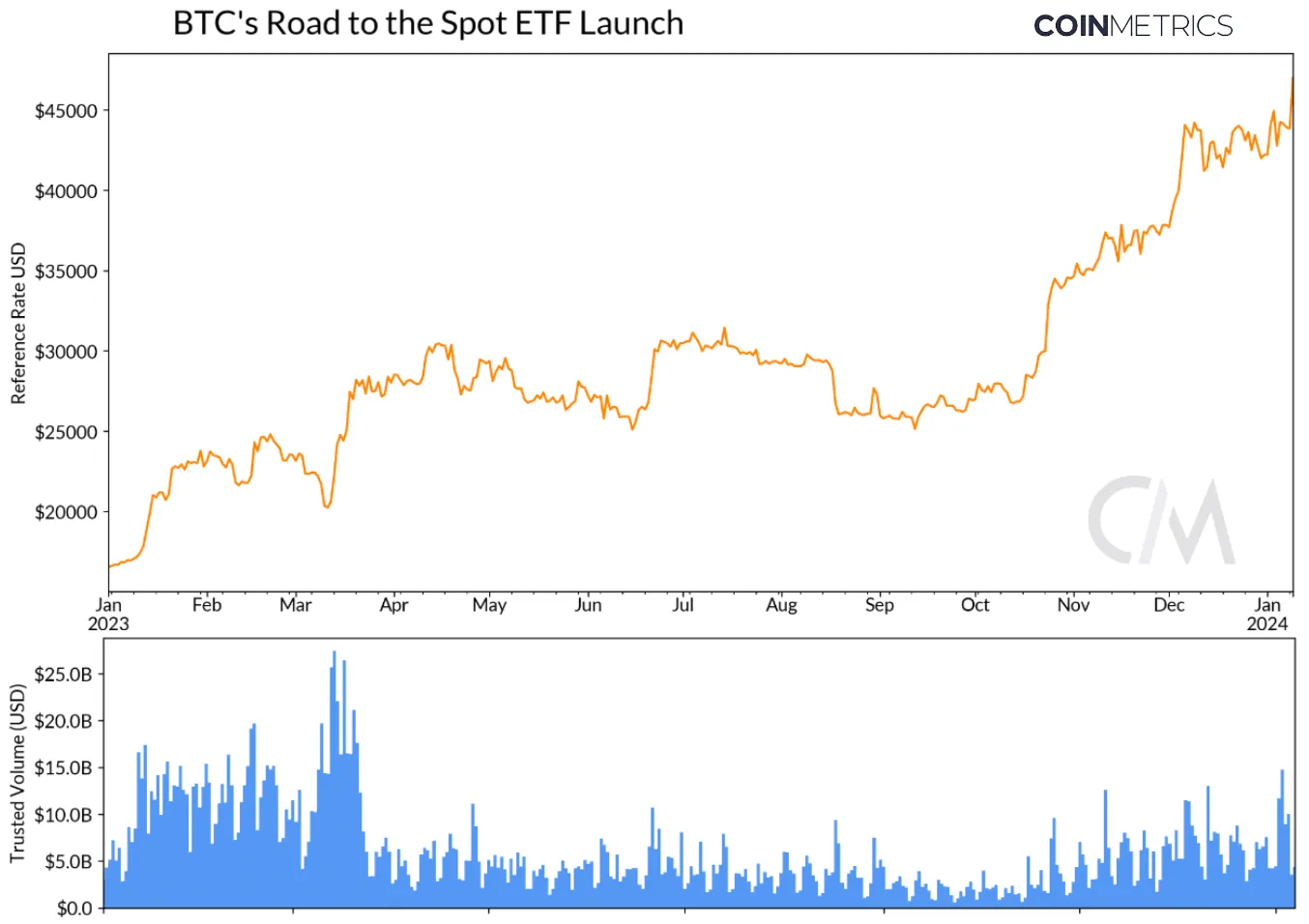
This sentiment was reflected in BTC’s price, which surged 156% in 2023. Spot trading volume rebounded in Q1 but stagnated after the collapse of Silicon Valley Bank in March. However, with growing ETF expectations, trading volumes began rising again and now average around $10 billion daily—still below pre-FTX crash levels. Bitcoin’s liquidity will also be a critical factor enabling efficient asset trading, especially now that ETF approval has been secured.
Dynamics Between Spot and Futures Exchanges
Bitcoin spot trading volume shares across exchanges show an increasingly balanced distribution. Binance’s dominance declined from over 75% in Q1 2023 to under 30% by January 2024. Other platforms like Coinbase and Bullish benefited accordingly, leading to a more even distribution of trading volume among centralized exchanges.

Regarding exchange roles, some lingering questions remain, particularly concerning the cost-efficiency structure following spot ETF launches. Nonetheless, investors now have another channel to access BTC, helping meet varying risk tolerances across different investor groups. For those seeking a secure and cost-effective way to gain exposure to Bitcoin assets, the ETF launch is highly favorable. Others may prefer self-custodying Bitcoin, for whom exchanges continue to provide essential access.
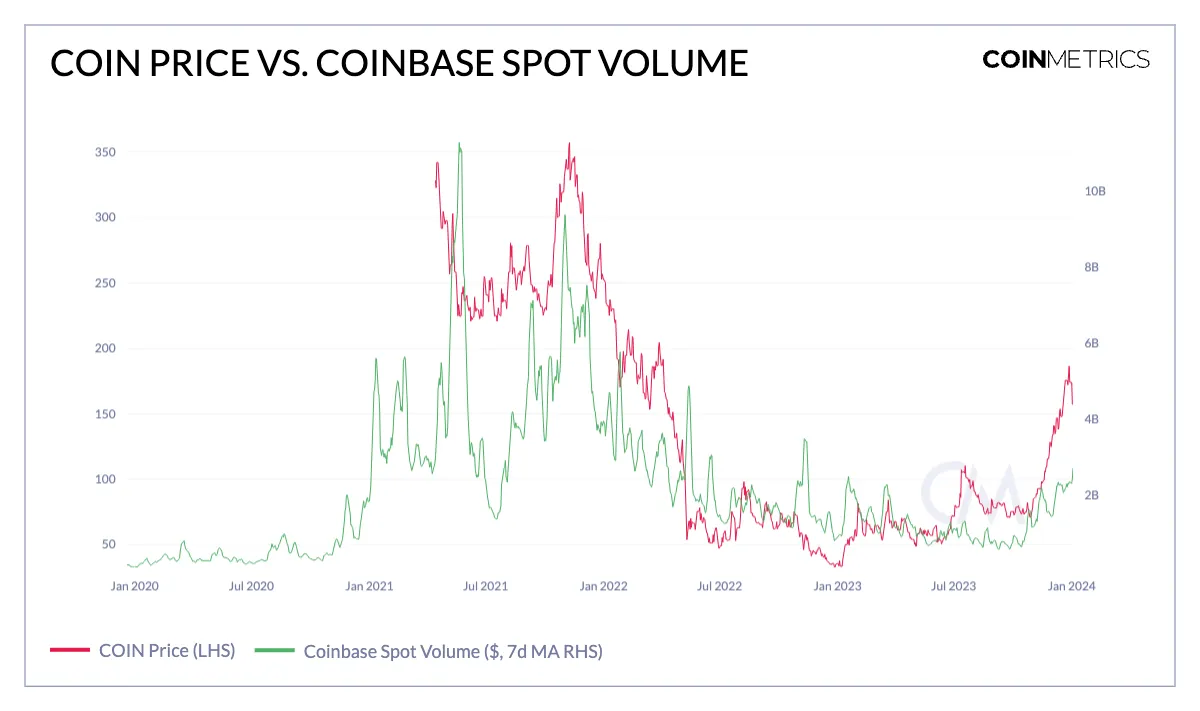
The role of domestic exchanges (specifically U.S.-based) will also come under scrutiny. However, given that Coinbase provides custody services for most applicants, the largest U.S. exchange stands to benefit not only from additional revenue streams through its diversified business model but also from increased trading volume driven by broader participation. With recent rebounds in the digital asset market, Coinbase’s average spot trading volume has already recovered to over $2.5 billion and could grow further as market activity continues.
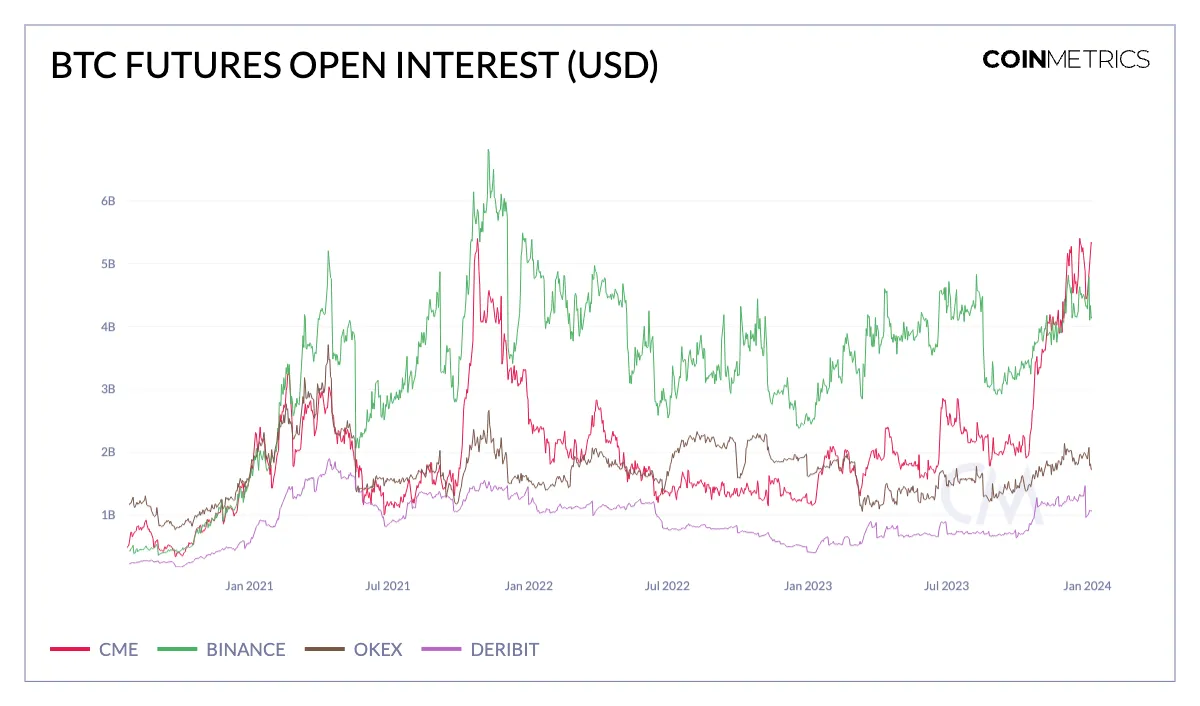
Prior to the advent of ETFs, derivatives played a crucial role in shaping market structural dynamics. With Chicago Mercantile Exchange (CME) futures open interest surging to a record $5.4 billion, we observed a shift in the digital asset market from being primarily retail-driven to one with greater institutional involvement. This trend is likely to expand further as more financial advisors, registered investment advisors, and family offices managing trillions of dollars begin incorporating BTC into traditional portfolios.
The week before and after ETF approvals may bring short-term volatility spikes—as seen last week when unexpected reports of potential SEC rejections triggered liquidations in open interest—but in the long term, Bitcoin’s outlook tells a different story.
Volatility and Return Characteristics
High historical volatility of BTC and other crypto assets is often cited as evidence of high-risk investments. While true in early stages, over time BTC’s average volatility has shown a downward trend, signaling its evolution into a more mature asset. The chart below illustrates similar trends for ETH and SOL, both newer entrants to the market and exhibiting higher volatility relative to BTC. Within the crypto asset space, it's clear these assets display varying degrees of volatility and maturity, influencing their overall market structure and portfolio roles.

Over a five-year horizon, comparing digital assets’ risk and return profiles against other investable assets reveals their unique portfolio utility. Traditional assets like gold offer the lowest risk-return potential, earning safe-haven status and placing them in a distinct category compared to large-cap tech stocks such as Apple (AAPL), Microsoft (MSFT), and Amazon (AMZN), which share similar characteristics. In contrast, the digital assets featured here exhibit distinctive traits. As the pioneer and largest digital asset, BTC shows lower volatility than ETH and SOL, yet offers greater return potential than tech stocks—indicating its development into a mature, growth-oriented asset. Moreover, BTC’s near-zero correlation with traditional assets further underscores its value in diversified portfolios and enhances its appeal to investors seeking uncorrelated returns.
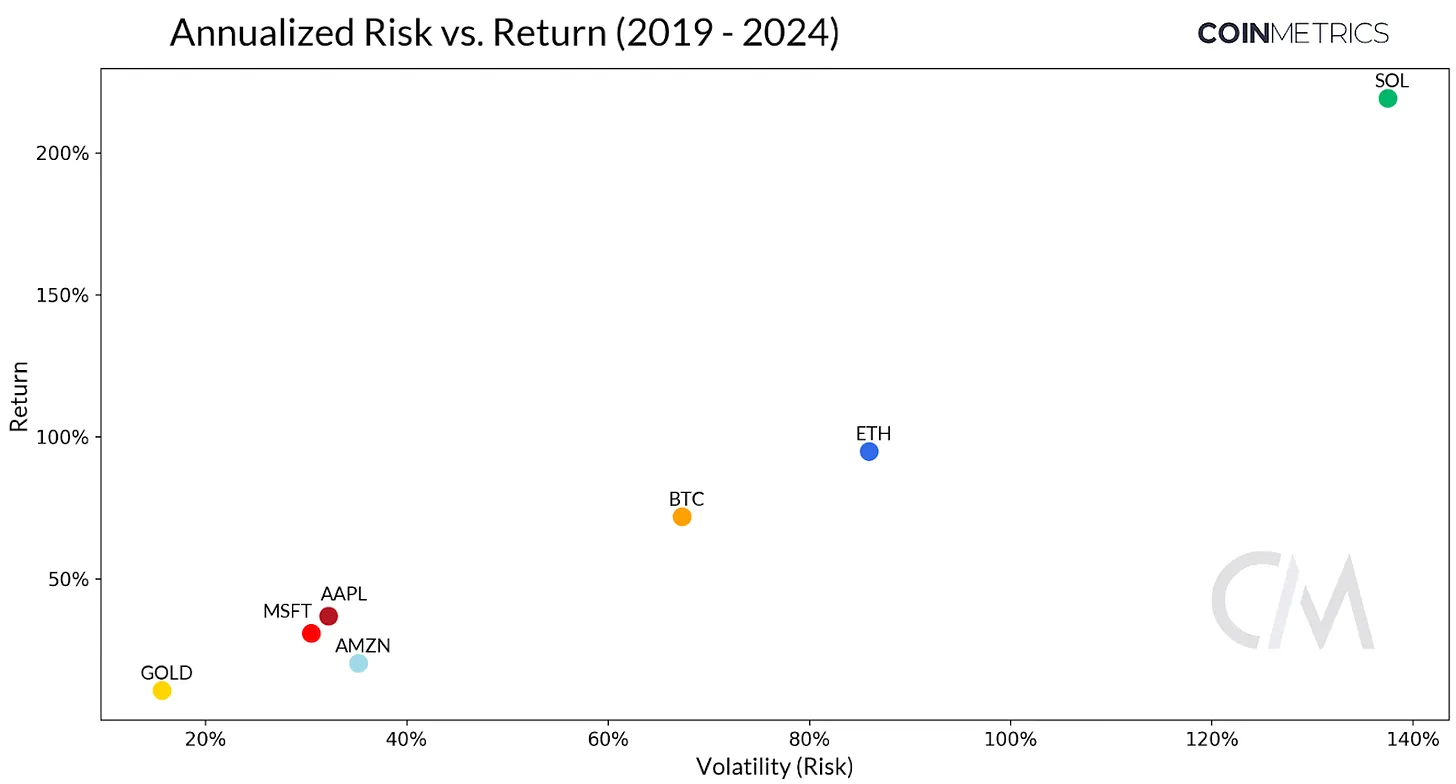
Together, these characteristics solidify BTC’s position as the largest and most liquid digital asset, making it the natural choice for the first spot ETF—and serving as proof of its market maturity. As ETH exhibits similar attributes, it is poised to become the next cryptocurrency approved for a spot ETF.
Conclusion
Bitcoin’s journey—from a novel digital currency to a mature, globally recognized network and asset class—is nearing realization. The arrival of spot ETFs marks a significant milestone in this direction, concluding a decade-long pursuit and representing a pivotal moment in market evolution. As the largest cryptocurrency enters a new phase, Bitcoin not only reinforces its centrality within the digital asset ecosystem but also affirms its significance on the global financial stage.
Join TechFlow official community to stay tuned
Telegram:https://t.me/TechFlowDaily
X (Twitter):https://x.com/TechFlowPost
X (Twitter) EN:https://x.com/BlockFlow_News
 @coinmetrics






