








OKX Ventures: Exploring the BTC Ecosystem
TechFlow Selected TechFlow Selected
OKX Ventures: Exploring the BTC Ecosystem
In the Bitcoin ecosystem, OKX Ventures has demonstrated a strong commitment and a sustained determination to contribute, dedicated to driving ecosystem innovation and accelerating the development of blockchain technology.
 Navigating Web3 tides with focused insights
Bitcoin Ecosystem Data Review
Macroscopically, as the cornerstone of crypto, Bitcoin has established a strong consensus on value, driven by factors such as ETFs, halving events, and macro liquidity. Microscopically, Bitcoin's on-chain addresses and user count are growing rapidly, while BTC Dominance remains stable.
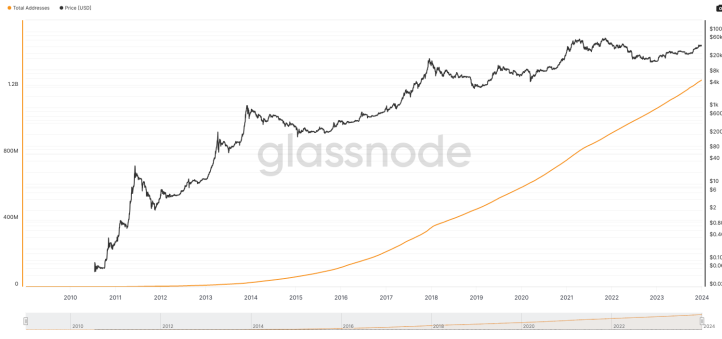
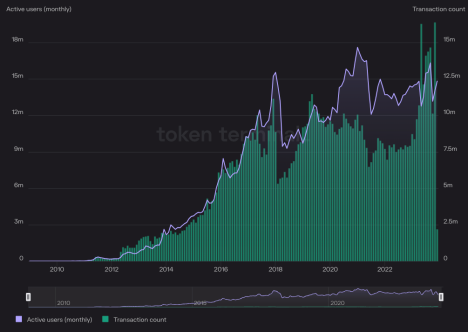
• First, the cumulative number of Bitcoin addresses has exceeded 1.2 billion. Global cryptocurrency users have surpassed 420 million, a dramatic increase from just 5 million in 2016. According to TokenTerminal, Bitcoin’s monthly active users are approximately 13.7 million, with 17.5 million on-chain transactions. In terms of blockchain growth, Bitcoin’s blockchain size is now about 507GB—70% larger than three years ago. These metrics reflect the explosive growth in adoption and usage of cryptocurrencies, especially Bitcoin.
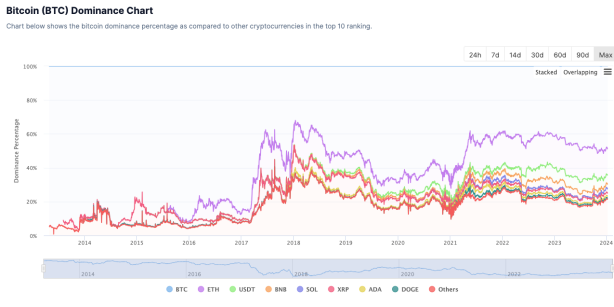
• Second, Bitcoin Dominance continues to remain high, maintaining its foundational role in the crypto market. Bitcoin accounts for 47% of the total market capitalization of all cryptocurrencies. While this ratio fluctuates as other digital assets rise, Bitcoin still holds its position as the market leader.

• Third, the halving brings positive momentum: When mining rewards are halved, the supply rate of new Bitcoins slows down. If demand remains steady or increases, prices are theoretically expected to rise. This mechanism makes each halving a potential catalyst for value appreciation.
○ Bitcoin’s year-to-date price increase in 2023 exceeded 150%, reflecting growing market optimism already priced in. The upward trend leading into the April 2024 halving may continue or even accelerate.
○ Historically, Bitcoin achieved average returns exceeding 400% within 12 months following the previous two halvings. This provides a historical precedent for forecasting future performance and instills confidence among investors.
• Fourth, Bitcoin spot ETFs: They make Bitcoin’s volatility increasingly resemble that of traditional financial markets. With institutional support from firms like BlackRock, the approval of spot Bitcoin ETFs signifies broader recognition of Bitcoin. These ETFs are expected to attract new capital from investors who previously approached crypto with caution. Media reports suggest the ETF approval could bring tens of billions of dollars in incremental funds to BTC over the next year.
○ For reference, SPDR Gold Shares (GLD), the first U.S. gold ETF launched in November 2004, accumulated over $1 billion in assets within just three days. In its first year, GLD’s assets under management (AUM) surged past $3 billion. By 2023, global gold ETFs managed approximately $150 billion in assets, demonstrating the profound long-term impact of such investment vehicles on the gold market.
○ Additionally, macro-level liquidity shifts—such as changes in the Federal Reserve’s balance sheet and developments in the U.S. Treasury market—are potential tailwinds for the 2024 crypto market. Fed liquidity support could be a major driver for Bitcoin and the broader crypto market in 2024.

Technical Innovation and Layer 2 Trends in the BTC Ecosystem
Innovations worth watching in the coming year
1. Asset issuance protocols may lead innovation:
○ Ordinals: Uses Bitcoin’s smallest unit, sats, to create unique NFTs. Top inscriptions have gained significant market consensus but face risks of network congestion and centralization.
○ RGB: Extends colored coins and the Lightning Network, improving privacy and scalability.
○ Taproot Assets: Built on the Taproot protocol activated in 2021, it enhances privacy and efficiency for smart contracts. Integrated with the Lightning Network, it streamlines asset issuance and transfer processes and speeds.
2. BitVM: A Turing-complete virtual machine:
○ Concept: Enables verification of complex smart contracts without changing Bitcoin’s consensus—computation occurs off-chain, verification on-chain.
○ Advantages: Enhances programmability without altering Bitcoin’s core rules; reduces on-chain data load; improves fraud protection.
○ Limitations: Currently supports only two-party contracts; practical utility remains unproven, with potential performance and cost challenges.
○ Revival of OP_CAT: The potential restoration of this opcode could enhance BitVM’s adaptability and efficiency.
3. Development of Bitcoin Covenants:
○ Core Value: Allows additional conditions to be set when creating UTXOs, increasing diversity and security for smart contracts.
○ Evolution:
▪ Early proposals: Various initiatives like OP_CHECKOUTPUTVERIFY and OP_CHECKSIGFROMSTACK aimed to improve Bitcoin’s smart contract capabilities.
▪ Latest developments: OP_TXHASH and OP_CHECKTXHASHVERIFY enhance script access to SegWit data, improving flexibility and decentralization for Layer 2 solutions.
Overall, technical innovations in BTC are focused on enhancing the feasibility, privacy, complexity, and security of asset issuance standards. These advancements open exciting possibilities for Bitcoin’s future. As the community and developers continue their efforts, the richness of the BTC ecosystem is poised for continued growth.
Layer 2 Innovations: Rollups and Sidechains
Layer 2 solutions include sidechains, Plasma, Rollups, etc. The key difference between Rollups and sidechains is that Rollups cannot operate if the mainnet fails (consensus depends on the mainnet), whereas sidechains can function independently during mainnet outages (they have independent consensus).
• Rollups are divided into two types: those where the mainnet verifies and those where the mainnet merely “witnesses”:
○ Witness-only (no verification): Stores and aggregates DAS (data availability sampling). Solutions like Celestia generate detailed DAS information secured by their own sovereign layer, or aggregate and store DAS in Taproot (due to high costs of storing full DAS on-chain).
○ ZKP-based verification: Fraud-proof schemes using zero-knowledge proofs. For example, B² converts ZKP verification programs into arithmetic circuits, implements AND and OR gates via NAND gates, transforms arithmetic circuits into logic gate circuits, and realizes them using Bitcoin Script, ultimately forming Circuit Taproot. The Taproot commitment is then placed on the main chain. Compared to BitVM, its circuit is deterministic, simplifying design. Rollup transaction details and proof data are stored across multiple decentralized storage protocols, enabling resumption even if the rollup temporarily halts.
• Sidechain projects have independent design preferences, facing the trade-off triangle of security, speed, and decentralization:
○ Stacks - Proof of Transfer (PoX): Miners bid Bitcoin to become block producers, validate transactions, and send completed block headers as hashes into Bitcoin transaction message fields, permanently recording them on the Bitcoin main chain.
○ RSK: Rootstock (RSK) uses the same SHA-256 algorithm as Bitcoin and connects via a two-way bridge. Bitcoin miners can perform “merged mining” without extra resource consumption, earning transaction fees from RSK simultaneously.
○ Drivechain: An open Bitcoin sidechain protocol allowing customizable sidechains based on different needs. Based on two Bitcoin Improvement Proposals: BIP 300 “Hashrate Escrows,” which compresses 3–6 months of transaction data into 32 bytes via “Container UTXOs,” and BIP 301 “Blind Merged Mining,” similar to RSK, where network security is maintained by existing Bitcoin miners through merged mining.
Evaluation criteria for Layer 2: Degree of reuse of mainnet security
Two ways of reusing security:
• 1. Reuse mainnet consensus and POW: Leverages mainnet DA and consensus. Projects like Bitmap and B² use zk schemes aggregating zk proofs and storing them on the mainnet, potentially using an Optimistic Rollup-style challenge mechanism to confirm commitments.
○ We believe short-term dominance lies with mainnet “witnessing” data approaches, but long-term we favor mainnet “verification” models. Fraud proofs in optimistic rollups may offer better outcomes: off-chain ZKP verification followed by writing inscriptions onto the BTC network, generating logic gate commitments from ZKP verifiers, committing via Taproot to the Bitcoin network, and using fraud proofs for on-chain confirmation—enabling inheritance of BTC’s security and efficiency while preserving orthodoxy.
○ Currently, projects like B² are advancing toward this vision—nodes plus partial Bitcoin infrastructure serve as the DA layer, ensuring validity and data availability of ZK-Rollup transactions; the BTC mainnet acts as the settlement layer, guaranteeing finality.
• 2. Reuse mainnet liquidity and POS: For example, Babylon offers fully slashable security, staker safety, and liquid staking; wrapped BTC (e.g., WBTC) bridges BTC to Ethereum and Solana, making ETH and Solana effectively BTC sidechains. Stacks and Bevm adopt similar models.
○ We are bullish on Babylon, leveraging Bitcoin’s native chain security to provide additional trust and capital to PoS chains. This cross-chain staking structure enables a new economic model: PoS chains can strengthen their security using Bitcoin’s market cap, while Bitcoin holders earn yield by supporting PoS chain security. This mechanism also increases Bitcoin’s utility and may incentivize broader participation in its ecosystem.
OKX Is Committed to Building the BTC Ecosystem
OKX Ventures Invests in and Supports Innovation in the BTC Ecosystem
B² Network
• Project Overview
○ B² Network is a Layer-2 solution built on Bitcoin, combining ZKP with BTC rollups to achieve higher orthodoxy and usability by writing aggregated storage and ZKPs into BTC inscriptions.
○ It runs the first ZK Proof Commitment Rollup based on zero-knowledge proof (ZK-proof) technology. Using rollup technology, it supports Turing-complete smart contracts, executes off-chain transactions, and reduces costs. During Bitcoin transaction confirmation, it integrates ZK-proofs, gate commitments, and Taproot challenge-response mechanisms to ensure transaction privacy and security.
○ The network aims to transform Bitcoin into a multi-functional platform, laying the foundation for applications such as DeFi, NFTs, and other decentralized systems.
• Project Advantages
○ Security and Decentralization: Built on Bitcoin, all B² rollup transactions are recoverable. Through ZK proof commitments and challenge-response mechanisms, bidirectional confirmation is achieved on Bitcoin—not just one-way data writes.
○ Seamless Development and Integration: EVM compatibility allows developers to quickly migrate from other EVM-compatible chains and simplifies DApp development. Account abstraction supports Bitcoin addresses, Ethereum addresses, and email-based accounts, enabling Bitcoin users to interact cross-chain on B² without switching wallets. By storing Bitcoin state, cross-chain transactions can be triggered without bridges from Layer 1 to Layer 2, giving developers programming capabilities atop Bitcoin transactions and providing a trusted decentralized Bitcoin indexer service.
○ Scalability for Mass Users: Rollup Layer operations require no consensus, ensuring high performance. B²’s robust data availability layer guarantees security. Low, affordable fees remain stable even during peak demand.
Bitmap Tech (formerly Recursiverse)
• Bitmap Tech (formerly Recursiverse) is an innovative project aiming to build an intelligent, decentralized, and composable digital world via the Ordinals network and Bitcoin Layer 1. It demonstrates a strong commitment to creating a valuable metaverse ecosystem and has launched a series of cutting-edge products:
○ BRC-420 Protocol: A decentralized economic framework operating on the Ordinals network, enabling creators to earn revenue directly without relying on platforms to host or process transactions.
○ Recursive Index and Inception Inscriptions: Showcase relationships and citation counts among inscriptions, highlighting the value interconnected inscriptions bring to the network. Inception introduces a multi-layer recursive inscription method, where top-level inscriptions can contain vast content and logic within minimal digital footprint.
○ Bitcoin Layer 2 Network: Plans to integrate the BRC-420 protocol and Bitmap with Layer 2 solutions like ZKPs, rollups, and the Lightning Network, further advancing its decentralized metaverse vision and positioning itself as a key player in the evolving digital landscape.
○ Bitmap.Game: The first metaverse product based on Bitmap assets, allowing any user to enter, chat, trade, and play with others. It is currently the largest metaverse product on the Bitcoin network in terms of user base.
• Key Highlights:
○ High Freedom: Anyone can use the BRC-420 protocol to create their own metaverse inscription.
○ Composability: Designed to integrate with Bitcoin Layer 2 solutions, bringing liquidity and scalability to L2.
○ Innovative Storytelling: Introduces a novel “bitmap protocol” for metaverse land, going beyond simple NFT formats to tell richer metaverse narratives.
○ Clear Positioning: Positioned as a metaverse protocol and NFT marketplace on Bitcoin, supporting BRC-420 inscriptions, with plans to integrate liquidity mechanisms via Layer 2 in the future.
○ Experienced Team: The CEO has a strong track record in web2, VR, and web3 engine development and entrepreneurship.
○ Compelling Products: The BRC-420 marketplace already features derivatives and an active community, with high floor prices indicating strong user interest and whale participation.
○ Strong Momentum: Obvious market FOMO around Bitmap NFTs, significant whale involvement, and strategic partnerships within the Bitcoin ecosystem highlight the project’s operational strength.
Babylon
• Project Overview
○ Babylon is a proposed Bitcoin staking protocol allowing Bitcoin holders to stake idle BTC to enhance the security of Proof-of-Stake (PoS) chains and earn yield in return. It aims to integrate Bitcoin with the PoS economy.
○ Babylon seeks to unlock a new use case for Bitcoin—increasing asset utilization efficiency while strengthening the economic security of PoS chains. This innovation positively impacts Bitcoin itself, its Layer 2s, and related PoS ecosystems.
• Key Highlights
○ Strong Security: The Babylon protocol ensures comprehensive security for PoS chains—any violation results in at least 1/3 of staked Bitcoin being slashed.
○ Staker Protection: As long as stakers follow PoS protocol rules, they are guaranteed to safely withdraw their funds.
○ High Liquidity: Babylon allows stakers to quickly unbond BTC without relying on community consensus.
○ Modular Plug-in Design: The protocol is modular, easily integrable with various PoS consensus algorithms.
○ System Architecture: Introduces a scalable system architecture supporting multiple stakers and multiple PoS chains.
○ Fast Unbonding: Features a fast, frictionless unbonding process, significantly reducing withdrawal time.
BitSmiley
• BitSmiley is the first native stablecoin project in the BTC ecosystem—a comprehensive financial protocol built on the Bitcoin blockchain and part of the Fintegra framework. It consists of three core components:
○ Decentralized Stablecoin Protocol: Through the Bitcoin network, BitSmiley launches an over-collateralized stablecoin protocol issuing UNO, a USD-soft-pegged stablecoin. Users mint UNO by locking BTC as collateral in the BitSmiley vault—an on-chain smart contract on the Bitcoin blockchain.
○ Trustless Lending Protocol: BitSmiley’s native lending platform enables decentralized borrowing. Borrowers deposit BTC to receive desired tokens, and upon repayment of principal and interest, their BTC collateral is returned.
○ Derivatives Protocol: BitSmiley plans to expand into lending-based derivatives, boosting capital efficiency and meeting demand for more sophisticated financial instruments in DeFi.
• Key Highlights:
○ Integrated Stablecoin Issuance on Bitcoin Blockchain: Effectively mitigates market risk from Bitcoin’s price volatility, offering users a more stable medium of exchange.
○ Advanced Liquidation and Auction Design: Employs Dutch auctions to handle under-collateralized positions, with automated execution via smart contracts, ensuring system robustness and decentralization.
○ Innovative Insurance and Risk Management: Proposes an insurance pricing model based on Extreme Value Theory and T-Copula, allowing participants to hedge against extreme price fluctuations and enhancing protocol security.
○ Enhanced Capital Efficiency: Loan splitting and merging functions improve capital utilization, catering to diverse borrowing needs.
○ Future Scalability and Innovation: Plans to introduce derivatives including credit default swaps (CDS), aiming to establish BitSmiley as a one-stop decentralized financial platform supporting multiple financial services.
alexGo
• Project Overview:
○ alexGo is a platform rooted in the Bitcoin DeFi (decentralized finance) ecosystem, aiming to become the premier DeFi platform for Bitcoin users, innovators, and the broader ecosystem—addressing Bitcoin’s limitations in DeFi due to lack of native smart contract and computation layers.
○ alexGo leverages the Stacks Layer 2 solution to introduce smart contract functionality to Bitcoin, eliminating barriers between Bitcoin L1 and L2 and enabling a seamless DeFi experience.
○ ALEX has established the "Bitcoin Lab" ecosystem fund, offering funding, technical support, community engagement, and a launchpad for projects—an attractive proposition for both developers and investors.
• Project Advantages:
○ Seamless Bridging: Enhances the overall Bitcoin DeFi experience through seamless bridging between Bitcoin Layer 1 and Stacks Layer 2.
○ Transaction Speed: The Stacks Nakamoto Release reduces block confirmation time from 10–15 minutes to just 5 seconds.
○ Reliability and Security: Comprehensive integration and cross-layer security, including collaborations with industry groups to build on-chain oracles for BRC-20, enhancing reliability and security in Bitcoin DeFi.
Portal DeFi
• Project Overview:
○ Portal DeFi proposes the first truly private cross-chain DEX protocol, addressing risks associated with centralized exchanges and the vulnerabilities of decentralized exchanges (DEXs) using cross-chain bridges and “wrapped tokens.”
○ Launches the PortalX system, enabling decentralized trading of Bitcoin and other assets and creation of financial contracts.
○ Users can directly access decentralized services via non-custodial wallets, achieving response speed and liquidity comparable to centralized exchanges while maintaining asset and data security.
○ Adopts technological innovations such as multi-party hash time-lock contracts and smart contracts, along with validator sets, to ensure fast, economical, and secure transaction execution.
• Key Highlights:
○ Cross-chain Interoperability: PortalX supports asset swaps across different blockchains, completely eliminating reliance on centralized third parties.
○ Zero-Knowledge Protocols: Leverages zero-knowledge proofs to ensure transaction privacy and swap security.
○ Censorship Resistance: Financial applications uphold decentralization principles, safeguarding freedom and resistance to external interference.
○ Non-Custodial Design: Users retain control of their assets during trades, solving custody issues.
○ PortalOS Operating System: A comprehensive OS supporting multiple functions of Portal DeFi, ensuring efficient system operation.
○ Validator Incentive Mechanism: Implements proof-of-stake with native token staking, ensuring sufficient incentives for network participants to maintain the system.
○ Solution to Tier-Nolan Atomic Swap Problem: Offers innovative fixes to classic atomic swap issues, such as fairness options and lack of incentive alignment.
○ Liquidity Aggregation: Through on-chain contract and protocol design, Portal aims to aggregate and match liquidity across decentralized financial applications.
OKX Ventures Empowers the BTC Ecosystem by Launching a Bitcoin Hackathon
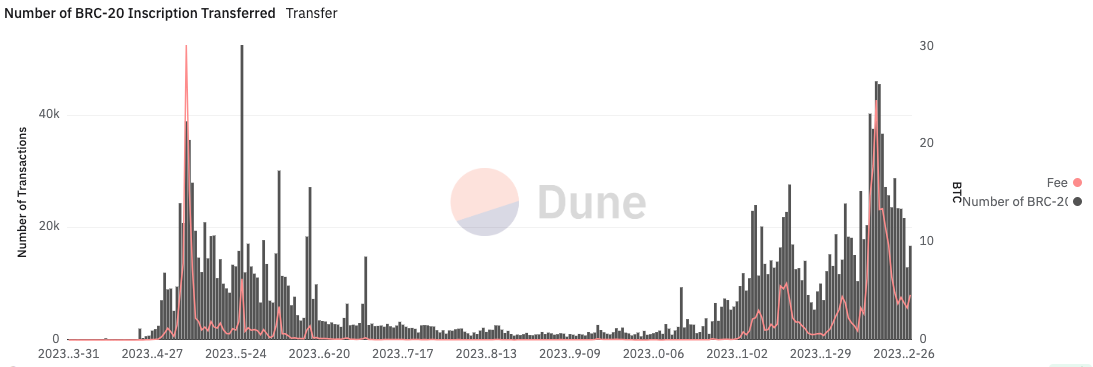
This year saw the explosion of Ordinals, essentially representing mass adoption of asset issuance capability. Following this, numerous asset issuance protocols emerged: Ordinals, BRC-20, RGB, Taproot Assets, Runes, Taro, Atomicals, TAP, PIPE, and many others. Data:
• BRC-20: Cumulative BRC-20 transfers exceed 45.4 million, with total fees generated surpassing 4,290 BTC;
• Ordinals: Total inscriptions exceed 53 million, with cumulative fees exceeding 5,383 BTC;
Innovation in asset issuance standards will unlock greater possibilities for the Bitcoin ecosystem.
The Ordinals ecosystem boom, coupled with large-scale asset issuance, creates demand for liquidity, infrastructure, gaming, NFTs, and other applications. Therefore, we aim to encourage more developer engagement in the Bitcoin ecosystem to build a richer, more vibrant environment.
OKX Ventures co-hosted the BTC Ecosystem Winter Pitch Day online with ABCDE and BeWater, receiving 51 project applications and investing in 7 finalists. Hackathon statistics:
• Project tracks included Layer 2, RGB, Lightning Network, Taproot, Ordinals, BRC-20, stablecoins, lending, and more;
• Teams came from around the globe—Singapore, Hong Kong, the U.S., Russia, Hungary;
• 82% of founders were serial entrepreneurs;
To foster a richer developer and application ecosystem, OKX Ventures will allocate $10 million to continuously support emerging entrepreneurs in the industry.
OKX Web3 Leads the Industry in the BTC Ecosystem
OKX Web3 Wallet is the first wallet ecosystem in the industry to make large-scale investments in the BTC ecosystem, dedicating substantial resources and earning consistent market acclaim.
OKX Web3 Wallet Data
As of December 2023, OKX Web3 Wallet’s Ordinals marketplace surpassed $1 billion in total trading volume, with 120,332 unique addresses and 552,818 total transactions. Its daily trading volume share peaked at 92%, placing it firmly at the industry forefront.
Currently, OKX Web3 Wallet’s Ordinals marketplace is the largest trading platform for BRC-20 tokens and BTC NFTs, supporting over 16,000 tradable BRC-20 tokens. The OKX Ordinals marketplace is fully decentralized, interaction-free of platform fees, and supports batch transfers, trades, and inscription of BRC-20 and BTC NFTs.
By year-end, OKX NFT Marketplace recorded nearly 20 million annual transactions, averaging $6.5 million in daily trading volume, with total volume reaching $2.366 billion. Driven by the inscription boom, OKX NFT Marketplace rose to become the second-largest NFT marketplace by volume in just November and December, capturing 32% of the market share.
OKX Web3 Wallet Focuses on Users, Continuously Meeting User Needs
OKX Web3 Wallet consistently prioritizes user needs, swiftly translating them into product requirements rather than imposing internal assumptions onto users.
OKX launched Cryptopedia, an all-in-one DApp discovery and reward interaction platform. It regularly hosts blockchain-themed events with partners, setting DApp interaction tasks to help users reduce search costs and engage precisely during fragmented time.
OKX Web3 Wallet introduced a DeFi section—a one-stop on-chain investment platform aggregating over 10 public chains, 60+ projects, and 200+ protocols. It supports V3 liquidity pools, one-click cross-chain investing, automatic yield calculation, and lower gas fees—making DeFi investing exceptionally simple.
The latest ecosystem map from OKX Web3 Wallet shows integration with over 70 public chains, support for more than 120 protocols in DeFi, aggregation of over 30 NFT marketplaces, and coverage across Game, Social, MEME, Tool, and other ecosystems—totaling over 300 supported platforms and protocols.
Conclusion
In the Bitcoin ecosystem, OKX Ventures has demonstrated a firm commitment and sustained dedication to driving innovation and accelerating blockchain technology advancement. With growing Bitcoin user numbers, expanding blockchain data, and the emergence of groundbreaking protocols like Ordinals, the Bitcoin ecosystem is undergoing unprecedented growth. OKX Ventures not only provides funding but also offers services and resources to help partners grow together.
Recognizing the vast innovation potential within the Bitcoin ecosystem, OKX Ventures leverages platform-level support such as OKX Web3 Wallet and OKX Chain to help projects establish themselves amid this transformative wave in crypto. For OKX Ventures, the prosperity of the Bitcoin ecosystem goes beyond mere financial investment—we prioritize long-term industry development and scale expansion.
Despite volatile market conditions, OKX Ventures focuses on fundamental progress—advancing theoretical innovation, launching practical new applications, and tracking real growth in user traffic and overall industry scale. We firmly believe that over the next three to five years, OKX Ventures will grow alongside the market, witnessing and seizing even greater opportunities brought by the Bitcoin ecosystem.
Join TechFlow official community to stay tuned
Telegram:https://t.me/TechFlowDaily
X (Twitter):https://x.com/TechFlowPost
X (Twitter) EN:https://x.com/BlockFlow_News
 OKX Ventures











