Top-Level Wealth Game: Exploring the New Flywheel and Governance Models of Web3 Gaming
TechFlow Selected TechFlow Selected
Top-Level Wealth Game: Exploring the New Flywheel and Governance Models of Web3 Gaming
This article focuses on analyzing the design of top-tier get-rich-quick gambling mechanisms and ecosystem flywheel dynamics, represented by Gas Hero and Lumiterra.
 Navigating Web3 tides with focused insights
Author: Aiko
With the recent market recovery, some interesting projects have emerged. These also represent practical cases following Web3 game design theories such as IAT (In-app Taxation) and BLOG.
Therefore, this article aims to accomplish two things:
1) Using Gas Hero and Lumiterra as examples, clarify the new flywheel of Web3 games under the IAT business model—namely, top-tier get-rich-quick gambling.
2) Analyze governance models in Web3 games using Gas Hero, Lumiterra, and Crypto Raiders as case studies.
For those unfamiliar with the concepts of "IAT" and "BLOG," we recommend reading our previous research reports (special thanks to Jason and Kydo for making these cutting-edge theories possible):
Theory and Limitations of IAT
We are pleased to see that in-game taxation as a monetization method is viable. As we described, the total value of in-game value carriers multiplied by transaction turnover has great potential to amplify the overall lifecycle value of a game, delivering higher value to both ecosystem participants and game developers.
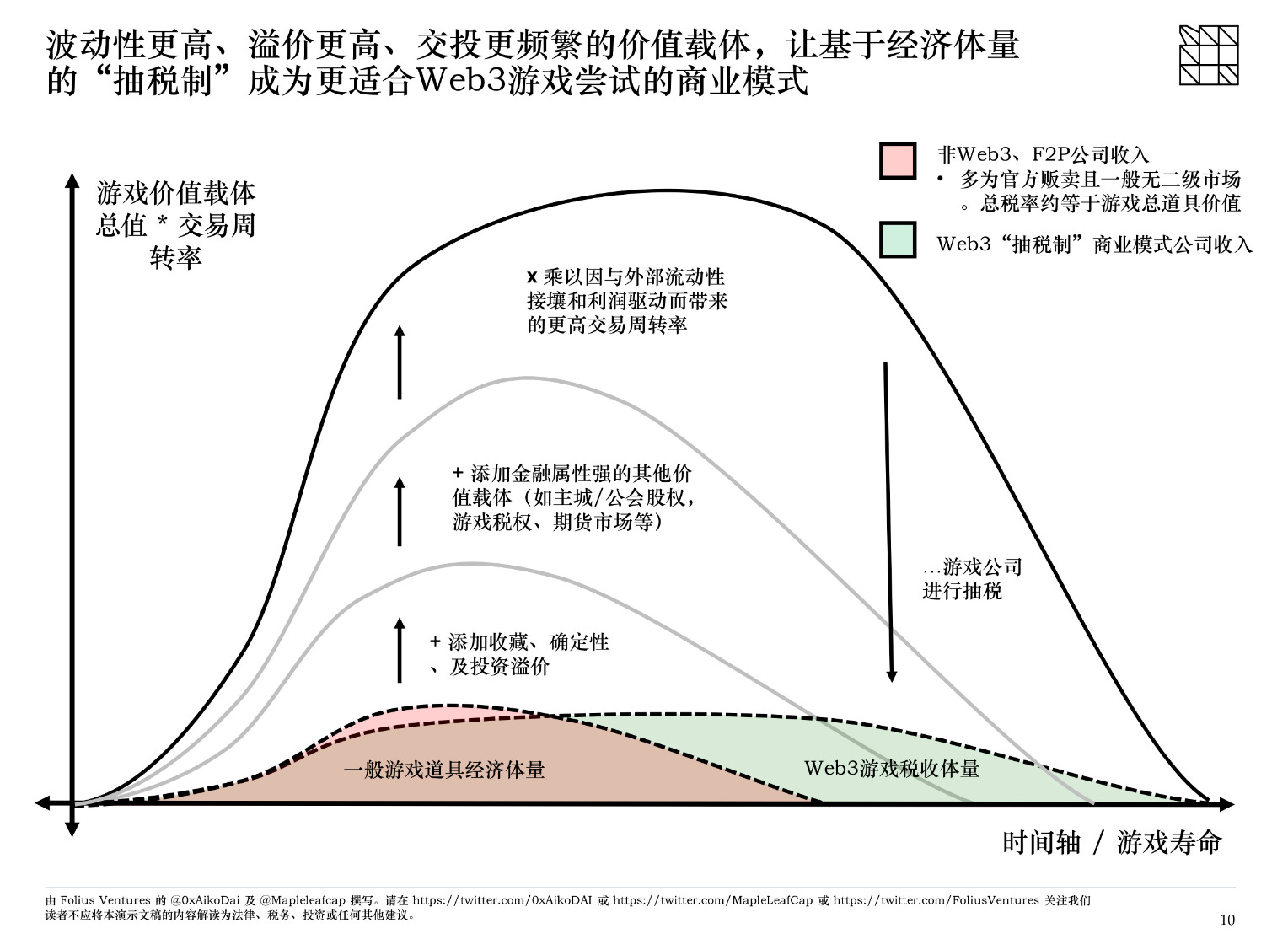
When writing our previous IAT report, we focused on shifting traditional closed/semi-closed economic design thinking toward a taxation-based business model and corresponding gameplay to increase transaction activity and tax revenue.
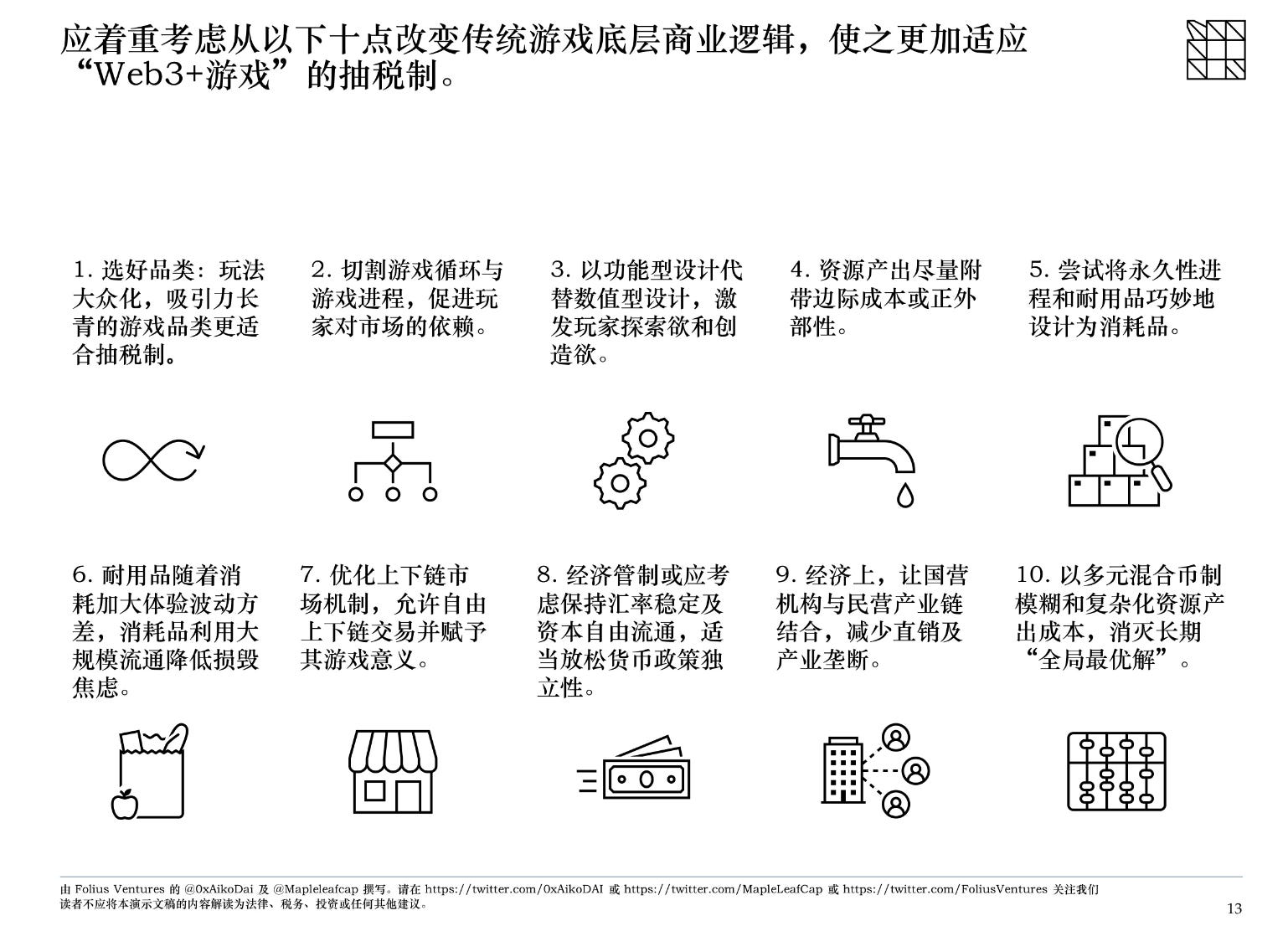
However, due to limitations in Web3 gaming practice and theory about a year ago, we did not further elaborate on what should be done with these "taxes" after collection—how they could form a closed loop and better support long-term ecosystem expansion.
Previously, our imagination regarding taxation was limited. We saw sufficient tax revenue and cash flow enabling teams to develop future projects and build ecosystems (look at Axie Infinity and STEPN today), but failed to envision or mention that taxes can serve as a powerful incentive layer continuously existing within the game, forming an even larger flywheel.
Before diving into details, we must agree on one fundamental premise—the sense of purpose in Web3 games.
Maslow’s hierarchy of needs in Web3 games differs completely from traditional games. While both aim for social recognition and admiration, in traditional games, such admiration may come from dealing massive damage or owning flashy wings and mounts. In the crypto world, admiration mostly stems from envy toward wealth-getting myths.
Thus, the correct way to use tax incentives to drive the ecosystem flywheel is: enable top players to fulfill their dreams of getting rich through organic in-game transactions, becoming objects of envy for all other players.
Next, we'll explore this concept more deeply through Gas Hero and Lumiterra.
The New Flywheel in Web3 Games
Gas Hero
At its core, Gas Hero is a five-loop idle combat SLG game. Players earn various assets across different loops, representing the most critical components of their power system besides heroes (weapons, pets, and upgrade items). Every 100 such assets combine into one NFT tradable on secondary markets. Meanwhile, official auction houses are provided regionally to sell locally scarce goods directly.
This gives rise to the first type of player—the "gold farmer": low-level players who grind loops and buy goods from auction houses to resell profitably in P2P markets. The transaction taxes generated by these players (4% from auction house trades and 2% from P2P market trades) become the funding source for the IAT reward pool.
Players seeking higher returns and influence diverge into two paths, gradually forming “official players” and “PvP players.”
For official players: below city level, leadership requires winning intense PvP battles through force; above city level, aspiring leaders must participate in elections by donating large amounts of GMT to secure a spot among the top 15 global rankings. Since higher donations increase election success probability (via lottery), players engage in strategic donation: contributing enough GMT to stay in the top 15 while slightly increasing donations to boost winning odds—leading to potentially rising donation levels over time.
For PvP players: PvP is inherently a major game mechanic. To compete for the donation prize pool, they naturally arm themselves fully, refine strategies, optimize team composition and positioning. This drives heavy purchases and consumption of heroes, pets, and equipment, boosting marketplace activity and providing steady income (30%-50% APY) for lower-tier farming players.
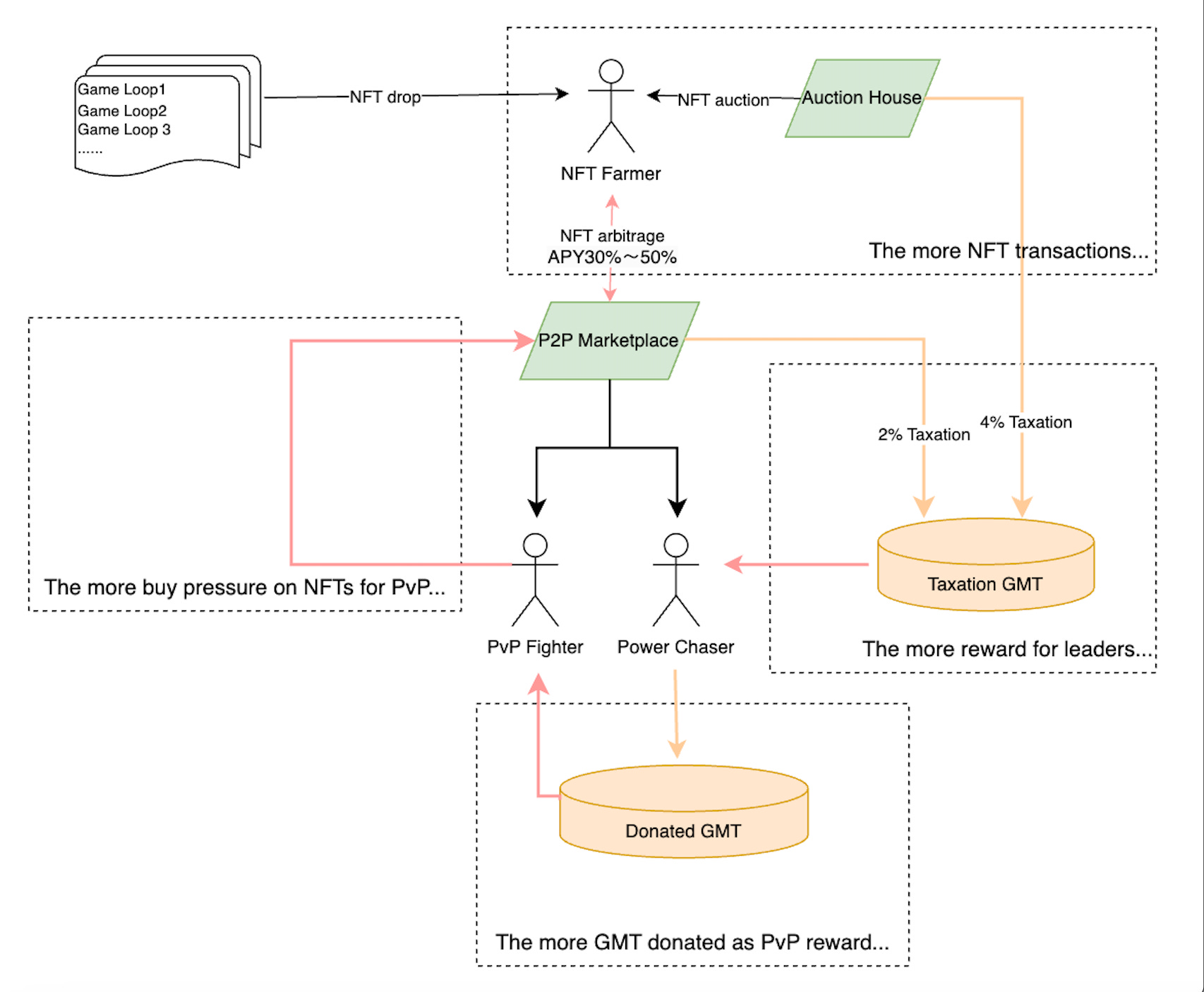
As shown in the diagram, the entire flywheel operates as follows: increasing NFT transactions generate abundant tax revenue, boosting rewards for official players, further incentivizing larger donations during elections (higher donations = higher win probability); these accumulating donations then serve as prizes attracting PvP participants; PvP players, needing to upgrade, become primary buyers of NFTs, creating strong demand in the marketplace, which in turn encourages gold farmers to produce more NFTs and arbitrage between auction houses and open markets.
Ultimately, Gas Hero successfully motivates three distinct player types through two prize pools, a trading platform, and auction houses—and sustains this cycle continuously.
Lumiterra
Lumiterra's core design closely resembles the model presented in our IAT report: three gameplay loops correspond to three professions, each dependent on resources obtained by others in their respective loops—an interdependent structure carefully designed to maximize item trading. Lumiterra uses a commodity-based economy to express this interdependence, lowering player learning barriers. Moreover, farming SIM games (like Stardew Valley and Animal Crossing) are known for exceptionally long lifespans.
The game's incentive flywheel can be summarized simply:
1) Content players naturally generate significant transactions, with all transaction taxes funding rewards for DeFi users providing liquidity. More in-game players and transactions mean more stable APY returns for off-chain DeFi users supplying stablecoins and $LUA liquidity;
2) These DeFi users interact with protocols, generating fees and slippage profits for the protocol, which then fund base prizes for AMM lotteries. More DeFi users and interactions lead to larger AMM prize pools;
3) High jackpots attract gambling players to collect specific in-game materials, mint them into lottery tickets, and participate in draws—providing substantial buying pressure for content players.
4) Furthermore, participation in lotteries becomes the largest resource sink in the game—approximately 60% of resources consumed permanently at this stage—and 5% of taxes from AMM trades are also added to the prize pool.
If we strip away intermediate layers, fundamentally: content players incentivize DeFi users, who in turn incentivize gambling players, who act as the biggest buyers of NFTs and largest consumers of in-game resources, thus re-incentivizing content players. The ecosystem flywheel completes its loop.
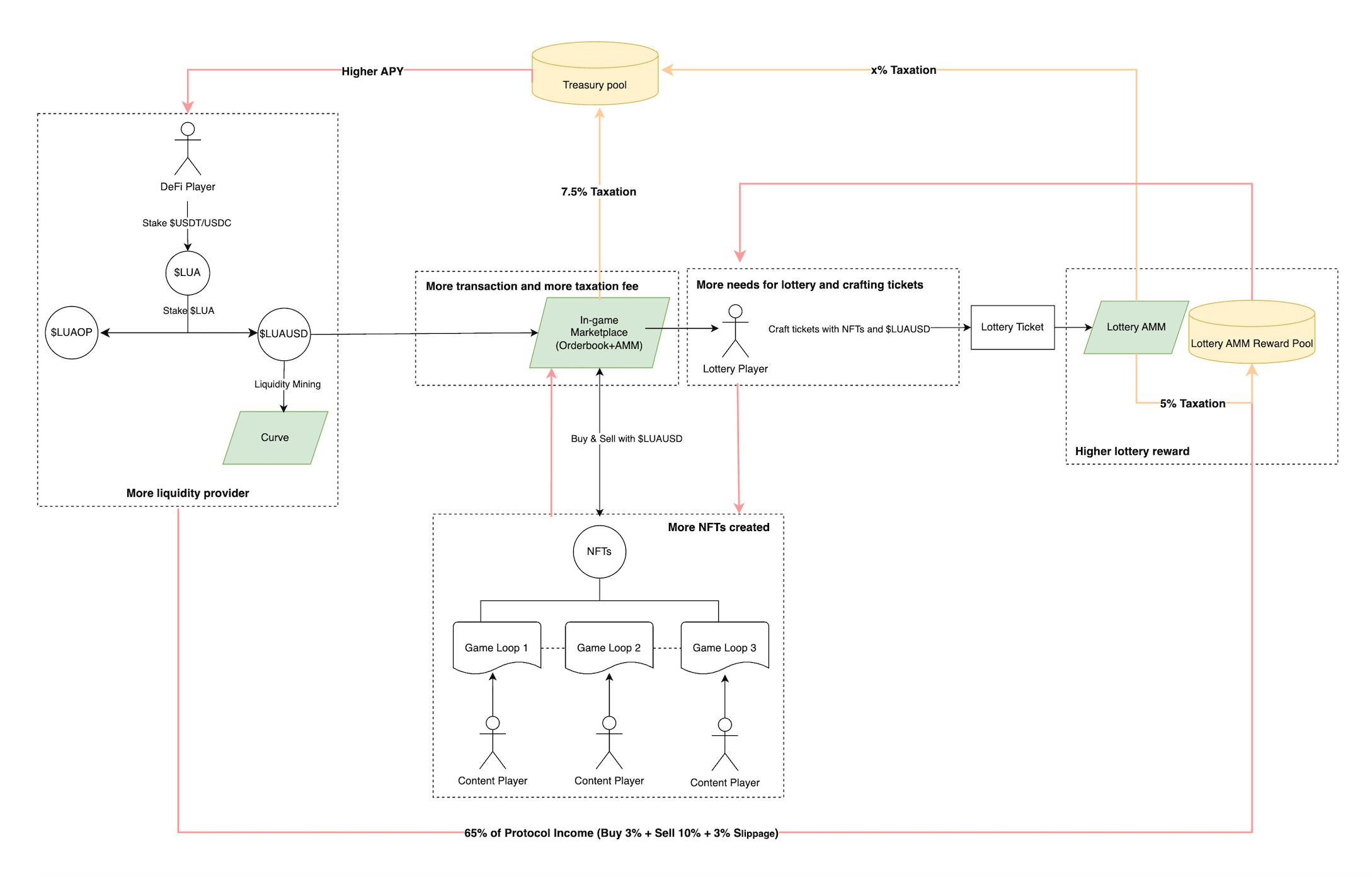
Assuming NFT traders earn ~10–30% APY from buying/selling NFTs, DeFi users might achieve 50–150% APY depending on strategy and in-game volume, while lottery participants could exceed 200% APY.
Thus, the game consistently mobilizes all ecosystem participants with highly probable outsized returns, while offering deserved, steadily growing, moderate long-term rewards as the ecosystem expands.
Summary
From our analysis of Gas Hero and Lumiterra, several commonalities emerge:
1) Super-sized returns originate from real in-game transactions and taxes, with all other designs revolving around “how to increase transaction frequency and friction” and “how to orchestrate interactions among different player types.”
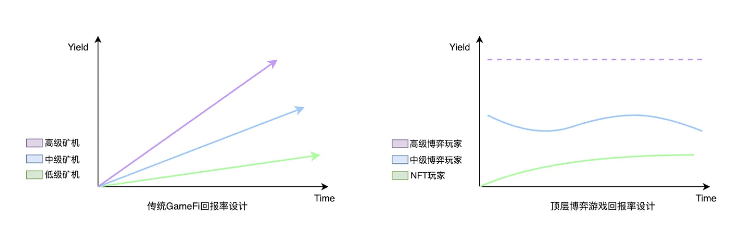
2) The game constantly motivates a subset of participants with small-probability, high-return opportunities, while offering others proportionate, stable, long-term returns aligned with ecosystem growth.
For example: lottery players >200% return vs. regular NFT players ~30% APY.
3) Players eligible for outsized returns inevitably consume the most game resources through gambling mechanics, acting as the largest sink in the system.
For example: donation contests and PvP battles in Gas Hero, and lottery participation in Lumiterra. Driving individual wins numerically requires consuming vast underlying resources, including permanent burning of labor and materials from many players.
4) For other ecosystem participants, provide appropriately stable returns over extended periods.
For example: normal arbitrage profits for Gas Hero NFT players and liquidity mining for Lumiterra DeFi users are relatively stable, cash-flow-backed returns.
5) It is especially important to bootstrap a gamified mechanism for a commodity economy from zero.
For example: the five-loop system in Gas Hero and three-loop system in Lumiterra create interdependent commodity economies—the foundation for the entire economic flywheel and governance operation.
These five design principles highlight a clear departure from traditional GameFi approaches seen in Gas Hero and Lumiterra: probabilistic super returns as the ultimate goal, funded by mass player arbitrage trading and gambling providing cash flow. Additionally, players receive matched, probabilistic, slightly fluctuating long-term returns based on their roles in the ecosystem, rather than one-time returns via purchasing different tiers of mining machines for faster payback and infinite mining.
Governance in Web3 Games
Next, I’d like to briefly discuss governance in Web3 games.
-
Analyze how Crypto Raiders attempted OHM-style governance but failed at launch due to game design flaws and a broken flywheel.
-
Compare the governance architectures of Gas Hero and Lumiterra.
Crypto Raiders
Crypto Raiders was the first game to designate game assets as ERC-20 tokens traded via AMM, and the first to implement OHM-style external governance.
It initially attracted researchers’ attention for pioneering the use of AMM for in-game resource trading—to eliminate counterparty risk, enable instant trades, and allow the team to earn protocol fees.
Later, Crypto Raiders partnered with Olympus Pro, aiming to shift all liquidity rewards to bonds within months. Two goals were set: 1) LP staking primarily attracts yield farmers; transitioning to protocol-owned liquidity (POL) would let the game treasury earn an extra $7,500 daily (~$2.73M/year), funding ongoing development; 2) reduce selling pressure on $RAIDER. However, this governance model never launched successfully before player numbers declined and the game entered decline.
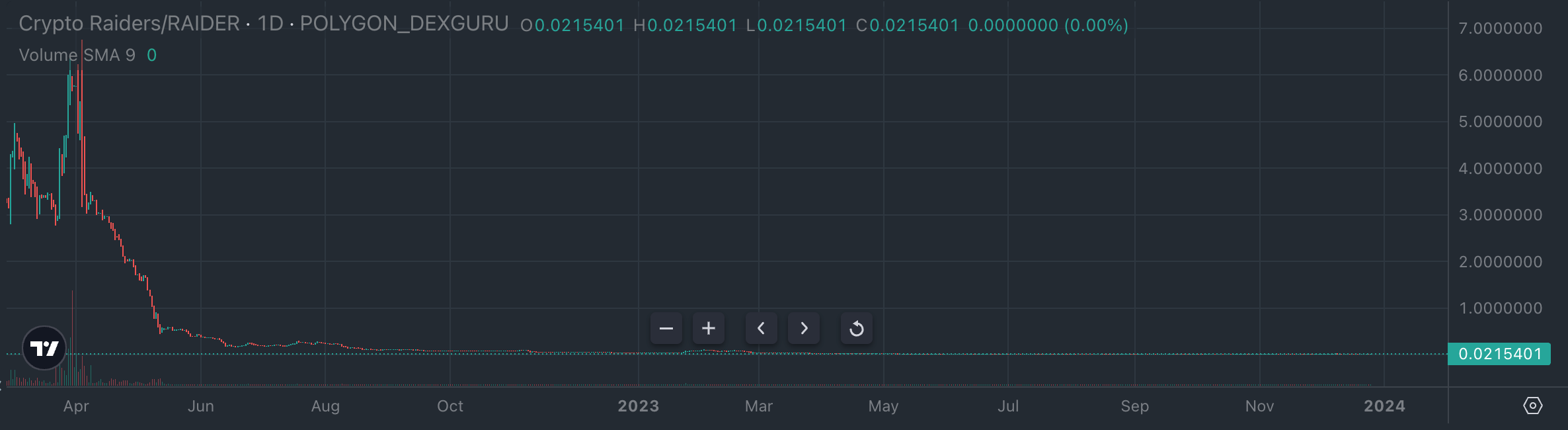
Today, $RAIDER trades at $0.02, with ~$3,000 in 24-hour volume.
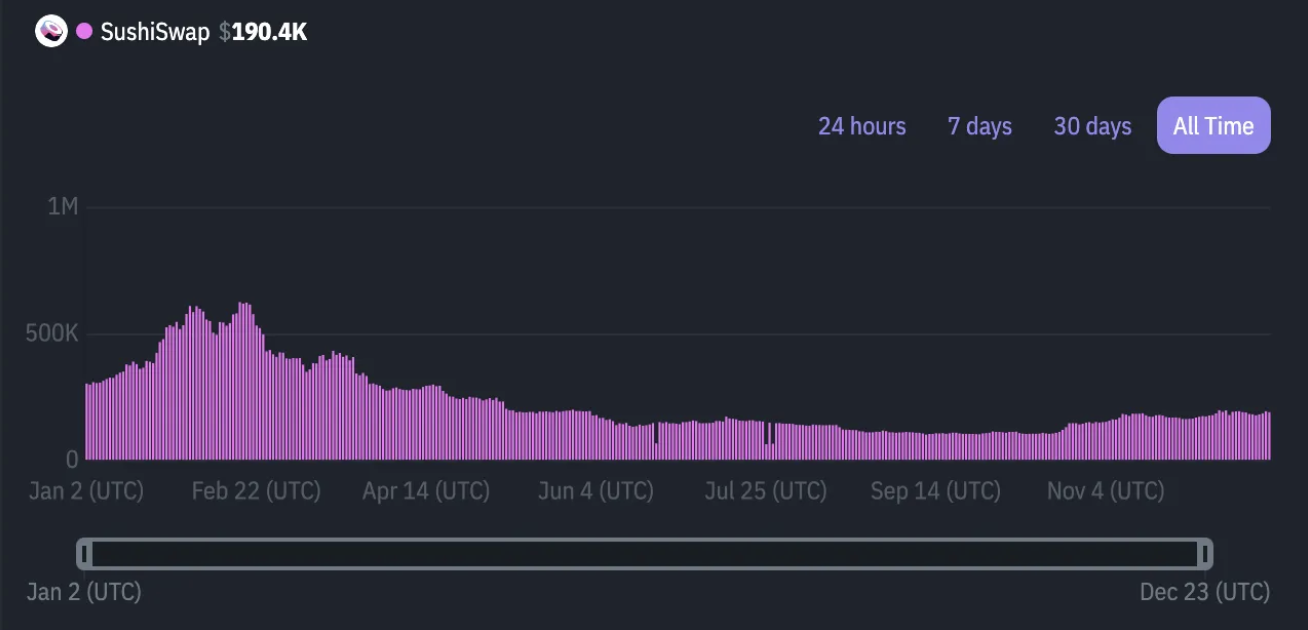
Current liquidity is also below $200,000.
Now, having studied Gas Hero and Lumiterra, what design improvements could have been made to Crypto Raiders—beyond uncontrollable factors like market cycles and speculative price swings?
1) Lack of a commodity economy makes the entire economic foundation unstable.
Game loop outputs are highly homogeneous, lacking deliberately designed supply-demand dependencies. Combined with insufficient content and slow updates, utility token AURUM floods the market without long-term circulation or sinks, leading most players to dump it immediately.
2) Misaligned incentives.
RAIDER benefits LP stakers, the team, and investors, while players receive AURUM—meaning player and LP stakeholder interests aren't unified. In other words, increased time/money investment by players brings no direct benefit to governance token holders; conversely, increased governance token holdings or liquidity provide no strong correlated gains to in-game players.
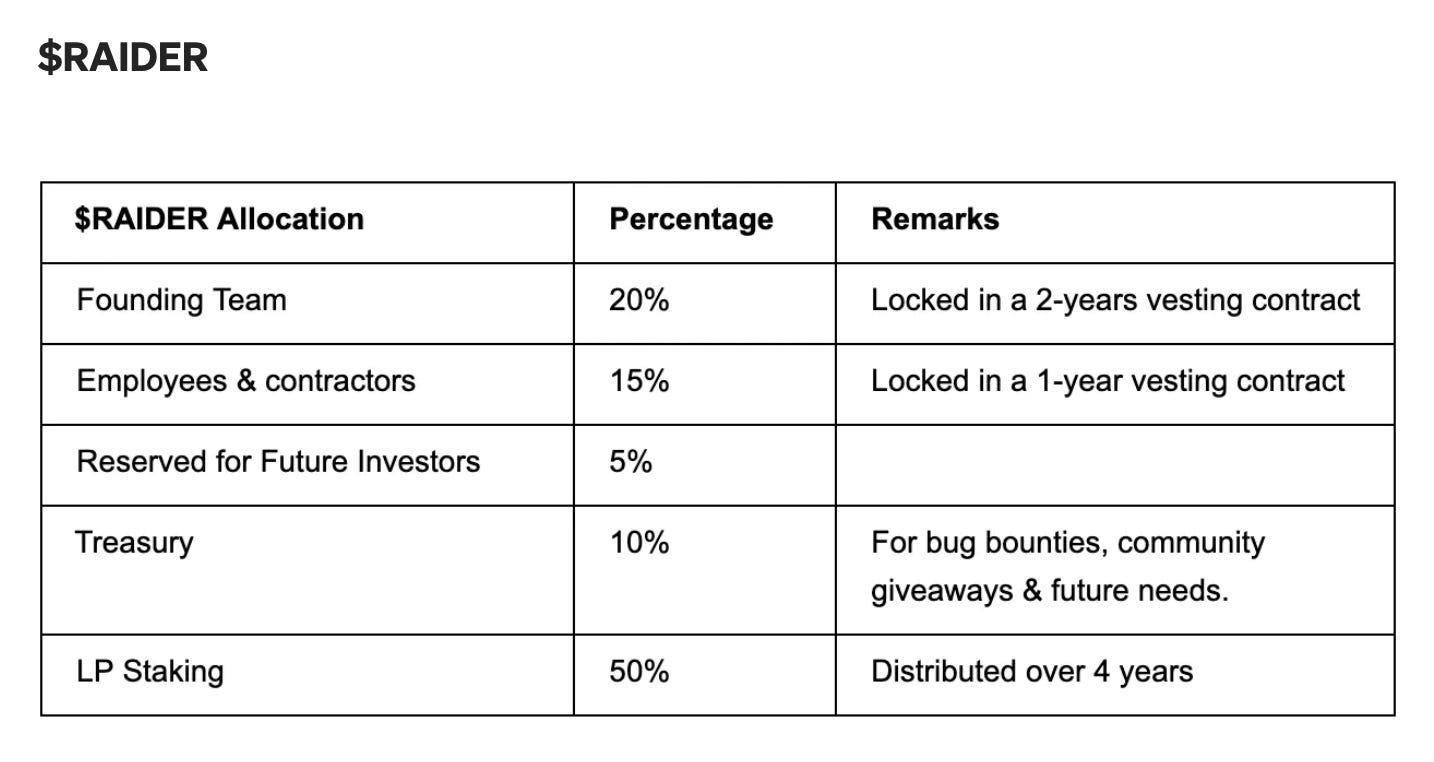
Clearly, there is poor coordination and dependency between liquidity providers and players in Crypto Raiders. Even with enhanced governance or improved external liquidity solutions, positive flywheel effects for ecosystem growth remain unattainable.
3) Ecosystem scale insufficient to sustain long-term governance operations.
Due to Dune dashboard data failure, only approximate figures remain. Peak active wallets reached 5,000–6,000, averaging around 2,000. Such scale struggles to support an AMM-centric commercialized game, let alone serve as a foundation for DeFi and governance.
Gas Hero & Lumiterra
Although both Gas Hero and Lumiterra include “governance” elements, their governance models differ significantly. The former adopts in-game governance, where governance is integrated into the game’s flywheel, launching alongside the game and offering utility to participants (donated funds further incentivize PvP players). Lumiterra employs external governance, separate from the in-game flywheel, not launched initially, serving instead as a future playground for $LUAG holders—who will eventually vote within CRV-like frameworks when conditions mature.
Gas Hero’s governance functions more like income distribution among officials, where entering the official class requires donating large amounts of GMT as PvP prize pools—thus boosting overall game engagement. When regional officials want to encourage greater participation and trading, meta-governance/meta-economic interactions emerge—such as coordinated management in private groups (posting announcements, setting alarms for auctions), even behaviors like Red Packet giveaways or monthly salaries seen in games like Total War: Empire, ultimately leading to superior performance and generous returns for their guilds and regions.
Lumiterra’s “governance” aligns more with DeFi logic, likely resembling ve-token models where voting weight depends on lock-up amount/duration, and outcomes affect all voters’ yields. This external governance relies more on protocol mechanics than human social dynamics, potentially creating communication gaps between layers—for instance, a liquidity provider may not understand in-game guild structures, making organic mutual reinforcement and economic stimulation difficult. Allocating rewards within CRV-style frameworks risks benefiting parties disconnected from actual in-game players—the upside may still concentrate among DeFi whales, lacking effective participant alignment and risking conflict. This vulnerability shares similarities with Crypto Raiders’ failed external protocol governance.
While Gas Hero has just launched and Lumiterra remains in testing, the above conclusions are speculative, with return estimates approximate. Real-world effectiveness requires long-term observation. Still, subtle design differences may lead to divergent ecological evolutions later. Moreover, although self-sustaining economic flywheels differ from perpetual Ponzi-like user acquisition models, they still require substantial user bases—the more players involved, the more stable the ecosystem. Both projects should strive to expand their user bases to sustain flywheel momentum.
Afterword
This article focuses on analyzing the top-tier wealth-gambling and ecosystem flywheel mechanisms exemplified by Gas Hero and Lumiterra, emphasizing the importance of aligning stakeholder interests and expanding ecosystems outward via flywheels in Web3 game design.
However, this piece is incomplete. Due to missing data (Dune dashboard failure), limited theoretical frameworks (only our prior IAT and BLOG writings exist), and absent stakeholders (the Crypto Raiders team has moved to a third project, players have left), it’s challenging to produce a data-rich analysis tracing the evolution of Web3 game economic models. Thus, this article serves merely as a record and synthesis during industry development—hopefully helping entrepreneurs designing and exploring new economic models identify emerging paradigms and apply them quickly—not as a rigorous, fact-based research report.
Additionally, beyond serving as experimental grounds for new mechanisms, Web3 games remain fundamentally playable, interactive investment vehicles. Therefore, external traffic operations, community consensus building, brand backing, asset management, etc., are equally crucial. As stated in our last report, multidisciplinary teams are still essential. Developing long-lived, breakout-hit Web3 games will require collective effort from the entire community.
Join TechFlow official community to stay tuned
Telegram:https://t.me/TechFlowDaily
X (Twitter):https://x.com/TechFlowPost
X (Twitter) EN:https://x.com/BlockFlow_News
 @0xAikoDai