
A Brief Analysis of ZKByte: A Bitcoin Layer 2 Scaling Solution Based on ZK and BitVM
TechFlow Selected TechFlow Selected
A Brief Analysis of ZKByte: A Bitcoin Layer 2 Scaling Solution Based on ZK and BitVM
Enhance speed, efficiency, and security.
 Navigating Web3 tides with focused insights
Author: ZKBase (formerly ZKSpace)
The primary goal of this design is to establish a purpose-built Layer2 network for the Bitcoin blockchain. The Bitcoin Layer2 network aims to meet the growing demand within the Bitcoin ecosystem for faster and more efficient transactions. By offloading certain transaction processing tasks from the main chain, it seeks to alleviate congestion on the Bitcoin mainnet and significantly reduce the time required for transaction confirmation.
Given the inherent computational limitations of the Bitcoin Virtual Machine (VM), our design leverages BitVM, demonstrating its potential for executing smart contracts between two-layer networks. Through the use of challenge-and-response schemes, BitVM presents a novel approach to programmability on the Bitcoin network, breaking through traditional constraints.
To enhance the security and integrity of the Bitcoin Layer2 network, the design implements state validation by integrating zero-knowledge proof (ZK) technology. These advanced cryptographic techniques allow the Bitcoin mainnet to effectively verify the state of the Layer2 network without compromising the privacy and confidentiality of underlying transactions. Zero-knowledge proofs enable verification of information without revealing specific transaction details, thus ensuring the integrity of the Layer2 network while preserving privacy.
Overall, the design aims to improve the scalability, speed, and efficiency of the Bitcoin network through a Layer2 architecture, utilizing BitVM for smart contract execution and integrating zero-knowledge proof technology for state validation—all while maintaining the privacy and security of underlying transactions.
0. Architecture
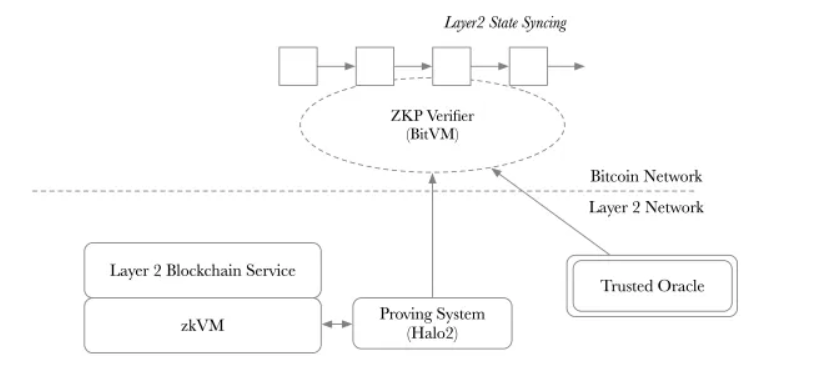
The Layer2 blockchain adopts an account model. The entire state of the blockchain is verified via a zkVM based on the Halo2 proof system. The Layer2 state is synchronized with the Bitcoin mainnet, and all Layer2 states are validated by a zero-knowledge proof (ZKP) verifier implemented using BitVM. We use a single UTXO to track all Layer2 states. Additionally, we employ a trusted oracle to ensure that only inputs/outputs of locking/unlocking scripts adhere to the Layer2 protocol.
1. Layer2 Committee and Trusted Oracle
A Layer2 committee composed of a selected group of users oversees the overall operation of the Layer2 network. In the event of protocol issues, the committee can intervene and halt the protocol to protect all users' assets. The trusted oracle plays a critical role in verifying the correctness of input/output UTXOs and scripts.
2. First Layer to Second Layer
A single Taproot address is created on the Bitcoin network to represent the Layer2 protocol. When a UTXO is created and transferred to this Taproot address, the corresponding UTXO is effectively "deposited" from the Bitcoin mainnet to Layer2.
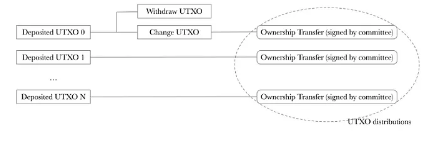
A protocol or committee account specifically manages the "transfer" rights of all UTXO assets deposited into Layer2. Only the protocol, trusted oracle, or committee account can change ownership of deposited UTXOs. The trusted oracle ensures that ownership transfer transactions include the correct output UTXO script.

3. Block Synchronization with Bitcoin Mainnet
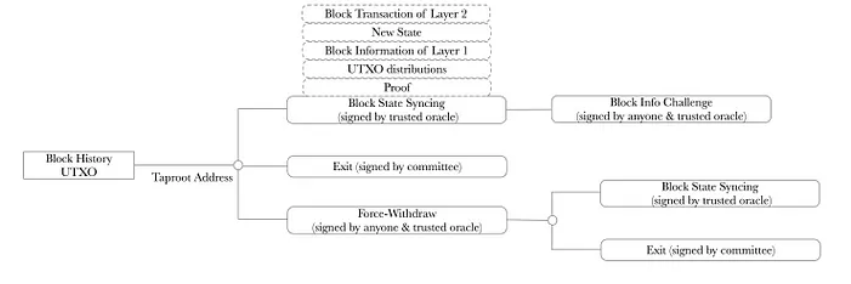
All Layer2 network states are synchronized with the Bitcoin mainnet in the form of blocks. For each block, the following information should be provided:
- Transactions within a specific block;
- New account states after applying these transactions;
- New UTXOs under the current block state (always prepared even if the protocol is compromised);
- Block information from the Bitcoin network;
- Zero-knowledge proof (proving the correctness of state transition from the previous block to the current block). All such states on the Bitcoin mainnet are recorded in a UTXO transaction history.
3.1 More About Proofs
Zero-knowledge proofs are used to verify the correctness of Layer2. The following must be proven:
- Layer2 block transactions are correctly signed.
- All new account states are properly processed.
- All deposit transactions prior to a specific block on the Bitcoin mainnet are correctly processed.
- For the current state, all UTXO allocations are correctly created.
3.2 Block Information Challenge
To ensure the accuracy of specified block information on the Bitcoin mainnet, we use a challenge-and-response scheme. A prover can demonstrate the accuracy of block information by showing that N additional blocks exist after the specified block within the lock-up period.
3.3 ZKP Circuit and BitVM Enhancement
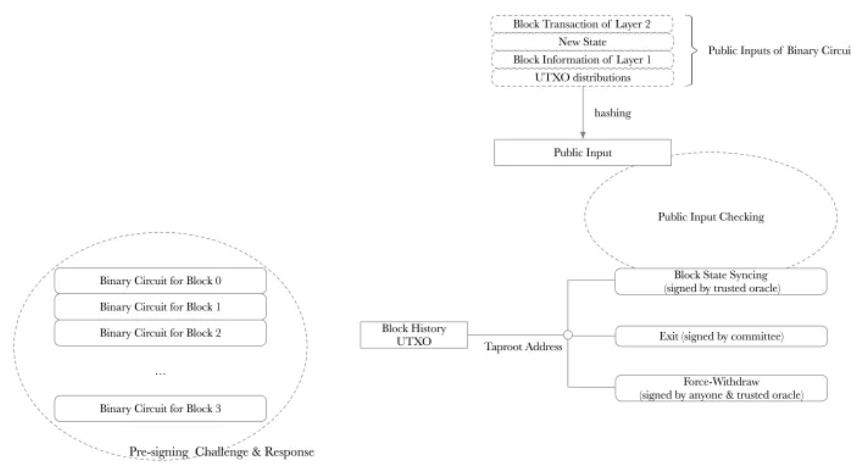
As shown in the BitVM paper, ZKP verification can be represented as a binary circuit subject to challenges by two parties. Through pre-signed transactions, challenges can be sent to obtain bit commitments of the circuit. If both 0 and 1 are revealed, the challenge succeeds. To use BitVM for ZKP verification, two considerations are important:
- The same binary circuit commitment can only be used once. That is, if the same circuit commitment is reused across multiple blocks, it may reveal both 0 and 1 of a bit commitment.
- For ZKP verification, besides circuit satisfiability, the "public inputs" must also be checked.
To address these two drawbacks, a unique binary circuit is created for each Layer2 block, and the "public inputs" are fixed. Bitcoin scripts are used to handle hashing and checking of public inputs. Correct bit commitments of public inputs are verified by the trusted oracle. Regarding circuit satisfiability, any member within the committee has the right to initiate a challenge.
4. From Layer2 to Bitcoin Mainnet
Assets can be moved from Layer2 to the Bitcoin mainnet via two methods: withdrawal and force-withdrawal. Withdrawal transactions are initiated from Layer2, where the ZKP circuit ensures transactions are processed as intended. Force-withdrawal transactions are initiated from the Bitcoin network.
4.1 Withdrawal and Force-Withdrawal Transactions
Withdrawal transactions triggered from Layer2 are validated using the ZKP circuit to ensure correct processing. Force-withdrawal transactions initiated from the Bitcoin network must be included in the next block state update.
4.2 UTXO Allocation
When a block's state is updated, UTXO allocation is synchronized. In the event the protocol halts, all UTXOs can be applied to ensure the safety of user assets. Among these UTXOs, only those designated for withdrawal or force-withdrawal are signed by the protocol.
5. Layer2 Exit
Once a ZKP fails validation, the committee must halt and exit the protocol. If the protocol stops, the committee signs all UTXO allocations specified in the latest Layer2 block state. With these signatures, users can withdraw from Layer2 without any loss.
Join TechFlow official community to stay tuned
Telegram:https://t.me/TechFlowDaily
X (Twitter):https://x.com/TechFlowPost
X (Twitter) EN:https://x.com/BlockFlow_News
 @ZKSpaceOfficial