








How CEXs Can Take the Lead in the "Inscriptions War" as Bitcoin's Ecosystem Returns to Its Peak
TechFlow Selected TechFlow Selected
How CEXs Can Take the Lead in the "Inscriptions War" as Bitcoin's Ecosystem Returns to Its Peak
Controlling the narrative in the Bitcoin ecosystem may make one the helmsman of the next bull market surge.
 Navigating Web3 tides with focused insights
By Mia, ChainCatcher
As the U.S. interest rate hike cycle nears its end, global financial markets are gradually recovering—and the crypto market is no exception. Fueled by strong market expectations surrounding the SEC's potential approval of a spot Bitcoin ETF, Bitcoin’s wealth effect has become increasingly evident. The price of Bitcoin has surged from $16,500 at the beginning of the year to $44,000. This rally has attracted massive capital inflows, propelling the Bitcoin ecosystem into another period of rapid development. A wave of inscription-based assets such as BRC20, Ordinals, and ARC20 has swept across the Bitcoin chain. As an indispensable player in the crypto space, TechFlow is naturally seizing this opportunity to capture the new blue ocean of crypto.
On December 12, Binance officially launched the BRC-20 project Sats (1000SATS) and added a "seeds" label, making it the second inscribed asset listed by Binance following ORDI in November. With this momentum, the inscription market has entered a new era of mass FOMO ("fear of missing out"), characterized by chaotic yet vibrant activity. According to Dune analytics, as of December 26, cumulative fees generated from inscriptions on the Ordinals protocol have surpassed 5,000 BTC—approximately $215,697,899. The total number of inscriptions minted has approached 52 million. Furthermore, data shows that after April 2023, the volume of Ordinals inscriptions has remained consistently high, clearly reflecting sustained enthusiasm among on-chain participants.
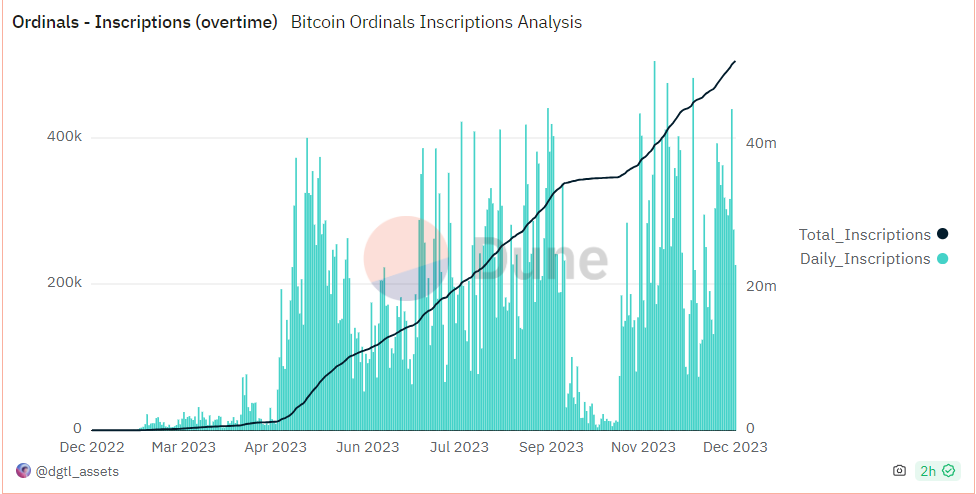
Image source: https://dune.com/dgtl_assets/bitcoin-ordinals-analysis
Despite these robust on-chain metrics, centralized exchanges (CEXs), which serve as secondary market hubs, appear particularly passive. Inscription assets typically adopt a “fair launch” model, allowing users to mint directly without pre-sales or venture capital allocations—giving investors greater control. Under these conditions, traditional CEXs lose their usual advantages. Facing an increasingly rigid CEX landscape, the vast and untapped inscription market has emerged as a promising breakthrough. How then can centralized exchanges reclaim market share and influence in this “inscription war”? And how far can their reform efforts go?
OKX
According to data, OKX NFT Marketplace saw its daily trading volume exceed $50 million on December 18 due to Bitcoin Ordinals trading—surpassing platforms like Blur ($13.21 million), Magic Eden, and OpenSea to become the largest NFT marketplace by daily volume. This surge is attributed to OKX’s strategic support for BRC-20 and Bitcoin Ordinals. Undoubtedly, OKX Web3 Wallet’s sharp market awareness has positioned it as a frontrunner in the “inscription war.”
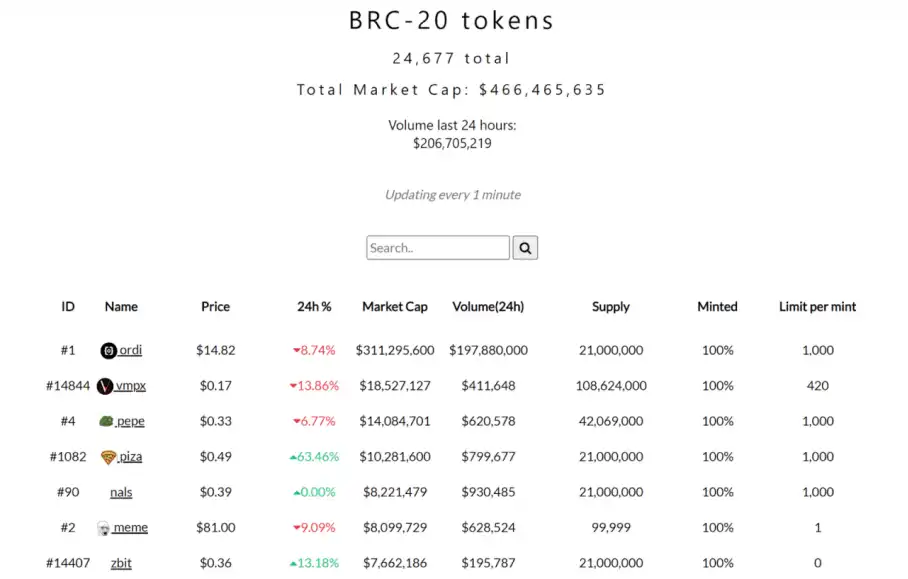
In fact, as early as May this year, the BRC-20 concept began gaining traction thanks to its “first-come, first-served” mechanism, drawing meme coin capital into the Bitcoin ecosystem. Minting and trading activities for BRC-20 tokens started flourishing. By May 18, 2023, there were already 24,677 BRC-20 tokens with a total market cap of $466 million. Among them, Ordi held the highest market cap, accounting for 66.7% of the total BRC-20 market.
As an early supporter and builder of the Bitcoin ecosystem, OKX quickly identified the “wealth code” within and became the first mover among major CEXs. On May 16, OKX unveiled its Web3 Wallet Bitcoin ecosystem roadmap, announcing plans to launch a BRC-20 trading market supporting BRC-20 token trades and BTC cross-chain swaps. By late May and early June, it would also support minting of Ordinals inscriptions and BRC-20 tokens, trading of Ordinals NFTs, STX staking (on BTC Layer 2), and BRC-20 staking—making OKX Web3 Wallet the first multi-chain wallet to support Ordinals.
According to Dune data, OKX Web3 Wallet’s Ordinals marketplace has achieved a total trading volume close to $1 billion—reaching $979,501,762. Compared to the overall Ordinals protocol trading volume of approximately $2.15 billion, this accounts for roughly 45%. Other key metrics are also impressive: a total of 484,791 transactions and 107,507 unique addresses. These figures solidify OKX Web3 Wallet’s position as the leading marketplace for BRC-20 inscriptions and BTC NFTs.
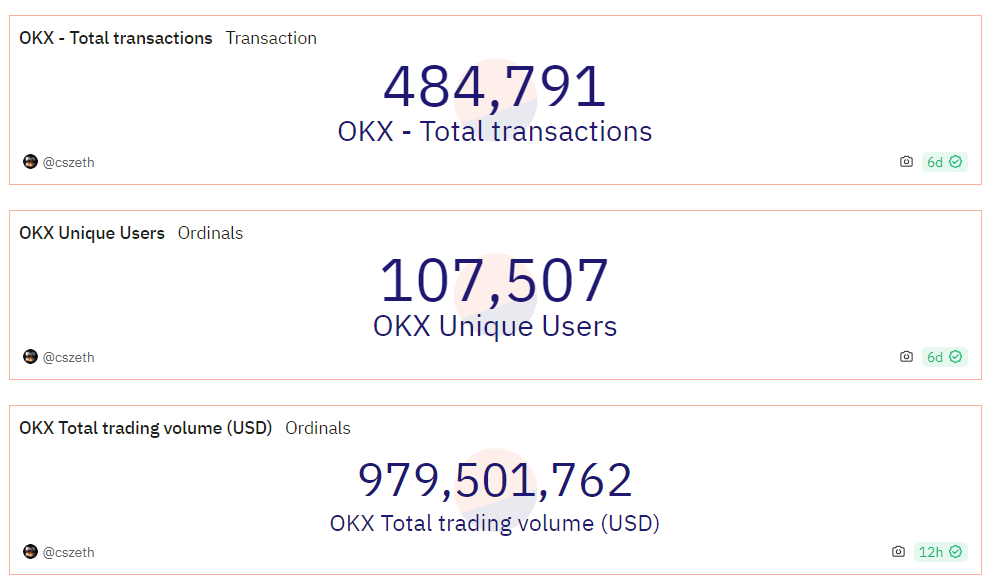
Image source: https://dune.com/cszeth/ordinals-marketplace-okx
As the inscription narrative evolves, the inscription market is blossoming across multiple blockchain ecosystems. The sector has expanded beyond Bitcoin to include Arbitrum, Solana, Avalanche, BNB Chain, Polygon, and even previously dormant chains such as Fantom and Dfinity, where some inscription projects have recently emerged. This diversification has driven OKX toward broader multi-chain development. Currently, OKX Web3 Wallet’s inscription tool supports additional chains including Mantle, Celo, Metis, Klaytn, Gnosis Chain, Goerli, and Sepolia, bringing the total number of supported public chains to 22. According to official information, users can choose between text mode or hexadecimal mode to engrave single or batch texts. This extensive multi-chain support gives OKX a commanding lead in the inscription market.
Binance
As a veteran exchange in the top tier of CEXs, Binance appears relatively underwhelming in this “inscription race.” Compared to OKX’s bold moves, Binance has taken a conservative approach—listing only two inscription assets so far: Ordinals (ORDI) and Sats (1000SATS). On December 2, it launched the BRC-20 project Sats (1000SATS) and introduced 1-50x USDT-margined perpetual contracts for 1000SATS. In terms of Web3 wallet functionality, Binance has shown no meaningful support for inscriptions. In response to user complaints about the poor usability of Binance’s Web3 wallet, co-founder He Yi stated: “The reason users find Binance Web3 Wallet inconvenient might be because the product and R&D teams initially viewed BRC20 as a cyclical trend similar to NFTs, uncertain whether it would sustain popularity, so they didn’t allocate sufficient resources. We will now place greater emphasis on it.”
Binance has faced criticism over its Web3 wallet performance. Currently, Binance Web3 Wallet supports 37 public chains, covering most major Layer 1 and Layer 2 networks. In contrast, OKX supports 61 chains, notably including the Bitcoin network—a critical differentiator. While Binance is often labeled as a “winner-takes-all” platform, OKX’s richer on-chain features and Bitcoin network integration appear more strategically advantageous.
Perhaps Binance should shift its strategy from internal competition to innovation-driven development. Although ORDI and Sats have performed well post-listing, much of their success can be attributed to broader market trends and Binance’s accumulated “big-brand advantage.” The real challenge lies in securing a lasting foothold within the Bitcoin ecosystem. Whether the current momentum in Bitcoin’s ecosystem is a long-term trend or a fleeting phenomenon, it represents a significant blue ocean opportunity. As gatekeepers of the industry, CEXs must act as navigators. For Binance, overcoming the perception of “building in isolation” requires deeper industry reflection and a renewed strategic vision.
Bitget
Compared to the previous two exchanges, Bitget—the rising star among CEXs—has taken a less conventional path in the inscription space. Instead of competing head-on, Bitget has carved out its own niche by focusing on smaller-cap BRC-20 tokens and inscription assets on chains beyond Bitcoin. It has listed Solana-based inscription tokens SOLS and Zero, along with BRC-20 tokens MICE (MICE), BRC20.COM (COM), MMSS (MMSS), and Comsats (CSAS). This reflects Bitget’s distinct market strategy and highlights the expanding possibilities brought by multi-chain inscription adoption.
Looking ahead, we may envision inscription tokens being issued on every public blockchain just like traditional crypto tokens, and traded normally on CEXs. Bitget’s early foray into multi-chain inscription tokens demonstrates this very possibility. Perhaps more and more projects will begin issuing tokens via inscription methods, positioning Bitget as a likely preferred trading platform and testing ground for these emerging niche assets.
As inscription tokens gain wider recognition and adoption across the industry, Bitget’s early engagement could evolve into a strategic masterstroke—enabling it to expand its influence from individual projects to the broader inscription domain, thereby enhancing its brand presence as a forward-thinking cryptocurrency exchange.
The Inscription Market Could Reshape the CEX Landscape
History offers valuable lessons. Throughout the evolution of the crypto market, just as certain players benefited during the early DeFi boom on Ethereum, the new wave of innovation in the Bitcoin ecosystem presents substantial opportunities—including for exchanges. Data shows that Bitcoin still commands over 50% of the total cryptocurrency market capitalization and holds the strongest consensus. The emergence of inscriptions helps overcome Bitcoin’s historical limitation of lacking smart contract functionality, placing the Bitcoin ecosystem on more equal footing with Ethereum. This could mark Bitcoin’s best chance to reclaim its former glory. Thus, both the inscription sector and the broader Bitcoin ecosystem hold immense growth potential and positive outlooks.
Given the fast-paced nature of the crypto industry, the exchange that pioneers a comprehensive CEX framework for inscriptions and gains influence within the Bitcoin ecosystem may emerge as the leader in the next bull market. At present, OKX leads the pack in inscription adoption, Bitget is charting its own course, and He Yi’s recent comments suggest Binance is preparing strategic adjustments and increased investment in BRC-20. The “inscription war” among CEXs is heating up. Who will ultimately lead the future of the Bitcoin ecosystem? Only time will tell.
Join TechFlow official community to stay tuned
Telegram:https://t.me/TechFlowDaily
X (Twitter):https://x.com/TechFlowPost
X (Twitter) EN:https://x.com/BlockFlow_News
 ChainCatcher 链捕手











