
Wall Street heavyweights bet big on BTC, raking in 300% gains in bull market
TechFlow Selected TechFlow Selected
Wall Street heavyweights bet big on BTC, raking in 300% gains in bull market
MicroStrategy became one of the top-performing companies in the U.S. with a valuation above $5 billion in 2023.
 Navigating Web3 tides with focused insights
By Jake Piazza@CNBC
Translation: Qin Jin, Carbon Value Chain
MicroStrategy was founded nearly 35 years ago and for most of its history was a little-known software company focused on business intelligence.
But in 2023, the company's stock surged 337%, making it one of the best-performing U.S. companies valued at $5 billion or more, outpacing Nvidia's 234% gain and Meta's 194% surge.
Unlike its tech peers that rely on revenue growth and market share gains to drive stock performance, MicroStrategy’s investor appeal is almost entirely tied to bitcoin.
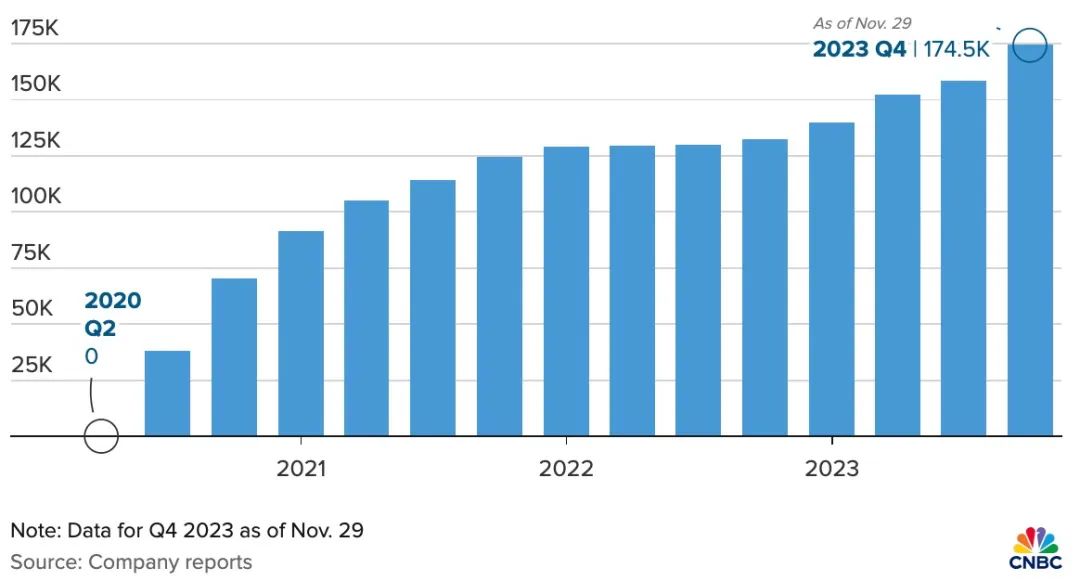
The company began buying cryptocurrency in mid-2020 and as of late last Friday had accumulated approximately 174,530 bitcoins worth about $7.65 billion.
Wall Street has been captivated by this story—the company’s shares have risen roughly twice as much as bitcoin itself this year.
"It really is bitcoin," said Joseph Vafi, an analyst at Canaccord Genuity. "All the other stuff is healthy, doing well—they're not ignoring it. It's doing fine, leading the software pack. But that's basically something we don't need to worry about."
MicroStrategy has a market value of $8.5 billion, meaning about 90% of its valuation is directly linked to the bitcoin it holds. When bitcoin plunges or surges, so does MicroStrategy. In 2022, when bitcoin fell 64%, MicroStrategy dropped 74%. Even after this year’s rally, MicroStrategy’s stock remains below its peak during the height of the crypto boom in 2021.
The bitcoin strategy dates back to July 2020, when the company announced it would begin allocating part of its cash reserves to alternative assets including digital currencies. At the time, MicroStrategy had a market cap of around $1.1 billion, with its software business having shrunk since 2015. Annual revenue was just under $500 million, with minimal profits.
Bitcoin Holdings of MicroStrategy
Quarterly Bitcoin Holdings
By mid-2020, MicroStrategy had just over $530 million in cash and short-term investments on its balance sheet. Michael Saylor, co-founder and then-CEO, saw these funds sitting idle due to low interest rates and wanted to put them to work.
He had to decide whether stocks, precious metals, or bitcoin represented the best use of capital.
"We decided to buy bitcoin because bitcoin represents digital gold," Saylor said on the first earnings call after announcing the strategy. "It's harder than gold. It's smarter, stronger, faster than gold."
Saylor’s decision created a way for investors to gain exposure to bitcoin through regular stock purchases without having to buy bitcoin directly. Saylor, who stepped down as CEO last year and now serves as executive chairman, told CNBC’s Morgan Brennan last week he expects the bitcoin bull market to continue into next year. He noted that 99.9% of the world’s money is invested in real estate, equities, bonds, and commodities, with only 0.1% allocated to bitcoin.
"As people learn about digital assets, they realize they should allocate increasing amounts of capital to this asset class, so their allocation moves from 0.1% to 0.2%," said Saylor, who co-authored a book on bitcoin last year titled *What Is Money?*
A New Use for Cash
MicroStrategy is not the first company to allocate part of its cash to alternative investments, nor the last to try creative ways to generate outsized returns. Earlier this month, GameStop CEO Ryan Cohen allowed his company to invest cash in stocks.
But MicroStrategy stands out because it is now viewed almost entirely as a bitcoin holding company.
"Michael Saylor is a visionary," said Vafi. "He saw a real opportunity to leverage the fact that they had a large amount of cash and a pristine balance sheet, and launched this bitcoin financial experiment. And it worked well, so they kept going down this path."
When analyzing why MicroStrategy’s stock has significantly outperformed bitcoin this year, Vafi described it as a "scarcity premium," given the limited avenues for stock investors to access the market.
That could change in the new year as investors prepare for a wave of bitcoin exchange-traded funds (ETFs). Currently, there are bitcoin futures ETFs, which consist of contracts tied to bitcoin prices but do not hold the cryptocurrency itself. Investors can also buy shares in the Grayscale Bitcoin Trust, which owns bitcoin but trades over-the-counter rather than on major exchanges.
Last year, regulators rejected Grayscale’s application to convert its trust into a spot bitcoin ETF, citing investor protection concerns. Grayscale sued the U.S. Securities and Exchange Commission (SEC), and in August an appeals court ruled in Grayscale’s favor—a decision many industry insiders believe paves the way for a new wave of ETF approvals. Asset managers including BlackRock, Fidelity, and Invesco have already filed applications with the SEC to launch their own products.
Vafi said the prospect of competition poses little threat to MicroStrategy.
"To some extent, I think that’s a very high-level question," he said. "If a bitcoin ETF is approved, the price of bitcoin could go up—and potentially go up substantially."
MicroStrategy offers more than just a bet on bitcoin’s direction. While ETFs are passively managed, MicroStrategy can actively deploy its bitcoin holdings—for example, using them as collateral to create additional business opportunities.
Shirish Jajodia, vice president of finance and investor relations at MicroStrategy, told CNBC via email: "The continued maturation of the bitcoin regulatory environment, along with the growing institutional demand we’re seeing today, is highly encouraging for MicroStrategy. We truly believe this will positively impact mainstream investor and corporate adoption of bitcoin."
On the company’s recent earnings call, Saylor emphasized that MicroStrategy’s software business remains a key advantage. "It’s a mature cash flow generator that enables us to buy more bitcoin," he said.
For many investors who shorted MicroStrategy this year, it has been a painful experience.
According to data from S3 Partners, as of early December, short sellers in crypto-related stocks lost $6.1 billion for the year, with Coinbase’s surge inflicting the most damage. The firm reported that short sellers spent $2.19 billion during the first three quarters of the year covering their positions, mostly buying back shares in Coinbase and MicroStrategy.
Based on data provided by S3 Partners last week, short sellers lost $4 billion on Coinbase and $1.4 billion on MicroStrategy this year. S3 noted that approximately 23% of MicroStrategy’s publicly traded shares were sold short, second only among crypto firms to bitcoin miner Marathon Digital. By comparison, the average short interest across U.S. stocks is 5%.
MicroStrategy shows no signs of slowing down its bitcoin buying spree. The company said it purchased approximately 16,130 bitcoins in November for over $593 million—even as bitcoin prices continued to rise. That’s more bitcoin than the company bought in any full quarter since the first three months of 2021.
Join TechFlow official community to stay tuned
Telegram:https://t.me/TechFlowDaily
X (Twitter):https://x.com/TechFlowPost
X (Twitter) EN:https://x.com/BlockFlow_News