AI+Crypto Ultimate Report: What Kind of AI+Crypto Delivers Higher Returns for Products?
TechFlow Selected TechFlow Selected
AI+Crypto Ultimate Report: What Kind of AI+Crypto Delivers Higher Returns for Products?
A more reasonable aspect of AI applications lies in enhancing user experience and improving development efficiency, or serving as a crucial component in the AI market.
 Navigating Web3 tides with focused insights
Author: Ian @Foresight Ventures
TL;DR
After months of deep diving into the intersection of AI and crypto, my understanding of this space has evolved significantly. This article compares my early views with current trends in the sector. Readers familiar with the space can start from the second section.
-
Decentralized compute networks face real market demand challenges. The ultimate goal of decentralization must be cost reduction. While Web3’s community traits and tokens bring non-trivial value, for the compute赛道 itself, they remain additive rather than transformative. The key is to integrate with actual user needs—not blindly treat decentralized compute as a supplement to centralized shortages.
-
AI Marketplaces: I discuss a vision for a fully financialized, on-chain AI ecosystem where community and tokenomics play a central role. Such a marketplace encompasses not just compute and data but models and applications. Model financialization is core—enabling users to directly participate in value creation while generating downstream demand for compute and data.
-
Onchain AI: ZKML faces dual challenges on both supply and demand sides. OPML offers a more balanced trade-off between cost and efficiency. While technically innovative, OPML doesn’t solve the fundamental issue: there's still no clear demand for trustless onchain AI.
-
Application Layer: Most web3 AI projects are overly naive. AI’s real value lies in enhancing UX, improving dev efficiency, or serving as a key component within an AI marketplace ecosystem.
1. A Retrospective on the AI + Crypto Space
Over the past few months, I’ve conducted in-depth research on the AI + crypto narrative. After several months of reflection, I’m glad I identified certain trajectory shifts early—but I also recognize some earlier assumptions were flawed.
This article focuses purely on viewpoints, not introductions. It covers major directions in web3 AI and contrasts my previous and current perspectives. Different angles may offer unique insights—approach them critically.

Let’s first revisit the main AI + crypto themes I outlined earlier this year:
1.1 Distributed Compute
In “Rethinking Decentralized Compute Networks”, I analyzed how crypto could enhance compute networks under the broad thesis that compute will become one of the most valuable resources in the future.
While decentralized compute networks have the largest potential demand in large AI model training, they also face the greatest technical hurdles—complex data synchronization, network optimization, data privacy, and security concerns. Although existing technologies offer preliminary solutions, the massive computational and communication overhead prevents their use in large-scale distributed training. Clearly, decentralized compute finds more immediate applicability in inference, where computational complexity and data interaction are lower—making it better suited for distributed environments. Still, latency, privacy, and model security remain significant challenges.
1.2 Decentralized AI Marketplaces
In “The Best Attempt at a Decentralized AI Marketplace”, I argued that a successful decentralized AI marketplace must tightly integrate the strengths of AI and Web3—leveraging decentralization, asset ownership, revenue distribution, and the added value of decentralized compute—to lower barriers for AI adoption, encourage developers to share models, protect user data privacy, and build a developer-friendly platform for AI resource exchange.
At the time, I believed (though now I see it may not be entirely accurate) that data-centric AI marketplaces held greater potential. Model-centric marketplaces require a critical mass of high-quality models, but early platforms lack user base and quality content, leading to insufficient incentives for top model creators. In contrast, data-centric marketplaces can accumulate vast amounts of valuable, especially private, data through decentralized collection, incentive design, and guaranteed data ownership.
Success hinges on accumulating user resources and building strong network effects—so participants gain more value inside the ecosystem than outside. Early focus should be on attracting and retaining quality models, then shift toward drawing in end users once a solid model library and data moat are established.
1.3 ZKML
Before ZKML became widely discussed, I explored the value of onchain AI in “AI + Web3 = ?”.
Without sacrificing decentralization or trustlessness, onchain AI has the potential to elevate web3 to the “next level.” Today’s web3 resembles early web2—still unable to support broader applications or create substantial value. Onchain AI could provide a transparent, trustless solution to bridge this gap.
1.4 AI Applications
In “AI + Crypto and Web3 Female-Oriented Gaming — HIM”, I analyzed how LLMs add value in web3 apps using our portfolio project “HIM.” What kind of AI + crypto integration delivers higher returns? Beyond hardcore infrastructure-to-algorithm development of trustless onchain LLMs, another path is to de-emphasize the black-box nature of inference by finding suitable use cases where powerful reasoning can be effectively applied.

2. Current State of the AI + Crypto Landscape
2.1 Compute Networks: High Potential, High Barriers
The core logic behind compute networks remains unchanged—but market demand is still a challenge. Who would opt for a less efficient and less stable solution? Therefore, a few key questions need to be answered clearly:
What is decentralization for?
If you ask a founder of a decentralized compute network today, they’ll likely list benefits like enhanced security, anti-censorship, transparency, trustlessness, better resource utilization, improved data privacy, and resistance to interference...
These are all common talking points—any web3 project can claim anti-censorship, trustlessness, privacy. But I argue these aren’t what matter. Think deeper: Can decentralized networks really outperform centralized servers in security? Do they truly solve privacy issues? Contradictions abound. So here’s my take: The ultimate purpose of decentralizing a compute network must be lower cost. The more decentralized, the cheaper the compute.
Thus, fundamentally, “utilizing idle compute” is more of a long-term narrative. Whether a decentralized compute network succeeds largely depends on whether the team has thought through the following:
The Value of Web3
A clever token design and its resulting incentive/punishment mechanisms are clearly strong value-adds provided by decentralized communities. Compared to traditional internet, tokens—as complementary tools to smart contracts—enable protocols to implement more complex incentive and governance systems. Transparency, reduced costs, and increased efficiency are all benefits brought by crypto, offering greater flexibility and innovation in incentivizing contributors.

But we should also rationally assess this seemingly natural “fit.” For decentralized compute networks, the value brought by Web3 and blockchain is merely an “add-on,” not a fundamental disruption. It doesn’t change the basic operational mode of the network or overcome current technical bottlenecks.
In short, Web3’s value enhances the appeal of decentralized networks but won’t alter their core structure. Relying solely on Web3’s value isn’t enough for decentralized networks to truly succeed in the AI wave. As mentioned later, right tech for the right problem—the game isn’t simply solving AI compute shortages, but introducing a fresh approach to a stagnant field.
It might involve monetizing compute like PoW or storage mining—turning compute into an asset. Providers earn tokens by contributing computing power, creating direct economic incentives to join. Or it could involve creating a web3-based market that consumes compute, financializing upstream layers (e.g., models) to open up demand points willing to accept slower, less stable compute.
Figure out how to align with real user needs. After all, users and participants don’t just want efficient compute—“making money” is always one of the strongest motivators.
The core competitive advantage of decentralized compute networks is price
If we must discuss the practical value of decentralized compute, the biggest opportunity from web3 is the potential to further compress compute costs.
The higher the degree of decentralization among compute nodes, the lower the per-unit compute price. This can be driven by several factors:
-
Introducing tokens allows node rewards to be paid in protocol-native tokens instead of cash, fundamentally lowering operational costs;
-
Permissionless access and web3’s strong community effect drive market-driven cost optimization—more individuals and small businesses can contribute existing hardware, increasing supply and driving down prices;
-
An open compute market created by the protocol fosters price competition among providers, further reducing costs.
Case: ChainML

In short: ChainML is a decentralized platform providing compute for inference and fine-tuning. In the short term, ChainML will launch Council—an open-source AI agent framework—to generate demand via chatbot integrations across applications. Long-term, ChainML aims to become a full AI + web3 platform (to be detailed later), including both model and compute markets.
I believe ChainML’s technical roadmap is highly reasonable. They understand the key point: decentralized compute isn’t about matching centralized performance to meet AI industry supply—it’s about gradually lowering costs so that certain demand segments can accept lower-quality compute sources. Thus, in the early stage when the protocol cannot access a large number of decentralized nodes, the priority is securing reliable, efficient compute sources. Hence, product-wise, starting centrally makes sense—running the full stack early, using strong BD to acquire clients and expand market presence, then gradually decentralizing compute provision to smaller providers, and eventually to individual miners. This is ChainML’s divide-and-conquer strategy.
From a demand-side perspective, ChainML has built a centralized MVP infrastructure protocol designed to be portable. Since February, they’ve been running the system with customers, and since April, in production. Currently hosted on Google Cloud, but built on Kubernetes and other open-source tech, making migration to AWS, Azure, CoreWeave, etc., straightforward. The plan is to gradually decentralize—from niche cloud providers to individual compute miners.
2.2 AI Markets: Greater Imagination
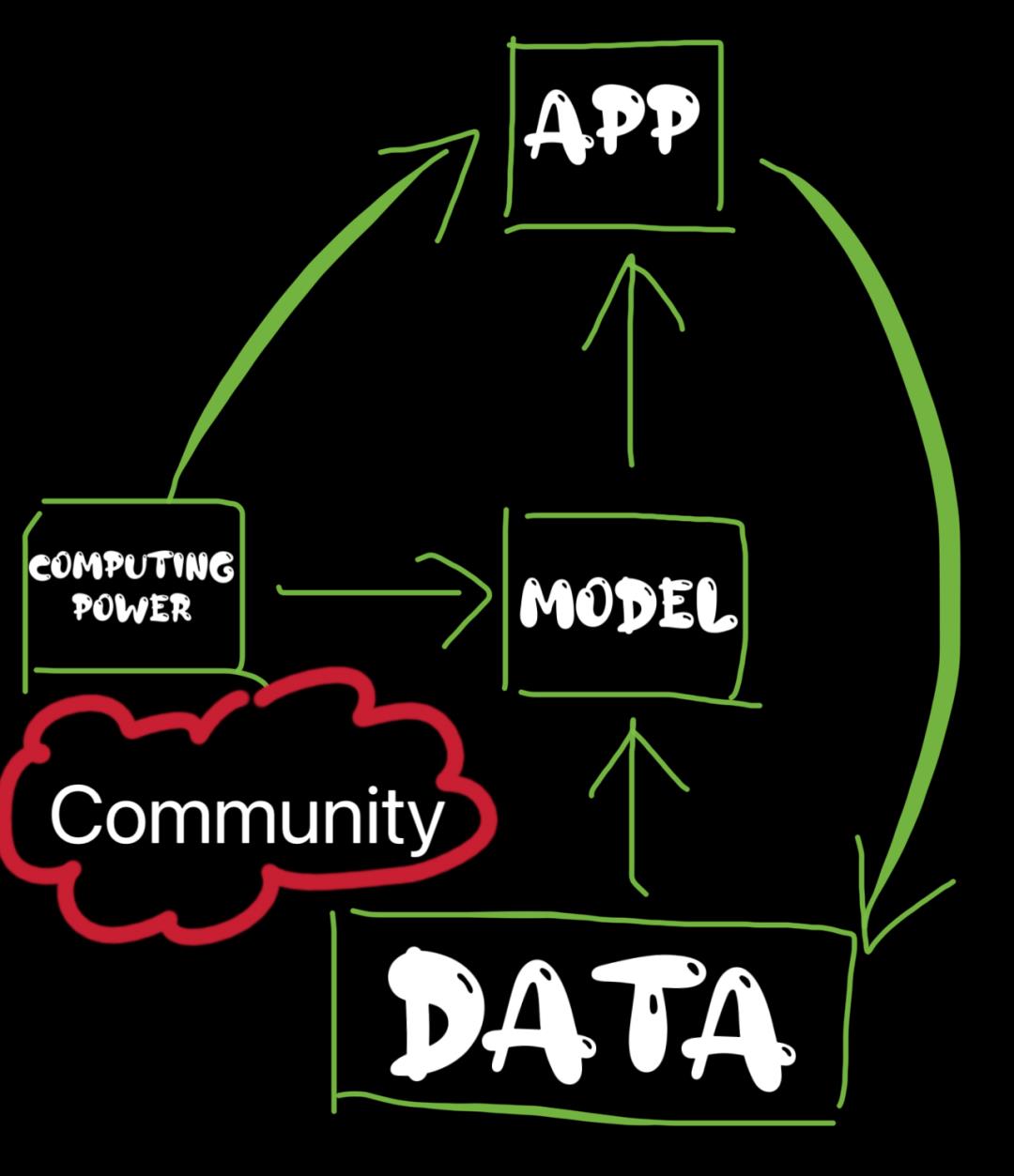
Calling this sector an "AI marketplace" somewhat limits its scope. Strictly speaking, a truly imaginative “AI market” should be a middleware platform that fully financializes the entire AI pipeline—from underlying compute and data, to models and applications. Earlier, I noted that the primary challenge for decentralized compute is creating demand. A closed-loop, fully financialized AI market could naturally generate such demand.
Something like this:
A web3-enhanced AI market sits on compute and data foundations, attracting developers to build or fine-tune models using valuable data, which then spawn model-based applications. These apps and models, during development and usage, generate demand for compute. Under token and community incentives, bounty-driven real-time data collection or ongoing contributor rewards can expand the uniqueness of the data layer. Meanwhile, app adoption feeds back more valuable data into the data layer.
Community
Beyond token-driven value, community is arguably web3’s greatest contribution—one of the core drivers of platform growth. With token incentives, contributor engagement and output quality can surpass centralized institutions. Data diversity becomes a key strength, crucial for building accurate, unbiased AI models—and currently a bottleneck in data-centric approaches.
The heart of the entire platform, I believe, lies in the models. We realized early that a marketplace’s success depends on high-quality models and the incentives for developers to contribute. But we may have overlooked one question: if web3 projects can’t compete with traditional platforms on infrastructure, developer community, or reputation, how can they catch up given the latter’s massive user base and mature infrastructure? The answer may lie in AI model financialization.
-
Models can be treated as tradable assets. Viewing AI models as investable assets may be a novel innovation enabled by Web3 and decentralized markets. This allows users to directly participate in value creation and benefit from it. This mechanism also encourages pursuit of higher-quality models and community contributions, as user returns are tied to model performance and application outcomes;
-
Users can stake tokens to invest in models. Revenue-sharing incentivizes users to support promising models, economically motivating developers to build better ones. For stakers, the most intuitive way to evaluate a model (especially image generation models) is repeated testing—creating demand for the platform’s decentralized compute. This could be one answer to “who would use slower, less stable compute?”
2.3 Onchain AI: Can OPML Take a Shortcut?
ZKML: Missteps on Both Demand and Supply
Undoubtedly, onchain AI is a visionary and worthy direction. Breakthroughs here could bring unprecedented value to web3. However, ZKML’s high academic barrier and infra requirements make it unsuitable for most startups to pursue head-on. Most projects don’t need trustless LLM support to achieve meaningful value.
Not all AI models need to be moved onchain with ZK for trustlessness. Most users don’t care how a chatbot reasons through a query or whether Stable Diffusion uses a specific architecture or parameter set. In most cases, users only care if the output is satisfactory—not whether the inference process is trustless or transparent.
If proving systems didn’t incur 100x overhead or much higher inference costs, ZKML might stand a chance. But given the high onchain inference costs, any demand side has reason to question the necessity of onchain AI.
From the demand side:
Users care whether the model’s output makes sense. As long as results are reasonable, the trustlessness offered by ZKML is essentially worthless. Consider this scenario:
-
If a neural-network-powered trading bot consistently delivers 100x returns per cycle, who would question whether the algorithm is centralized or verifiable?
-
Likewise, if the bot starts losing money, the team should focus on improving model performance—not spending capital and effort on making it verifiable. This is the contradiction in ZKML demand. Put simply, model verifiability doesn’t fundamentally address skepticism toward AI in many scenarios—it’s missing the point.
From the supply side:
Developing a proving system capable of supporting large language models is a long and arduous journey. Judging from current leading projects, we’re far from seeing large models go onchain.
As discussed in our prior ZKML article, the technical goal is converting neural networks into ZK circuits, which faces two main challenges:
-
ZK circuits do not support floating-point numbers;
-
Large-scale neural networks are difficult to convert.
Current progress:
-
Latest ZKML libraries support simple neural networks—some claim basic linear regression models can go onchain. But live demos are rare.
-
Theoretically supports up to ~100M parameters—but remains theoretical.
ZKML’s progress has fallen short of expectations. Leading projects like Modulus Lab and EZKL have shown systems that can convert simple models into ZK circuits for onchain inference proof. But this is nowhere near realizing ZKML’s true value—not even close. There seems to be no strong motivation to break through technical bottlenecks. A sector severely lacking demand fails to attract academic attention, making it harder to build compelling PoCs to satisfy or grow the limited demand—a potential death spiral for ZKML.
OPML: Transition or Endgame?
The difference between OPML and ZKML is that ZKML proves the full inference process, while OPML re-executes part of the inference only when challenged. Clearly, OPML solves the biggest issue: excessive cost/overhead. It’s a highly pragmatic optimization.
As pioneers of OPML, the HyperOracle team laid out the evolution from one-phase to multi-phase opML in “opML is All You Need: Run a 13B ML Model in Ethereum”:
-
Build a VM for offchain execution and onchain verification, ensuring equivalence between the offchain VM and the onchain smart contract implementation.
-
To ensure inference efficiency within the VM, implement a lightweight DNN library (independent of frameworks like TensorFlow or PyTorch), along with scripts to convert models from these frameworks into the lightweight format.
-
Cross-compile AI inference code into VM instructions.
-
Manage VM images via Merkle tree. Only the Merkle root representing VM state is uploaded to the onchain smart contract.
However, this design has a critical flaw: all computation must occur within the VM, preventing GPU/TPU acceleration and parallel processing, limiting efficiency. Hence, multi-phase opML was introduced:
-
Only the final phase runs inside the VM.
-
Earlier phases run in native environments, leveraging CPU, GPU, TPU capabilities and enabling parallelism. This reduces VM dependency and boosts performance to near-native levels.
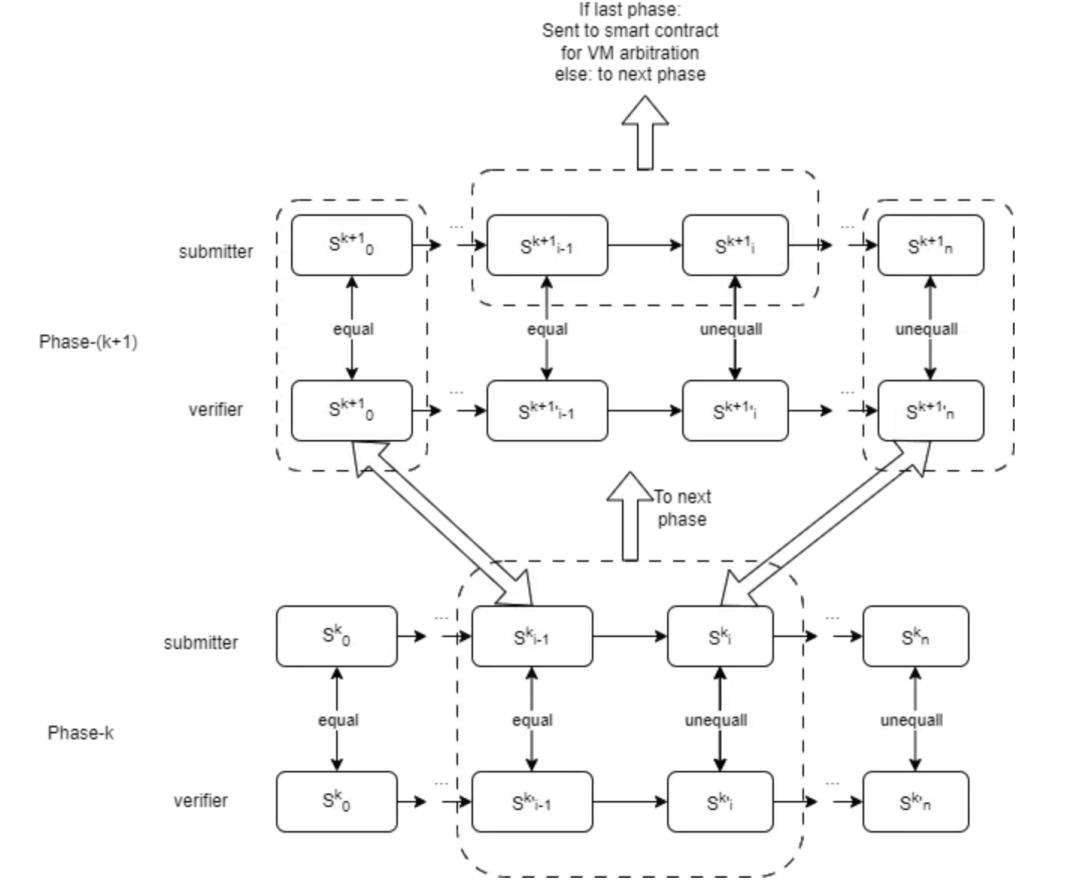
Reference: https://mirror.xyz/hyperoracleblog.eth/Z__Ui5I9gFOy7-da_jI1lgEqtnzSIKcwuBIrk-6YM0Y

LET’S BE REAL
Some view OPML as a transitional step before full ZKML. But more realistically, it’s a pragmatic trade-off based on cost and deployment expectations. Perhaps full ZKML will never arrive—at least I’m pessimistic. Then, the hype around onchain AI must confront reality: cost and feasibility. In that case, OPML may represent the best practical approach—just as OP and ZK ecosystems aren’t replacements but complements.
Yet, don’t forget—the demand gap remains. OPML’s cost and efficiency improvements don’t resolve the core contradiction: “If users only care about result validity, why move AI onchain for trustlessness?” Transparency, ownership, trustlessness—these sound flashy together, but do users actually care? By comparison, value should be demonstrated through inference capability.
I see this cost optimization as a technically innovative and solid attempt—but value-wise, more like a clumsy justification;
Perhaps the onchain AI space is just a hammer searching for nails. But that’s not inherently wrong. Early-stage industries need continuous exploration of cross-domain innovations, iterating until the right fit emerges. What’s wrong isn’t technological experimentation—but blind bandwagoning without independent thinking.
2.4 Application Layer: 99% Frankensteins
Admittedly, attempts at AI in web3 applications are relentless—everyone seems FOMO-driven. But 99% of integrations should stay exactly that: integrations. No need to inflate a project’s value simply because it leverages GPT’s reasoning.
At the application layer, there are roughly two viable paths:
-
Leverage AI to improve user experience and development efficiency: Here, AI isn’t the highlight—it works behind the scenes, often imperceptibly. For example, the HIM team intelligently combines gaming content, AI, and crypto—using AI as a productivity tool to boost dev speed and quality, while also enhancing gameplay via AI reasoning. AI and crypto indeed add significant value, but ultimately, it’s about effective tooling. The project’s real edge remains the team’s game development expertise.
-
Integrate with an AI marketplace, becoming a key user-facing component of the broader ecosystem.
3. Final Thoughts…
If anything needs emphasis: AI remains one of the most promising and high-opportunity sectors in web3—the overarching thesis hasn’t changed.
But what excites me most is the AI marketplace paradigm. At its core, this platform or infra design meets real value-creation needs and satisfies stakeholder interests. Macroscopically, creating a web3-native way to capture value beyond models or compute alone is compelling enough. It also enables users to uniquely participate in the AI wave.
Maybe in three months I’ll overturn my current views. So:
The above are just my very candid thoughts on this space—absolutely not investment advice!
Join TechFlow official community to stay tuned
Telegram:https://t.me/TechFlowDaily
X (Twitter):https://x.com/TechFlowPost
X (Twitter) EN:https://x.com/BlockFlow_News
 Foresight Ventures