









Upgrade acceleration? Unlock expiry? Why is the Polkadot ecosystem surging collectively?
TechFlow Selected TechFlow Selected
Upgrade acceleration? Unlock expiry? Why is the Polkadot ecosystem surging collectively?
In any case, Polkadot, once imbued with boundless expectations, seems to be getting another chance to reintroduce itself.
 Navigating Web3 tides with focused insights
Author: Azuma, Odaily Planet Daily
Over this past weekend, the Polkadot ecosystem appeared to take the baton in sector rotation, with major projects experiencing sharp price increases.
As of writing:
-
Polkadot (DOT) trades at $9.05, up 35.6% over the past week;
-
Kusama (KSM) trades at $51.05, up 79.3% over the past week;
-
Moonriver (MOVR) trades at $31.22, up 386.2% over the past week;
-
Moonbeam (GLMR) trades at $0.543, up 65.9% over the past week;
-
Acala (ACA) trades at $0.12, up 56% over the past week;
-
Astar (ASTR) trades at $0.105, down 13% over the past week (in reality also rose, but coincidentally launched on Upbit a week ago, doubling under the "kimchi premium");
-
Clover (CLV) trades at $0.08, up 52.5% over the past week.
So what exactly drove this recent surge in the Polkadot ecosystem? We attempt to find answers from multiple angles including fundamentals, secondary market structure, and market sentiment.
From a fundamental perspective, the most significant recent development for Polkadot is undoubtedly the progress toward its 2.0 upgrade.
Earlier this year, Gavin Wood introduced the concept of Polkadot 2.0 at the Polkadot Decoded conference, proposing Agile Coretime as a replacement for the current parachain auction mechanism to optimize blockspace allocation and lower entry barriers for the ecosystem.
Previously, Agile Coretime had been successfully deployed on Polkadot's testnet Rococo. According to Gavin Wood’s recently released “Polkadot Year in Review 2023,” Agile Coretime is expected to launch on the canary network Kusama and the mainnet Polkadot in Q1 next year—significantly earlier than the community’s previous expectations.
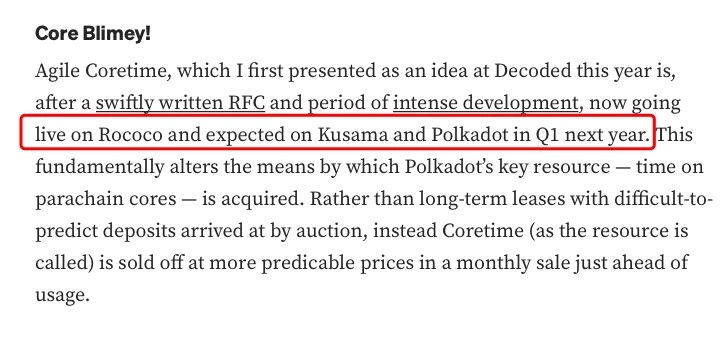
Odaily Planet Daily note: Polkadot typically follows an upgrade sequence of Rococo → Kusama → Polkadot.
In addition to architectural upgrades, Snowbridge—the cross-chain bridge between Polkadot and Ethereum—is also expected to go live in Q1 next year, significantly breaking down liquidity barriers and improving interoperability between the two ecosystems.
On the secondary market structure front, the Polkadot ecosystem is approaching a critical juncture—the final unlock of token incentives offered by the first batch of parachain auction winners is imminent.
Starting in December 2021, Polkadot launched its highly anticipated first round of parachain auctions, drawing nearly 100 million DOT into bidding and pushing DOT prices to their all-time high (ATH) at the time. Ultimately, five projects emerged victorious: Acala, Moonbeam, Astar, Parallel, and Clover.
According to the original incentive schemes, these projects’ native token rewards were scheduled to be released gradually over approximately two years—e.g., ACA and GLMR were distributed over 96 weeks, while ASTR was unlocked over 22 months.

For example, users who participated in Polkadot’s parachain auctions via Binance’s BDOT product will receive the final tranche of ACA, GLMR, and other rewards on December 27.
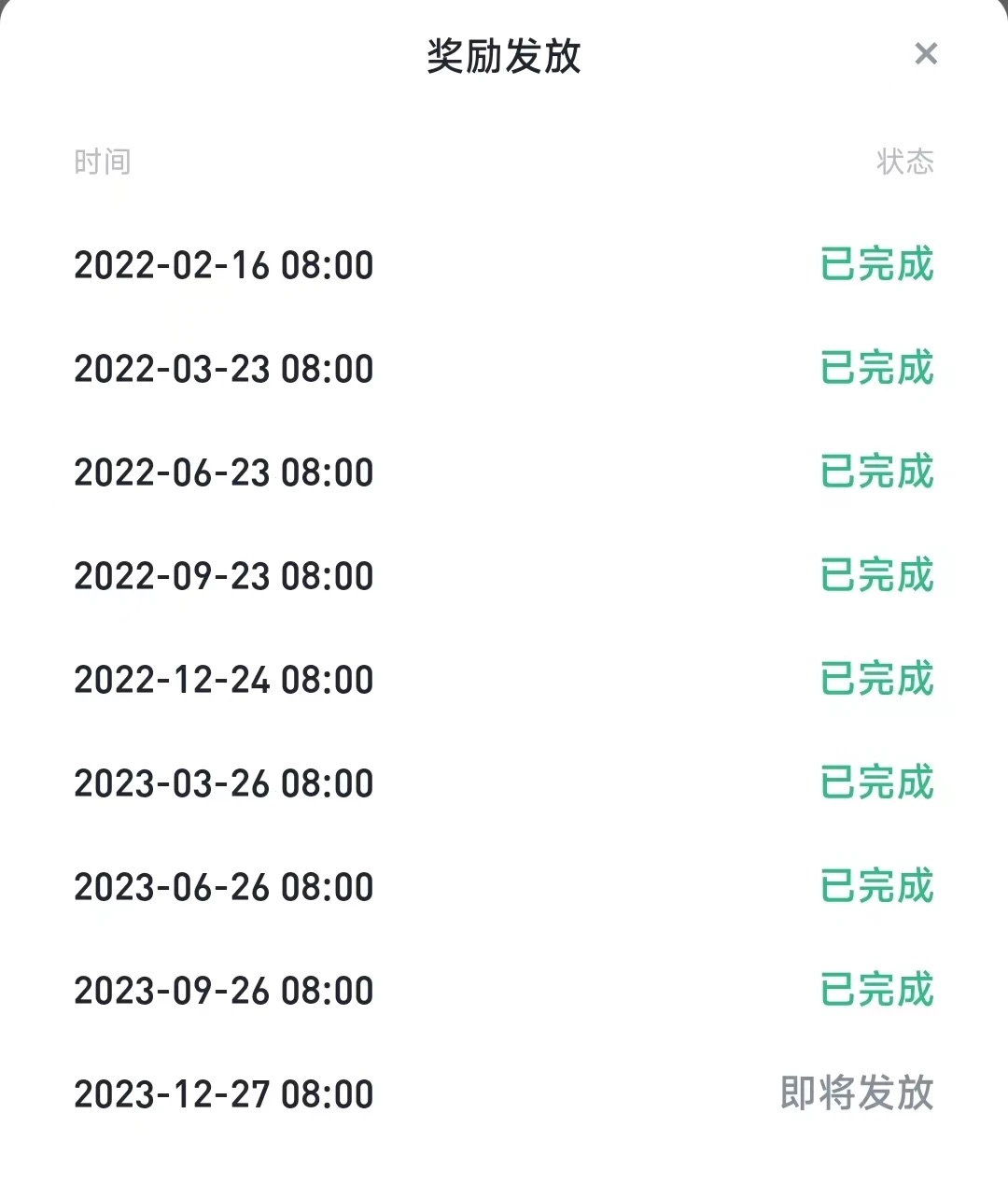
Therefore, from a secondary market structure standpoint, the current moment represents a pivotal phase for mainstream tokens within the Polkadot ecosystem—a period of thorough early-position reshuffling and impending reduction in circulating supply—which may help explain the current collective rally.
From a market sentiment perspective, Solana’s surge has prompted renewed scrutiny of Ethereum’s (EVM) limitations and the potential of heterogeneous public chains.
Looking back at Polkadot’s development over the past few years, one might criticize it for insufficient ecosystem activity due to the exclusivity of its auction mechanism or point to governance controversies. However, it's widely acknowledged that Polkadot has consistently received strong praise for its developer support.
As market expectations increasingly focus on application-layer breakthroughs as the catalyst for the next bull run, doubts are growing about whether Solidity can adequately support complex dApp development, while Rust’s reputation continues to rise.
Amid the rising chorus declaring “Solana flips Ethereum,” some have inevitably noticed that Polkadot’s promoted smart contract language, ink!, shares roots with Rust and holds similar potential to support a breakout at the application layer.
In summary, the above analysis offers only hypotheses regarding the recent surge across the Polkadot ecosystem. The true cause—or combination of causes—remains uncertain, as no one can provide an absolutely precise answer.
Regardless, Polkadot—once burdened with boundless expectations—now appears to have a fresh opportunity to reintroduce itself to the market. How this story unfolds will be something we witness together in the new year.
Join TechFlow official community to stay tuned
Telegram:https://t.me/TechFlowDaily
X (Twitter):https://x.com/TechFlowPost
X (Twitter) EN:https://x.com/BlockFlow_News
 Odaily











