








How does U.S. OFAC's long-arm jurisdiction affect the Ethereum network?
TechFlow Selected TechFlow Selected
How does U.S. OFAC's long-arm jurisdiction affect the Ethereum network?
OFAC is making a difficult decision; meanwhile, Coinbase continues to process Tornado Cash transactions without interruption.
 Navigating Web3 tides with focused insights
Author: JP Koning
Translation: Luffy, Foresight News
Coinbase, the largest cryptocurrency exchange in the United States, is publicly processing Ethereum transactions linked to Tornado Cash—a blockchain infrastructure that was sanctioned by the U.S. government last year for providing mixing services to North Korea. According to Tornado’s alert, Coinbase has validated 686 transactions related to Tornado over the past two weeks.
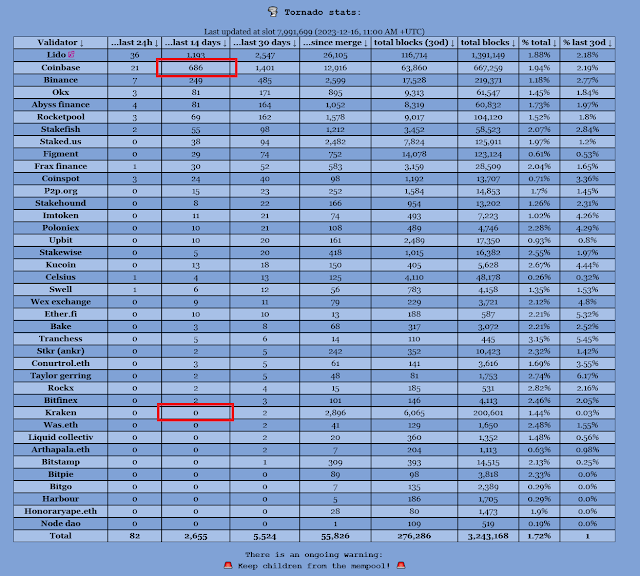 The table shows the number of blocks proposed by each validator involving any transaction interacting (deposit or withdrawal) with Tornado Cash contracts or the TORN token. Source: Toni Wahrstätter
This situation is awkward for everyone involved.
First, it's embarrassing for the regulator—the Office of Foreign Assets Control (OFAC) at the U.S. Department of the Treasury. OFAC clearly states that individuals within the U.S. must not transact with sanctioned entities unless they hold a license. Yet the largest crypto exchange in the U.S. is engaging with the sanctioned entity Tornado Cash without such a license.
OFAC could look away and pretend nothing unusual is happening—almost exactly what it has done so far. But because these interactions are immutably recorded on the blockchain, everyone can see the violations taking place. Eventually, OFAC will have to confront this issue and make some tough decisions—some of which may ultimately harm companies like Coinbase and even the Ethereum network itself.
The entire episode is also embarrassing for the crypto industry. After much of the ecosystem collapsed in fraud and bankruptcies in 2022, cryptocurrencies found themselves under cultural attack and broadly disfavored. It desperately needs social legitimacy, yet leading firms in the space are choosing to defy one of the key pillars of U.S. national security policy.
Meanwhile, Kraken, Coinbase’s main U.S. competitor, has taken a completely different approach toward Tornado Cash. As shown in the table above, while Coinbase processed 686 related transactions, Kraken handled zero Tornado Cash-related transactions over the past two weeks. These divergent approaches only highlight the awkward reality of how crypto “complies” with sanctions laws.
Before diving deeper, we need to understand some basics. For those confused about crypto, here’s a quick explanation of why Coinbase interacts with Tornado Cash while Kraken does not.
What Is Validation?
First, both Coinbase and Kraken operate many different businesses. Their most well-known function is providing an exchange platform where users can deposit funds and trade crypto tokens.
I suspect both companies are very careful to ensure their exchanges avoid any interaction with Tornado Cash. For example, if someone attempts to deposit funds tied to Tornado into the Coinbase exchange, I’m certain Coinbase would quickly freeze that transaction—exactly what OFAC requires them to do. Crypto exchanges have previously run into trouble for dealing with sanctioned entities: last year, Kraken was penalized by OFAC for allowing Iranian individuals to conduct 826 transactions.
But the issue here isn’t with these companies’ trading platforms. The interaction between Coinbase and Tornado Cash occurs in an adjacent business line. Let’s examine how Coinbase and Kraken’s validator services work.
Suppose Sunil lives in India and wants to make a transaction on the Ethereum network, such as depositing some ETH into Tornado Cash. He first inputs the instruction into his MetaMask wallet. This order is then broadcast across the Ethereum network for validation, along with a small fee or tip. Validators are responsible for collecting batches of pending transactions—including Sunil’s deposit to Tornado Cash—and proposing them to the Ethereum network in the form of a “block.” In return, validators receive the tips left by traders.
The largest validators are those holding large amounts of ETH (Ethereum’s native token). Since Kraken and Coinbase hold millions of customers’ ETH, they’ve become two of the most important providers of Ethereum staking services. According to the Ethereum staking dashboard, Coinbase accounts for 14% of global block validations, while Kraken accounts for 3%. So even though Sunil doesn’t deposit cryptocurrency directly onto Coinbase’s exchange, he might still interact indirectly through its block proposal and validation operations.
Validators can choose which transactions to include in their blocks. This explains the difference between the two exchanges: Kraken chooses to exclude transactions like Sunil’s deposit to Tornado Cash, whereas Coinbase includes all Tornado Cash-related transactions in its proposed blocks, earning associated transaction fees in the process.
In summary, Coinbase operates its exchange in compliance with OFAC rules, but runs its validation service differently than Kraken. Next, we need to add another crucial piece to the story. What should OFAC do?
OFAC Searching for Answers
For those unfamiliar with how U.S. sanctions work, a major part of OFAC’s job involves blacklisting foreign individuals and organizations deemed threats to U.S. national security or foreign policy goals. These blacklisted entities are known as SDNs (specially designated nationals). U.S. citizens and companies cannot engage with SDNs without a license.
OFAC also imposes comprehensive sanctions, which prohibit U.S. persons or businesses from interacting with entire countries like Iran.
For each designated individual or entity, OFAC discloses useful information including names, aliases, addresses, nationality, passport numbers, tax IDs, birthplaces, and dates of birth. U.S. individuals and companies are expected to check this data against every counterparty they transact with to ensure no dealings with SDNs. They must also be aware of comprehensive sanctions to avoid inadvertently interacting with entire sanctioned populations—such as all Iranians. Failure to comply can result in fines or imprisonment.
While Coinbase appears to ignore OFAC requirements in its validation services, Kraken does not—and incorporates the SDN list into its internal validation logic. However, Kraken only does so in a limited way, as I’ll show below.
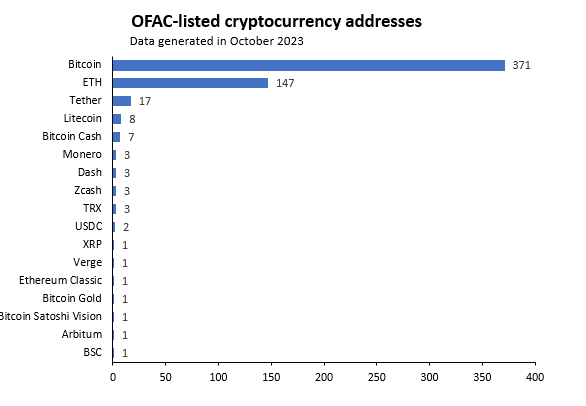
Five years ago, OFAC began adding known cryptocurrency addresses of SDNs to its database. To date, OFAC has published around 600 crypto wallet addresses, including about 150 Ethereum addresses—many linked to Tornado Cash. Kraken uses this list of roughly 150 addresses as the basis for excluding certain transactions from its blocks.
Within the crypto community, this behavior is sometimes described as creating “OFAC-compliant blocks.” Cryptoeconomic theorists argue that it undermines Ethereum’s core values of openness and censorship resistance. While Kraken’s method may appear to be a compliant way of proposing blocks, it actually isn’t.
OFAC-Compliant Blocks
Currently, Kraken’s block validation process only filters out transactions involving the ~150 Ethereum wallets explicitly listed by OFAC, including Tornado Cash addresses. But many SDNs associated with these 150 wallets may already have shifted to new wallets. Kraken takes no steps to identify these new wallets, so it almost certainly processes SDN transactions in its blocks—violating OFAC policy.
There are approximately 12,000 SDNs on OFAC’s list, most of whom are not explicitly linked to specific Ethereum wallets. But that doesn’t mean they don’t own such wallets. To achieve true compliance, Kraken would need to scan the entire list of 12,000 SDNs and verify none appear in its blocks. Clearly, it does not do this.
Compliance with OFAC goes beyond cross-checking the SDN list. Recall that OFAC also enforces comprehensive sanctions against countries like Iran, prohibiting any U.S. entity from dealing with Iranians generally. Since Kraken only excludes the ~150 Ethereum addresses mentioned by OFAC, it almost certainly allows transactions from Iranians into its proposed blocks. This is ironic, given that Kraken was previously penalized for allowing Iranians to use its trading platform. Evidently, Kraken applies one policy for its exchange and another for its block proposal service.
Now Coinbase’s complete disregard for OFAC policy makes more sense. Perhaps it’s better to openly reject compliance and claim sanctions laws don’t apply to validation, rather than partially comply and thereby implicitly accept OFAC’s jurisdiction over validation. As part of this strategy, Coinbase might argue that validation is not a financial service but rather “transmission of informational materials,” which falls outside the scope of sanctions law.
After starting down the compliance path, the only way for Kraken’s validation business to come close to full adherence to sanctions law would be to adopt the exact same rigorous procedures used by its own cryptocurrency exchange. This would mean painstakingly collecting and verifying IDs of all potential transactors, cross-checking them per OFAC requirements, and thereafter only proposing blocks composed of transactions from an internally approved address list. By adopting this comprehensive approach to validation, Kraken would move significantly closer to compliance—and ease OFAC’s embarrassment.
OFAC Policy Decisions Are Not Simple
However, this approach comes with drawbacks. For Kraken, the cost of verifying IDs for block inclusion would be high. I suspect the company might eventually be forced to stop offering validation services altogether. Even if Kraken and Coinbase implement KYC processes meeting OFAC standards for block assembly, most Ethereum transactions would likely shift to offshore validators—who do not check IDs because they are unregulated and not bound by OFAC policies.
Thus, the transactions OFAC seeks to prevent would still occur.
More complicated still, by pushing validation offshore, U.S. national security agencies would destroy an emerging “American Ethereum chokepoint”—a tool they could otherwise leverage to extend American influence abroad. If you’re wondering what this means, consider how New York currently uses correspondent banking relationships to enforce U.S. policy overseas. An Ethereum network based in San Francisco could serve as its crypto equivalent—but only if it isn't driven offshore.
To prevent validation from shifting overseas, the government could combine two requirements: mandating KYC for domestic block validators, and requiring all U.S. individuals and companies to route their Ethereum transactions only through sanction-compliant validators. This would bring U.S. Ethereum activity back onto domestic soil and into the hands of firms like Coinbase and Kraken.
But this is a complex game, and you can understand why OFAC has hesitated so far.
On the other hand, OFAC cannot delay forever. True, crypto remains niche. But OFAC is an agency democratically authorized to enforce laws—and those laws are clearly being broken. It cannot simply “shirk its duty.” Sanctions involve national security, adding urgency to the matter.
One option is for OFAC to grant explicit exceptions to U.S. blockchain validators via special licenses. But this raises issues of technological neutrality and equal treatment under the law. Why should Coinbase and Kraken be allowed access to financial networks involving sanctioned participants, while traditional operators like Visa or American Express receive no such exemptions?
It’s not just a fairness issue. By carving out blockchain validators, OFAC might inadvertently encourage the broader financial sector to migrate toward blockchain-based validation, since it has become the least regulated—and therefore cheapest—technical solution for deploying various financial services. At that point, OFAC would find itself with far less to regulate, as a significant portion of financial flows would reside outside its jurisdictional reach.
I don’t envy OFAC officials. They face a difficult decision. Meanwhile, Coinbase continues processing Tornado Cash transactions by the hour.
Join TechFlow official community to stay tuned
Telegram:https://t.me/TechFlowDaily
X (Twitter):https://x.com/TechFlowPost
X (Twitter) EN:https://x.com/BlockFlow_News
 @HookAgency











