









On-chain data analytics platform: commercialization exploration
TechFlow Selected TechFlow Selected
On-chain data analytics platform: commercialization exploration
Platforms of this type, in addition to developing social features, could tap into financial transaction capabilities as another source of revenue.
 Navigating Web3 tides with focused insights
Author: DT, DODO Research
With the rapid development of the Web3 industry, data querying and analytics have become focal points for users. Representative information and data service platforms are undergoing commercialization challenges and transformations, standing at a crossroads in pursuit of self-sustainability.
This article examines six data-service-oriented information products—DeBank, 0xScope, Nansen, Dexscreener, Arkham, and Dextool—to discuss monetization strategies and the platform landscape under capital-driven growth. These six were selected for two reasons: first, they have relatively long operating histories and stable user bases; second, they represent diverse approaches to monetization.
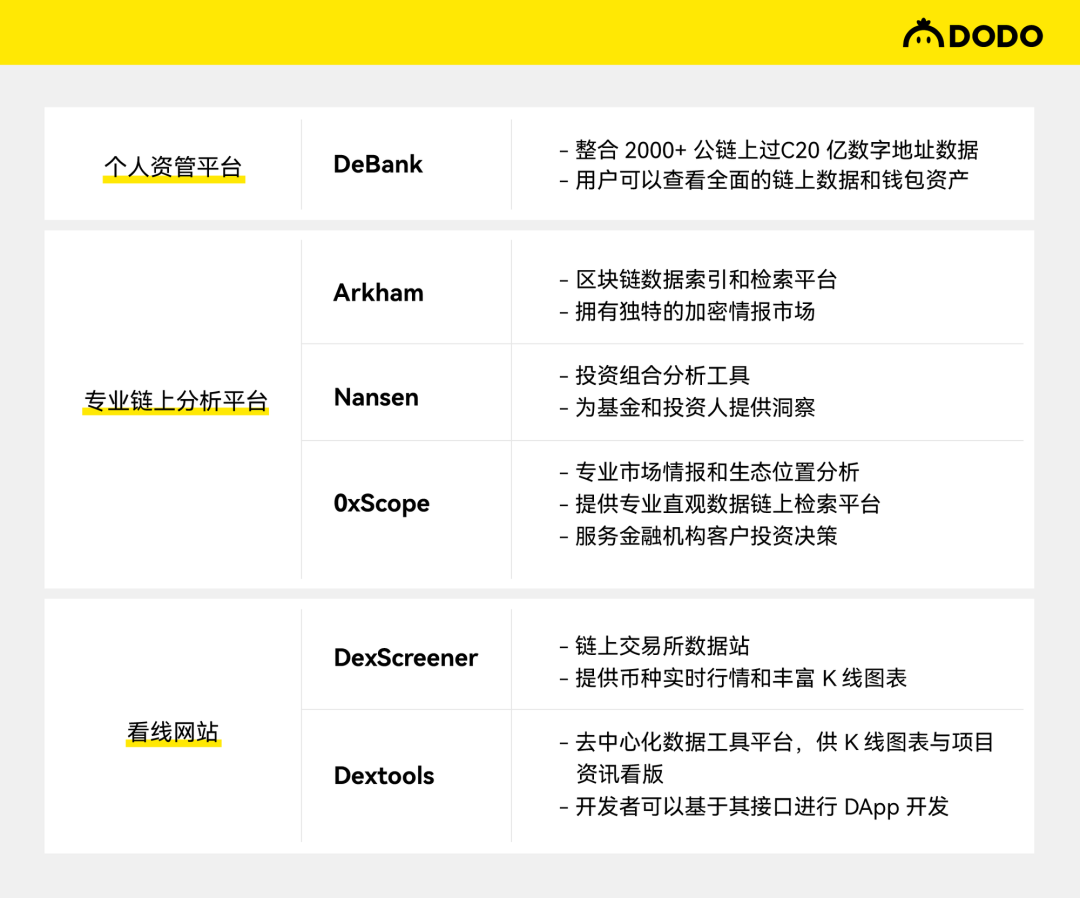
Below, we briefly introduce the services offered by these six websites, which can be categorized into three types:
-
The first is DeBank, a leading personal asset management platform that enables seamless management of your assets across multiple blockchains;
-
The second includes professional on-chain analytics platforms like 0xScope, Nansen, and Arkham, offering visualized on-chain data along with active analysis of smart money movements, large transfers, and activities of project team wallets or whale wallets;
-
The third comprises charting sites such as Dexscreener and Dextool, providing price charts and project information for newly launched tokens on decentralized exchanges.
Traffic Analysis
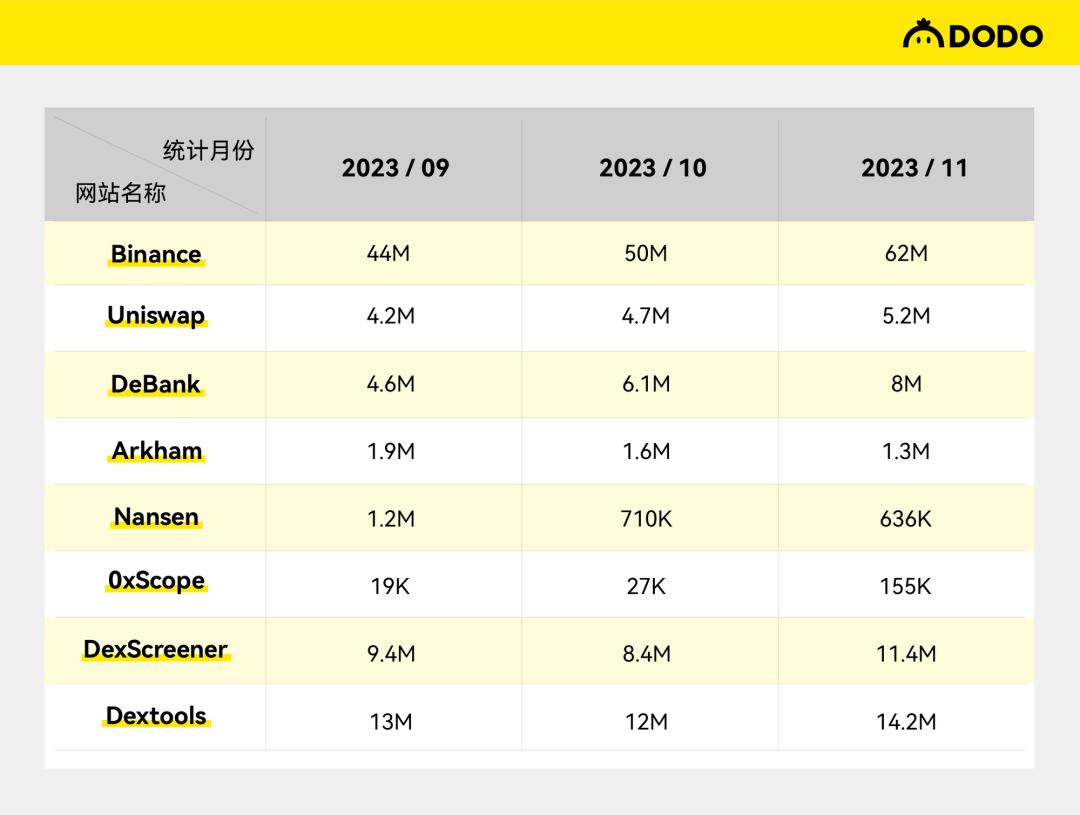
We now examine the popularity of these six platforms using website visit statistics from SimilarWeb, comparing them against Binance (the leading centralized exchange) and Uniswap (the leading decentralized exchange).
DexScreener, Dextools, and DeBank—platforms more oriented toward retail users—see monthly visits ranging between 5–15 million. While still far behind Binance, their traffic rivals that of Uniswap. In contrast, Arkham, Nansen, and 0xScope offer more specialized services targeting institutional clients or API users. Many retail users follow only their Twitter feeds rather than visiting the websites directly, resulting in significantly lower site traffic.
Earlier entrants in blockchain data services have built scale through continuous tool innovation and accumulated substantial user bases, laying solid foundations for future commercialization efforts.
Funding Overview
Given that these information and data service providers typically rely on free offerings to gain early traction, venture capital plays a significant role in their development. Below we summarize the funding details of these six projects based on Crunchbase data.
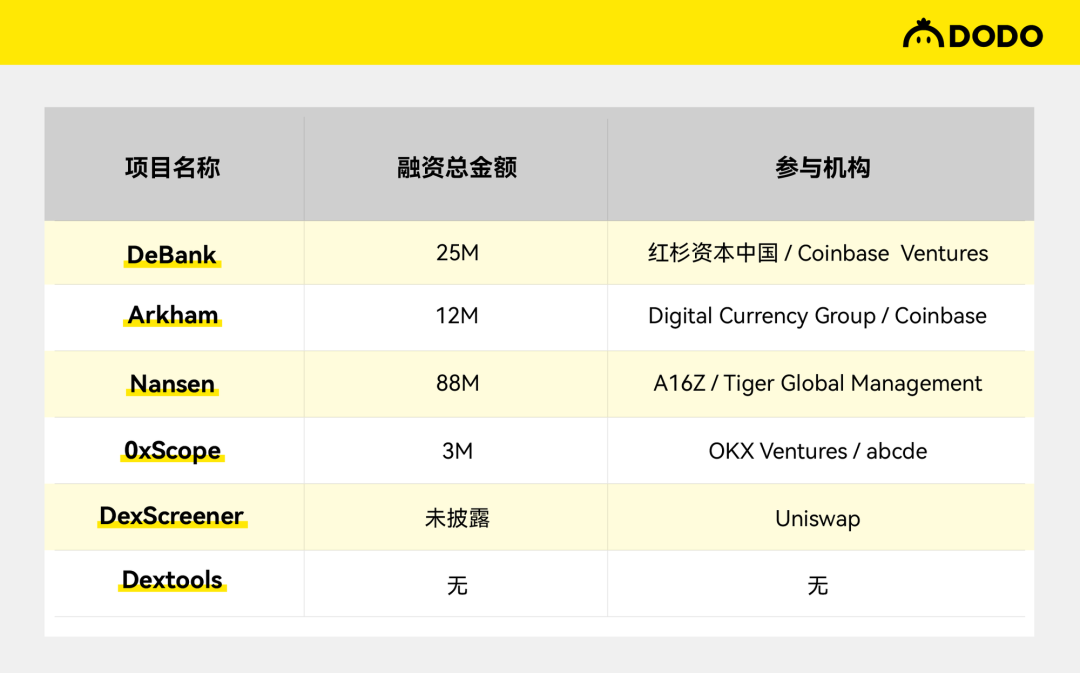
Most of these pioneering data analytics platforms have opted for venture-backed high-speed growth. Several have raised tens of millions of dollars, providing strong financial backing for their commercial expansion. Capital infusion helps startups rapidly strengthen engineering capabilities and broaden business scope. Data platforms accelerate product and commercial system development through investment support.
Although DexScreener has not publicly disclosed any fundraising, Crunchbase indicates it received early support from Uniswap and several angel investors. Dextools took a different path, starting grassroots within the community by launching its token $DEXT for community fundraising and establishing a comprehensive paid-token mechanism.
Monetization Models
External capital strengthens operational capacity during the startup phase, but direct revenue generation from end-users remains essential for achieving long-term independence.
Analyzing the business frameworks of these six projects reveals diverse monetization strategies. Their revenue models can generally be grouped into four categories:
-
Enterprise/institutional custom services
-
Project-side advertising
-
API usage fees
-
Retail user subscriptions
High-end analytics tools like Nansen and Arkham primarily serve enterprises and institutions, making customized data services their core revenue source. DeBank and 0xScope monetize via developer API traffic while also exploring commercial partnerships with projects. All four platforms have introduced retail subscription plans. In contrast, Dextools and Dexscreener adopt a more mass-market approach, offering free services to general users while charging project teams for advertising and premium visibility.
One particularly interesting case is Arkham Intelligence, which offers not only enterprise subscription services but also developed the Arkham Intel Exchange—a blockchain intelligence marketplace enabling monetization of on-chain insights. Buyers can post bounties for specific analytical content, while sellers can auction their research findings. Transactions are managed and incentivized via smart contracts using cryptocurrencies like ARKM as payment, with Arkham collecting transaction fees. Although current user adoption is limited, Arkham Intel Exchange exemplifies an innovative, crypto-native business model.
Another notable initiative is DeBank’s DeBank Chain project. Though the chain hasn’t launched its mainnet yet, DeBank aims to leverage its strong user base to build a SocialFi-focused asset layer. By operating the L2 sequencer, DeBank could earn additional fees, opening up new revenue possibilities for analytics platforms.
It's evident that early-stage blockchain data analytics platforms continue to experiment and refine their business models. Leveraging the unique financial characteristics of Web3 to create novel monetization methods remains one of the key challenges for information and analytics platforms. According to TokenInsight, the encrypted data analytics market could reach $1.5 billion by 2025, with over a million direct paying users. As blockchain achieves mass adoption, this market holds immense potential.
Revenue Estimation
Since these projects are still in early stages and haven’t disclosed profit or subscriber figures, we estimate revenues using analogies from Web2 markets—applying average ad conversion rates, and typical ratios between monthly visits and actual users versus paying users.
For digital subscription products, a 5% conversion rate from monthly active users to paying users is common. However, most early-stage apps and tools see 1–3%. Given that Web3 users are earlier in adopting paid services, we assume a 1% conversion rate. Additionally, since monthly page views often exceed unique visitors due to repeat visits—especially on tools or trading platforms where users may generate over 20 pageviews per month—we estimate that actual user count represents about 10% of total monthly pageviews.
Using DeBank’s subscription fee of $15/month and the above assumptions: 5 million monthly pageviews translates to approximately 500,000 real users (10%), and with a 1% conversion rate, yields around 5,000 subscribers—generating roughly $75,000 monthly, or $900,000 annually in subscription revenue.
For Nansen and 0xScope, both charging around $100/month, applying the same estimation logic results in annual subscription revenues of approximately $960,000 and $900,000 respectively. Arkham Intelligence does not currently offer individual subscriptions, so no estimate can be made.
In addition, Dextools and Dexscreener derive most income from advertising. Earlier in the year, DODO Research used on-chain address analysis to estimate Dextools’ annual ad revenue at approximately $10 million. With similar monthly traffic and the introduction of premium ad packages, Dexscreener’s revenue is reasonably estimated at no less than $5 million annually.
Note: The above revenue estimates do not represent actual figures but are projections based on market trends and on-chain data. Subscription and advertising revenues constitute only part of these platforms’ total income—enterprise custom services and API fees remain significant additional revenue streams.
Conclusion
In my view, beyond developing social features, integrating deeper financial and trading functionalities could unlock another major revenue stream for such data platforms. In Web3, trading and profiting remain users' primary goals—whether they're using DeBank’s asset management interface, Nansen, Arkham, or 0xScope’s analytics dashboards, or charting sites like Dexscreener and Dextools, users ultimately seek actionable insights to inform profitable trades.
Therefore, if these platforms can establish unique partnerships with exchanges—whether centralized or decentralized—to enable seamless one-stop trading experiences and share in the generated revenue, it would create a win-win scenario. DeBank’s Rabby Wallet already demonstrates such an effort, and we hope to see more information platforms adopt similar integrated services.
Supported by institutional capital and validated by real user traffic, the importance of information data platforms is clear in today’s multi-chain environment with exponentially growing blockchain data. Choosing the right monetization strategy aligned with their positioning and strengths, continuously iterating products and enhancing user experience, and strategically leveraging external funding for rapid scaling—these factors are critical to securing a lasting position in the blockchain data services market.
If these platforms can successfully integrate transactional functionality and social attributes into their business models, they will open up even greater possibilities, positioning themselves as vital players in the era of information abundance.
Join TechFlow official community to stay tuned
Telegram:https://t.me/TechFlowDaily
X (Twitter):https://x.com/TechFlowPost
X (Twitter) EN:https://x.com/BlockFlow_News
 Dr.DODO











