








Veda Protocol indefinitely postponed: Controversy over Ordinals "vulnerability" sparks debate in Bitcoin community
TechFlow Selected TechFlow Selected
Veda Protocol indefinitely postponed: Controversy over Ordinals "vulnerability" sparks debate in Bitcoin community
The direction of community voting appears to lean more toward supporting Ordinals, and the likelihood of a fork is relatively small.
 Navigating Web3 tides with focused insights
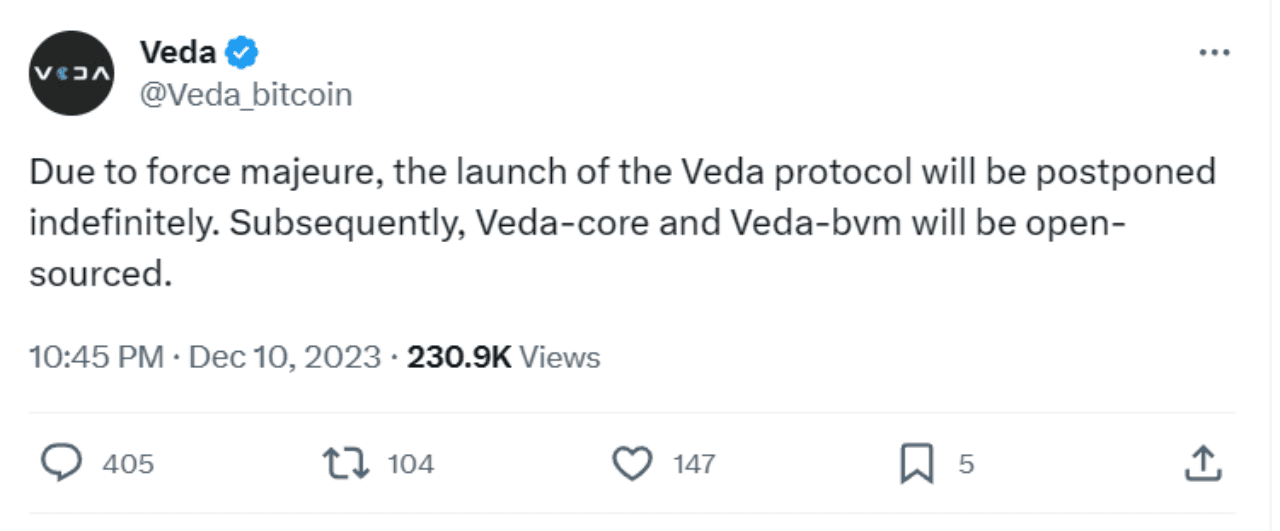
On December 10, Veda, an Ordinals extension protocol, announced on X that its launch would be indefinitely postponed due to force majeure, and that Veda-core and Veda-bvm would be open-sourced. The goal of the Veda protocol was to address the lack of L1-level smart contracts on Bitcoin without altering Bitcoin's core consensus. Unexpectedly, two hours before posting the delay announcement, Veda had declared it was about to launch, having already finalized its token economics and token standards, and had begun indexing for its Ordinals services. Subsequently, personal details of the project’s founder were exposed within the community.
Earlier articles discussed controversies around surging Ordinals transactions causing congestion on the BTC network. After months of frenzy, Ordinals now appears to be caught in fresh turmoil. Veda's open-sourcing is just one ripple in this storm, while Dashjr labeling Ordinals as a "vulnerability" sits at its center. These events have cast uncertainty over Ordinals' future development and triggered further concerns. This article from TrendX Research will delve into these incidents and their implications for Ordinals moving forward.
Are Ordinals a “Vulnerability”?
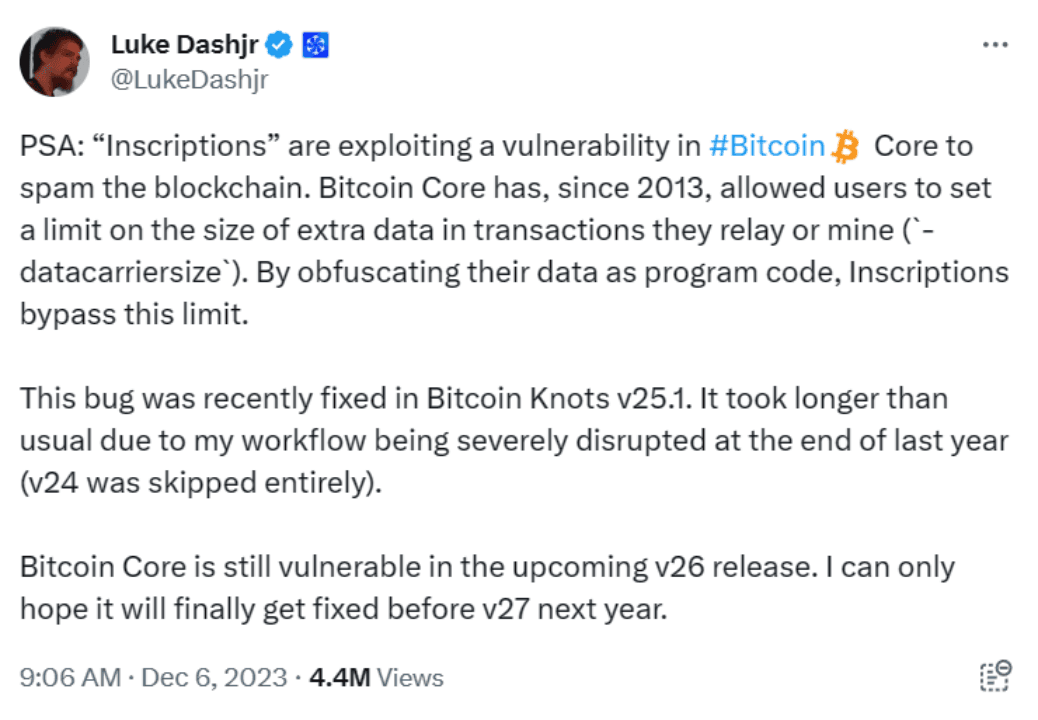
On December 6, Bitcoin developer and co-founder of Ocean mining pool Luke Dashjr launched a scathing critique against inscriptions like Ordinals and BRC-20 tokens, calling them spam attacks exploiting a BTC vulnerability. According to Dashjr, since 2013, Bitcoin Core code has allowed users to set size limits on extra transaction data; inscriptions bypass this limit by disguising their data as program code, making them a “vulnerability.”
Dashjr stated that Bitcoin Core remains vulnerable to “spam attacks” in the upcoming v26 release, with developers aiming to resolve the issue before next year’s v27. He added that if the vulnerability is fixed, although existing inscriptions would persist, Ordinals and BRC-20 tokens would cease to function. On the same day, Ocean, the decentralized mining protocol where Dashjr serves as CTO, announced on X that Bitcoin Knots had upgraded to “fix a vulnerability long exploited by modern spam attackers.” Dashjr later revealed that this vulnerability had been cataloged in the U.S. National Vulnerability Database as CVE-2023-50428.
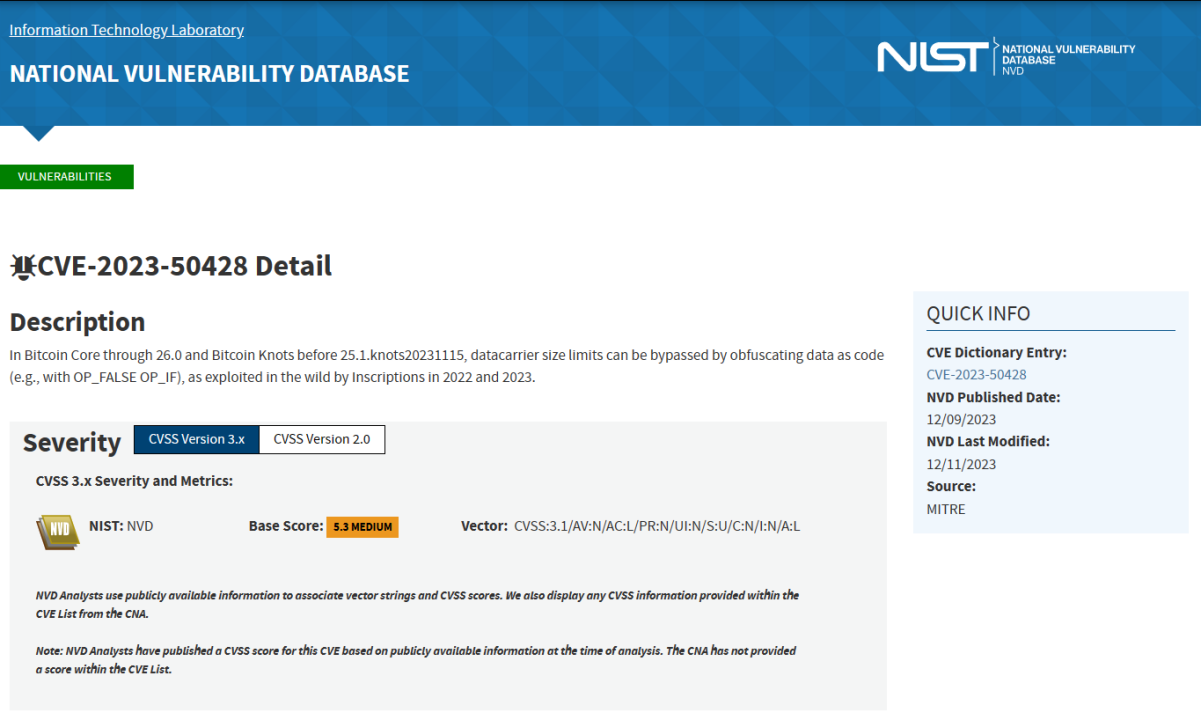
Inscription entries listed in the U.S. National Vulnerability Database
Debate Over Ordinals
Debates surrounding Ordinals have long existed, but Dashjr’s comments have escalated them to new heights. On Bitcointalk forums, many discussions advocate resisting what they call “attacks on Bitcoin,” accusing malicious BSV developers. There are also talks about implementing soft forks to enforce strict Taproot script size validation, filtering content deemed “spam attacks,” or even hard forking to roll back Taproot.
Bob Bodily, co-founder and CEO of Ordinals marketplace Bioniq, disagrees. He argues: “Due to Ordinals, demand for Bitcoin block space has increased this year, generating over $100 million in network fees. Miners want higher revenue, and Ordinals have brought about a revival of Bitcoin, creating massive demand for block space.” Bodily also warns that such moves would undermine many benefits brought by Taproot and SegWit upgrades and eliminate valid use cases for Bitcoin. Even under restrictions, he believes demand for protocol transactions like Bitcoin Ordinals will persist.
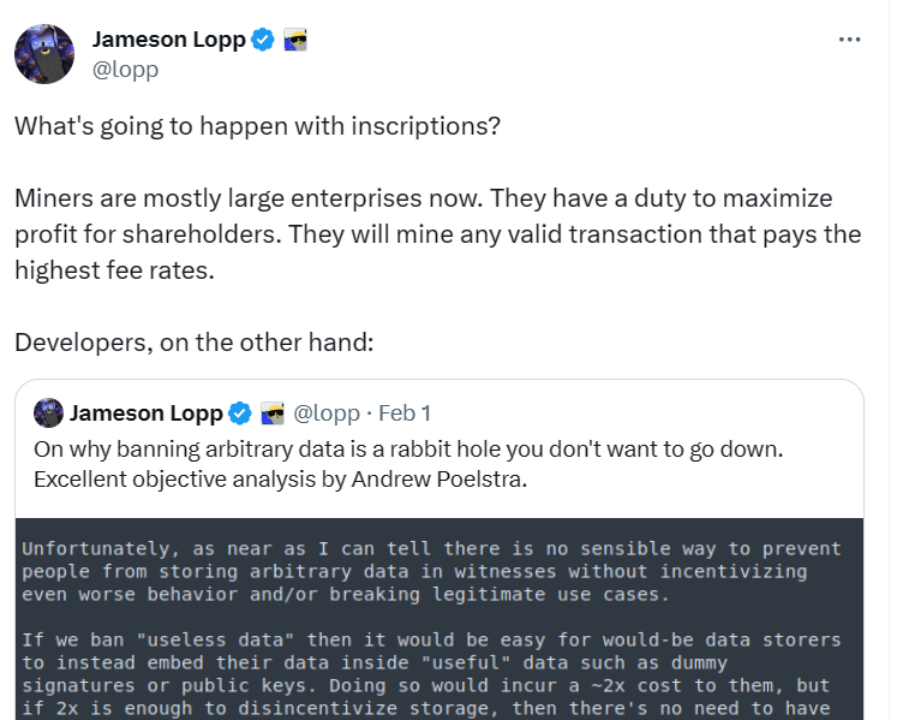
Like Bodily, Casa CTO Jameson Lopp expects economic rationality to prevail. He explained on X that miners are now mostly large enterprises responsible for maximizing shareholder profits, so they will mine any valid transaction offering the highest fees. He also noted that few agree with classifying inscriptions as vulnerabilities, and Dashjr’s classification of them as spam attacks is subjective.
Hass McCook, former member of the Bitcoin Mining Council and staunch Bitcoin believer, dislikes Ordinals but also believes “getting rid” of them isn’t desirable. He said: “What matters most beyond Bitcoin itself is freedom. My overall view is that I personally don’t like it (Ordinals), nor do I see its value. But I don’t want to censor it. I think that could lead down a very dark path.”
Future Outlook for Ordinals
Luke Dashjr’s proposal does not imply final execution—he holds no authority over Bitcoin code, and upgrades require miner voting.
Bitcoin differs from Ethereum—developers’ opinions aren’t decisive. Code upgrades must pass miner approval, and opposition can block implementation. Even if developers insist on upgrading, miners retain the right to fork. However, at this critical moment of spot Bitcoin ETF approval, the likelihood of a fork is extremely low.
Meanwhile, removing high-fee transactions from the mempool would reduce miner income, making it unlikely that miners would engage in a “moral battle” over this issue. Even if parts of the Bitcoin community aim to preserve Bitcoin’s value and rectify negative outcomes caused by Ordinals—such as rising gas fees and network congestion—they cannot deny the positive developments Ordinals have simultaneously spurred within the BTC ecosystem.
Noted podcaster Peter McCormack stated these assets (Ordinals) offer no benefit to those using Bitcoin for payments, as they only create a high-fee environment. Clearly, the explosion of Ordinals has harmed the interests of some Bitcoin holders—this lies at the heart of the debate between supporters and opponents.
Conclusion
The debate over Ordinals is far from over. Their emergence has left a profound impact on the Bitcoin ecosystem, sparking discussions on gas fees, block space demand, and more. As for the conflict between supporters and opponents, and the broader effects on the Bitcoin network, future protocols or solutions may eventually provide better answers. The Bitcoin community now faces how to handle Ordinals—but overall, the likely direction of community sentiment appears more inclined toward supporting Ordinals, with a fork remaining relatively improbable. After all, for miners and Ordinals supporters alike, as long as at least one Bitcoin mining pool includes inscription transactions, they are unlikely to disappear.
Join TechFlow official community to stay tuned
Telegram:https://t.me/TechFlowDaily
X (Twitter):https://x.com/TechFlowPost
X (Twitter) EN:https://x.com/BlockFlow_News
 @TrendX_official











