









Observing Order Flow Innovations from the Lifecycle of Ethereum Transactions
TechFlow Selected TechFlow Selected
Observing Order Flow Innovations from the Lifecycle of Ethereum Transactions
In the entire MEV supply chain, Builders operate in a highly competitive market. As the most fundamental production resource in block construction, order flow has naturally become a strategic battleground.
 Navigating Web3 tides with focused insights
Author: Jiawei, IOSG Ventures
Introduction
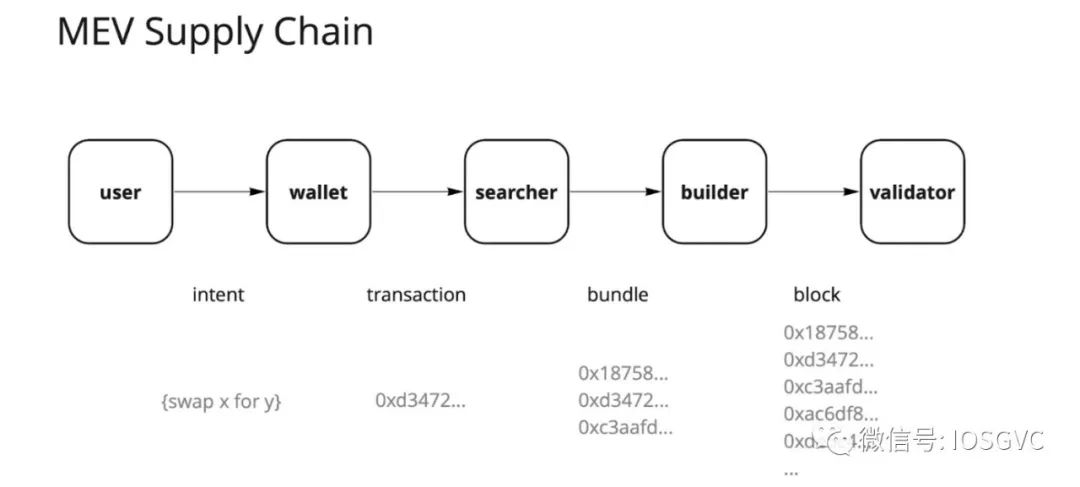
Source: Flashbots
When sharing the investment thesis around Infra, I often use this image — viewing different Infra projects through the lens of the MEV supply chain (or transaction lifecycle) is quite insightful.
Thanks to the relentless efforts of many researchers, we’ve transitioned from a few years ago’s MEV dystopia into a relatively clear supply chain, though many challenges remain unsolved.
In this context, order flow plays a pivotal role. If we view the supply chain as a riverbed, then order flow is the water flowing atop it. In this article, we’ll explore some key aspects of order flow.
Orderflow… wat do?
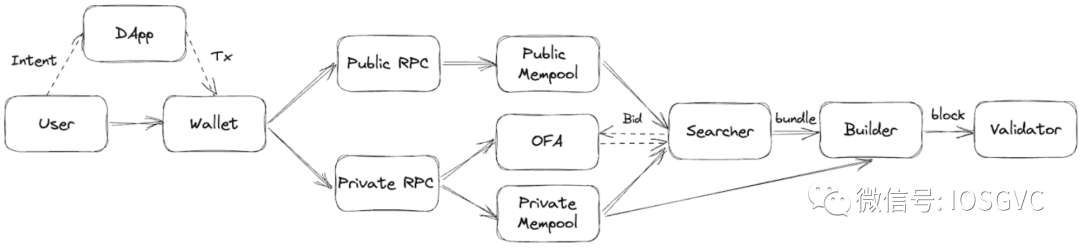
Source: IOSG Ventures
Quintus defines an “order” as anything on Ethereum that can alter the blockchain state. More simply, we can think of a transaction as an order. The diagram above attempts to illustrate the journey of order flow across the supply chain. However, reality might look more like this...
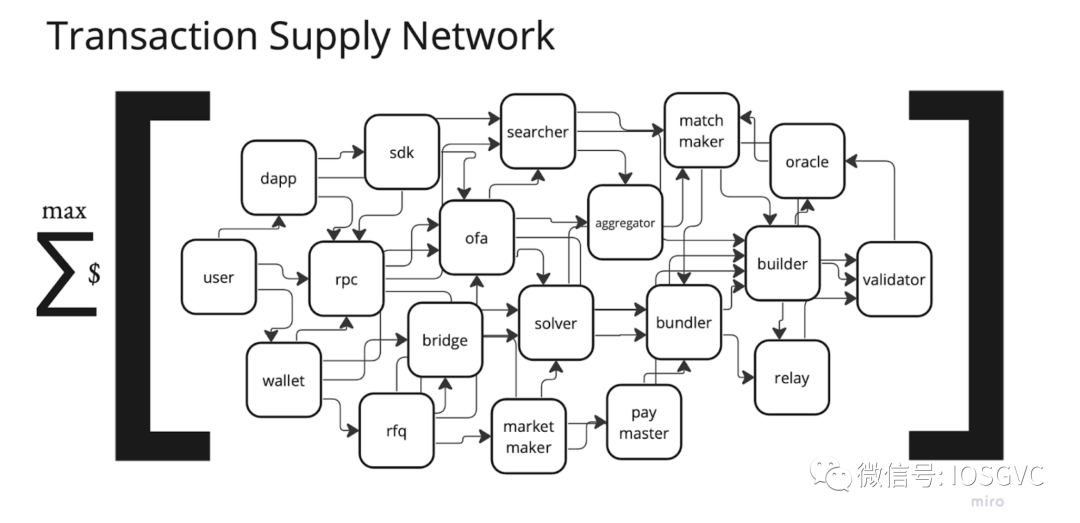
Source: Frontier
Of course, this article won’t attempt to unpack every detail. The MEV supply chain has become vast and complex—explaining all nuances clearly in a short time is nearly impossible. Therefore, we’ll focus primarily on two topics here: private order flow and order flow auctions (OFA).
Private Orderflow Dominance
Public mempools will dry up… - Hasu
When discussing private order flow, two terms often appear: private order flow and exclusive order flow. These terms differ semantically. For example, MEVBlocker bypasses the public mempool and sends order flow directly to top builders. Here, the order flow is private but not exclusively held by any single builder. Additionally, OFAs are often not truly "private" transactions since participants may subscribe to or observe the order flow (though access may be permissioned), typically to maximize competition among roles in the auction.
The community has extensively discussed private order flow and how it could act as a driver of centralization.
Source: IOSG Ventures
Across the MEV supply chain, builders operate in a highly competitive market. As the most fundamental input for block construction, order flow naturally becomes a battleground. In response, builders commonly offer various services to attract upstream order flow:
-
Transaction pre-confirmation: For instance, as Vitalik mentioned in his SBC 2022 talk, a builder could publicly commit to including a transaction immediately upon receiving one with a priority fee greater than 5, via a verifiable message; if the fee exceeds 8, users might even receive a post-state root. This proves effective in use cases requiring urgent block space.
-
Front-running protection—the primary selling point of most OFAs.
-
Revert protection: If a bundle fails or reverts, the builder will not include it (meaning users don’t pay gas). By routing regular user transactions as bundles, MEVBlocker’s RPC endpoint offers this protection. Blocknative data shows only about 4.2% of private transactions revert on-chain, compared to ~13.8% of public ones—highlighting the value of revert protection.
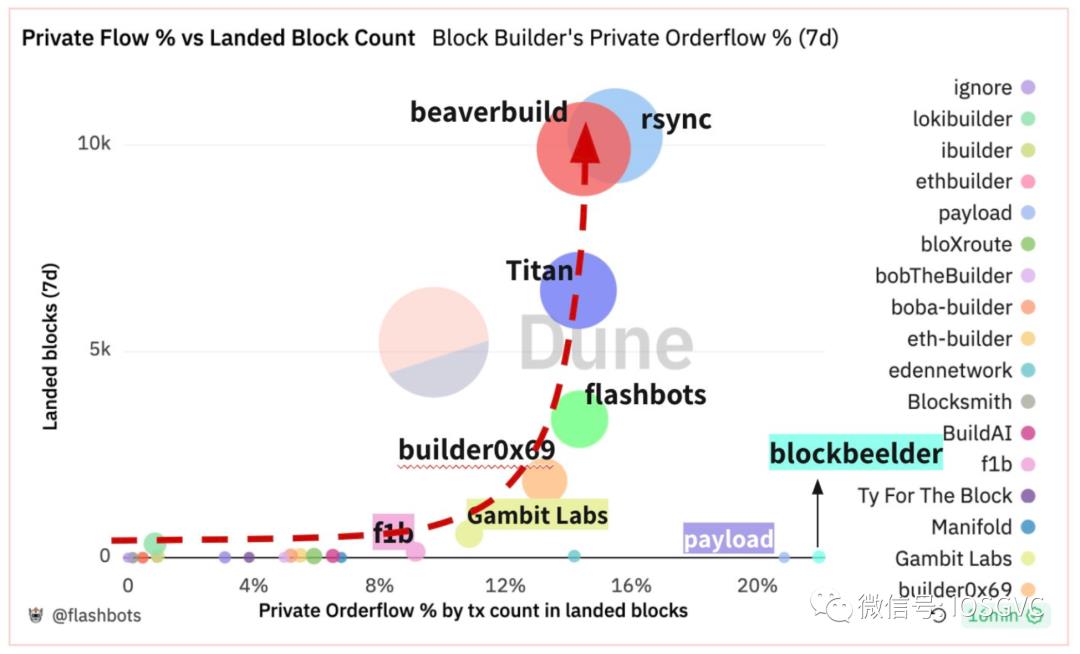
Source: Danning Sui (@sui414)
The relationship between landed blocks and private order flow is evident in the chart above.
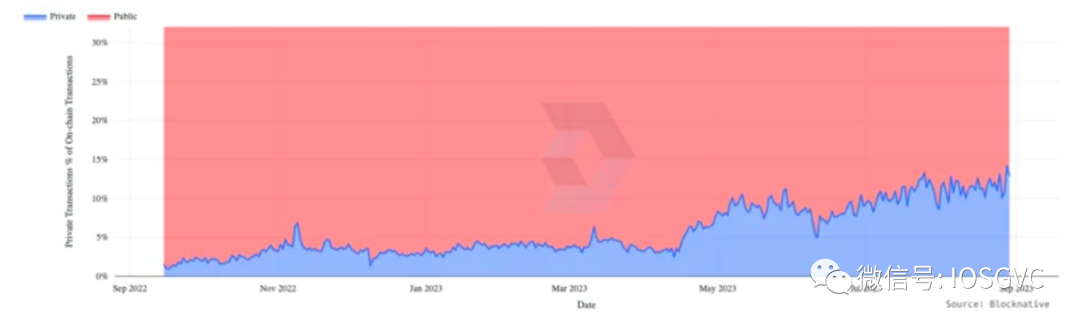
Source: Blocknative
Recent studies indicate growing concerns around private order flow. Blocknative reports that private transactions have risen from 5% pre-merge to ~15% today, meaning 15% of current Ethereum transactions are sent privately.
Broadly, private order flow can be categorized into Searcher Flow and User Flow.
Searcher Flow
-
Atomic Flow
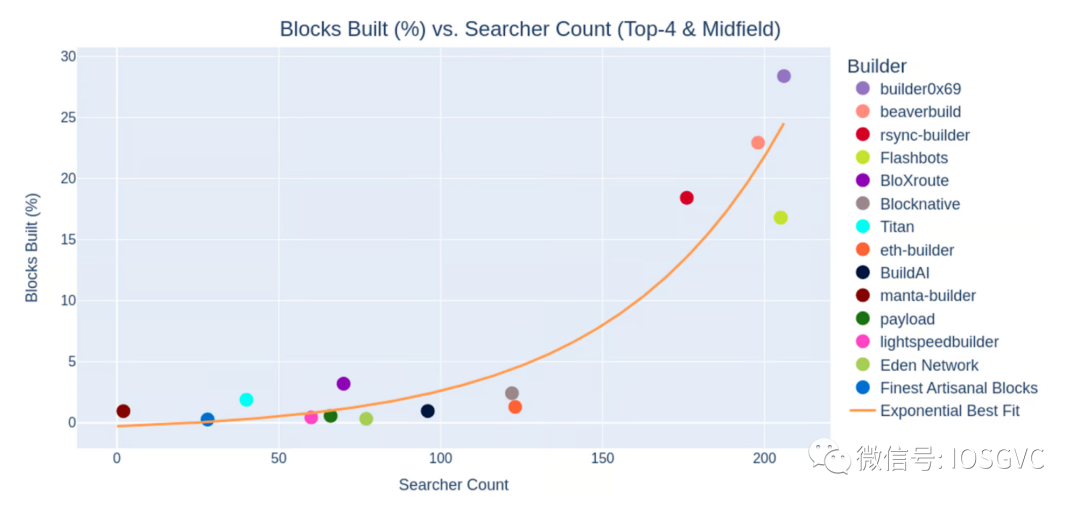
Source: Titan Builder
Atomic Flow refers to transactions such as DEX-DEX arbitrage, sandwich attacks, and liquidations.
Some time ago, Titan complained on Twitter that despite holding 15% market share and building over 50,000 blocks in seven days, they received orders from only about half of all searchers.
Titan’s research indicates a positive, often exponential correlation between a builder’s market share and the number of searchers connected to them.
-
Non-atomic Flow
Non-atomic Flow refers to CEX-DEX arbitrage.
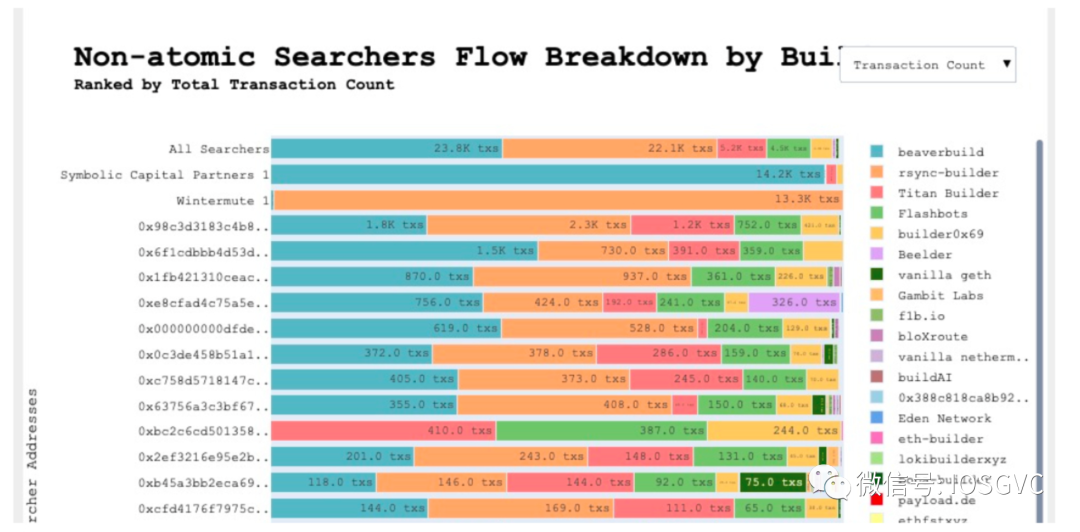
Source: searcherbuilder.pics
In atomic MEV scenarios, searchers generally distribute their bundles evenly across the top three builders. However, in non-atomic MEV, Titan—despite being a top-three builder—holds only ~8.8% of order flow. The chart above reveals a stark difference, highlighting exclusive access by vertically integrated searcher-builders.
Overall, inclusion guarantee is the most critical factor for searchers when deciding where to send their bundles—it depends on whether their discovered MEV opportunity can be realized on-chain.
Additionally, searchers face trade-offs. Submitting bundles to all builders maximizes inclusion chances, but Titan notes risks such as bundle fragmentation and information leakage of long-tail strategies.
Currently, most searchers send bundles to top builders. When considering sending to searcher-builders, potential conflicts of interest must also be weighed. Mid-field builders hold ~16% market share and should also be considered.
-
To mitigate EOF…
Exclusive orderflow has a solution. - Stephane
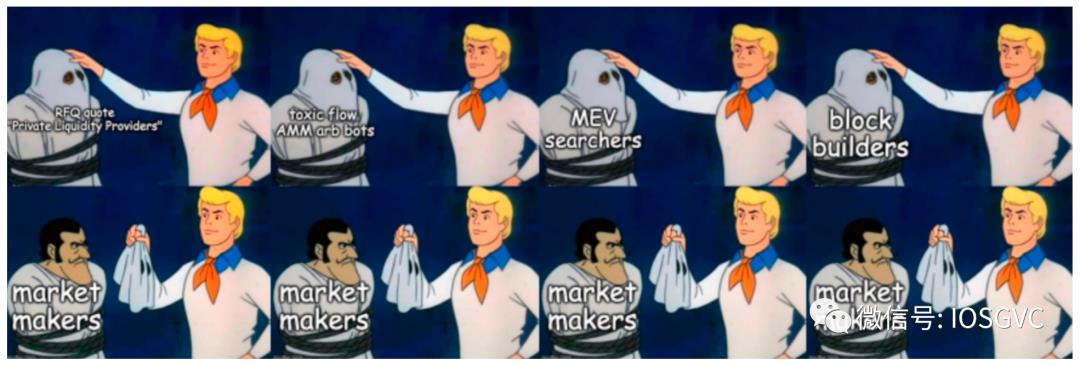
Quintus outlines several solutions here.
-
Neutrality of large infrastructure. Like Optimistic Rollup watchtowers, the community must closely monitor actions of major infra players. Under potential public scrutiny, we believe entities like Metamask and Infura will act cautiously. Still, “relying on agents to do the right thing isn’t in the spirit of blockchains.”
-
Decentralizing the builder role. Vitalik shared thoughts at the SBC MEV Workshop, later expanded by Jon in his article covering algorithms, resources, builder services, and order flow. Indeed, distributed builders offer censorship resistance and stronger trust guarantees versus centralized entities. However, technical trade-offs exist—achieving certain benefits (e.g., decentralization) often sacrifices others like efficiency and low latency. While distributed builders may be a viable path, dominating a competitive market remains challenging, especially given the time sensitivity across the supply chain. Of course, this cost is unavoidable for true decentralization.
-
Default settings. Upstream players should flexibly route order flow—not defaulting solely to top builders—but also supporting and encouraging new entrants.
On compliance, Alex noted on Twitter that integrated searcher-builders acquiring private order flow may inadvertently engage in insider trading. In traditional finance, using material non-public information (MNPI) for personal gain in securities trading is illegal.
Evan’s article provides a thorough analysis of OFAC risks within the MEV supply chain. Builders face similar OFAC exposure as searchers but must more proactively screen incoming order flow and reject those linked to individuals on the SDN List.
In traditional finance, Pay-for-Order-Flow (PFOF) remains controversial. In crypto, we believe further compliance exploration is still needed.
User Flow
Currently, MEV flows through wallets, dApps, RPCs, searchers, builders, and validators—users have little control over the MEV they generate.
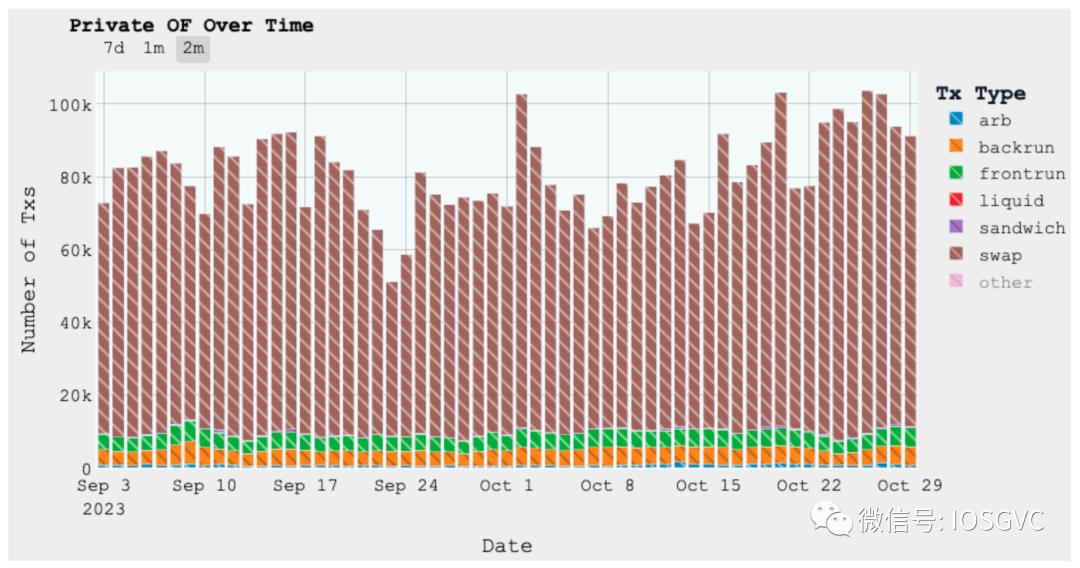
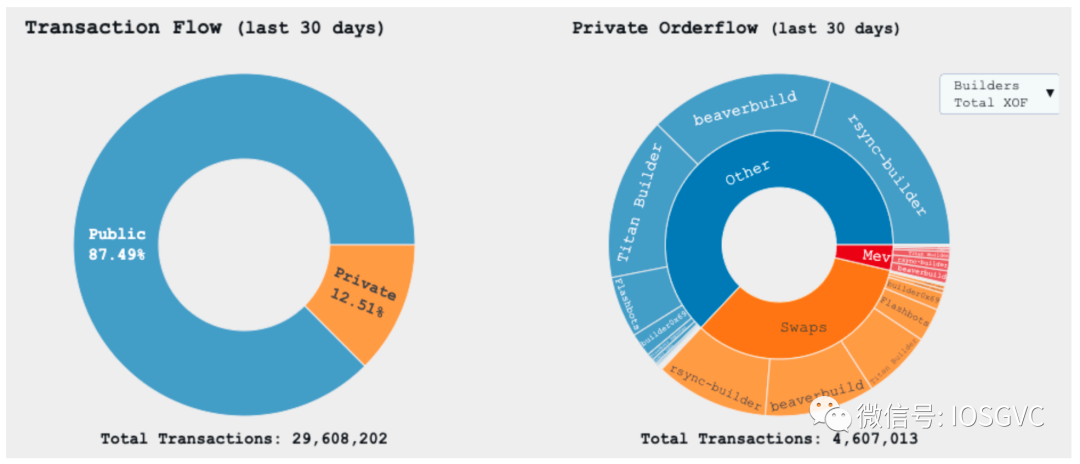
Source: mempool.pics
Frontier’s research shows that within six months, ~71% of payments to validators came from transactions involving at least one swap. The chart above further illustrates that when breaking down private order flow by type, swaps dominate over atomic searcher flow.

Source: Dune@angelfish
Angelfish’s dashboard shows major order flow still originates from DEXs like 1inch and Uniswap. Notably, vertically integrated platforms such as Metamask Swap and Tokenlon (by imToken) also capture meaningful volume.
Additionally, the rise of Telegram bots like Unibot, Maestro, and Banana Gun is notable. Their main appeal lies in usability, wallet abstraction, and simplified dApp interaction. They also offer features such as front-running and revert protection.
These bots have seen significant growth in traffic recently. Months ago, Maestro signed an exclusive deal with bloXroute—sending all its orders via bloXroute’s private RPC. Interestingly, Stephane (Frontier) and Vadym (Kolibrio) recently launched Alfred, a TG bot attracting considerable attention.
Telegram has a massive user base. While claiming mass adoption via TG bots may be premature, we anticipate that iterative improvements will bring novel developments in order flow and reshape the entire supply chain.
Current State Summary of Orderflow Types
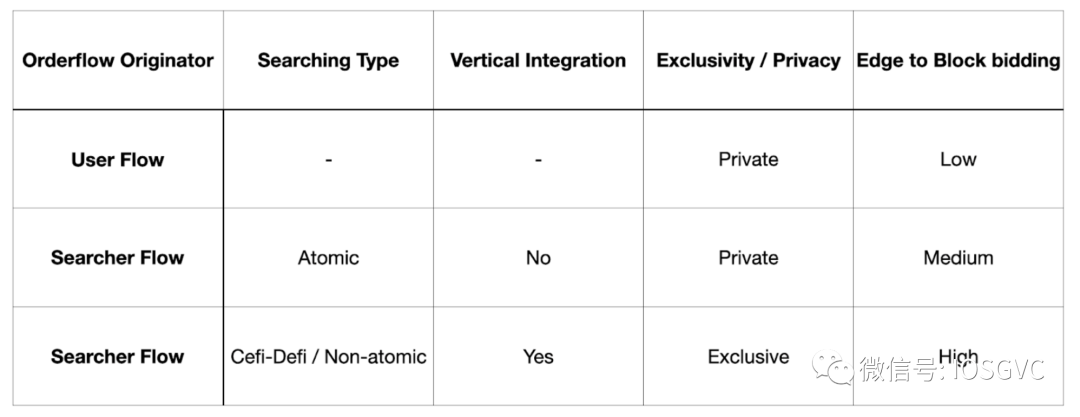
Source: Danning Sui (@sui414)
In summary, the table above highlights distinctions among different order flow types.
As previously noted, integrated searcher-builders hold a significant edge in non-atomic searcher flow compared to neutral builders, due to exclusive internal order flow access and profit recycling from their own searchers to bid higher in auctions.
By consolidating market share, they also attract more atomic searcher flow. Conversely, neutral builders rarely receive non-atomic flow, while smaller atomic searchers lack their own builders and must submit bundles widely. Altogether, these dynamics cement the dominance of integrated searcher-builders in today’s block-building landscape.
Orderflow Auction (OFA)
-
Overview
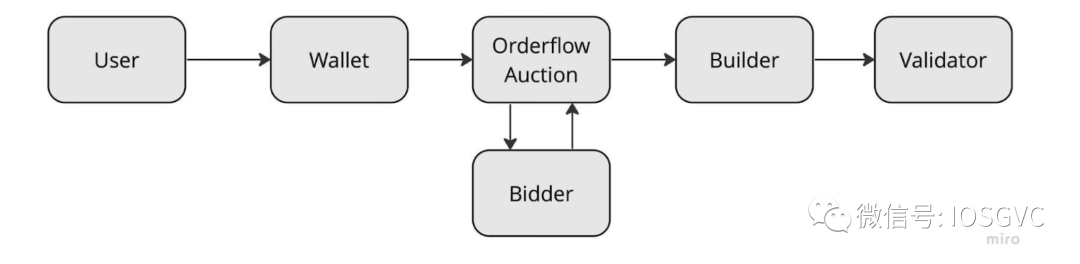
Source: Frontier Research
OFA is a mechanism for price discovery of order flow—enabling buyers and sellers to establish approximate pricing through interaction.
Frontier and Monoceros have provided extensive analyses of OFA, covering design spaces and trade-offs. Frontier’s research offers a solid foundation for understanding OFA design principles. Many companies, such as Kolibrio and DFlow, are actively exploring this space. We won’t rehash those details here.
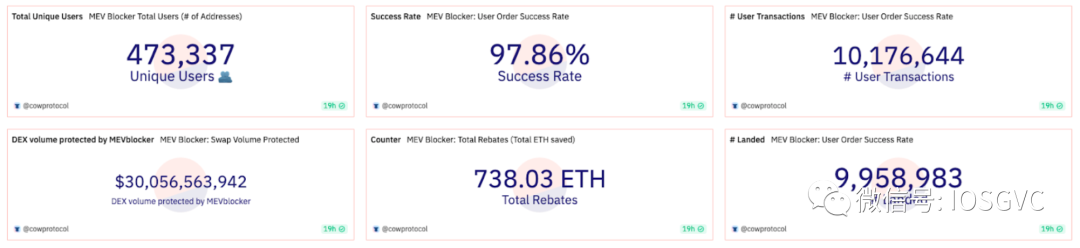
Source: Dune@cowprotocol
On data, according to the MEV Blocker Dashboard, transactions routed via MEV Blocker represent ~3%-4% of all Ethereum transactions, involving ~470,000 users and generating ~738 ETH in rebates. Builder0x69 and Beaverbuild returned the most rebates, each exceeding 200 ETH.
Currently, numerous OFAs are operational, actively engaging upstream players like wallets.
Although OFAs promise “comprehensive protection” as a user-friendly endgame solution, Blair’s article points out that private transactions with front-running protection don’t necessarily mean better settlement or faster execution compared to public ones.
The article notes that while OFAs prevent front-running, they don’t guarantee optimal execution—users’ trades may still suffer unexpected slippage.
It also emphasizes that sending private transactions via "eth_sendBundle" differs from "eth_sendRawTransaction". Non-MEV user bundles lack competitiveness and force builders to run unnecessary simulations, potentially worsening execution speed.
Finally, Blair highlighted the current Observability Gap in OFAs: How can users or wallets verify that auctioneers and builders are acting honestly? In one case study, 19 user transactions eligible for rebates were falsely claimed by a builder’s backrun bot—revealing an existing transparency gap in OFAs.
-
Takeaways
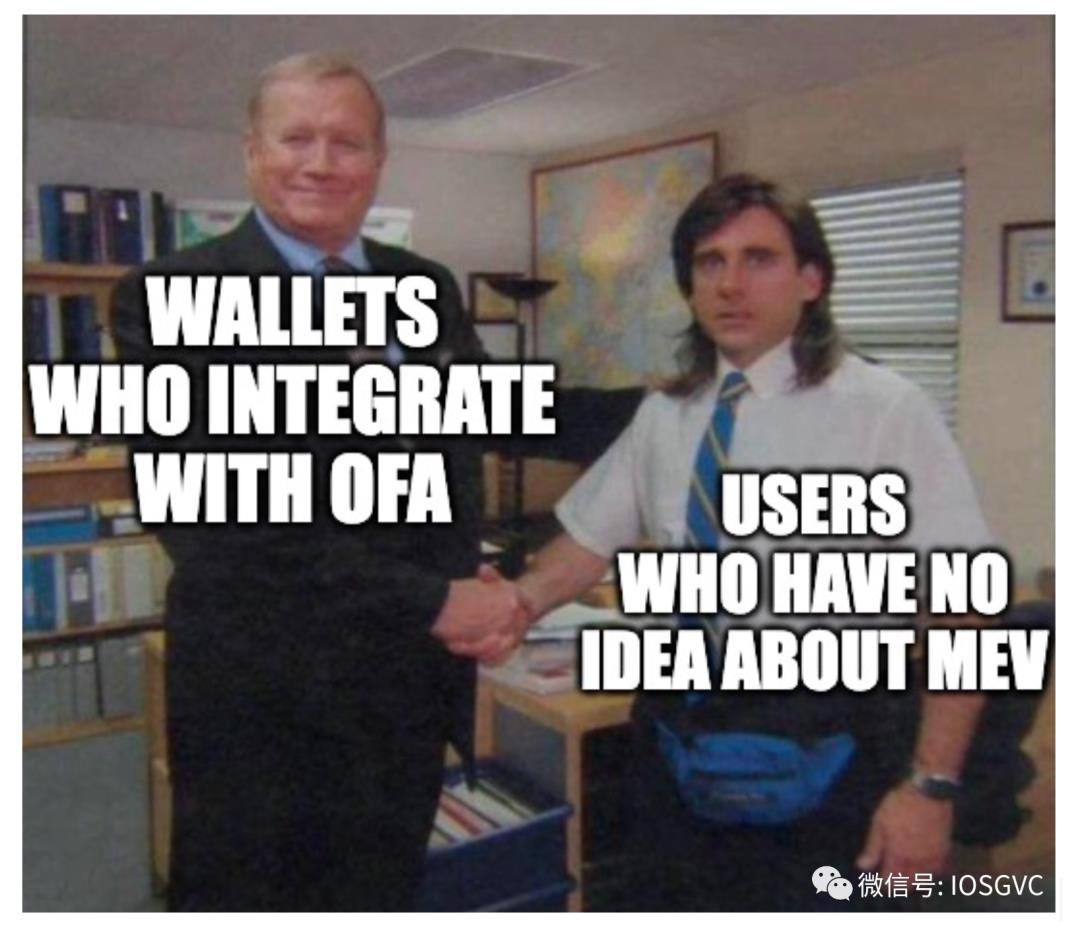
Here, we share observations from the Asia-Pacific market.
-
Users
According to imToken's 2023 Crypto Wallet Report, 63% of respondents found trading on exchanges more convenient or cheaper than using wallets. Additionally, 38% perceived wallets as less secure than exchanges, citing fears of hacking (29%) or losing funds due to personal errors (18%).
This suggests many users still lack sufficient understanding of on-chain mechanics. Thus, expecting users to voluntarily switch from default wallet RPC settings to OFA involves notable friction. Significant user education remains necessary.
-
Wallets
For OFA adoption, wallets may need to make decisions on behalf of users. Based on our conversations with wallets, we find:
- Most wallets view OFA as a vitamin, not a painkiller.
- Some wallets lack clarity on MEV and its implications.
- Some perceive OFA as still early-stage and opaque. This lack of transparency is a key barrier, as they cannot assess associated risks.
- Although some recognize OFA as a monetization opportunity, integration isn’t a top priority. Since its April launch, MEV Blocker has generated only 783 ETH in total rebates—relatively minor for most wallets. Transaction inclusion speed and success rate matter more than potential rebates.
- Overall, wallets remain optimistic yet cautious—currently lacking strong incentives to adopt OFA proactively.
According to Chainalysis’ The 2023 Geography of Cryptocurrency Report, Central and South Asian nations lead in grassroots crypto adoption. Our APAC observations show wallet adoption often follows geographic trends—for example, mobile wallets in the region quickly support multi-chain and consumer apps, making them well-suited for Southeast Asian markets.
Therefore, assuming key infrastructures like Metamask remain neutral, long-tail wallets focused on specific regions are more likely to adopt OFA first. This should be a primary focus for OFA platforms expanding their reach. With multiple OFAs competing, the wallet space will become extremely competitive.
OFA designs involve various trade-offs. The main challenge lies in convincing upstream supply chain players to adopt the solution. Public education is a slow, long-term process. Looking ahead, we believe OFA will gradually gain traction, potentially capturing over 30% of Ethereum transactions. Wallets play a crucial role in enabling this shift. Throughout this process, vigilance against centralizing forces is essential.
Closing Thoughts
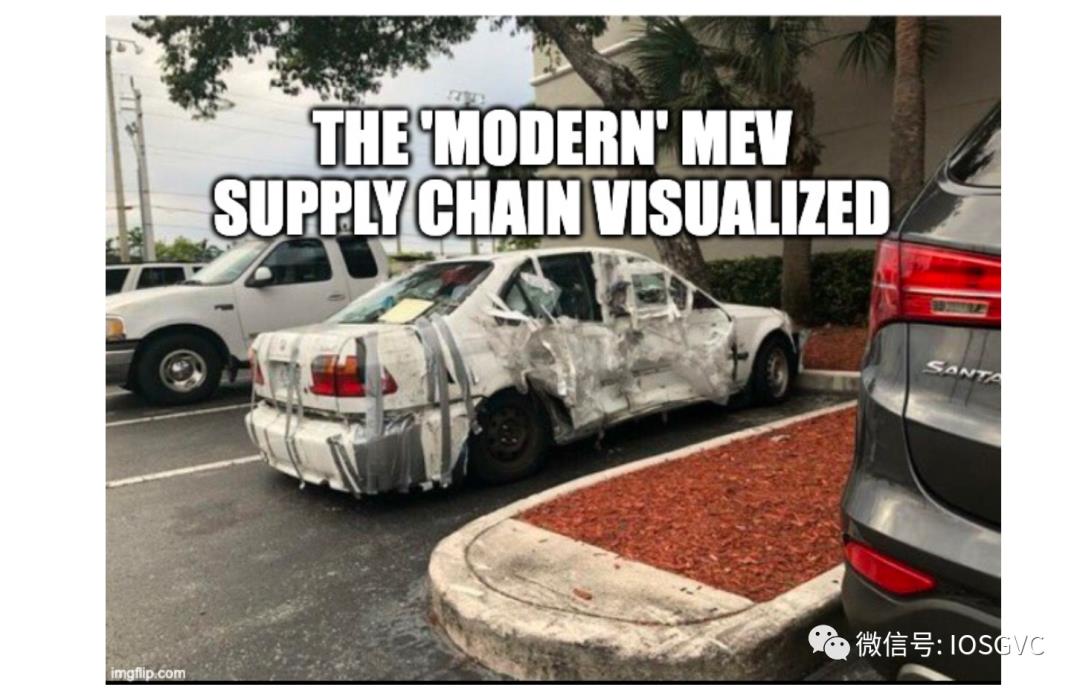
Source: Max Resnick (@MaxResnick1)
Within community discussions, centralization risks from large mining/validation pools have long drawn attention. However, upstream centralization risks tied to order flow are more subtle. Large infra entities like Metamask and Infura must remain mindful of potential biases in their decision-making. Smaller infra players can pursue bolder experimentation, driving ecosystem expansion.
Going forward, we expect intensified competition among stakeholders for order flow. Upstream players will increasingly consolidate and strengthen their pricing power. The emergence of OFAs and TG bots signals ongoing exploration toward the supply chain’s upper layers. During this evolution, we observe developers placing greater emphasis on user-centric and MEV-aware design.
Many challenges in order flow remain unresolved. At Flashbots’ MEV Researchathon, researchers proposed co-creating orderflow.pics. Recently, Toni launched mempool.pics—a site displaying stats on private order flow and participants. Winnsterx introduced the Transparency Dashboard searcherbuilder.pics. An increasing number of researchers and developers are focusing on the development and future of order flow, pushing for a more competitive, fair, and censorship-resistant supply chain. We will continue to monitor closely.
Stay tuned!
Join TechFlow official community to stay tuned
Telegram:https://t.me/TechFlowDaily
X (Twitter):https://x.com/TechFlowPost
X (Twitter) EN:https://x.com/BlockFlow_News
 IOSG Ventures











