Podcast Notes | Interview with Solana CEO Anatoly: Solana's Past, Present, and Future
TechFlow Selected TechFlow Selected
Podcast Notes | Interview with Solana CEO Anatoly: Solana's Past, Present, and Future
Some teams operate on a cycle opposite to the crypto market, focusing more on product development rather than short-term market fluctuations.
 Navigating Web3 tides with focused insights
Written by: Revelo Intel
Translated by: TechFlow
Solana's ecosystem continues to recover—where is it headed next?
In this podcast episode, Raoul and Solana CEO Anatoly discuss Solana, its NFTs and DeFi projects, reviewing and forecasting their past, present, and future development.
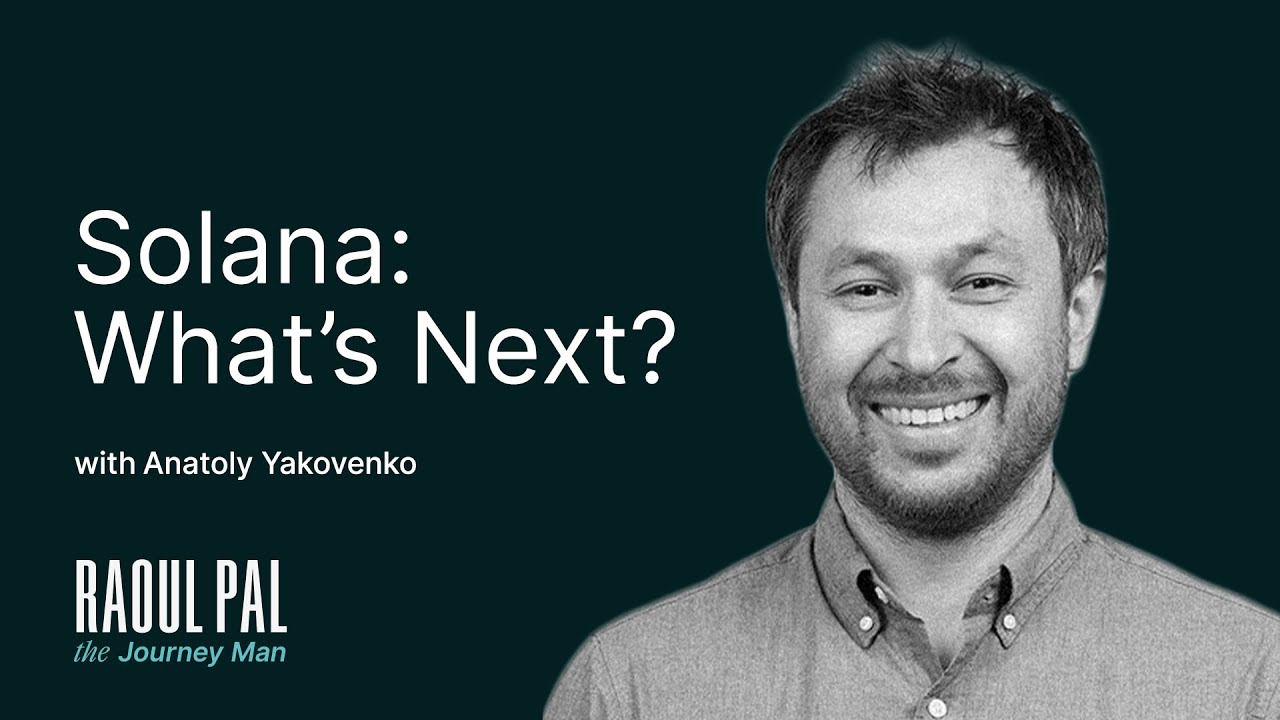
Host: Raoul Pal, Founder of Real Vision
Guest: Anatoly Yakovenko, CEO of Solana
Original title: “Solana: Past, Present & Future ft. Anatoly Yakovenko”
Release date: December 4, 2023
Solana’s Last Year
-
Anatoly reflected on the challenges Solana faced over the year, particularly managing negative sentiment following the FTX incident.
-
He added that being part of an ecosystem feels different—as if it’s pushing them forward. After witnessing how the community responded to adversity, he became more bullish on the Solana ecosystem. Despite difficulties, teams remain committed to building within the ecosystem rather than forking to create their own blockchain.
-
Anatoly said he tends to overthink worst-case scenarios, while Raj Gokal (Solana co-founder) excels at positively reframing situations. Having a partner who balances optimism and pessimism helps in finding better solutions.
-
He added that startups often face near-death scenarios, but having an optimistic partner helps navigate these challenges.
-
Anatoly noted that building on Solana isn’t solely driven by financial incentives, as many teams have diverse motivations. Some teams operate counter-cyclically to crypto markets, focusing more on product development than short-term market fluctuations.
-
He added that the Solana community experienced significant turmoil due to the FTX fallout. Despite this, it was crucial for the community to take action and support teams affected by the event.
-
Anatoly said they worked to identify teams whose operations were severely impacted due to reliance on FTX. Fortunately, many teams had diversified funding sources and weren't significantly affected.
-
He added that some teams adjusted strategies in response to changing market conditions—for example, shifting investments from high-yield platforms to short-term Treasuries.
Solana and the Application Layer
-
Anatoly said startups should plan around an 18-month cycle to prove their value and progress. Demonstrating product-market fit (PMF) within this timeframe is critical. Even with longer operational runways, thinking in 18-month cycles remains essential.
-
He cited the Backpack team as an example. The founders channeled personal impact and emotion into working harder. Instead of expanding the team, they focused on increasing work hours. Their dedication led to significant growth, building a strong community and product. Strategic decisions at each stage contributed to their success.
-
Anatoly said Solana provides a cheap, fast, and scalable solution. Developers can focus on building applications instead of scaling infrastructure. While there is some overlap with scaling technologies like ZK, the primary focus remains on improving the application layer. Given Solana’s already low costs, raising funds for L2 solutions is challenging.
-
He added that Solana’s low cost makes fundraising for L2s difficult. Ethereum’s expensive L1 and L2 solutions offer compelling value propositions. Solana’s focus is on building applications people will use—not adding more layers or frameworks.
-
Anatoly said compressed NFTs offer a cost-effective way to track assets on-chain. Applications like ticketing and loyalty points can benefit from low-cost blockchain-based asset tracking. The concept of compression has been discussed for a while—and reality often ends up stranger than fiction.
-
He added that artists with large followings can monetize their art by charging subscribers. NFTs create scarcity and rarity for digital art, enabling artists to offer unique works to their audience.
-
Anatoly believes focusing less on declining prices of limited-edition NFTs and more on building relationships between artists and followers will lead to more innovative applications. The true potential of NFTs isn’t yet fully understood, but the technology could enable incredible use cases.
-
He added that just as people in the early internet had to learn what hyperlinks were, there’s a learning curve with crypto wallets. As more people become familiar with wallets and crypto, broader NFT adoption will follow.
-
Anatoly mentioned companies like Instagram could benefit from integrating compressed NFTs into their platforms. There’s still vast untapped potential for innovative NFT applications.
Solana and DeFi
-
Anatoly said DeFi on Solana has seen significant growth, especially on platforms like marginfi, Solend, Jupiter, and Jito. These platforms continued building and maturing even during bear markets and challenging events.
-
He added that DeFi represents decentralized markets for lending, trading, staking, etc. The intersection of L1 staking security with DeFi applications like Jito creates interesting opportunities for earning additional yield.
-
Anatoly said DeFi is considered the most important application in crypto because it represents inroads into traditional finance. Although adoption may be challenging due to people’s reluctance to relinquish control over finances, DeFi will inevitably play a major role in the future of finance.
-
He added that integrating DeFi into blockchain networks can create positive feedback loops between validators and app users. This connection leads to greater decentralization, faster transaction speeds, and a more tightly integrated ecosystem.
-
Anatoly said Backpack is a new exchange aiming to build something better than the FDA, using multi-party computation (MPC) to achieve super transparency and proof of customer funds.
-
He added that despite limited resources, they successfully developed a wallet and Mad Lads’ NFT ecosystem, and launched a fully licensed centralized exchange. Currently, the centralized exchange is more connected to fiat rails than DeFi tracks—but they hope this changes in the future.
-
Anatoly said Cube is another exchange launched by Bartosz, formerly engineering director at Solana Labs. Cube emphasizes security and uses MPC for customer fund protection.
-
He added that they designed a system where they don’t directly hold user funds, instead using multi-party wallets for fund segregation. Both Backpack and Cube aim to prevent past failures, prioritizing security and innovation.
Solana and NFTs
-
Anatoly said projects like Mad Lads have strong teams capable of executing their vision, which attracts more users. Other factors have also contributed to NFT space growth—it has consistently moved faster than general crypto in terms of trends and innovation.
-
Anatoly said the goal of decentralization is eliminating single points of failure. One challenge is multiple teams implementing the same L1. Ethereum achieved significant decentralization through four distinct L1 implementations, though this slowed progress. Measurable decentralization helps assess the risk of irrecoverable network failures and is crucial for building robust systems.
-
He added that the Firedancer team consists of high-frequency trading experts skilled in programming languages like C and C++, with deep knowledge of hardware and performance optimization.
-
Anatoly added that while the Firedancer team has experience building projects from scratch, other teams may have different perspectives since they’re familiar with both the start and end states of existing projects.
-
Anatoly said the team focuses on optimizing the underlying protocol without making changes. Their goal is to prove that adding more cores to any part of the system improves performance.
-
He added that adding more cores should improve performance without modifying the base protocol. The current focus is demonstrating scalability of existing hardware components. Once a full client runs, there will be no single point of failure—a key milestone.
-
Anatoly said Firedancer allows testing and identifying bottlenecks in the system, driving optimization efforts. When necessary, the Labs and Firedancer teams can review and accept proposed algorithmic changes. Network scalability depends on software improvements and validators upgrading their hardware.
-
He added that Visa-level transaction throughput cannot meet the demands of high-frequency trading TPS or traditional exchanges. Solana aims to build a hyper-optimized atomic state machine capable of meeting securities industry needs. As demand grows, hardware upgrades are expected to happen organically, ensuring continuous network performance improvement.
-
Anatoly said composable computer systems like Solana can scale to support various functions simultaneously—including Visa-like payments, NFTs, and Jupiter. It enables efficient cross-market trading. For example, on Jupiter, you can swap 20 cents across five different markets because it’s more cost-effective.
-
He added that traditional financial systems suffer inefficiencies due to fees charged per market. In contrast, composable computers eliminate these inefficiencies by offering cheap and fast transactions. The vision is running finance on an extremely fault-tolerant, massive computer with multiple implementations, synchronized at light speed. This decentralized technology has the potential to outperform centralized systems—not just because it’s decentralized, but because it offers cheaper transactions and better price discovery.
-
Anatoly said Solana’s global nature enables rapid propagation of state transitions worldwide. When a market-moving event occurs in one location, information reaches others almost instantly. As a result, price discovery becomes more efficient, with prices across markets converging faster.
-
He added that this gives Solana an edge over centralized systems, which still face latency in transmitting information across geographies. By delivering comparable price discovery capability at lower cost and higher speed, Solana has the potential to be competitive in financial markets.
Regulation and Final Thoughts
-
Anatoly expressed hope for faster regulatory progress in the U.S. He believes market structure and stablecoin bills would provide guidance for other countries, leading to globally standardized regulation. However, progress so far has been slow, with only partial measures implemented.
-
Anatoly said labeling Solana and other projects as securities without proper legal rulings creates uncertainty, making it difficult to address regulatory challenges. Despite these hurdles, having a U.S. foundation provides advantages when engaging with regulators. Demonstrating tangible benefits of crypto projects—such as affordable data plans via Helium—can help gain support from U.S. lawmakers.
-
He added that from their perspective, compliance with U.S. laws is inevitable for any crypto company, regardless of where it was initially founded. He believes founding a crypto company in the U.S. offers equal chances of success compared to founding elsewhere.
-
Anatoly believes companies like Google Play Store have become more open to revenue models involving NFTs. However, he expects Apple may struggle in this transition due to its reliance on controlling and monetizing content.
-
He added that finding a model where platforms earn a percentage of market revenue rather than total sales might be a solution—but this could affect their profits. He noted both Google and Apple face threats from AI, forcing them to adapt and find new business models.
-
Anatoly believes AI poses a bigger threat to established companies than crypto, as it disrupts their existing business models. Developers are encouraged to see AI as an opportunity—to bypass traditional apps and build text-based interfaces using GPT-style technologies.
-
Anatoly believes the next market cycle will see a significant increase in application development. He noted that developer quality and product standards at hackathons continue to rise, indicating growth and innovation in the space.
-
He expressed excitement about new companies forming and new products launching. However, he pointed out that transitioning from hackathon winners to successful companies with product-market fit remains challenging. He expects more investment to flow into application development, which has so far received relatively limited funding compared to infrastructure.
-
Anatoly suggested that because Solana focuses more on application development, it may attract more investment in apps compared to Ethereum. He emphasized the need for more success stories in app development to draw in venture capital.
-
Finally, he added that Ethereum’s focus on infrastructure development, especially L2s, may limit its appeal to investors.
Join TechFlow official community to stay tuned
Telegram:https://t.me/TechFlowDaily
X (Twitter):https://x.com/TechFlowPost
X (Twitter) EN:https://x.com/BlockFlow_News
 Revelo Intel