

10 Things You Need to Know About the Inscriptions Controversy
TechFlow Selected TechFlow Selected
10 Things You Need to Know About the Inscriptions Controversy
Perhaps actively limiting transaction volume would be a good idea.
 Navigating Web3 tides with focused insights
By 0xTodd
Here are 10 small insights to share with you:
1. If the Bitcoin Knots client, as Luke mentioned, upgrades and refuses transactions containing $Ordinals inscriptions, can inscriptions still be used?
Answer: If a Bitcoin Knots client is selected to produce a block, inscription transactions will not be usable (i.e., cannot be included on-chain).
2. How likely is it for a Bitcoin Knots client to produce a block?
Answer: Currently quite low. As of December 2023, there are over 17,000 Bitcoin Core clients, but fewer than 100 Bitcoin Knots clients (though this number has previously reached up to around 500).

3. Wait, what exactly is a client?
Answer: For PoW blockchains, there is software responsible for three functions: "storing the ledger, mining, and wallet operations." This software is called a "client."
Since blockchains are permissionless, in theory anyone can develop a client as long as it follows the chain's consensus rules. Thus, various clients exist—such as Bitcoin Core and Knots.
4. If Bitcoin Core actually followed through and decided to ban inscription transactions, would inscriptions become completely unusable?
Answer: Not necessarily. Bitcoin Core clients themselves vary—many users still run older versions.
Among the more than 17,000 Bitcoin Core users today, about 9,000 use versions 24–25, and around 5,000 use versions 21–23. So even if version 27 adds rules prohibiting misuse of block space, older versions will continue functioning normally.
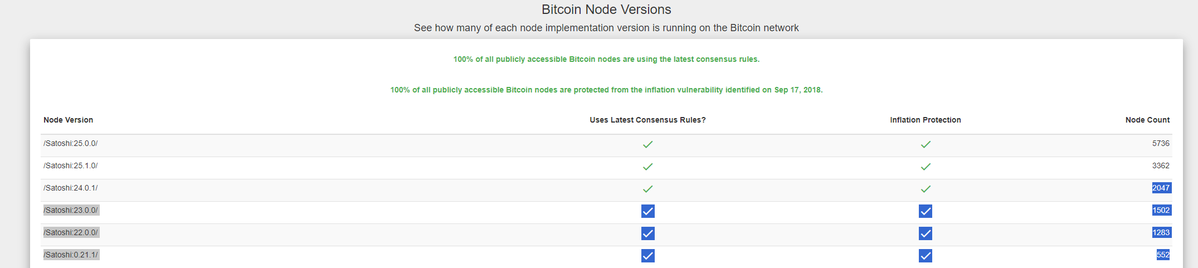
Therefore, by waiting patiently until an older version of Core produces a block, an inscription can still be processed. For example, instead of confirming every 10 minutes, it might take 30 minutes.
Of course, miners tend to upgrade to the latest version. If eventually everyone upgrades, inscription usability would deteriorate significantly.
5. If Ordinals decides to fork the Bitcoin chain, will it succeed?
Answer: Technically, forking is simple—you could copy the Bitcoin Core code and use it with minimal changes (since older versions support inscriptions).
But reaching consensus is difficult. What does consensus mean? You’d need miners, exchanges, holders, and even the SEC to agree that “the big coin with little coins inside is the real Bitcoin”—which is nearly impossible.
6. Suppose I insist on forking—would such a forked Bitcoin have any value?
Answer: It would have some value, but very limited.
Bitcoin’s pride lies in its powerful hash rate ensuring security. A new chain would be less secure than Bitcoin and could issue digital artifacts—but then again, why not just use an EVM chain?
7. Are Ordinals and BRC-20 truly exploiting vulnerabilities in the Bitcoin blockchain?
Answer: Yes—but calling it an “exploit” is too strong. At most, it’s “bypassing limitations.”
Subjectively, Ordinals doesn’t carry the malicious intent implied by “exploit,” a term usually reserved for hackers. Objectively, however, it does waste Bitcoin block space.
8. Really? What exactly happens during inscription—and how are limits bypassed?
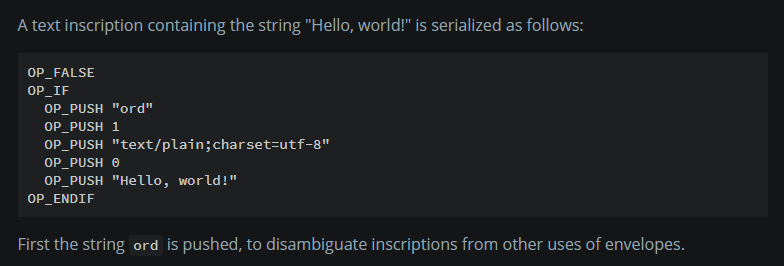
Answer: “Inscription” means selecting one satoshi (0.00000001 BTC) and “coloring” it. Then, using Taproot (a new Bitcoin technology), you attach metadata to that single satoshi via text scripts.
For example, the metadata may specify: protocol is Ord, format is UTF-8, content is “hello world”.
If we must draw an analogy, it’s like this:
WeChat red envelopes were meant for money transfers. But now, every time I send you 1 cent, we insist on using the note field to chat.
This isn’t really an exploit—it’s more like abuse.
Bitcoin wasn’t designed to support NFTs, but this “transfer + note” method achieves it indirectly.
Moreover, Taproot enables bypassing the original size limit on notes, expanding them from a few bytes up to 512 bytes.
8.5 Side note: You should know that notes and smart contracts are different.
A smart contract is like signing a binding agreement.
A note is just a note.
They do not carry equal weight.
This is also one key difference between Ethereum-style NFTs and BRC inscriptions.
-
If I transfer funds to you via a smart contract, it’s a genuine, non-repudiable transaction.
-
If I transfer via a note—for example, saying Todd’s inscription now belongs to Alex—I’ve only written it in the note.
Now, thanks to the Ord protocol, the community accepts such notes as valid proof of ownership transfer.
9. Inscriptions aren’t NFTs, right?
Indeed not—they differ in several ways.
NFTs often store data off-chain, while inscriptions store everything directly on the BTC chain.
Of course, this double-edged sword is precisely what troubles Bitcoin supporters.
The upside: miner revenues increase, which *might* become crucial after multiple halvings.
The downside: the Bitcoin ledger grows larger (due to stuffing extra data via workarounds), making full-node storage harder.
As the ledger grows, fewer people run full nodes, making the blockchain resemble a consortium chain.
9.5 Does ledger size really matter that much?
Ethereum’s ledger has always been large. Only recently has the community realized this problem and begun discussing ways to prune historical states or even old blocks.
Bitcoin, by contrast, uses small blocks and has historically managed ledger growth well, keeping its size manageable and enabling many full nodes—making it highly decentralized.
10. Where should inscriptions go from here?
Perhaps voluntarily limiting inscription size would be a good direction—reducing it further from current levels.
Taproot was introduced by Bitcoin Core to enable basic scripting functionality on Bitcoin.
Ordi leverages Taproot to bypass maximum note size limits. But stuffing so much data into Bitcoin via such loopholes isn't ideal—especially increasing capacity from a few bytes to hundreds, a hundredfold jump.
However, if usage is slightly restricted and kept within reasonable bounds to avoid a “tragedy of the commons,” I believe the Bitcoin core community wouldn’t strongly oppose these small digital artifacts. That might be the better path forward.
Join TechFlow official community to stay tuned
Telegram:https://t.me/TechFlowDaily
X (Twitter):https://x.com/TechFlowPost
X (Twitter) EN:https://x.com/BlockFlow_News
 @0x_Todd















