PEPE and ORDI with tens of thousands of times returns—the strongest assets on Earth this year
TechFlow Selected TechFlow Selected
PEPE and ORDI with tens of thousands of times returns—the strongest assets on Earth this year
They won't be the last meme.
 Navigating Web3 tides with focused insights
Written by Kaori, BlockBeats
Among tech and internet assets, the most widely circulated investment legends in the market are undoubtedly NVIDIA, Luckin Coffee, and Pinduoduo. For large capital players, price doubling of these massive market-cap leaders is already enough to prompt them to cash out.
Yet from an ordinary person's perspective, the strongest asset this year remains crypto—specifically, meme coins with explosive potential. In what was widely considered a bear market in 2023, two meme coins, PEPE and ORDI, shocked the industry with returns of 375,000x and nearly 20,000x respectively.
Meme coin projects represent the greatest "wealth code" opportunity for average investors in the cryptocurrency space, precisely because novelty never runs dry here. Unlike other commercial crypto projects such as DeFi or web3Games, memes may appear to lack a business model, yet their actual business logic and PMF (Product-Market Fit) are crystal clear: providing mass crypto investors with highly speculative instruments full of imagination.
The phrase "providing for the masses" refers to how meme concepts are simple, fresh, often bizarre or controversial—making them more likely to capture public attention amid information overload. "Highly imaginative" means they lack real-world operations anchoring their token prices; valuations based purely on "consensus" can soar infinitely high.
Even the most serious crypto practitioners cannot deny that "speculating to make money" is a crucial—if not the primary—driving force behind the crypto world. The endless stream of new meme projects perfectly satisfies this demand, serving as ideal PMF vehicles.
PEPE: The Cultural Heir of Meme Coins
The success of dog-themed meme coins made the market realize that memes have unique potential within the crypto sphere—spreading subcultures through community evangelism can generate tremendous power. After surviving a full bear cycle, meme coins like Shiba Inu (SHIB) and Dogecoin (DOGE) not only endured but even outperformed many so-called value investments.
If you're a traditional investor—whether practicing value investing or short-term trading—you'd naturally conduct thorough research into every aspect of an asset before committing funds. But meme coins don't give you that luxury—they thrive on emotion and marketing.
PEPE draws inspiration from the long-popular internet meme “Pepe the Frog,” originating from Matt Furie’s comic series “Boy's Club.” It gained traction around 2008 on cultural forums like Myspace, Gaia Online, and 4chan, then became one of Tumblr’s most viral images by 2015.
Crypto has never lacked hype around this sad frog—from tokens to NFTs, everything exists. But PEPE in 2023 brought this meme to its peak moment of cultural and financial significance.
The official PEPE X account posted its first tweet on April 5 and launched trading on April 15. PEPE initially traded at approximately $0.000000001, with a total supply of 420.69 trillion.
PEPE boldly declared itself “the most watched meme coin currently in existence. Doge is outdated—it’s time for PEPE to take over.” The numbers “420” and “69” in its 420.69 trillion supply are themselves culturally significant meme numbers. Clearly, PEPE’s rise owes much to the prior cultural groundwork laid by the “sad frog” meme, along with the wealth fantasies cultivated by earlier meme coin projects.
PEPE’s early price momentum was driven by the founding team and fans sharing frog-themed memes across social media. Then on May 6, Binance Launchpool listed PEPE, followed by Binance introducing 1–20x USD-margined perpetual contracts for PEPE. From there, PEPE repeatedly hit new all-time highs.
At the time, market sentiment was rising—Bitcoin had doubled from its lowest point. Crypto traders, envious of AI and semiconductor stocks soaring in U.S. equity markets, desperately needed an outlet to release pent-up emotions. Combined with the Binance effect, PEPE delivered unmatched performance in the first half of the year.
Within just one month of launching at the end of April, PEPE reached a staggering $1.5 billion market cap, with peak 24-hour trading volume exceeding $1.7 billion. At its height, this volume rivaled spot Bitcoin trading volumes on some of the largest centralized exchanges. Among bear market assets, PEPE may have been the first to match Bitcoin’s liquidity.
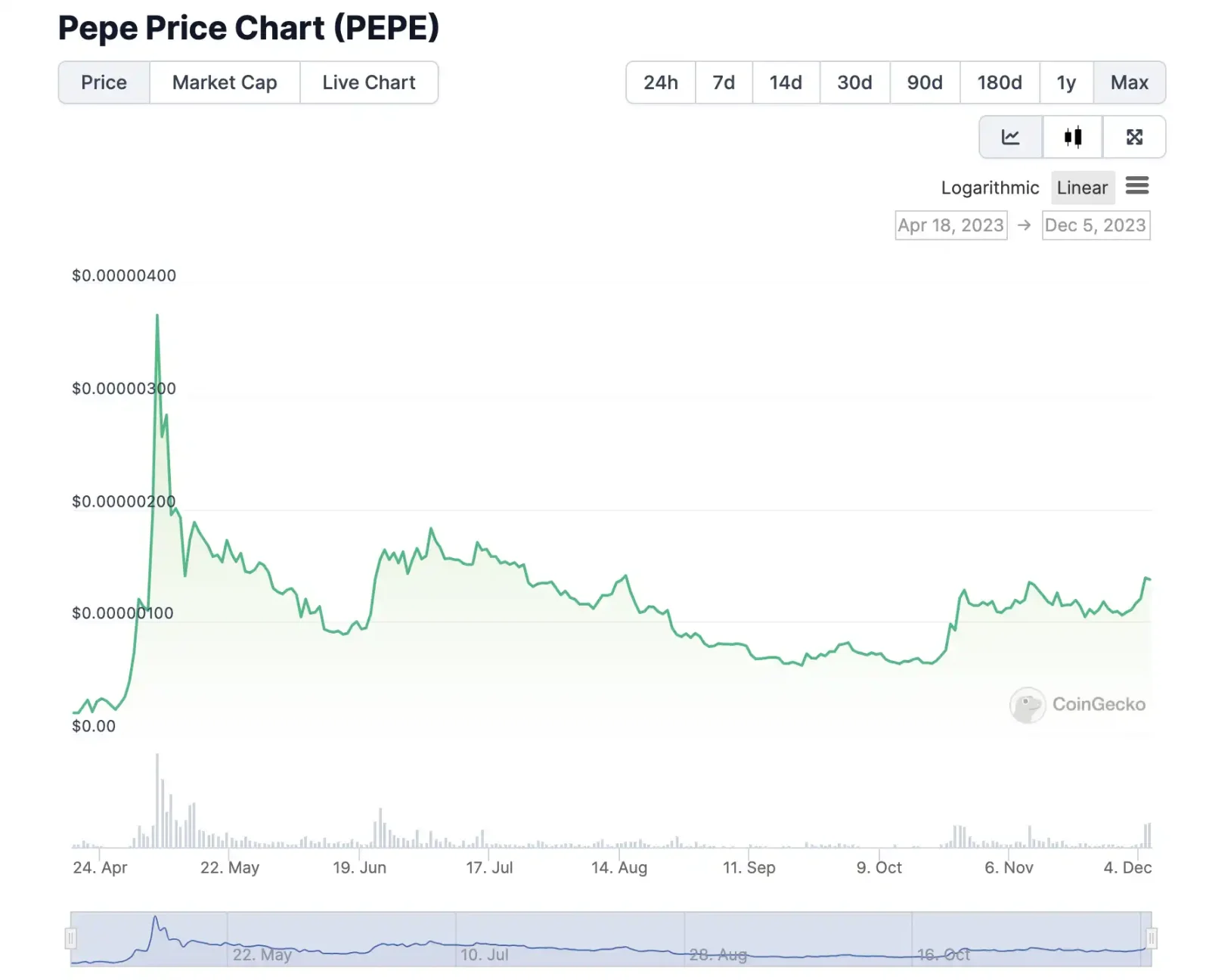
PEPE price chart; Source: CoinGecko
ORDI: The Inscription Leader Wearing a Meme Cloak
Unlike PEPE, which positioned itself squarely within meme culture from day one, ORDI—the Bitcoin ecosystem’s inscription project—took a more subtle path to becoming a wealth phenomenon.
ORDI’s story begins in December 2022, when Bitcoin developer Casey introduced the Ordinals protocol, sparking asset experimentation within the Bitcoin ecosystem.
On March 8, 2023, an anonymous developer @domodata launched the BRC-20 inscription standard based on the Ordinals protocol and deployed the experimental token $ORDI. By March 9, all ORDI had been minted—at a cost of about $2–3 per inscription, each containing 1,000 ORDI tokens, implying an initial price of roughly $0.003 per ORDI.
Today, ORDI trades at $54—a near 20,000x increase over nine months.
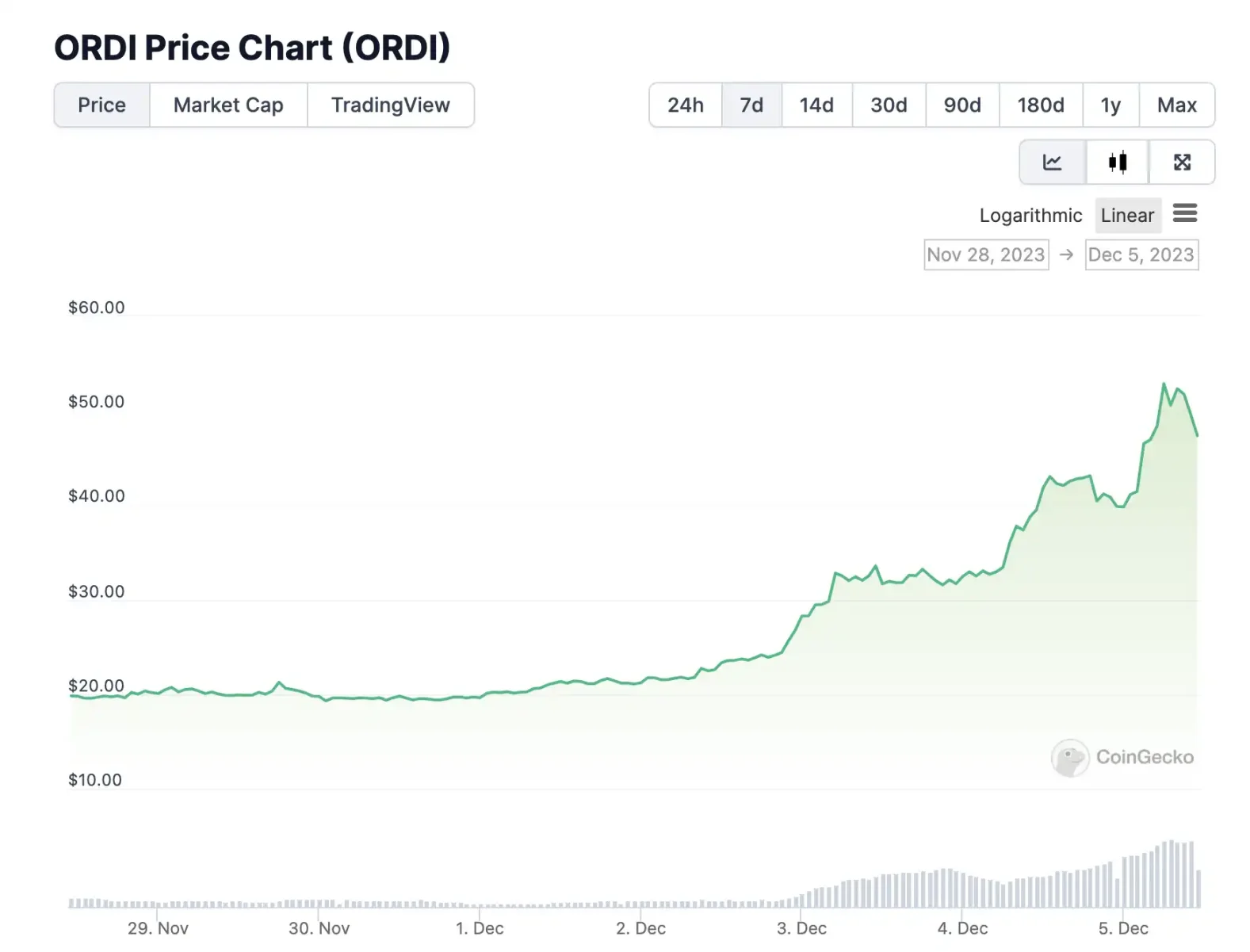
7-day ORDI price chart; Source: CoinGecko
A year later, ORDI appears to be the most successful product of this Bitcoin experiment—but its price flywheel didn’t start spinning immediately.
Bitcoin long served only as a store of value and transfer mechanism. When people began building ecosystems and applications on it, they quickly realized that compared to Ethereum’s mature DeFi and NFT landscapes, the Bitcoin ecosystem remained unfriendly to average crypto users. At the time, Bitcoin’s price offered little confidence either. Beyond dedicated Bitcoin ecosystem builders, few ordinary investors believed projects like ORDI could truly succeed.
On March 23, UniSat launched a BRC-20 marketplace, pushing ORDI to $0.3—but shortly after, due to double-spending issues, UniSat shut down trading. A month later, it relaunched the marketplace for select users only, sending ORDI’s price to $1.
Gradually, people began recognizing the future potential of BRC-20 as a new asset issuance method. As always, the crypto community eagerly dives into novel ideas, and the fair launch narrative attracted significant capital inflows.
As major exchanges started showing interest, the seeds of ORDI’s first breakout were sown. On April 27, OKX held a vote on whether to support BRC-20, raising market expectations for a listing.
On May 8, Gate.io listed ORDI, driving its price above $20—an all-time high—and causing Bitcoin network transaction fees to account for 43.7% of miners’ total income that day. However, profit-taking and broader market weakness soon drove ORDI down to around $7.5. On May 20, both OKX and Huobi listed ORDI, but as BTC dropped to $25,000 and market conditions worsened, ORDI fell further to $5, entering a prolonged downtrend lasting over four months.
During this period, the Bitcoin ecosystem saw no major breakthroughs. Most market participants once again grew skeptical of Bitcoin inscriptions, which had briefly sparked excitement months earlier. In September, user complaints arose when withdrawals of ORDI from OKX encountered issues. Sentiment only began improving on October 18, when UniSat released BRC-20-swap, reigniting interest in ORDI.
From there, the Bitcoin ecosystem exploded, with narratives and sentiment reaching unprecedented levels. On November 7, Binance announced ORDI listings, pushing its price from $7.4 to $13.5. As BTC rose, ORDI climbed steadily to $20. Early December saw ORDI jump from $21.7 to $32; on December 5, it broke $50, hitting a record high of $54.
Over these 270-plus days, ORDI surged from $0.003 to $54—earning its title as arguably the top-performing crypto asset of 2023. Yet throughout this journey—from initial confusion and dismissal to current status as BTC ecosystem price leader—ORDI faced no shortage of skepticism. Even Casey, creator of the Ordinals protocol, expressed discomfort with BRC-20’s direction during ORDI’s Binance listing period.
From PEPE to ORDI, it’s evident that Binance remains the most trusted platform for asset distribution. Getting listed on Binance has become a decisive catalyst for price surges—and exactly the kind of marketing boost meme projects love most. “What I am doesn’t matter; where I’m listed matters more”—just like Dogecoin going to the moon, fueling further price expectations.
To speculators, crypto itself is one giant meme, where ordinary people still have opportunities to strike gold. Compared to logical investments like NVIDIA or Pinduoduo, meme coins remain the most explosively rewarding wealth vehicle for everyday individuals.
In crypto markets, the prerequisite for buying any token is believing someone else will pay more for it in the future. This is especially true for meme coins, which rely far more on psychological drivers than fundamentals. Economists call this the “Castle-in-the-Air Theory”—focusing on an asset’s perceived psychological value and emphasizing the impact of mass psychology on pricing. That is, “investors attempt to build castles in the air, speculating on future price increases rather than estimating intrinsic value.”
Join TechFlow official community to stay tuned
Telegram:https://t.me/TechFlowDaily
X (Twitter):https://x.com/TechFlowPost
X (Twitter) EN:https://x.com/BlockFlow_News
 BlockBeats