








How can Wormhole help Pyth Network become a leading first-party oracle network?
TechFlow Selected TechFlow Selected
How can Wormhole help Pyth Network become a leading first-party oracle network?
This article will explore the core functionalities of Pyth Network and its role in DeFi, while focusing on how Wormhole enables efficient cross-chain technology.
 Navigating Web3 tides with focused insights
The development of DeFi cannot be separated from oracles. As the "messenger" between smart contracts and real-world data, oracles enable DeFi applications/protocols to securely and reliably obtain financial data from the external world, ensuring the system operates accurately and stably. Consequently, numerous oracle protocols have emerged in the market, including well-known ones such as Chainlink. However, as the market grows increasingly complex, high-quality, first-party market data has become even scarcer, posing a major obstacle to building transparent and efficient DeFi services.
Against this backdrop, Pyth Network emerged with the mission of providing real-time, reliable first-party financial market data to decentralized applications. Meanwhile, Wormhole, as a leading cross-chain messaging protocol, offers an efficient solution for seamlessly connecting different blockchains, elevating Pyth Network to new heights. By leveraging Wormhole's cross-chain messaging service, Pyth Network has successfully distributed its first-party data across multiple ecosystems, establishing itself as one of the world’s leading first-party oracle networks.
This article explores the core functionalities of Pyth Network and its role in DeFi, while focusing on how Wormhole enhances Pyth Network’s capabilities through efficient cross-chain technology, making it one of the most influential data oracles in the market.
Before diving into the main content, here’s a quick update: Wormhole has completed a $225 million funding round at a $2.5 billion valuation and announced the establishment of Wormhole Labs. Those interested in joining the Wormhole Chinese community can scan the QR code below:

Part 1: What is Pyth Network?
Pyth Network is an oracle network designed to deliver real-time, high-precision market data to the crypto market and DeFi ecosystem, including price, interest rate, and volatility information. The network aggregates first-party data from over 90 trusted data providers, such as renowned exchanges, market makers, and financial institutions, making it available for use by smart contracts and other on-chain or off-chain applications. To date, Pyth delivers real-time price feeds for cryptocurrencies, stocks, foreign exchange, ETFs, and commodities to smart contract developers across more than 40 blockchains.
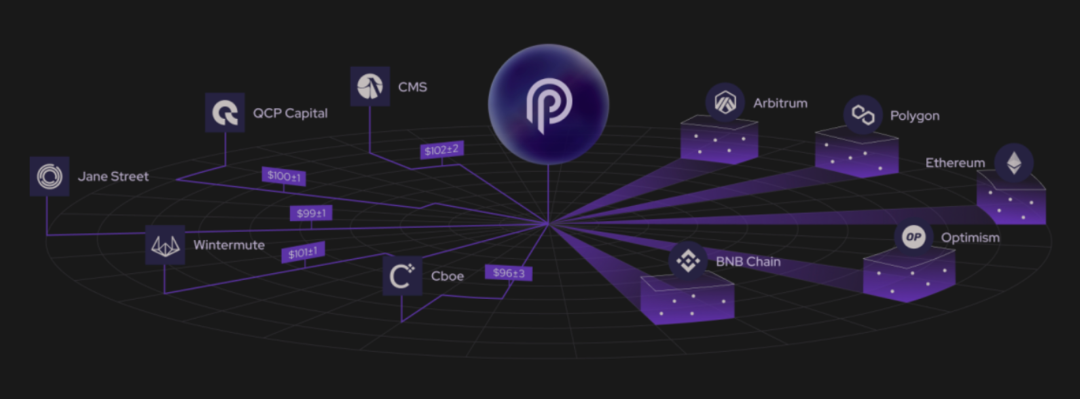
Pyth Network stands out in the DeFi space due to its unique insights and technological innovations, highlighted by the following key features:
01 Decentralization and Strong Security
Pyth Network aggregates data from multiple sources in a decentralized manner, reducing risks associated with reliance on any single data provider. With numerous independent data providers collectively maintaining and updating the data, Pyth builds a robust security layer that enhances the system’s resilience against attacks.
02 Low Latency and High-Frequency Data Updates
Pyth Network uses a pull-based model, achieving lower latency and higher-frequency updates compared to common push-based oracle models by updating prices off-chain at high speed. Each price feed is updated every 400 milliseconds, offering superior support for financial applications requiring low-latency and frequent price updates.
03 Comprehensive Data Coverage and Multi-Chain Availability
Pyth Network covers a broad range of asset classes, including cryptocurrencies, stocks, foreign exchange, ETFs, and commodities. Moreover, Pyth is not limited to any single blockchain. After price publication and aggregation on Pythnet (Pyth’s application-specific chain), price updates are delivered across chains via Wormhole, extending asset price data to dozens of blockchains. This multi-chain availability ensures that applications on all supported blockchains can access real-time data, enabling seamless data integration for cross-chain DeFi solutions.
04 Transparent, High-Precision, and Highly Available Data
Pyth Network emphasizes data transparency and accuracy. It sources data directly from traditional and decentralized financial data creators, meaning each data point is traceable to its publisher and originates as first-party data. The identity and reputation of publishers ensure data quality. This approach guarantees that Pyth’s data is transparent, verifiable, and highly accurate, significantly enhancing its usability. High availability ensures users can access required data anytime and anywhere, which is crucial for maintaining the continuity and reliability of DeFi services.
Thanks to these features, Pyth Network has become a trusted DeFi data platform, securing a strong position in the competitive oracle market through technological innovation and a robust network of ecosystem participants.
The key difference between Pyth Network and many well-known oracles lies in their data update mechanisms—specifically, the distinction between push-based and pull-based oracles, which also leads to differences in suitable application scenarios. For clarity, we’ll briefly compare Pyth Network with Chainlink as an example.
Data Update Mechanism:
-
Chainlink is a push-based oracle, which actively pushes data onto the blockchain at fixed time intervals or when price changes exceed a certain threshold.
-
Pyth Network is a pull-based oracle, allowing users or smart contracts to actively request (pull) data. This means demand-side applications (such as dApps or smart contracts) can fetch data at custom frequencies. When a smart contract is designed to frequently check and pull the latest data, it achieves lower latency and higher update frequency.
Application Suitability:
-
Chainlink meets basic needs for DeFi products with low update frequency requirements (e.g., lending, swaps), where high-frequency, low-latency real-time pricing isn't critical.
-
Pyth Network’s low-latency nature makes it ideal for applications requiring high-frequency, real-time data, especially in high-volatility markets or scenarios sensitive to fast trade execution, such as derivatives and margin trading.
Part 2: WH × Pyth Synergy
As discussed above, Pyth Network has established a solid DeFi data delivery platform and pricing system through technological innovation and a strong ecosystem. To enable this data to be widely disseminated and utilized across the broader blockchain ecosystem, cross-chain communication protocols are essential. When it comes to real-time data transmission and cross-chain interoperability, Wormhole plays an indispensable role as a critical hub connecting heterogeneous blockchain worlds in Pyth Network’s inter-chain data flow.
Wormhole and Pyth Network established a partnership back in 2021. Through Wormhole’s cross-chain communication technology, Pyth Network can transmit its first-party, high-frequency market data in real time to any blockchain connected to Wormhole. This enables Pyth’s price feeds to be used by dApps across dozens of blockchains without concerns about data tampering or latency. Well-known Web3 applications such as Synthetix, Venus, and Hashflow leverage Pyth Network’s oracle services across chains like Ethereum, BNB Chain, Optimism, Arbitrum, Polygon, and Avalanche, all relying on Wormhole to deliver price data from Pyth Network.
The diagram below illustrates how Pyth Network delivers price data from Pythnet to target chains via Wormhole:
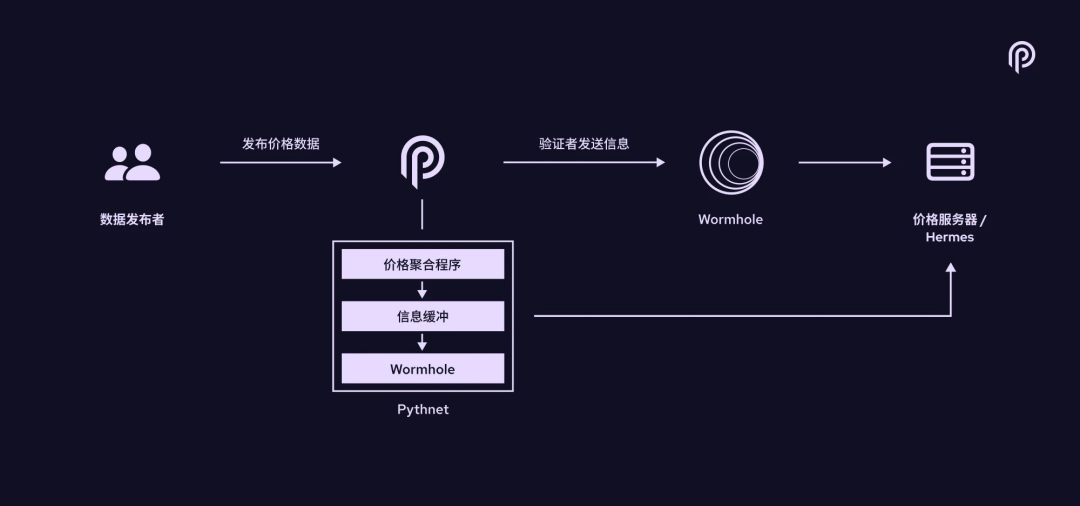
The process works as follows:
[1] Data Publication: Data providers first publish their price data on Pythnet.
[2] Data Aggregation: On-chain oracle programs on Pythnet aggregate these prices into a composite price and confidence interval.
[3] Data Transmission: Pythnet validators send Wormhole messages containing the Merkle root of all prices to the Wormhole contract on Pythnet for each Pythnet slot.
[4] Wormhole Guardians Verification: Wormhole Guardians observe these Merkle root messages and generate a signed VAA (Verifiable Action Approval).
[5] Hermes Listening and Storage: The price server Hermes continuously monitors Pythnet and Wormhole to retrieve Pyth’s Merkle root information, storing the latest price messages along with their Merkle proofs and signed Merkle roots.
In simple terms, Hermes acts as a repository for Pyth’s latest price data, ensuring users can access up-to-date information. All end-users—including applications and smart contracts—who wish to leverage Pyth Network’s price data interact with Hermes to retrieve the latest pricing information and integrate it into their applications and transactions. Additionally, Pyth provides public APIs, enabling on-chain protocols to easily integrate with Pyth contracts via simple API calls to access and utilize current price data.
Through this process, Pyth Network achieves efficient, secure, and real-time data transmission across blockchains, ensuring decentralized applications can access the latest and most accurate market pricing information.
In summary, the integration between Wormhole and Pyth Network creates powerful synergies. Wormhole’s cross-chain communication technology combined with Pyth Network’s real-time market data lays the foundation for a stronger, more efficient, and interconnected DeFi ecosystem. As more blockchains join Wormhole, Pyth Network’s influence and reach will continue to expand, solidifying its role as a critical bridge between real-world data and blockchain applications.
Part 3: Conclusion
As the DeFi ecosystem matures, the collaboration between Pyth Network and Wormhole sets an innovative benchmark for the industry. We are witnessing the emergence of a new paradigm for data and asset circulation, with Pyth Network and Wormhole playing indispensable roles.
Pyth Network’s high-precision, low-latency market data solution, combined with Wormhole’s efficient cross-chain communication capabilities, together form a reliable, flexible, and widely applicable data transmission framework. This framework not only supports existing DeFi applications with stable and trustworthy data but also opens doors for emerging innovations. As more blockchains and asset types are integrated, the scope and impact of this framework will continue to grow.
Join TechFlow official community to stay tuned
Telegram:https://t.me/TechFlowDaily
X (Twitter):https://x.com/TechFlowPost
X (Twitter) EN:https://x.com/BlockFlow_News


