The Dawn of a New Era: The Shift from EVM to Modular Blockchains
TechFlow Selected TechFlow Selected
The Dawn of a New Era: The Shift from EVM to Modular Blockchains
The great shift away from EVM has never been closer.
 Navigating Web3 tides with focused insights
Written by: TheRollup
Compiled by: TechFlow
Dear all,
We are at a pivotal moment for modular blockchains — moving beyond the Ethereum Virtual Machine (EVM). This shift has the potential to bring thousands of previously hesitant developers into the crypto space!
While EVM once dominated, it's now time to embrace new technologies shaping the future of blockchains. Below, we’ll explore the limitations of EVM, the promise of alternative virtual machines, and the pioneers leading this transformation.
Cheers!
We are entering a critical juncture for modular blockchains—the monumental shift away from EVM has never been closer.
Teams engaging with non-crypto developer communities have been patiently waiting for this moment!
Imagine if we could recruit thousands of previously unwilling developers from diverse backgrounds to contribute to building the crypto-centric future we all desire… This reality is unfolding right here, right now—we will onboard thousands of capable developers in the coming years.
But none of this will happen on EVM...
In today’s article, I’ll walk you through the state of EVM and its limitations, why other virtual machines built on years of technological stacks are superior, and highlight several key pioneers forging this path forward.
As an Ethereum evangelist, I must say it's hard to speak negatively about the Ethereum Virtual Machine. EVM has rightfully dominated as the backbone for countless decentralized applications—it functions as an execution layer responsible for executing smart contracts and managing all transactions.
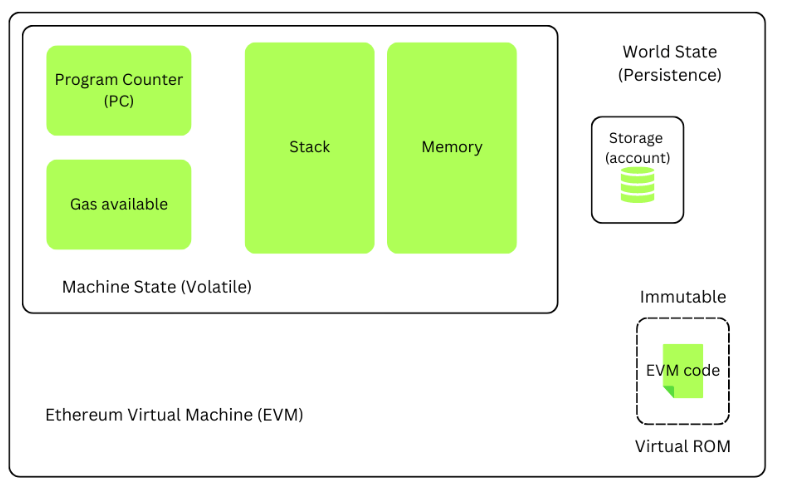
You can create any type of smart contract and program using EVM, which gave rise to the narrative of "programmable money."
While this technology revolutionized crypto, EVM does have limitations:
First, it is relatively new. Compared to traditional codebases, there isn’t much existing infrastructure ("codebase") such as compilers and libraries.
Second, from a developer perspective, learning Solidity is difficult and comes with many constraints compared to other programming languages like Rust, Move, or JavaScript.
Additionally, economically speaking, EVM faces limitations when compared to other execution-layer virtual machines. Many newer alternatives are cheaper and more powerful.
Looking ahead, we clearly see the narrative shifting.
Now is the time to ask:
Is it time to move beyond EVM as the settlement layer?
I believe 2024 will be the breakout year for new execution layers. High-performance, non-EVM execution environments will become standard, as DeFi protocols aim to minimize costs (e.g., gas fees) and games/applications demand high-throughput environments.
This new narrative isn't about abandoning Ethereum, but rather embracing diversity and exploring new possibilities within the modular ecosystem. We must recognize that the world of modular blockchain design is vast and varied—and Ethereum is just one (important) piece of the puzzle.
Let’s dive into how various teams are performing in this vertical:
Polygon Miden and Risc Zero are pioneers in a new approach to virtual machine design, focusing on efficiency and scalability within the zk-space.
Cartesi is building a Linux-based virtual machine called Cartesi Machine. It deterministically simulates traditional computer chips (64-bit RISC-V ISA), enabling full operating systems (e.g., unmodified Ubuntu) to run. This allows developers to execute traditional computer programs, languages, and libraries in a verifiable way.
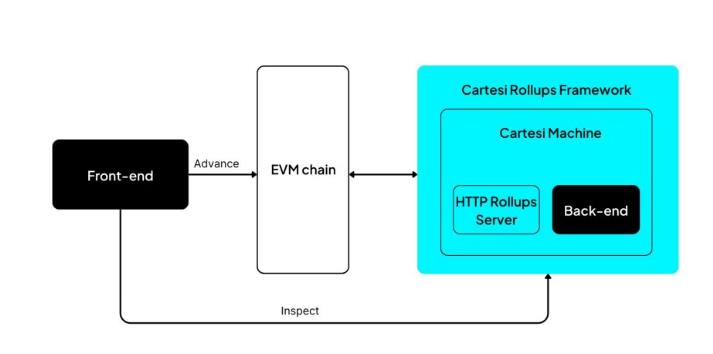
Developers familiar with Linux can enter Cartesi’s application-specific rollup ecosystem and build any dApp. Recently, a developer unfamiliar with Solidity/EVM used Cartesi’s VM to build ChainGPT, an LLM-based dApp.
Aztec Network is pushing the boundaries of privacy by developing a virtual machine capable of enabling private transactions on public blockchains.
Fluent xyz is reimagining how virtual machines handle data processing, creating a platform that combines the power of blockchains with the flexibility of virtual machines.
A notable company disrupting the virtual machine narrative is: Movement Labs.
The Move VM was designed with performance and security in mind. It addresses common vulnerabilities like reentrancy, providing developers with a secure environment. Movement Labs decouples the virtual machine from the blockchain stack, making it portable and modular. Move’s parallel processing and safety features are being brought to EVM for the first time!
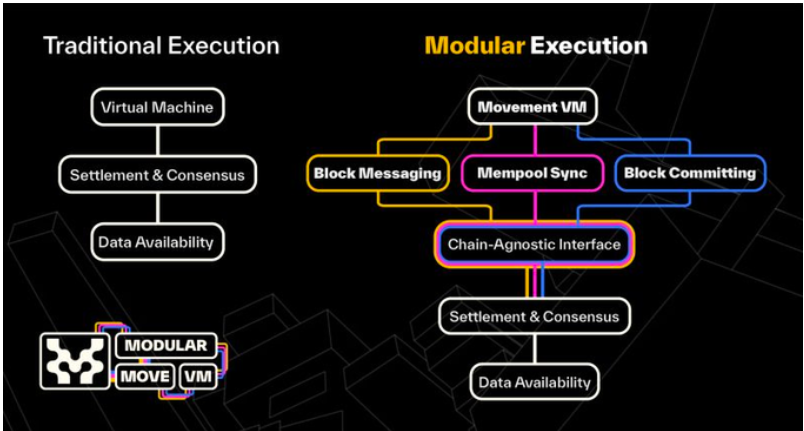
All of this is powered by the Movement SDK. dApps within the SDK can be freely and flexibly deployed to any network integrated with the SDK and any Move environment. The SDK also includes the Fractal Transpiler, allowing Solidity dApps to upgrade their smart contracts to Move without writing Move code.
In short, Movement Labs is lowering development barriers through innovative virtual machines and smart contract languages, enabling dApps to launch natively in Web3 via the Movement SDK.
Another virtual machine based on parallel processing is: Fuel Network.
FuelVM is a parallelized virtual machine designed to scale Ethereum and modular stacks. It is a highly advanced smart contract execution engine built on the principle that every computation matters.
As shown below, FuelVM (like other VMs) operates at the execution layer to deliver higher performance.
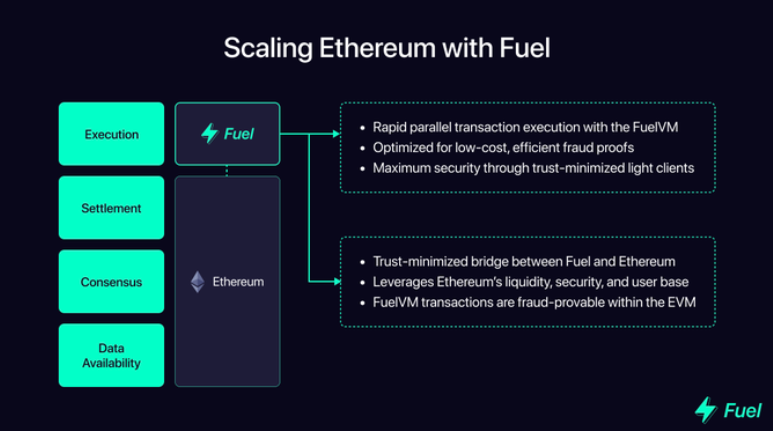
FuelVM brings several unique advantages to the VM landscape—not only parallel transaction execution but also an asset-centric design featuring native assets, predicates, and state minimization.
Light clients, parallel execution, and efficient fraud proofs are key highlights. Developers choose FuelVM for its superior developer experience and ability to overcome many of EVM’s limitations.
As we head into 2024, the virtual machine space is clearly undergoing a major transformation. DeFi pioneer Stani Kuchelov recently emphasized this shift on Twitter... If there's one thing I've learned in crypto, it's to follow the super minds who spot trends early.
This new wave is about building modular designs, encouraging innovation, and offering diverse options. We should acknowledge that modular design outperforms monolithic design. Let’s set aside maximalism and instead pursue better user experiences.
Let us embark on this exciting journey with a clear call to action: Follow the growth and evolution of the modular world!
With no need to rely on EVM anymore, our developer base is set to grow dramatically!
Join TechFlow official community to stay tuned
Telegram:https://t.me/TechFlowDaily
X (Twitter):https://x.com/TechFlowPost
X (Twitter) EN:https://x.com/BlockFlow_News
 @therollupco