USDC crushed by USDT at a steep discount—why is Circle pushing for IPO again?
TechFlow Selected TechFlow Selected
USDC crushed by USDT at a steep discount—why is Circle pushing for IPO again?
From the perspective of capital operations, going public is also a better choice for Circle.
 Navigating Web3 tides with focused insights
Author: Weilin
Since its launch, USDC—the so-called "compliance-focused" representative among dollar-pegged stablecoins—has been locked in a market share battle with the "pioneer" USDT. In the second half of this year, however, USDC's downward trend has become increasingly evident.
As of November, USDC’s circulating market cap stood at $24.42 billion, compared to USDT’s $87.72 billion—making USDT more than three times larger in scale.
Back in 2018, Circle, the issuer of USDC, aimed to leverage its compliance advantage to capture market share. At one point, the two major dollar stablecoins were neck-and-neck in terms of circulation volume on the Ethereum network.
An unexpected blow came in March this year when Silicon Valley Bank (SVB), which held USDC reserves, collapsed. Suddenly, Circle not only had over $3 billion in funds frozen but also faced redemption demands for $2 billion worth of USDC, causing USDC to temporarily lose its 1:1 peg with the U.S. dollar.
To make matters worse, competition is intensifying. Even traditional payment giant PayPal has entered the arena with its own stablecoin, PYUSD. The dollar-pegged stablecoin market is now entering an era of fierce competition for existing market share. Bloomberg recently reported that Circle is considering going public in 2024. Is another crypto firm turning to traditional capital markets to survive?
USDC Circulating Market Cap Falls Short of One-Third of USDT
In the dollar-pegged stablecoin market, the market sizes of USDC and USDT have always fluctuated in relation to each other. But starting in the second half of 2023, USDC’s market cap began a sharp decline while USDT surged.
In January, USDC’s market cap was $44.5 billion; by November, it had dropped to $24.42 billion. Meanwhile, USDT’s market cap rose from $66.24 billion in January to $87.72 billion in November—more than 3.5 times that of USDC.
As of November 27, the total circulating market cap of all dollar-pegged stablecoins reached $127.55 billion. USDT accounted for 68.7%, USDC for 19.1%, and the remaining ~12% was shared among other stablecoins such as DAI (a decentralized stablecoin), TUSD, BUSD, and others.
If there’s one thing that qualifies as absolutely essential in the crypto market, it’s dollar-pegged stablecoins—the “hardest” of the hard. If you think of Bitcoin (BTC) and Ethereum (ETH) as “commodities” in the crypto world, then dollar-pegged stablecoins are the “money” used to buy them.
This concept of an asset theoretically pegged 1:1 to the U.S. dollar has, since its creation by pioneer Tether, served as the intermediary for exchanging various cryptocurrencies.
Initially, Tether’s USDT dominated the market entirely. It wasn’t until 2018 that Circle launched USDC, emphasizing compliance and using auditable mechanisms to ensure each USDC was backed by U.S. dollars or cash equivalents, thus maintaining parity with the dollar.
The emergence of USDC not only broke USDT’s monopoly but also pushed Tether toward greater reserve transparency. In January 2021, USDC briefly surpassed USDT in circulation volume on the Ethereum network, positioning Circle as Tether’s most formidable rival.
However, in 2023, USDT regained dominance, pulling far ahead with a 3.5x market cap advantage. According to CoinMarketCap, the turning point occurred in March, when USDC faced its biggest crisis since inception.
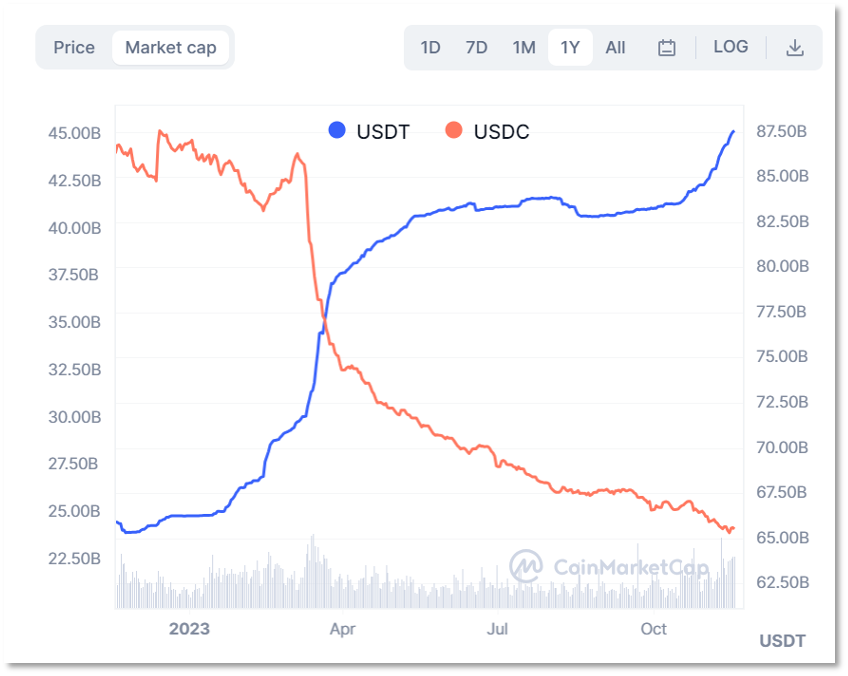
Starting in March, USDC’s market share began a sustained decline
On March 10, Silicon Valley Bank (SVB), ranked 16th largest in the U.S., collapsed after suffering massive losses from long-term Treasury investments during the Federal Reserve’s rate hikes. Downgraded credit ratings and continuous customer withdrawals led to a bank run and eventual failure.
Unfortunately, SVB was one of the banks holding Circle’s cash reserves. On the day of the bank’s collapse, Circle disclosed that approximately 25% of USDC’s cash reserves—around $3.3 billion out of $40 billion—were held at SVB.
Amid panic, demand for redeeming USDC into U.S. dollars spiked, with over $2 billion worth of USDC exiting the stablecoin market. This short-term redemption pressure caused USDC to de-peg, plummeting to around $0.87.
Since then, USDC’s market share has failed to recover. Although it remains the second-largest dollar-pegged stablecoin by market cap, the gap with USDT feels like “back to square one.”
Even more threatening, payment giant PayPal has now entered the space. In August, PayPal launched its own dollar-pegged stablecoin, PYUSD. As of now, PYUSD has a circulating market cap of $158 million. Though small in size, PYUSD is another compliant stablecoin focused on payments, backed by PayPal’s 400 million users and vast cross-border payment infrastructure—giving it immense application potential.
Facing rivals both within and beyond Web3, how will Circle defend its market position?
On November 8, Bloomberg cited sources reporting that Circle is consulting advisors about a potential IPO in 2024, with discussions currently underway.
A familiar question arises again: Are crypto firms that earned profits in the digital asset space now turning to traditional capital markets for survival? This time, the answer may not hinge on choosing between Old Money and New Money.
Why Is Circle Pursuing an IPO Again?
In August, Circle CEO Jeremy Allaire revealed the company’s financials in an interview with Bloomberg. He stated that Circle generated $779 million in revenue during the first half of the year, already surpassing its full-year 2022 revenue of $772 million. Its profit of $219 million in H1 also exceeded its 2022 full-year profit of $150 million.
Allaire’s disclosure appears designed to build momentum for an IPO. But if Circle is already so profitable, why rush into going public?
The CEO has made his reasoning clear: taking Circle public is a core part of its strategy to enhance trust and transparency.
Compared to capital-raising, an IPO serves more as a powerful credibility endorsement for Circle—especially after the March redemption crisis, which severely damaged its competitive standing against Tether.
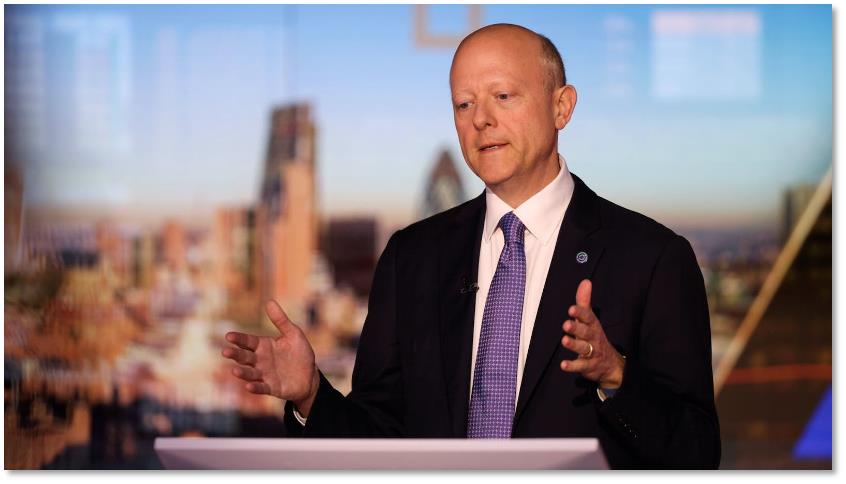
Jeremy Allaire, CEO of Circle
While stablecoins serve as the “hard currency” of the crypto world, their circulation ultimately depends on overall market demand. Theoretically, when prices of assets like BTC and ETH rise, demand for stablecoins decreases as investors prefer riskier holdings. Conversely, during market downturns, investors flock to the stability of pegged coins.
This means that stablecoin demand—and thus market size—only grows sustainably if the broader crypto market expands in value. Unless, of course, stablecoins can find applications beyond the crypto ecosystem.
Therefore, amid limited demand, new entrants must fight tooth and nail just to gain ground in the existing market.
Circle did manage to break through before—but lost ground in its battle with dominant player Tether.
With defeat to Tether now a reality in crypto markets, and facing a new heavyweight like PayPal in traditional finance, Circle must protect its position by tapping further into Web3 finance while emphasizing its compliance edge. An IPO offers a strong pathway to reach previously inaccessible capital and clients—including mainstream financial investors and institutions.
To date, Circle has raised multiple rounds of venture funding from backers including Goldman Sachs, General Catalyst Partners, BlackRock, Fidelity Investments, and Marshall Wace. According to Axios, Circle was valued at $7.7 billion in 2022.
Given that the crypto market remains in a bear phase, VCs have slowed investments in late-stage crypto firms—precisely the category Circle falls into. From a capital strategy perspective, going public now makes even more sense.
In fact, Circle first considered an IPO back in July 2021, planning to go public via a SPAC merger with a blank-check company and list on the NYSE. Later, as USDC’s market share grew rapidly, Circle’s valuation peaked at $9 billion—seemingly the perfect moment to go public, and extensive preparations were made.
At the time, CEO Allaire positioned Circle on Twitter as “the most open and transparent fully-reserved stablecoin issuer in today’s market.”
He stated that not only would all of Circle’s financial accounts meet the highest accountability standards, but all disclosures would eventually comply with regulations set by top U.S. financial regulators like the SEC. “As we grow, Circle carries greater expectations and a stronger need for transparency. We intend to lead throughout this process,” he said.
Ultimately, it was the SEC that blocked the path. In December 2022, Circle disclosed that the S-4 registration form—required for issuing new shares in a merger—had not been declared “effective” by the SEC within the agreed timeframe. Thus, Circle’s IPO plans were halted.
In 2023, Circle began strengthening partnerships with traditional financial firms, including BNY Mellon, Plaid, Signature Bank, Visa, and Mastercard—companies deeply involved in banking operations.
Additionally, as a crypto service provider, Circle welcomed an investment from U.S.-based exchange Coinbase in August—a publicly listed company and one of the earliest compliant platforms to adopt USDC, helping drive USDC’s early expansion in the stablecoin market.
Moreover, USDC plans to expand issuance onto six new blockchain networks, where growing DeFi ecosystems could boost demand. Recent news indicates that in November, Layer 1 upstart Sei Network secured a strategic investment from Circle and plans to integrate USDC into its expanding suite of applications.
After falling into a deep hole due to SVB’s collapse, Circle is now pursuing a dual-track strategy—Web3 finance plus traditional finance—and an IPO would serve as one of its key pillars.
For now, it remains unclear what valuation Circle might seek in its IPO. If Bloomberg’s report is accurate, we may get our answer in 2024.
Join TechFlow official community to stay tuned
Telegram:https://t.me/TechFlowDaily
X (Twitter):https://x.com/TechFlowPost
X (Twitter) EN:https://x.com/BlockFlow_News