








TON Ecosystem Endorsed by Telegram with 800 Million Monthly Active Users: A Testing Ground for Non-Financial DApps
TechFlow Selected TechFlow Selected
TON Ecosystem Endorsed by Telegram with 800 Million Monthly Active Users: A Testing Ground for Non-Financial DApps
A breakout of the payment ecosystem combining Telegram and TON is a high-probability future event.
 Navigating Web3 tides with focused insights
Author: Sullivan
Key Takeaways
-
TON originated in 2018 as the Telegram Open Network. In 2019, the project faced legal action from the U.S. Securities and Exchange Commission (SEC), leading the team to abandon further development. After 2020, the New TON (TON Foundation) developer community took over, rebranding it as The Open Network. By September 2023, TON's circulating market cap ranked among the top ten cryptocurrencies.
-
Technically, TON features a heterogeneous multi-chain architecture with three layers—Masterchain, Workchain, and Shardchain—that allow parallel transaction processing across multiple chains, making it a "blockchain of blockchains" or a 2-layer blockchain system. Through workchains and dynamic sharding, TON aims to support millions of transactions per second for large-scale user adoption.
-
TON’s growth strategy hinges on strong token price control combined with expansion within the Telegram ecosystem. While its technical design shares similarities with prior public chains like Solana and ICP, TON’s core advantage lies in its deep integration with Telegram’s 800 million monthly active users (MAU), serving as a major gateway for Web2 users entering crypto.
-
Unlike other Layer 1 blockchains that focus on building DeFi ecosystems and accumulating TVL, TON prioritizes use cases such as Telegram payments, bots (TG Bot), and mini-games. As a result, traditional valuation metrics like Mcap/TVL may not accurately reflect TON’s true value.
-
The TON Foundation announced the global rollout of TON Space, a self-custodial digital wallet integrated into Telegram, scheduled for November. Although Telegram has had an embedded wallet for some time, the key update shifts from custodial wallets to non-custodial TON Space accounts.
-
Given Telegram’s massive user base, the convergence of Telegram and TON into a powerful payment ecosystem is highly probable. However, due to early Proof-of-Work (PoW) mining, TON token distribution remains highly concentrated, with mismatched circulating supply and daily trading volume indicating centralized control. This benefits short-term price stability and project momentum but poses long-term risks of centralization and potential sell pressure.
1. TON Development History
In 2018, Telegram launched the Telegram Open Network (TON) project and raised $1.7 billion through an ICO, issuing the $GRAM token. However, in October 2019, the U.S. SEC filed charges alleging illegal fundraising. Consequently, in May 2020, Telegram founder Pavel Durov publicly announced the abandonment of the blockchain project and agreed to pay an $18.5 million fine to the SEC.
Also in May 2020, the TON Labs development team open-sourced the TON codebase and ceased development, agreeing to return funds to investors. Subsequently, a decentralized community called Free TON, composed of developers, 13 validators, and users, launched a fork named "Free TON Blockchain," with its token named "Ton Crystals." However, the Ton Crystals team later stopped updates and development.
In May 2021, a grassroots developer group known as New Ton resumed research and development of TON, rebranding it from Telegram Open Network to The Open Network, with the native token renamed TON. From November 2021 onward, TON began listing on exchanges, and Telegram’s founder publicly expressed support for the project.
In August 2021, the TON/WETH trading pair was listed on Uniswap, followed by listings on various DEXs and major CEXs throughout Q4 2021 and 2022 (Binance had not listed TON as of November 2023).
In November 2021, during the peak of the previous bull market, Bitcoin reached its all-time high before pulling back, prompting a final surge in altcoins. TON rose rapidly from $0.8 to $4.5 before correcting. Throughout the subsequent bear market, TON maintained relative price stability between $1 and $2.5, while steadily increasing in market capitalization.
In April 2022, the TON Foundation established a $250 million ecosystem fund, “TONcoin Fund,” backed by Huobi, KuCoin, MEXC, 3Commas Capital, TON Miners, and Kilo Funds. Shortly after, the foundation introduced a wallet bot for Telegram, enabling direct sending, receiving, and exchanging of TON and other cryptocurrencies within Telegram.
In July 2022, the TON Foundation launched a new $90 million ecosystem fund, TON Alpha-Vista, funded by VistaLabs, Alphanonce, Miner's Fund, and Kilo Fund.
By September 2023, a rapid price increase drew significant market attention, pushing TON’s market cap to $9 billion, placing it ninth among all cryptocurrencies.
Despite earlier regulatory challenges, TON gained strong support from the blockchain and cryptocurrency communities and experienced sustained market enthusiasm in 2023. With ambitions to serve Telegram’s 800+ million users, TON aims to deliver fast, secure decentralized payments, digital identity, and other services, scaling to support millions of transactions per second and a robust decentralized ecosystem.
2. TON Features
2.1 Technical Uniqueness of TON
TON addresses blockchain scalability and interoperability through its multi-chain architecture. Key technical aspects include:
a. Multi-chain Architecture: TON operates as a blockchain network composed of three layers: Masterchain, Workchain, and Shardchain (up to 2^32 workchains; some sources cite 2^92, but based on the latest whitepaper, 2^32 appears correct—corrections welcome). The Masterchain serves as the primary chain storing protocol information and parameters. Workchains handle smart contract transactions and can be further divided into Shardchains. Dynamic sharding enables TON to process millions of transactions per second with fast cross-chain communication regardless of network size.
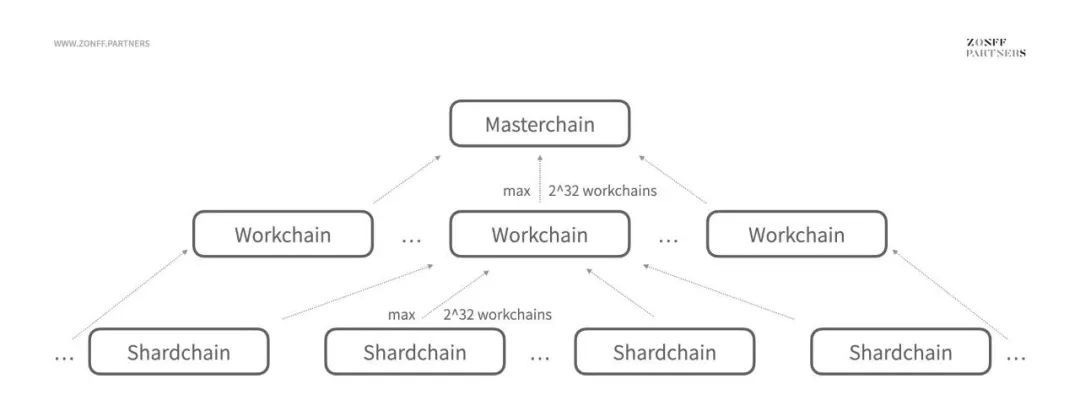
Image source: CGV FoF (reproduced by Zonff Partners)
Masterchain and Workchains are heterogeneous—each workchain may have different account formats, transaction structures, virtual machines (VMs), or native currencies—but they adhere to common interoperability standards. This heterogeneity resembles projects like EOS and Polkadot.
Workchains and their Shardchains are homogenous—each workchain can split into up to 2^60 shardchains (some references say 2^64, but the latest whitepaper supports 2^60). These shards share identical rules and block formats, differing only in the set of accounts they manage based on address prefixes. Their uniform structure is similar to Ethereum’s proposed sharding model.
b. Proof of Stake + Byzantine Fault Tolerance (BFT): TON uses a consensus mechanism akin to Cosmos and Polkadot. Node participation requires no permission—only a stake of tokens and standard IT capabilities. There are four roles in the network: Validators, Nominators, Fishermen, and Collators. Validators signing invalid blocks face automatic penalties including partial or full slashing of staked tokens or temporary suspension. BFT ensures finality without forks, ideal for tightly coupled multi-chain systems.
c. Account Privacy & Anonymity Protection: TON Proxy acts as an anonymity layer, similar to I2P (Invisible Internet Project), creating a decentralized virtual private network (🪜) to protect online privacy. This feature is valuable for high-balance accounts or validators seeking to hide IP addresses and locations to resist DDoS attacks.
d. FunC / Fift / TACT: FunC is a domain-specific, statically typed programming language used to write smart contracts on the TON Virtual Machine (TVM). Programs written in FunC are typically compiled into bytecode via Fift—a low-level language closely aligned with TVM opcodes. Both languages are challenging for most developers, so the official team introduced TACT, a more accessible alternative.
2.2 Differences Between TON, Ethereum, and Solana
The TON team published a comparative analysis paper highlighting differences between TON, Solana, and Ethereum:
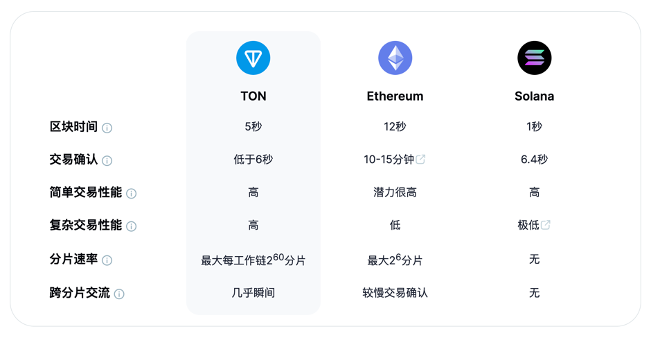
Image source: https://ton.org/zh/analysis
a. Block Generation and Finality Time
Users often care about transaction speed and confirmation times.
TON - A new block is generated approximately every 5 seconds on each shard chain and the masterchain. Shard chain blocks are created nearly simultaneously, while the masterchain block follows about one second later, incorporating hashes of the latest shard blocks.
Ethereum - Ethereum uses slots (12 seconds) and epochs (32 slots = ~6.4 minutes). Block finality requires at least two epochs (~12.8 minutes).
Solana - Claims block generation per second or faster, but finality takes longer—typically after 16 voting rounds (~400ms each), totaling ~6.4 seconds.
b. Performance
Performance reflects the platform’s ability to handle complex smart contracts critical for DeFi, GameFi, and DAO applications.
TON - A Turing-complete, high-performance blockchain capable of handling any complex transaction across the masterchain and all workchains.
Ethereum - Only the beacon chain features a Turing-complete EVM. Limited to ~15 transactions per second. Lack of cross-shard interaction restricts execution in truly decentralized environments.
Solana - Turing-complete but performs well only on simple predefined transactions (e.g., balance changes without state modifications). Optimal performance requires all account data to fit in RAM; otherwise, issues arise.
c. Scalability
Scalability relates directly to user count and interactions (transactions, smart contract executions, infrastructure requests).
TON - Supports workchains and dynamic sharding—up to 2^32 workchains, each divisible into 2^60 shards—with near-instant cross-shard and cross-chain messaging, achieving millions of transactions per second.
Ethereum - Supports up to 64 shard chains plus the beacon chain. Cross-shard message passing will require 10–15 minutes for finality before processing. Shards are expected to act primarily as data storage rather than running EVM smart contracts.
Solana - Does not support sharding or workchains.
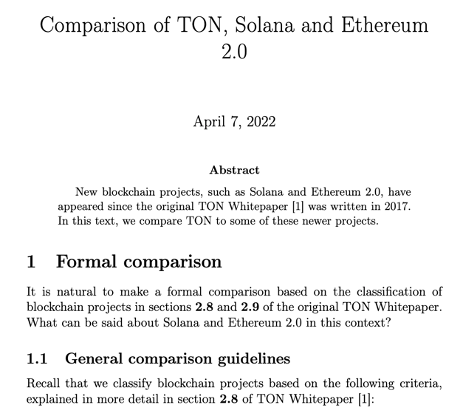
Whitepaper: Comparison of TON, Solana and Ethereum 2.0
3. Toncoin Token
TON has an initial total supply of 5 billion tokens with no hard cap. The team holds 1.45%, while the remaining 98.55% were mined during the early PoW phase. The network has since transitioned from PoW to PoS, with annual inflation around 0.6% to reward validators securing the network. The token issuance model was unique—similar to Bitcoin—in that all TON (98.55% of total supply) was mineable starting June 2020 until the last token was mined on June 28, 2022, marking the successful conclusion of the TON IDO.
TON tokens are used for paying transaction fees, staking to secure the network, governance decisions, and ultimately, payments. They also facilitate decentralized data storage, TON Proxy usage, TON DNS, voting, validator rewards, and more.
Current total supply is approximately 5 billion TON, with 1.08 billion held in inactive miner wallets (frozen), ~470 million staked by PoS validators, and ~3.53 billion in circulation.
Due to TON’s unique history, unlike many new public chains, there are no large holdings by early investors or venture firms susceptible to unlock dumps. Instead, concentration lies with early miners—now, the top 100 whale addresses hold over 50% of the total supply.
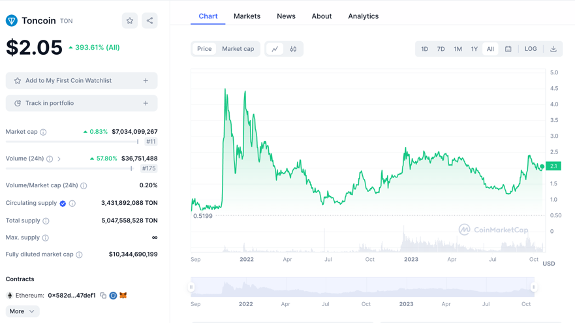
Image source: CoinMarketCap
In February 2023, the TON VOTE passed a proposal to temporarily freeze inactive mining wallets for 48 months—wallets that had never been activated or made outgoing transfers. Currently, 171 inactive wallets hold over 1.081 billion TON, representing about 21% of total supply at the time.
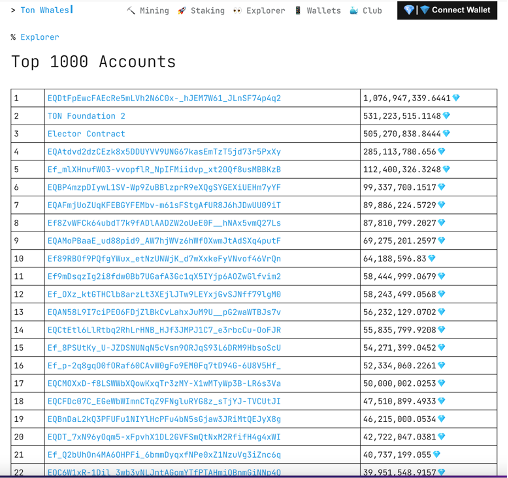
Image source: Tonwhales
While freezing inactive wallets alleviates short-term sell pressure, these balances are unlikely to remain frozen permanently due to decentralization principles. Compared to Bitcoin, where the top 100 addresses hold just 13.63%, this imbalance poses significant long-term threats to TON’s ecosystem.
Besides freezing inactive wallets, the community voted to burn half of transaction fees to reduce circulating supply. However, current daily burns amount to only ~450 TON—negligible against a 5-billion-token supply.
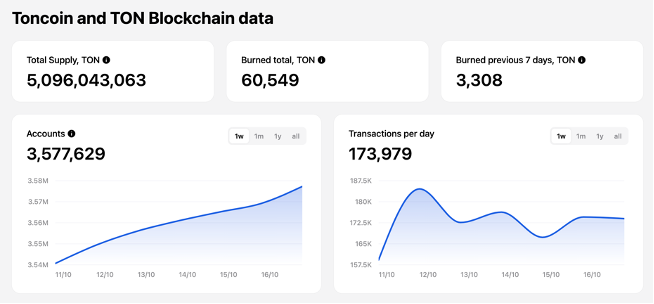
Image source: Tonstat
Examining TON’s price reveals a severe mismatch between market cap and daily trading volume. Despite ranking 11th in market cap and 139th in trading volume, this valuation considers only circulating supply, not FDV. Including all tokens, FDV exceeds $10 billion. Since launching on Uniswap in August 2021, TON’s price has largely remained between $1 and $2.5, briefly spiking to $4.5 during the November 2021 bull run before retreating. Notably, even during bear markets, it never dropped below its $0.5 launch price. This resilience likely stems from limited retail supply available for dumping, avoiding the prolonged downtrends seen in other L1s. Moreover, despite maintaining a multi-billion-dollar market cap since 2022, daily trading volumes have often dipped to mere millions. In contrast, Solana—also maintaining tens of billions in market cap during bear markets—routinely sees hundreds of millions in daily volume, over ten times higher than TON’s.
This concentration and latent sell pressure deter institutional inflows. Combined with low liquidity, accurate valuation becomes difficult. Future adjustments to token distribution and circulation mechanisms will likely be needed to stimulate trading activity and stabilize market expectations.
Short-to-medium-term price stability is likely managed through coordinated efforts combining ecosystem developments and strategic positioning. Such market management isn't inherently negative—stable prices benefit long-term growth of the Telegram-integrated ecosystem, preventing disruption from volatility. Solana’s previous cycle demonstrated how effective market management could drive circulating market cap to $80 billion. Thus, for TON, active price management remains a positive factor in the near term. Long-term, however, the fact that over 50% of supply is held by the top 100 addresses introduces centralization risks and potential downside pressure. Investors holding substantial TON should monitor these top 100 on-chain addresses.
Notably, prominent market maker DWF Labs announced in June its commitment to contribute to TON’s tokenomics, market making, and liquidity provision. Additionally, as of November 2023, TON remains one of the few top-100 cryptocurrencies not yet listed on Binance (excluding exchange tokens and BSV), leaving room for future upside upon listing.
4. TON Ecosystem
According to ton.app, the TON ecosystem currently hosts 551 apps—an impressive number for a pre-explosion blockchain. However, only nine are listed on DefiLlama, with Bemo dominating over half of the TVL ($7.3M). Most are non-financial applications, aligning with TON’s vision as a testing ground for non-financial dApps.
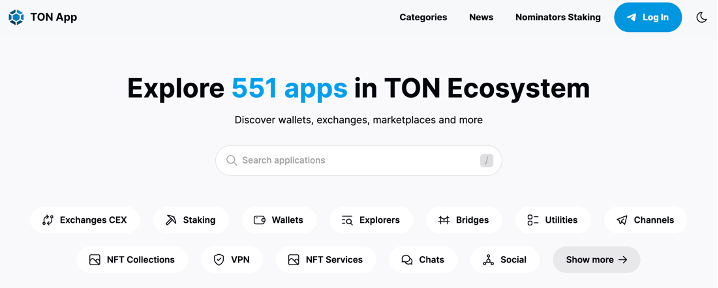
Image source: https://ton.app/
a. The Massive Payment Ecosystem Enabled by Telegram + TON Integration
At the recent Token2049 summit, Telegram and the TON Foundation officially announced their partnership: integrating TON’s self-custodial crypto wallet “TON Space” directly into Telegram’s menu, enabling full crypto self-sovereignty within the app. Telegram boasts 1.3 billion registered users globally, particularly strong in Russia, Iran, India, and parts of Asia and Europe. As stated by Telegram’s founder on July 18, the platform gains over 2.5 million new users daily, with MAUs exceeding 800 million.
As of January 2023, Statista reported this figure to be 1.4x that of X (formerly Twitter, 556 million), 61% of WeChat (1.309 billion), 86% of Facebook (931 million), and surpassing TikTok (715 million). As a must-have app in the crypto space, Telegram already commands a vast crypto-native user base.
With TON Space, users can seamlessly connect their Telegram accounts to TON-based dApps, accessing services directly. TON Space functions as a blockchain wallet supporting TON and other assets within the ecosystem. Some compare the significance of TON Space for Telegram to WeChat Pay for Tencent.
As early as April 2022, the TON Foundation introduced a new wallet bot @wallet to Telegram, allowing users to send/receive Toncoin and purchase Bitcoin directly within Telegram—eliminating the need to copy long wallet addresses or wait for confirmations.
In September 2023, the TON Foundation announced the global launch of TON Space, a self-custodial digital wallet built into Telegram, planned for November. TON Space offers self-custody—third parties cannot access user assets—enhancing security. Once live, TON Space will be embedded within Telegram Wallet, eliminating third-party settlement platforms and reducing external transaction risks while strengthening Telegram’s native crypto finance capabilities.
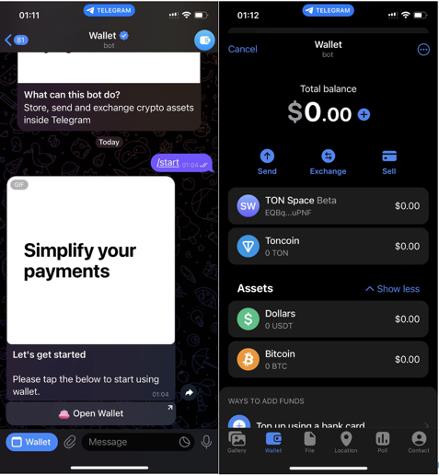
Currently, Telegram allows instant wallet access without downloads, supporting deposits and trades of USDT, TON, BTC, etc.
Telegram’s current payment functionality lets users transfer TON and BTC directly in chat rooms—just like WeChat Pay—greatly enhancing usability and empowering TON. Many blockchains struggle to break out due to lack of real-world use cases, but TON enjoys inherent advantages through Telegram’s billion-user base and immediate application scenarios.
b. Underdeveloped DeFi Ecosystem
Contrasting sharply with Telegram’s massive boost to TON is the current weakness of its DeFi ecosystem, with only $9.2 million in TVL. Just nine apps are tracked by DefiLlama, with Bemo alone accounting for over half ($7.3M). Even struggling chains like EOS maintain over $69 million in TVL.
Unlike other Layer 1s, TON does not rely on stacking DeFi TVL. Instead, its roadmap emphasizes Telegram payments, bots (TG Bot), and mini-games (akin to WeChat Mini Programs). Therefore, traditional Mcap/TVL valuation models may misrepresent TON’s actual potential. Its core strength lies in tight integration with Telegram’s 800M MAU, acting as a bridge for Web2 users into crypto. In the next cycle, Ponzi-like GameFi and SocialFi projects may flock to TON’s vast Web2 traffic pool.
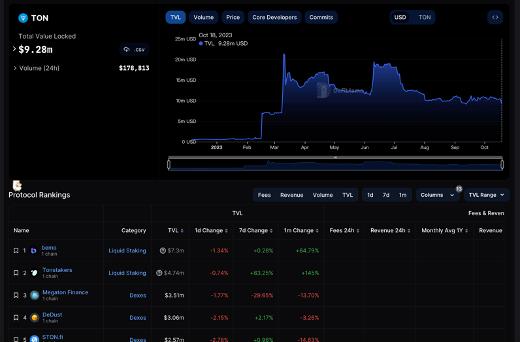
Data source: DefiLlama, as of October 18, 2023
Users familiar with Telegram’s payment ecosystem appreciate its convenience. Payments naturally demand robust financial infrastructure—stablecoins, DEXs, lending protocols, bridges—which remains underdeveloped on TON. This gap presents opportunities for entrepreneurs. TON’s DeFi ecosystem can follow proven models from mature blockchains without needing innovation or complex EVM compatibility.
c. Rapidly Growing TG Bot Sector
Beyond payments, Telegram bots represent another potential breakout area. Since May 2023, the bot sector has shown steady growth in trading volume, revenue, and new users. Top players Maestro, Banana Gun, and Unibot maintained strong volumes even during the bear market. Unibot’s token grew tenfold during the downturn, while Maestro achieved $54K in daily revenue (per DefiLlama; Maestro has not issued a token).
The bot boom owes much to Telegram’s native capabilities. Users leverage bots to track and mirror “smart money” trades—a rare source of positive returns during bear markets. Many seasoned Web3 users now praise the TG Bot space and adopt features like on-chain alert monitoring. Traditional monitoring tools exist within wallets, data dashboards, or custom software, but Telegram is disrupting these habits. Within Telegram + TON, users integrate information retrieval, social interaction, data alerts, payments, and crypto wealth management in one place.
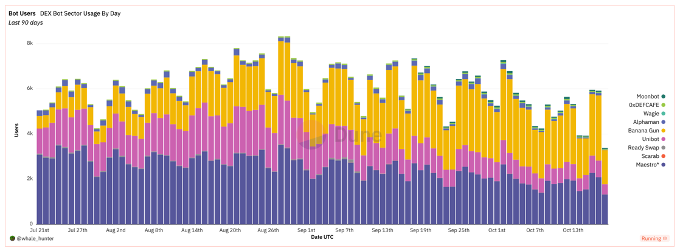
Data source: Dune Analytics
Additionally, future integrations with gaming, social, and NFT sectors could spawn novel product models—new frontiers for TON. Like WeChat’s mini-game ecosystem, Telegram could host similar experiences. Integrating @wallet with mini-games bypasses global restrictions on fiat deposits/withdrawals in games (compliance pending), lowering barriers for GameFi developers. Previous successes like Axie Infinity and StepN could be replicated with simpler mechanics on Telegram. For SocialFi trends led by Friend.tech and NFT platforms like OpenSea and Blur, users traditionally discover products on one platform (e.g., a trending NFT) then switch to another to participate. Telegram, thanks to TON Space integration, allows discovery and participation within the same platform—drastically reducing friction for both users and developers.
d. Developer Tools and Ecosystem Support
The TON Foundation actively supports developers in two main areas: Telegram Mini Apps and smart contracts.
Telegram Mini Apps are web applications running inside Telegram Messenger, built using HTML, CSS, and JavaScript. Developers use widely adopted tools like JavaScript for interface creation. Key points about Telegram Mini Apps:
-
In-app Integration: Designed for seamless integration into Telegram, accessible directly from chats or groups;
-
Cross-platform Compatibility: Accessible instantly across Android, iOS, PC, Mac, and Linux without additional downloads;
-
Bot Interaction: Often leverage Telegram Bots for interactive, automated experiences—responding to inputs, executing tasks, and facilitating engagement;
-
Development Framework: Built with standard web technologies (HTML/CSS/JS). Telegram also provides APIs and dev tools for integration;
-
Monetization Opportunities: Can generate revenue via in-app purchases, subscriptions, or ads;
-
Web3 & TON Integration: TON SDK enables easy integration of Mini Apps with TON ecosystem and tokens.
Smart contracts on TON are developed using the FunC language and executed on the TON Virtual Machine (TVM). FunC is a domain-specific, C-like, statically-typed language. FunC programs compile into Fift assembly code, generating bytecode for TVM. This bytecode (structured as a cell tree, like all data on TON) can create on-chain smart contracts or run locally on a TVM instance. Developers can find detailed documentation on the official TON website.
Moreover, the TON Foundation runs a Grants program focusing on DeFi, GameFi, cross-chain middleware, developer tools, and DAO governance. Projects like Tali AI, TonUp, Oputs DEX Aggregator, and Gatto received grants in Q3 2023. Developers interested in building on TON are encouraged to apply.
5. Future Growth Potential of the TON Ecosystem
In summary, TON serves as an excellent testbed for non-financial applications—a stark contrast to typical foreign public chains. Despite early setbacks—including SEC fines and returning $1.2 billion in investments—TON made several strategic moves correctly: launching its token at the end of the 2021 bull market to capitalize on favorable conditions, maintaining a high market cap with relatively low liquidity through tight price control, gradually expanding exchange listings during the 2022 bear market, and leveraging Telegram’s Web2 traffic to bootstrap a payment-focused ecosystem. Altogether, TON’s prospects in the next bull cycle remain highly promising.
Join TechFlow official community to stay tuned
Telegram:https://t.me/TechFlowDaily
X (Twitter):https://x.com/TechFlowPost
X (Twitter) EN:https://x.com/BlockFlow_News
 @ZonffPartners






