








MT Capital Research Report: A Comprehensive Overview of the Inscriptions Sector
TechFlow Selected TechFlow Selected
MT Capital Research Report: A Comprehensive Overview of the Inscriptions Sector
BRC20 has the strongest community consensus because it was the most original protocol and the first to be listed on exchanges, and its fair launch left an excellent impression in users' minds.
 Navigating Web3 tides with focused insights
Author: Xinwei
TL;DR
With ORDI's listing on Binance, the Bitcoin ecosystem's inscriptions sector is rapidly evolving, giving rise to various innovative technologies and concepts. SegWit and Taproot upgrades have significantly enhanced Bitcoin’s programmability and scalability, fueling the emergence of projects like Ordinals, BRC-20, and Atomicals. These technological advancements not only improve transaction capacity and flexibility within the Bitcoin network but also create new revenue streams for miners.
Introduction
With ORDI's launch on Binance Exchange, we are witnessing the dawn of a new era: a wave of technological innovation and market prosperity led by the Bitcoin ecosystem. From the initial surge in inscriptions at the beginning of the year to the renewed excitement today, the rapid development and substantial value growth of the Bitcoin ecosystem have attracted widespread attention. But what lies behind this surge in BTC's ecosystem popularity and rapid value expansion?
Technology
Before exploring this question, it is essential to understand several key technological advancements in the Bitcoin ecosystem.
Segregated Witness (SegWit), a critical upgrade to Bitcoin’s core protocol introduced in 2017, was designed to address Bitcoin’s scalability challenges and specific vulnerabilities. It primarily resolves transaction malleability issues and increases Bitcoin’s block size limit, enabling more transactions to be included per block. SegWit introduced the concept of block weight, replacing the traditional block size limit, allowing full blocks to hold approximately 2,700 transactions—significantly more than the previous 1,650.
Additionally, SegWit brought about a new encoding method called Bech32 and two innovative script types.
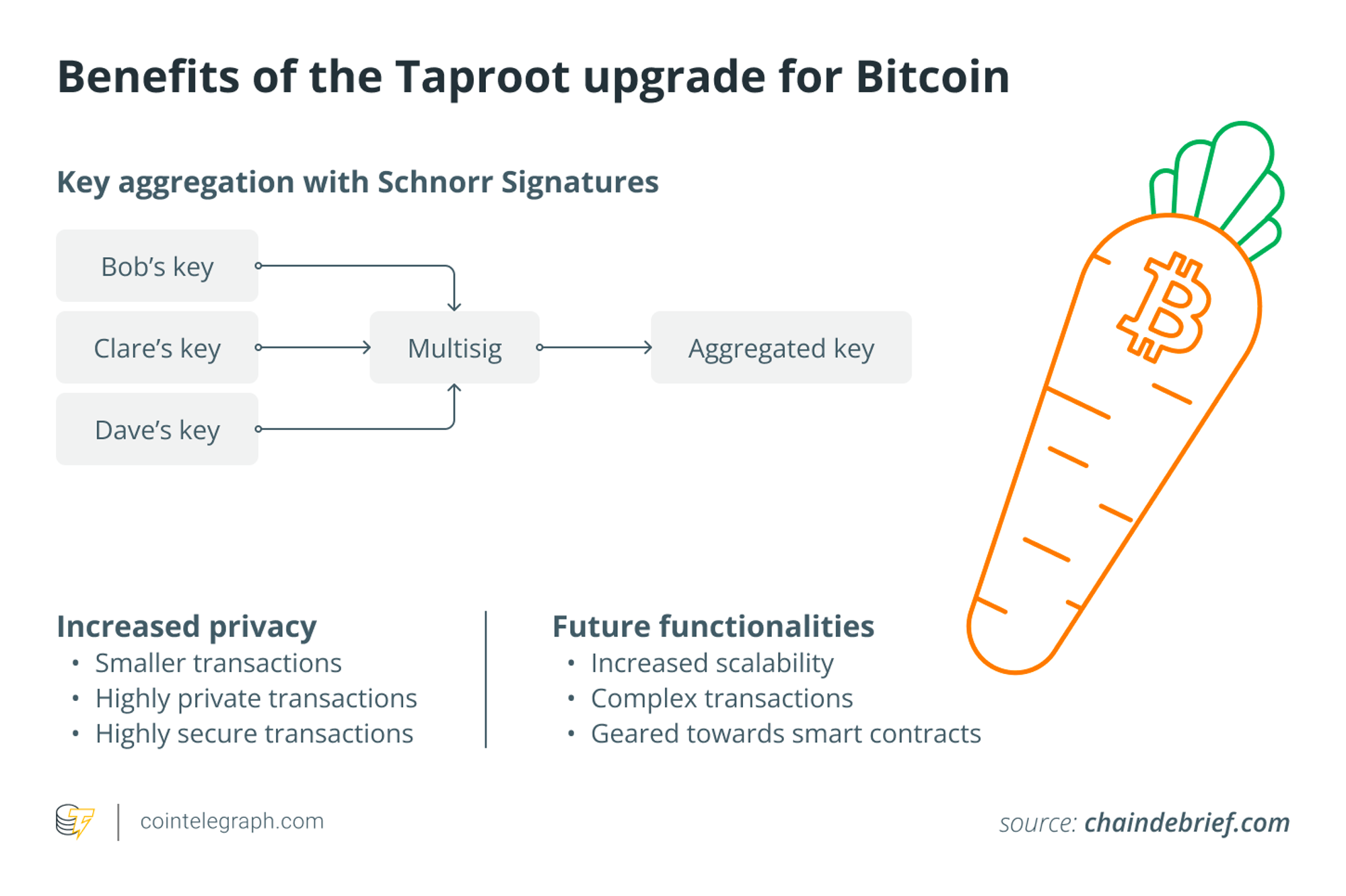
Then came the Taproot upgrade at the end of 2021, which enabled Bitcoin to support more complex scripts and data types, bringing significant progress in BTC’s programmability and scalability. This laid the foundation for the explosive growth of the Bitcoin ecosystem in 2023.
The Taproot upgrade mainly involves changes in transaction verification methods and the introduction of the Schnorr signature algorithm. The adoption of Schnorr signatures offers numerous benefits, including improved privacy—especially in multi-signature wallets. It allows all private keys to be compiled together, making multi-signature transactions indistinguishable from regular ones, thus enhancing privacy. Moreover, Schnorr signatures support batch validation, making transactions across the entire network cheaper and faster.
Taproot also unlocked the potential for creating smart contracts on Bitcoin. While potentially more expensive and functionally limited compared to platforms like Ethereum, the ability to interact with smart contracts on a $700 billion asset like Bitcoin is immense and could propel smart contract technology into the mainstream.
Miner Incentives
Regarding miner incentives, recent data indicates that with the rise of projects like Ordinals and Atomicals, the Bitcoin inscription market is experiencing unprecedented prosperity. According to on-chain analytics from OKLink, Bitcoin miners’ income has seen a notable increase over the past three months. Specifically, in November, the proportion of revenue derived from on-chain fees rose from 2.4% on August 19 to 23.46% on November 16. This surge is largely attributed to the influx of Ordinals-related transactions, indicating that the development of the inscription market has significantly boosted miners’ fee income. By April 2024, when Bitcoin undergoes its next halving event, this ratio could reach 50%.
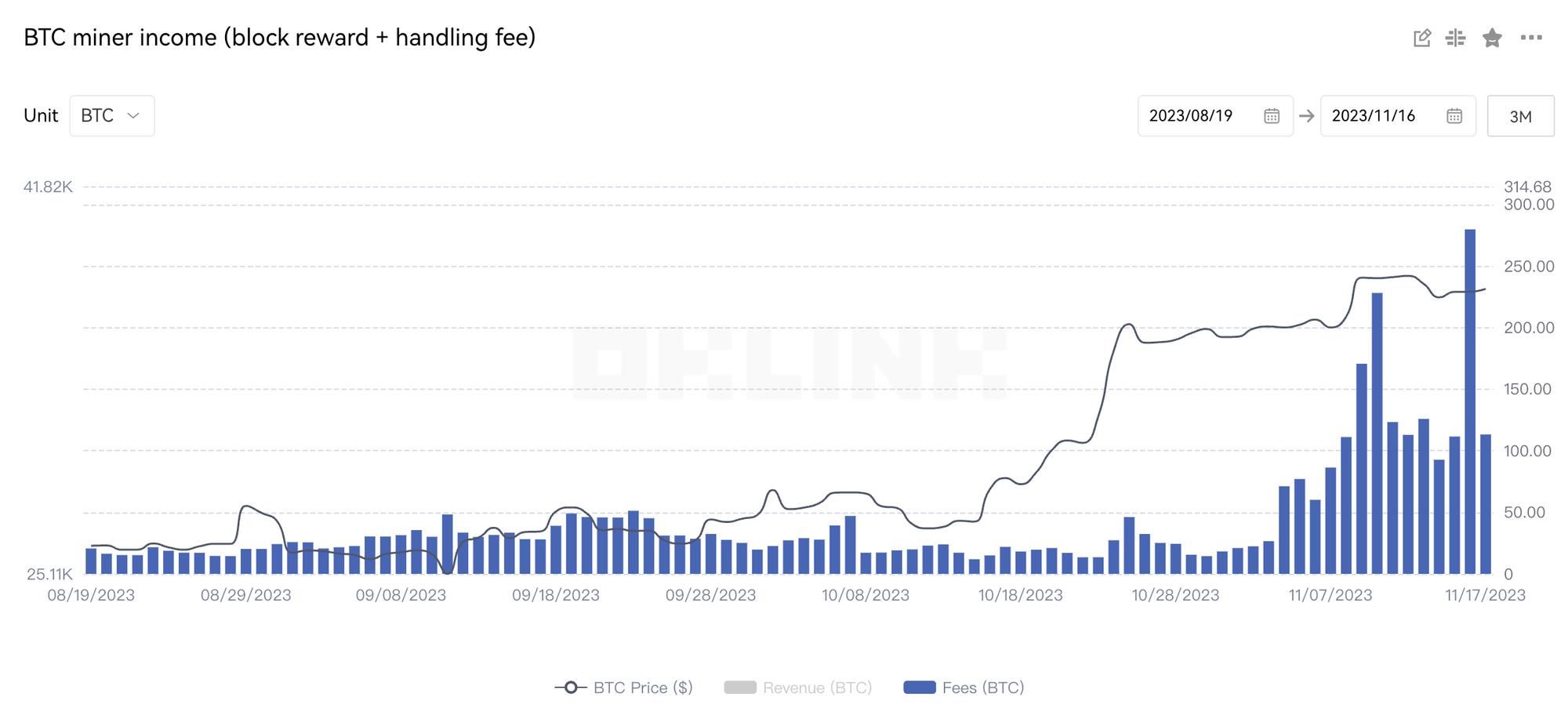
Currently, due to most U.S.-based Bitcoin mining operations running at a loss and semiconductor industry facing process node bottlenecks, the race for mining hardware computational power has slowed. As a result, miners may increasingly turn to Bitcoin inscriptions as a new source of income. For instance, within less than a year since the launch of Ordinals, over 50,000 tokens have been issued, with minting and trading volumes growing rapidly—greatly increasing miner fee revenues.
The expansion of the inscription sector not only drives higher miner earnings but may also become a primary catalyst for further growth in this space. However, miners are more focused on the increase in transaction volume rather than fluctuations in inscription prices.
These combined factors are driving the rapid advancement of the Bitcoin inscription landscape. Yet, it must be recognized that this is not merely a passing market fad—it represents deep structural changes and technological progress within the Bitcoin ecosystem. As Bitcoin continues to demonstrate its robust potential across multiple dimensions, there is strong reason to believe that the inscription track will become a pivotal force shaping the broader cryptocurrency industry.
Ordinals & BRC20
The Ordinals project, initiated by developer Casey Rodarmor in December 2022, leverages Bitcoin’s SegWit and Taproot upgrades to enhance the flexibility and functionality of Bitcoin scripts. Ordinals assigns a unique sequence number to each satoshi (the smallest unit of Bitcoin) and tracks them through transactions, allowing additional data to be attached. This enables users to inscribe data—such as images, text, or audio—onto specific unspent transaction outputs (UTXOs), effectively realizing an asset transfer mechanism. Officially launched earlier this year, Ordinals quickly ignited activity across the BTC ecosystem.
The emergence of the Ordinals protocol complements the adoption of Taproot, facilitating the encoding and writing of NFT data directly into Bitcoin blocks. NFT images are permanently etched into BTC blocks, offering a more decentralized approach than ETH-based NFTs, which do not rely on third-party infrastructure for viewing or transferring NFTs.
Ordinal theory focuses on tracing the smallest unit of Bitcoin—the sat—and establishes rules so that each sat receives a unique identifier. Based on this theory, chain data can be linked to individual sats, forming inscriptions. These inscriptions are stored within Taproot scripts and identified and displayed by off-chain indexing nodes. Due to reliance on external indexing, inscription functionality depends heavily on ongoing development by the Ord community, such as parent-child inscription structures and cursed inscription indexes. Similar to Colored Coins, both store data within transactions for off-chain programs to index. However, while Colored Coins store data in outputs, inscriptions reside in Taproot script inputs.
Ordinals relies entirely on Bitcoin’s base-layer functions, with NFT transfers fully processed by the BTC network. Despite limited long-term potential due to their artistic nature, Ordinals were quickly embraced by the BTC maximalist community.
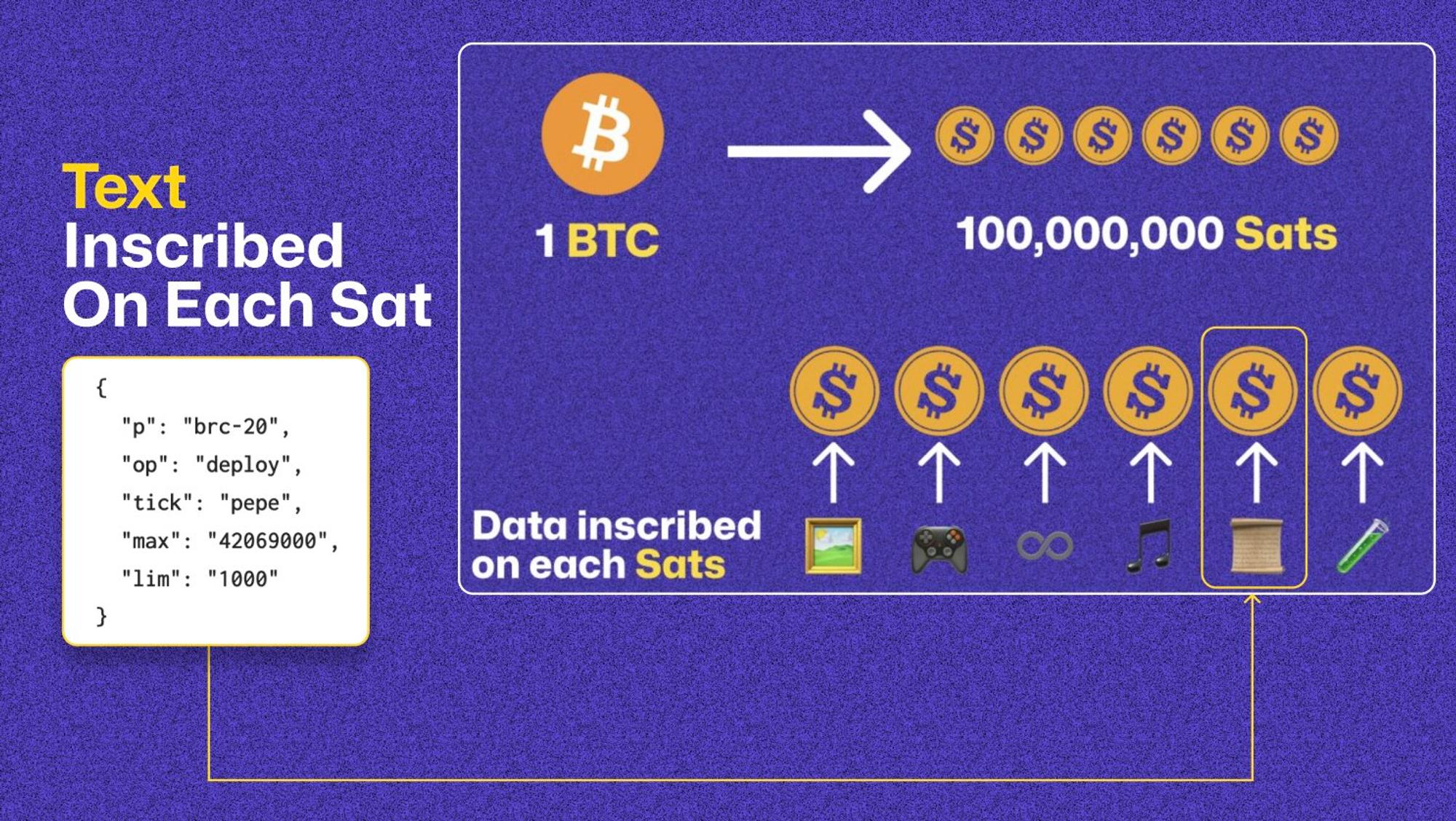
Initially used primarily for creating NFTs, Ordinals saw a major evolution on March 8, 2023, when anonymous developer Domo introduced BRC-20—an alternative to ERC-20, functioning as a meme coin issuance protocol on Bitcoin. BRC-20 defines a specific JSON data format inscribed onto the BTC chain via Ordinals. Deployers can set token supply and name, following a first-come-first-served model. $ORDI was the first BRC-20 token deployed by Domo.
Building upon inscriptions, BRC-20 enables fungible tokens by recording minting and transfer processes within a BRC-20 indexer. However, BRC-20 requires third-party sequencers to maintain ledgers off-chain, adding complexity and becoming a systemic weak point.
BRC-20 transfers are not executed directly on Bitcoin’s mainnet and require two separate BTC transactions (consolidation followed by transfer), generating excessive “junk” transactions. Thus, despite being widely adopted for its liquidity and versatility, BRC-20 remains controversial due to lack of support from Bitcoin’s core community. Recently, developers have begun building decentralized sequencers like #Trac, though progress remains constrained by the overall framework. At the Ordinals Summit, Domo proposed concepts such as Inscription-Based Virtual Machines and Rollups, suggesting BRC-20 may evolve toward Layer 2 solutions.
As BRC-20 gained traction, the use of the Ordinals protocol expanded—but not without friction. Casey’s team even requested Binance to remove references linking ORDI to Ordinals, signaling a desire to distance themselves. This highlights a clear divergence between Ordinals and BRC-20 in terms of community acceptance and developmental direction, despite both contributing to BTC ecosystem growth.
Atomicals & ARC20
Atomicals is an optimized alternative to Ordinals and BRC-20, focusing specifically on fungible tokens and addressing BRC-20’s overreliance on centralized off-chain indexing. It leverages and extends Bitcoin’s UTXO model, treating each satoshi’s UTXO as a distinct Atomical token or digital object, thereby enabling the creation and management of complex digital assets and token systems (ARC20) on Bitcoin.
Key features of Atomicals include:
-
Using the satoshi as the fundamental unit representing tokens.
-
Enabling the creation, transfer, and updating of digital objects on Bitcoin.
-
Providing a decentralized and culturally aligned tokenization method consistent with Bitcoin’s ethos.
-
Utilizing proof-of-work (PoW) to ensure fairness and decentralization during the minting process.
-
Aiming to expand Bitcoin’s capabilities to support broader applications.
Atomicals fundamentally rethinks how tokens can be issued in a decentralized, immutable, and fair manner on Bitcoin. Using the satoshi as a basic "atom," each satoshi’s UTXO represents one Token. To verify Atomicals transactions, one simply queries the corresponding UTXO on the Bitcoin blockchain. ARC20 tokens inherit Bitcoin’s atomicity, with all transfer calculations handled natively by the Bitcoin network.
Compared to BRC-20, ARC20 drastically reduces dependency on third-party sequencers, enhancing system decentralization. The composability of UTXOs strengthens ARC20’s programmability—for example, theoretically, swapping BTC and ARC20 could be achieved simply by switching UTXO inputs and outputs.
Since its launch in September, the first Atomicals token ATOM was quickly mined out. Compared to BRC-20, ATOM mining involves higher technical barriers and greater fairness.
Atomicals mints and propagates based on Bitcoin’s UTXO model, where 1 token equals 1 satoshi, aligning technically with Bitcoin purism. The Atomicals protocol has already defined the ARC-20 token standard and other use cases.
The Atomicals protocol is highly respected within the community, regarded as a comprehensive and well-structured framework. The ARC-20 token standard operates on Bitcoin’s UTXO model for minting and transfers, with every unit of ARC-20 permanently backed by 1 satoshi—i.e., 1 Token = 1 sat. All ARC-20 operations are fully supported by the Bitcoin network without requiring additional steps.
Atomicals introduces PoW into the ARC20 minting process: minters must compute hash values with specific prefix characters, ensuring a more decentralized and equitable distribution. The protocol includes Bitwork Mining parameters, allowing participants to directly mine inscriptions/NFTs. The ARC-20 standard adheres closely to Bitcoin’s foundational principles, and future tooling developments are expected to enhance its liquidity.
In summary, Atomicals emerges as a competitor to Ordinals, focusing on decentralized creation and management of fungible tokens and digital objects by extending Bitcoin’s UTXO model. With its technical advantages and alignment with Bitcoin’s core philosophy, the ARC-20 standard holds strong potential for gaining support from Bitcoin’s core community and unlocking broader application possibilities within the ecosystem.
Rune & PIPE
The RUNE protocol originated from Casey Rodarmor’s recognition of limitations in existing fungible token solutions on Bitcoin, such as BRC-20 and Taproot Assets. Casey envisioned a UTXO-based fungible token protocol to overcome these shortcomings.
Key features and design principles of the RUNE protocol include:
-
UTXO-based: Rune balances are stored in UTXOs, with each UTXO capable of holding any quantity of Runes.
-
Transaction and Protocol Data: Specific script outputs serve as part of the protocol data, defining Rune transfer and allocation rules.
-
Flexibility: Rune transfers are interpreted from data pushes within transactions, enabling flexible distribution mechanisms.
-
Issuance Mechanism: A second data push acts as a minting transaction, enabling the creation of new Runes.
-
Simplicity and Decentralization: The Runes protocol prioritizes simplicity, avoids reliance on off-chain data or native tokens, and fits naturally within Bitcoin’s UTXO model.
-
Symbol Assignment: Runes can be associated with symbols, but the protocol does not handle symbol squatting to preserve simplicity.
Although RUNE remains conceptual, BennyTheDev implemented the PIPE Protocol based on Casey’s architectural vision. PIPE is a key component of the TRAC ecosystem, which also includes the BRC-20 token $TRAC, Bitmap, and BennyTheDev’s OrdFi protocol TAP Protocol—a solution enabling DeFi functionalities like token swaps for BRC-20.
BennyTheDev, an active Bitcoin community developer, launched the BRC-20 utility tool LooksOrdinal in March, deployed the TRAC token in May, released the OrdFi-focused Tap Protocol in August, and introduced the Pipe Protocol in October—a refined implementation inspired by Runes.
The Pipe protocol follows the conceptual framework of Casey’s RUNE protocol, using a UTXO-based approach to implement fungible tokens. Its release captured the speculative momentum from BRC-20 and quickly completed its initial hype cycle. While RUNE may face adoption challenges within the Bitcoin community, its legitimacy surpasses that of BRC-20.
Overall, the emergence of RUNE and PIPE reflects the Bitcoin community’s continuous exploration and innovation in implementing fungible tokens. Though still in early stages, these protocols show promising potential and could bring increased transaction fees, developers, and users into the Bitcoin ecosystem.
Bitmap & BRC420
Bitmap.land is the first metaverse project in the Bitcoin ecosystem, built upon Ordinals theory and Bitmap theory.
-
Ordinals theory assigns serial numbers to each satoshi (the smallest unit of Bitcoin), establishing their scarcity. Each “satoshi” can be imagined as a numbered box whose rarity is determined by its creation time and can carry embedded data.
-
Bitmap theory, proposed by Twitter user @blockamoto on June 13, 2023, maps each input of a Bitcoin block transaction to a parcel of land, forming districts. Differences in input sizes result in parcels of varying dimensions.
Inspired by Decentraland and The Sandbox, Bitmap.land buyers adopt a similar logic of purchasing virtual plots and drawing patterns. Users inscribe data onto sats to claim ownership of specific Bitcoin blocks, akin to free minting.
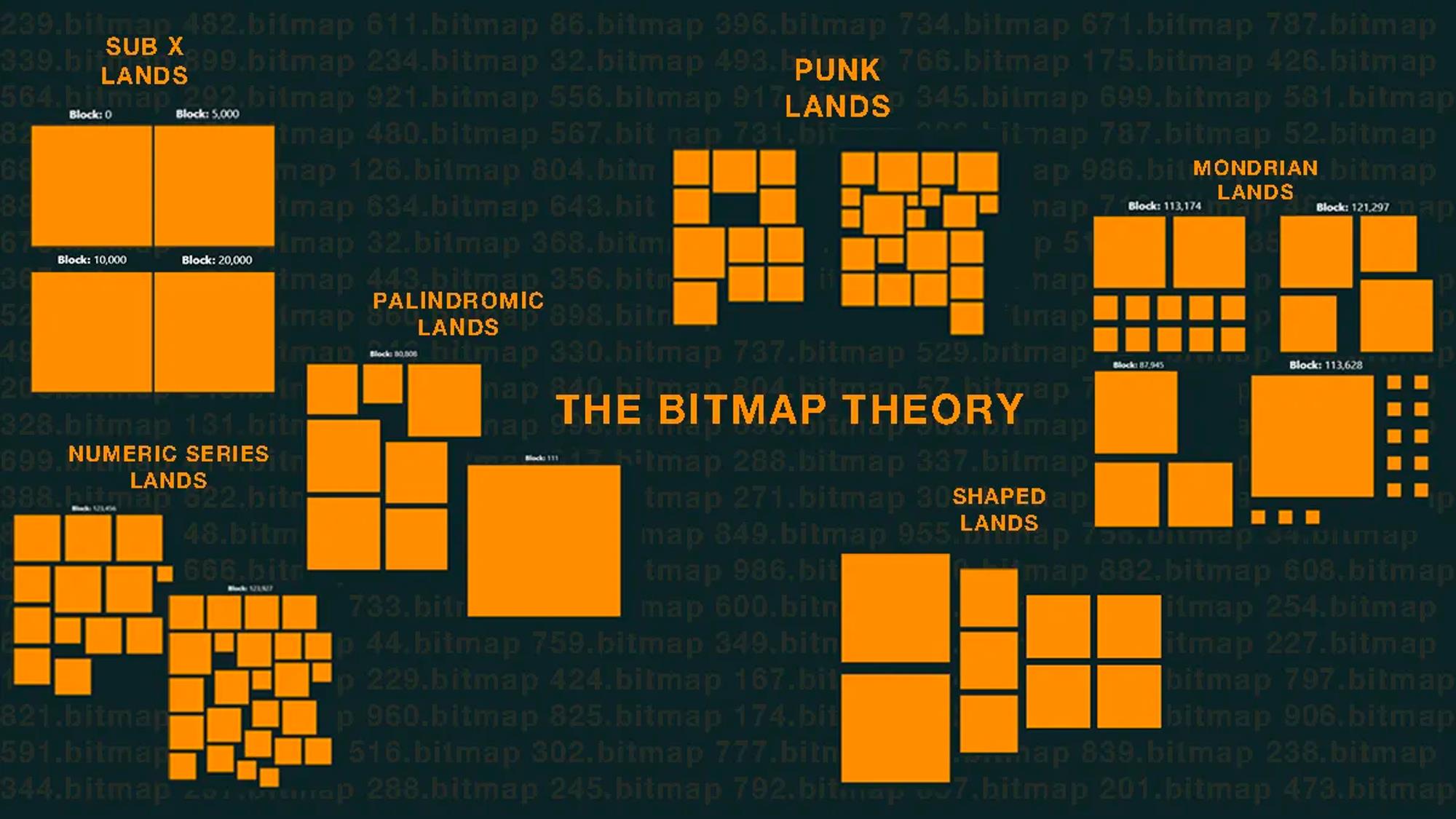
On the Bitcoin blockchain, each block is divided into four sections representing different halving cycles. Users can view block numbers and colors on the Bitmap.land website, with different colors indicating various sales statuses.
The sale of Bitmap.land is closely tied to Ordinals theory, much like how Decentraland and The Sandbox rely on the ERC-721 standard. While similar in principle to early colored coin concepts, the context of Bitcoin’s current narrative, consensus, ecosystem, and infrastructure makes it distinct. Although Ordinals theory isn’t as novel as ERC-721, BRC-20’s methodology is considered even more primitive.
Bitmap theory adds a new interpretive layer to Bitcoin blocks, offering novelty if limited practicality. It redefines the relationship between Bitcoin and the metaverse, allowing users to own and record individual blocks, adding a new dimension to the blockchain and integrating it into the metaverse.
Bitmap theory has captured the attention of the Ordinals community, reigniting inscription enthusiasm. Any Bitcoin block can become part of the metaverse via Bitmap, opening new creative and ownership opportunities.
Bitmap.land blurs the line between Bitcoin and the metaverse, paving the way for ownership, creativity, and community growth. As the inscription trend continues, this presents vast potential for those seeking a foothold in the digital realm.
The BRC-420 protocol, since November 13, 2023, has become one of the most active token protocols in the Bitcoin ecosystem, with total inscriptions exceeding 40 million. Unlike traditional token protocols, BRC-420 focuses on modular on-chain inscriptions, creating entirely new asset types on Bitcoin. Its first token, commonly known as the “blue box,” surged from an initial price of $0.15 to $1,000, delivering significant on-chain royalty income to developers in a short period.
BRC-420 is an asset protocol built on Bitmap, combining multiple inscriptions into complex assets ranging from small characters and pets to full game scripts and virtual machines. Thanks to its on-chain open-source nature, any client can run or verify these assets, embodying the true “Client Agnostic” spirit of fully on-chain gaming. While RCSV’s Bitmap browser dominates the market, other teams have opportunities to develop clients supporting BRC-420 assets.
From a market perspective, Bitmap holder addresses have surpassed 25,000, exceeding Sandbox to become the metaverse asset with the highest number of holders across all chains. This achievement stems from its fair launch mechanism and the collective efforts of over 200 development teams building around Bitmap. BRC-420’s market cap has grown alongside the rollout of the Bitmap browser and protocol, now reaching approximately $30 million.
RCSV, the team behind BRC-420, is actively advancing a fully on-chain gaming initiative for the Bitcoin ecosystem. This initiative emphasizes on-chain assets, gameplay mechanics, logic, and data, aiming to build a truly decentralized Bitcoin-based gaming environment. For example, developers can leverage BRC-420’s “combat module” to rapidly deploy new games while paying royalties through the protocol.
RCSV has also proposed a scaling solution for the Bitcoin network to address capacity constraints when processing high transaction volumes. The plan aims to migrate assets from Layer 1 to Layer 2 and implement a complete virtual machine environment at the next level down from Module. This setup seeks to maximize security while providing a low-cost, high-efficiency interaction environment for Bitcoin L1 assets.
In summary, the BRC-420 protocol and related Bitmap projects are sparking innovation and vitality within the Bitcoin ecosystem. By creating complex, modular digital assets, BRC-420 is opening new economic opportunities and interactive experiences for creators, developers, and users. With continued efforts from the RCSV team, the vision of fully on-chain gaming and the metaverse on Bitcoin is gradually becoming reality, revealing the vast potential of Bitcoin’s technology and applications.
BRC100
BRC-100 is an extended protocol based on Ordinals theory, specifically designed to enable various decentralized applications (dApps) on Bitcoin Layer 1. This protocol inherits core functionalities from BRC-20 such as creation, minting, and trading, while introducing the concept of decentralized computing. This means that using the BRC-100 protocol stack, developers can build dApps including DeFi, SocialFi, and GameFi, bringing truly decentralized, trustless, censorship-resistant, and permissionless applications to Bitcoin’s first layer.
A key feature of BRC-100 is interoperability—it ensures compatibility among all protocols and apps within its stack and supports interactions with BTC, BRC-20, and other Layer 1 chains such as Ethereum and Stacks. Additionally, the protocol integrates both UTXO and state machine models, enhancing security and computational capability.
The protocol also incorporates several innovative features, including inheritance, nested applications, address and application state management, permission settings, and decentralized governance. For instance, the inheritance concept allows protocols to directly or indirectly inherit BRC-100 characteristics. On the application side, apps built on BRC-100 and its extensions can be nested to form sub-applications. Furthermore, the protocol defines two roles—owner and administrator—laying the groundwork for decentralized app governance.
The utility of BRC-100 is evident in diverse use cases, from governance protocol BRC-101 to automated liquidity protocol BRC-102, along with staking, airdrops, lending, and stablecoin pools. These extension protocols allow BRC-100 to go beyond simple token trading and support more complex financial operations and computations.
Overall, BRC-100 opens a new frontier for decentralized applications on Bitcoin through its innovative features and powerful computational framework. It not only builds upon BRC-20’s strengths but also provides an open protocol architecture, unlocking new possibilities for the future development of the Bitcoin ecosystem.
Taproot Assets & Nostr Assets
Taproot Assets is a protocol launched by renowned firm Lightning Labs, aimed at creating and trading various digital assets on the Bitcoin network, integrated with the Lightning Network. Already widely accepted within the Bitcoin community as a mature derivative protocol, the Taproot Assets update expands Lightning’s functionality from simple peer-to-peer payment channels to a point-to-multipoint model capable of distributing and circulating assets. Taproot Assets registers token information within UTXO output scripts on Bitcoin’s mainnet, while transfer functions are executed within Lightning channels. A key difference from BRC-20 and ARC20 is that Taproot Assets uses a pre-minted issuance model controlled by a single issuer, rather than open, permissionless minting.
Backed by well-funded Lightning Labs and Twitter founder Jack Dorsey, Taproot Assets enjoys stronger legitimacy and community support compared to grassroots initiatives.
NostrAssets is an open-source protocol that brings Taproot Assets and Satoshis (Bitcoin units) into the Nostr ecosystem. Users can send and receive assets using Nostr’s public and private keys at the protocol layer. Settlement and security depend on the Lightning Network, while the NostrAssets protocol itself does not issue assets—it simply bridges existing assets into Nostr.
Features of NostrAssets include seamless integration of Taproot Assets and Bitcoin into the Nostr ecosystem, provision of developer tools for innovative products, enrichment of the Bitcoin and Lightning Network ecosystem, and enabling a smooth transition from chat to transactions. In the future, NostrAssets plans to import Taproot Assets from other Daemon Universes, enabling cross-boundary sending and receiving of Taproot Assets into and out of Nostr.
The vision of NostrAssets is to onboard more users into the Bitcoin ecosystem and deliver Taproot Assets to a global audience. By offering modular development tools, NostrAssets aims to facilitate the construction of decentralized applications that are user-friendly and commercially viable.

On October 30, Nostr Assets conducted an airdrop for early participants, distributing its first platform token TRICK&TREAT to celebrate Halloween. These tokens have since appreciated to a value of approximately $2,000.
Each token has a total supply of 210 million, totaling 420 million. The airdrop distributed around 80 million tokens, roughly 20% of the total supply.
Nostr Assets also announced plans to launch a Fair Mint feature soon and is actively seeking project teams interested in issuing assets via the protocol. Once live, this feature is expected to attract a wave of new assets, likely drawing significant community attention and participation. These initiatives indicate that Nostr Assets is actively expanding its ecosystem and preparing for future growth.
Ethereum Inscriptions
Ethscriptions is an alternative to smart contracts and Layer 2 solutions, allowing users to share information and perform computation on Ethereum L1 at low cost. It bypasses smart contract storage and execution by applying rules to Ethereum call data, achieving decentralized computing. In August 2023, Ethscriptions introduced a virtual machine (ESC VM), enhancing its functionality into a general-purpose computing engine.
The founders of Ethscriptions include Middlemarch (analogous to BRC-20’s domo) and Michael Hirsch. Their first protocol token, $eths—the current market leader—was initially minted for about $0.50 and later surged to around $3,000, delivering substantial returns to investors. While this performance trails behind top performers like $ORDI and $SATS in the BRC-20 space, it still demonstrates remarkable growth, securing Ethscriptions' place among high-return sectors.
Beyond $eths, other notable projects in the Ethscriptions space include Facetswap. Facet is a decentralized exchange developed by Middlemarch and Michael Hirsch, originally named dumbswap before rebranding. Although $Facet currently lags behind $eths in price and market cap, its potential value may become more apparent once the mainnet launches.
iERC20 is a new Ethereum-based token protocol offering a low-cost token ecosystem where anyone can deploy, mint, and trade tokens. $Ethi, the first token on the iERC20 ecosystem, enjoys official backing. This protocol not only gives Ethereum users more options but also promotes the development of Ethereum’s inscription ecosystem.
In recent crypto developments, iERC20 partnered with Sparkle, a GameFi project incubated by Binance, planning to introduce Inscription NFTs and other inscription assets onto iERC20 to enhance gameplay using inscription advantages. This collaboration sparked wide interest in the Ethereum community, shifting focus from ETHS to the iERC20 protocol.
A unique aspect of iERC20 is its integration of Swap functionality and EVM cross-chain capabilities, bridging Ethereum inscriptions with traditional Layer 2 solutions. This enables the inclusion of more mainstream coins and stablecoins, expanding the TVL of the inscription ecosystem and opening new growth avenues.
Additionally, iERC20 plans to introduce a PoW-based fair mining model and collaborate on launching new inscriptions, similar to Atomicals’ mining approach. This strategy could inject fresh momentum into Ethereum’s ecosystem.
Though $Ethi launched nearly simultaneously with $ETHS, its lower profile in the early stages meant it didn’t gain immediate fame like $ETHS. However, as $ETHS rose in price and visibility, $Ethi began attracting growing attention. $Ethi’s divisibility makes it more accessible to retail investors. While its market cap remains below $ETHS, its growth potential should not be underestimated.
Within the iERC20 ecosystem, $Ethi is viewed as a key utility tool, empowering holders in unique ways. For example, $Ethi holders may receive inscription airdrops from partner projects like the recent Sparkle collaboration. FOMO sentiment is spreading in the community, with many investors bullish on $Ethi’s future, viewing it as the officially recognized flagship token of iERC20, poised to appreciate with the rollout of PoW mechanisms and continued ecosystem expansion.
Overall, the ERC20赛道 is showing immense promise and may generate further breakthroughs following in BRC-20’s footsteps. With more high-quality projects joining and the ecosystem maturing, this space is likely to attract increasing user engagement and innovation.
Inscriptions on Other Blockchains
As the wealth effect generated by Bitcoin inscriptions spreads to other blockchains, various "RC-20" tokens have sparked heated discussions across communities, triggering FOMO dynamics—including Doge inscriptions, BSC inscriptions, Litecoin inscriptions, Base inscriptions, Polygon inscriptions, Solana inscriptions, and others.
 @mtcap_crypto






