








From Tier-3 Exchanges to Binance Futures: The Mining-Token Gold Rush Production Line Behind KAS
TechFlow Selected TechFlow Selected
From Tier-3 Exchanges to Binance Futures: The Mining-Token Gold Rush Production Line Behind KAS
Binance's listing of KAS futures marks the first time this "concealed production line" has established a "value discovery pathway" from third-tier PoW exchanges to mainstream trading platforms.
 Navigating Web3 tides with focused insights
Authors: Jack, Kaori, BlockBeats
Recently, due to the sustained rise of Kaspa's token KAS, the PoW concept has become another hot topic following Bitcoin ecosystem narratives, with the term "miner coin sector" repeatedly appearing in community discussions. However, beyond Bitcoin-related concepts and market momentum, the sudden surge in PoW interest seems no coincidence. Behind the "KAS myth," there appears to be an obscure, little-known "myth-making miner coin production line" hidden from mainstream markets.
The KAS Flywheel
On November 7, 2021, Kaspa’s mainnet officially launched based on the GhostDAG protocol, using a BlockDAG architecture to address scalability issues associated with traditional blockchain operations. The KAS mining algorithm is kHeavyHash, supporting GPU solo mining or dual mining with ETHW and ETC, as well as partial FPGA and ASIC mining. According to F2Pool data, KAS currently has a network hashrate of 60.97 PH/s, generating $1.5267 million in daily revenue.
Kaspa’s economic model resembles Bitcoin’s issuance mechanism—there is no pre-mine or private sale; all tokens can only be obtained through mining. The total supply of KAS is capped at 28.7 billion, expected to be fully mined over 186 months, with circulation largely completed by April 2037.
On November 16 this year, Binance unexpectedly announced it would list 1-50x USDT-margined perpetual contracts for KAS at 10:00 AM on November 17. According to CoinGecko, at the time of writing, PoW public chain Kaspa’s token KAS surged past $0.13, reaching $0.134—a 18.3% increase within 24 hours and a 37.40% gain over the past seven days.
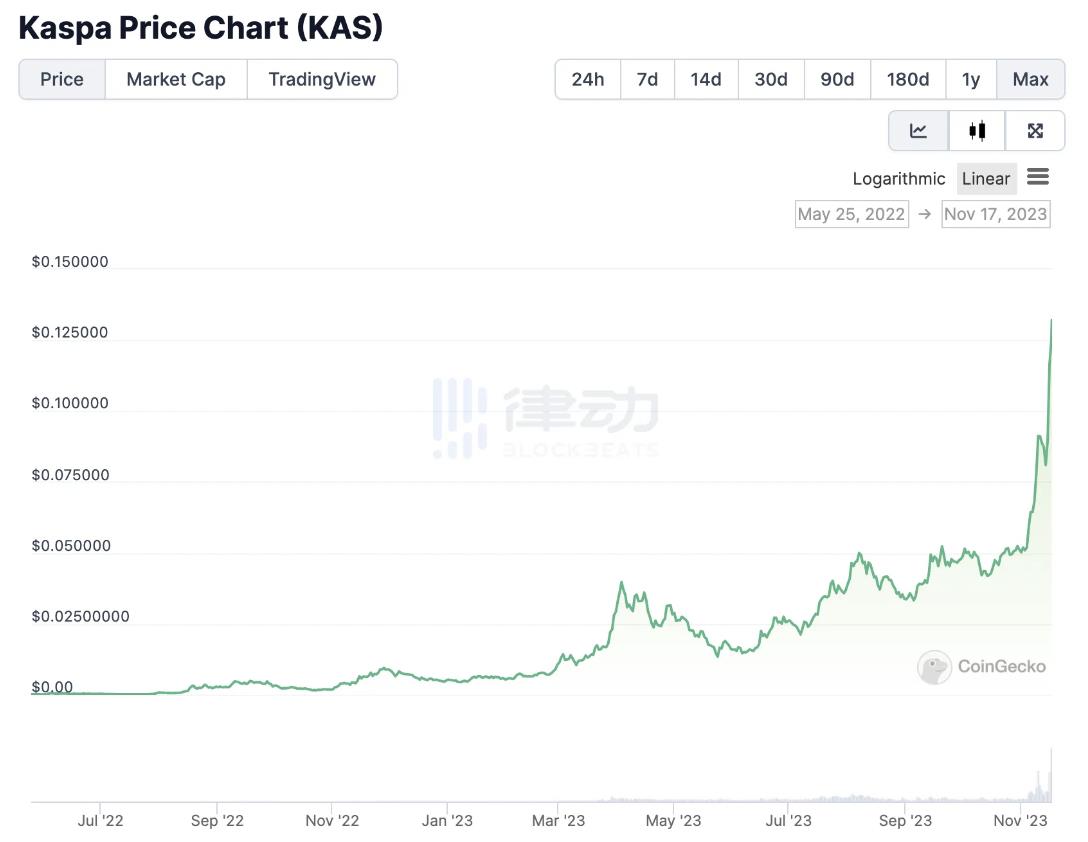
KAS price trend; Source:CoinGecko
The initial KAS price rally began around late May 2022 when it was listed on TxBit, where its lowest price reached $0.0002. In September that year, KAS was listed on MEXC, quickly surging to $0.008.
By April 2023, KAS hit a record high of $0.039, achieving an increase of over 1850% in less than a year. That month, trading volume remained strong, fluctuating between $15 million and $40 million daily, peaking above $500 million. At that time, the largest trading platforms for KAS were MEXC Global, TxBit, Gate.io, and Coinexcom.
In May, Glacial and Bitmain successively released dedicated ASIC miners, prompting mining hardware manufacturers to rush into the Kaspa space.
On May 17, Bitmain launched its first KS3 model Kaspa miner. According to F2Pool data, the KS3 delivers up to 8.3 TH/s computing power with a power consumption of 3188W and an efficiency of 384W/T. Based on KAS prices at the time, a single miner could theoretically generate $2,600 per day. However, industry insiders told BlockBeats that due to manufacturing costs and technical wear, actual returns may fall short of these figures.
Currently, mainstream KAS mining rigs include Feng Series, Antminer, and IceRiver models, with average power consumption exceeding 3000W and theoretical daily net profits ranging from $200 to $300.
However, by August, KAS had dropped about 50% from its peak, and new miners entering the market did not see strong sales performance. Insiders told BlockBeats this might indicate limited availability of high-performance mining equipment in circulation, and miners have yet to offload their tokens.
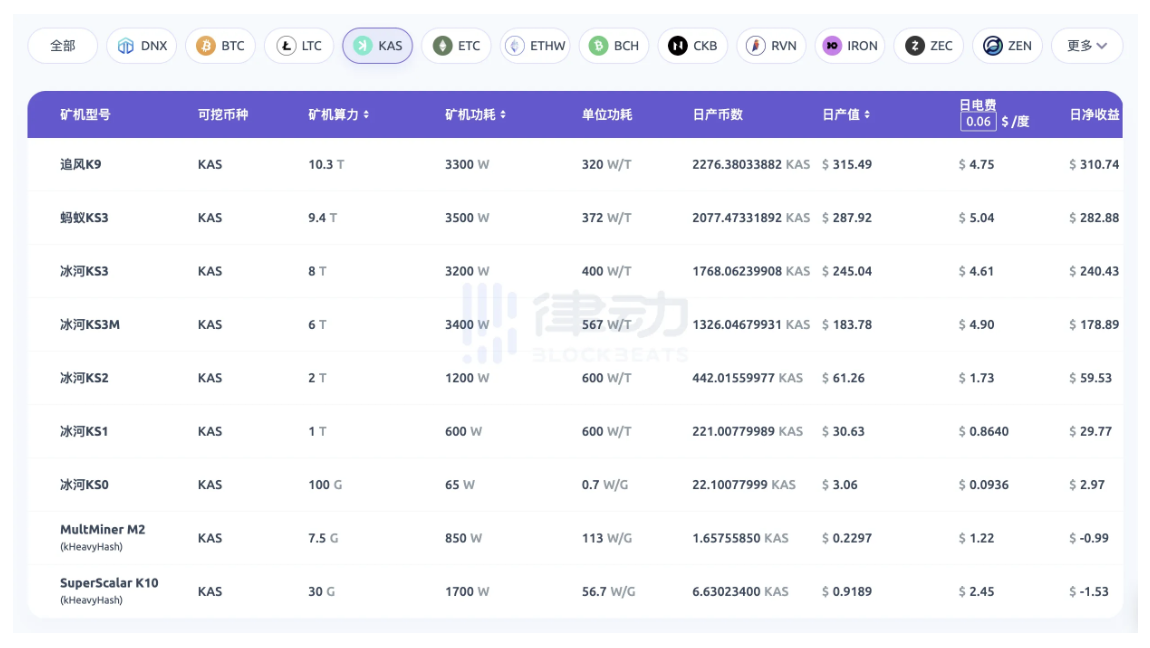 Kaspa miner models; Image source:F2Pool
BlockBeats found that the Kaspa community consistently demonstrates strong consensus and cohesion.
On August 14, TxBit announced it would shut down trading services by September 14, leading Kaspa community members to joke that “KAS enabled TxBit’s founder to retire early.” The community also plans joint airdrop campaigns with CoinPal and IceRiver. On November 9, Kaspa community members noticed incorrect market cap rankings for KAS on CoinMarketCap and strongly urged corrections. The next day, CMC updated the information, elevating KAS from rank 207 to 34.
As KAS prices continued rising, miner revenues also climbed. According to TrustPool data, in November, daily miner rewards for Kaspa exceeded $1.6 million, briefly making it the second-largest miner coin by revenue.

Global hashrate ranking; Source: X Community
With favorable conditions in the broader crypto market, FOMO sentiment around “KAS price strength” began spreading across secondary markets. Some community users observed that major exchanges appeared increasingly interested in KAS.
On November 3, OKX Web3 Wallet integrated Kaspa Network. On November 16, Binance announced the listing of KAS perpetual contracts, triggering a nearly 20% short-term price spike and setting off an ecosystem flywheel effect.
Miner Coins Enter Gold Rush Era, SafeTrade Emerges
Riding the KAS price surge, the "miner coin sector" reached emotional highs. Projects such as Spacemesh (SMH), Zephyr Protocol (ZEPH), and Qubic (QUBIC) gained significant attention. BlockBeats noticed that the name SafeTrade frequently surfaced in many discussion groups.
In August, Spacemesh (SMH) was listed on SafeTrade, jumping from $0.42 to a high of $2.285—an increase of 442%. That same month, SafeTrade announced support for Qubic (QUBIC), whose price rose to $0.0000039, up 1566% since listing.
SafeTrade is a centralized cryptocurrency exchange founded in 2018. Despite operating for five years, according to BitDegree Exchange Tracker, it ranks only 225th among exchanges. As of writing, Coingecko reports SafeTrade’s 24-hour trading volume remains below $3 million. Yet, despite severe liquidity constraints, this so-called "third-tier exchange" has become the preferred exit venue for miners.
According to SafeTrade’s official website, the platform currently lists 53 cryptocurrencies and 102 trading pairs, most of which are PoW-based miner coins—including popular ones like SMH and QUBIC.
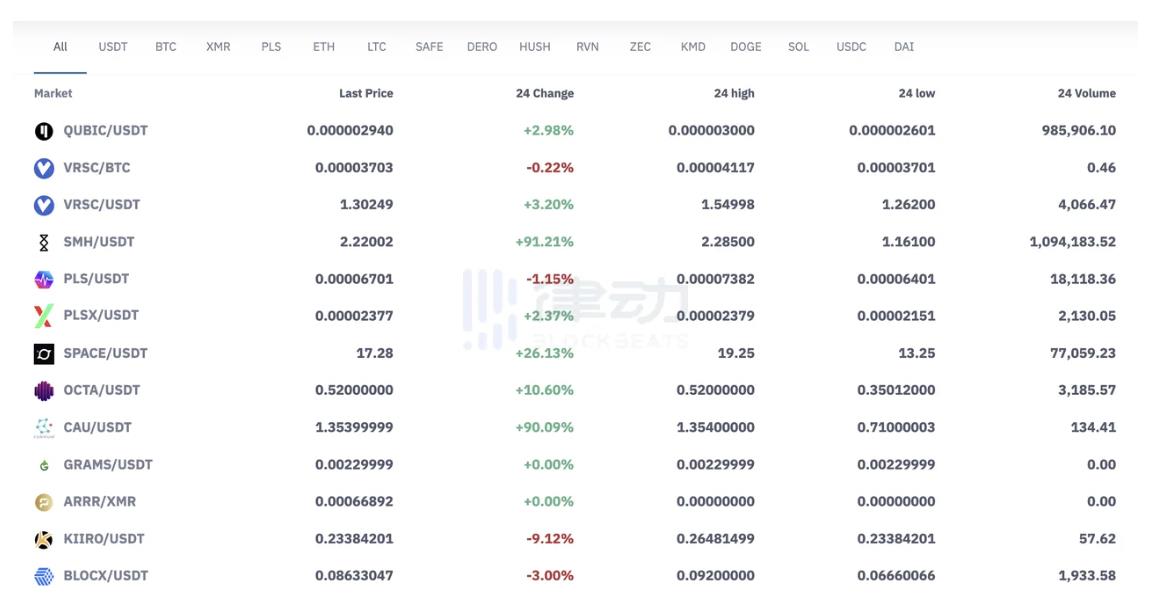
SafeTrade coin listing interface; Source: SafeTrade
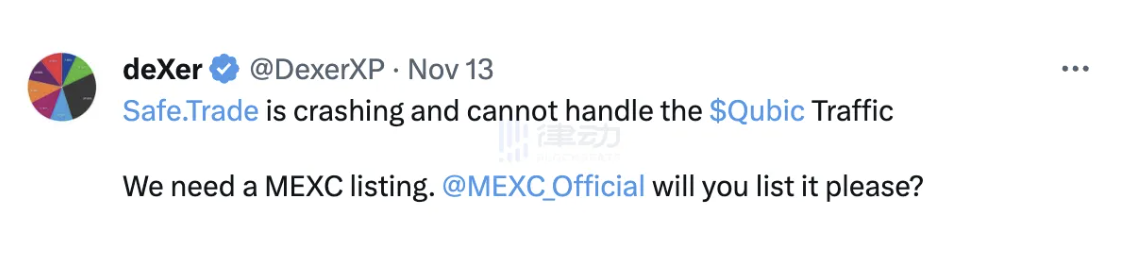
“TxBit brought us KAS before shutting down; now SafeTrade brings us QUBIC and SMH,” wrote Thrifty SoFi advisor deXer (@DexerXP) on X (formerly Twitter), adding, “QUBIC and SMH aren’t even listed on CoinGecko or CoinMarketCap yet—it’s still early.”
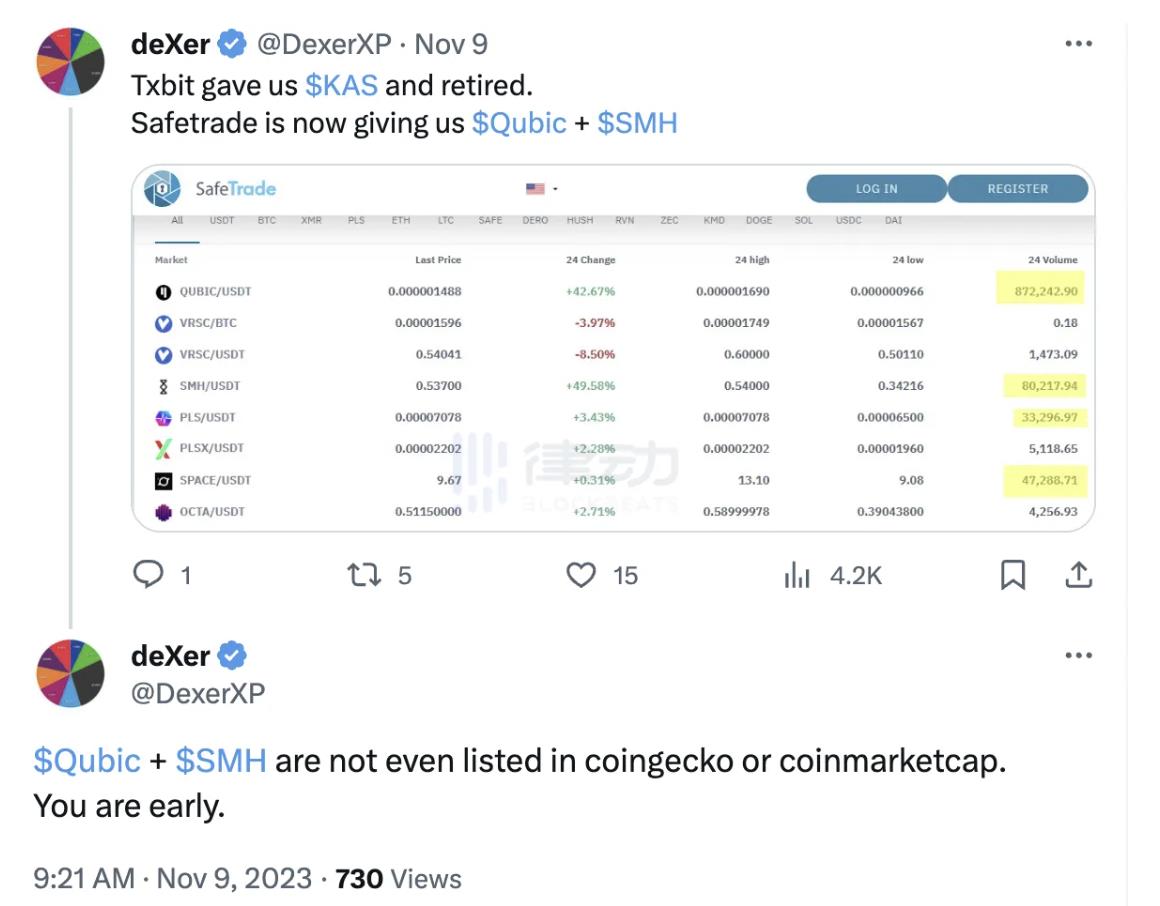
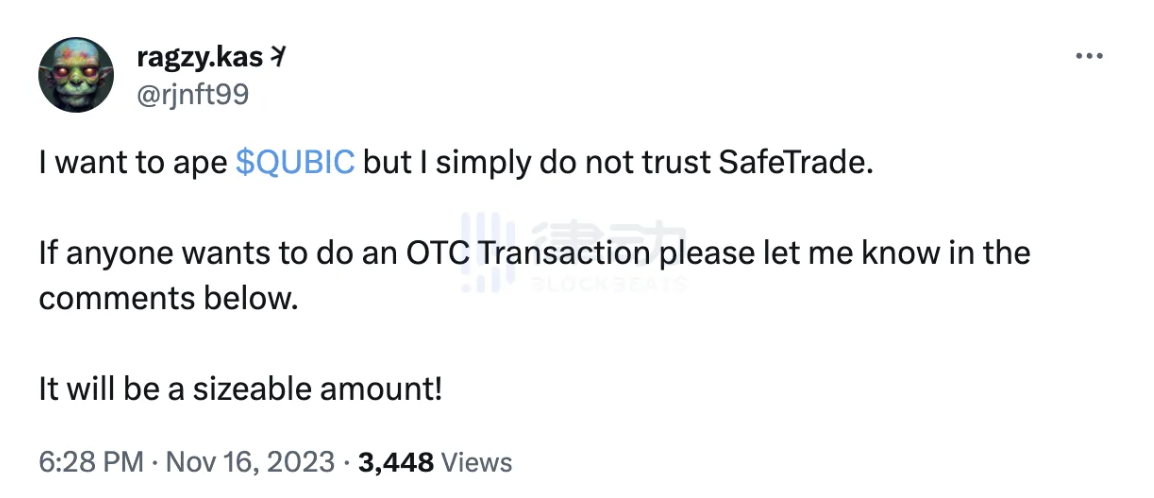
BlockBeats noted that while many PoW coins on SafeTrade have experienced explosive price growth, skepticism toward the platform persists. Users commonly express concerns such as “the exchange is too small and looks suspicious.” One user bluntly stated in a forum: “I want to buy QUBIC, but I don’t trust SafeTrade at all,” preferring OTC trades rather than depositing funds into the exchange.
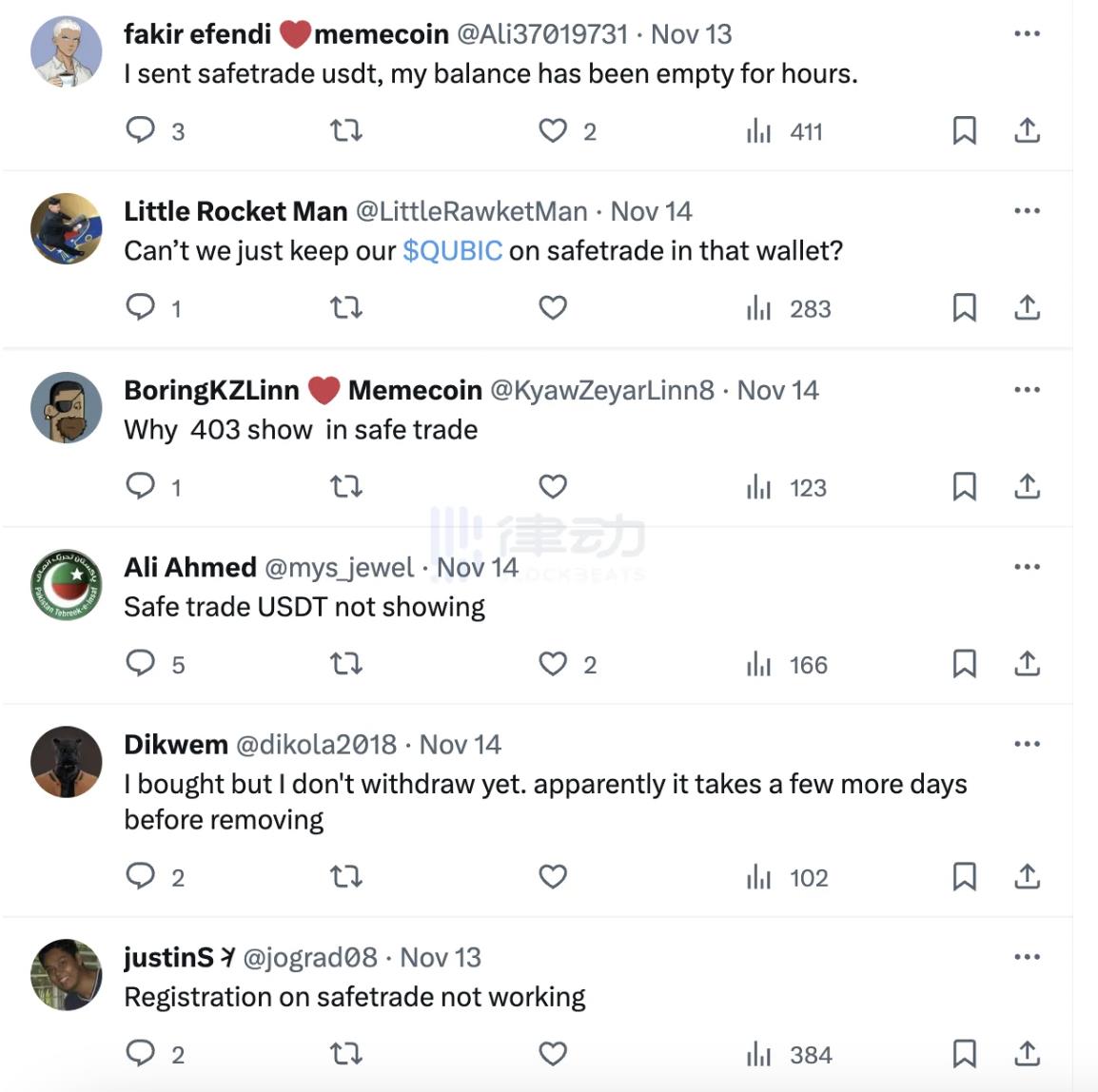
On November 12, due to excessive demand for QUBIC purchases overwhelming server capacity, SafeTrade temporarily suspended trading. The following day, when Qubic’s official team published instructions on buying QUBIC, numerous users complained in comments that their deposits failed to arrive. On that day, QUBIC’s price plunged from its peak to $0.0000023—a 69% drop. After SafeTrade restored deposit and withdrawal functions, the token price rebounded sharply.
PoW Exchanges: The Myth-Making Assembly Line
BlockBeats investigation reveals that “PoW exchanges” appear to follow a fixed business playbook and serve niche communities, yet remain largely overlooked by mainstream crypto markets.
Beyond SafeTrade, BlockBeats identified other small-scale “PoW exchanges” such as TxBit, Exbitron, XeggeX, and TradeOgre. These platforms share strikingly similar interfaces, mostly relying directly on TradingView charts without proprietary trading indicators. Aside from common major cryptocurrencies, they specialize in ultra-low-market-cap PoW miner coins and frequently witness “price miracles.”
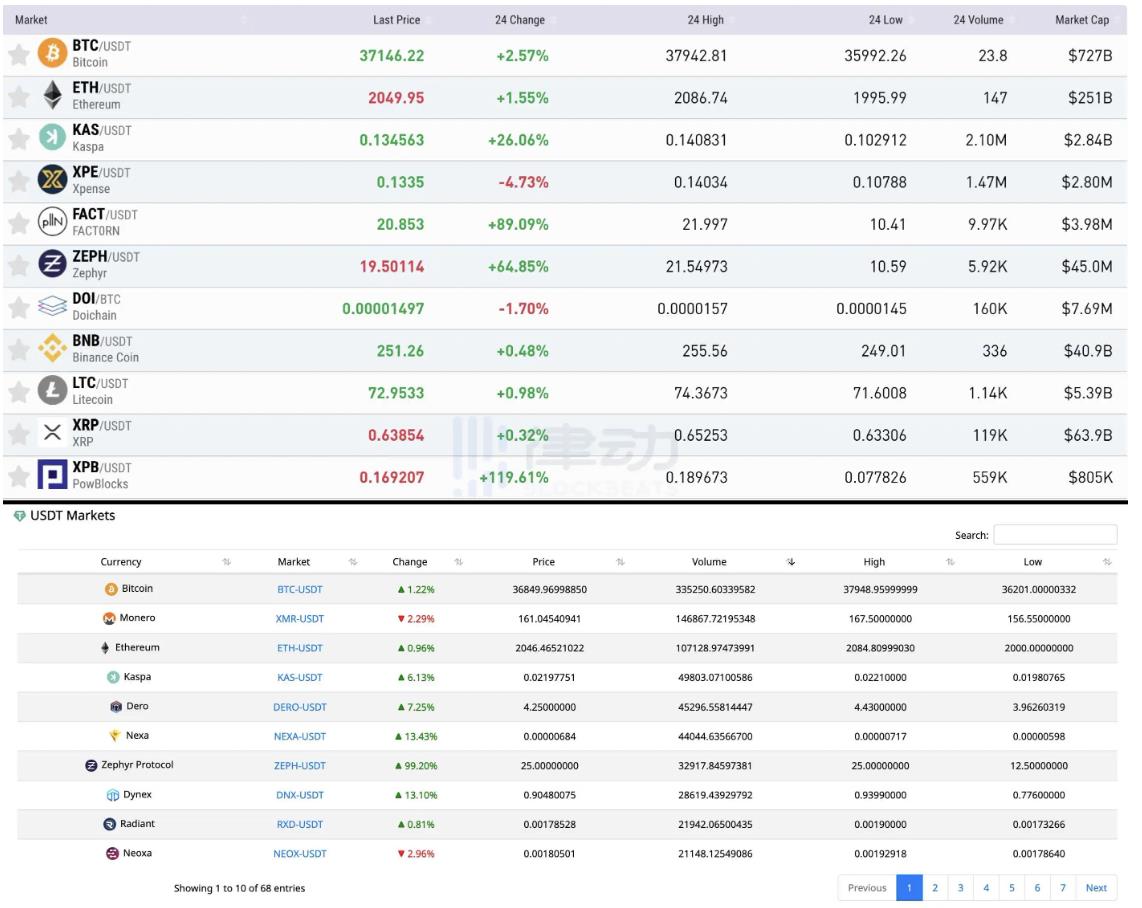
Top: XeggeX trading interface; Bottom: TradeOgre trading interface
TxBit, the first exchange to list KAS, announced in August it would permanently cease operations one month later. According to official statements, increasing compliance costs and regulatory uncertainty in cryptocurrency laws led to the shutdown decision.
Besides the now-defunct TxBit, Exbitron has also faded from the market this year. Launched in May 2021, Exbitron was a Germany-based centralized exchange focused on new token listings. In early February, it suffered a hack resulting in the theft of $390,000 worth of TRX. Since then, its official Twitter account has been inactive, and no price changes have occurred on its trading pairs.
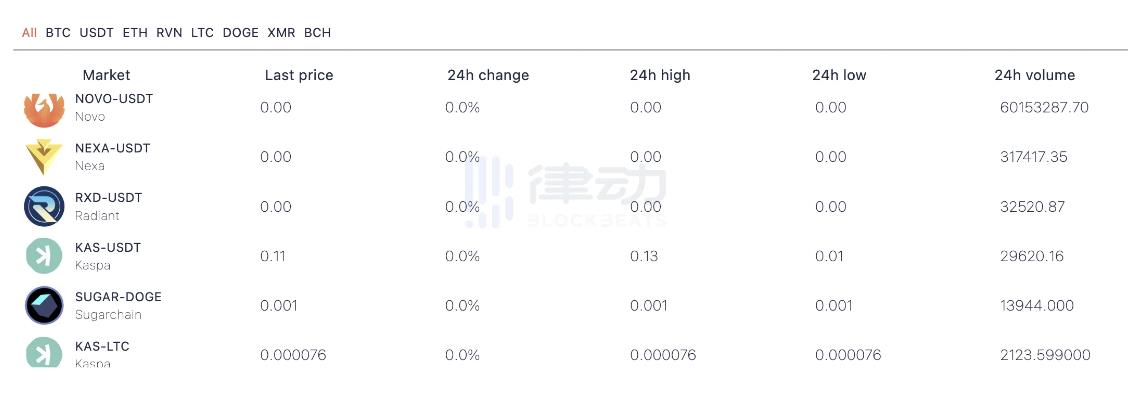
Exbitron coin listing interface; Source: Exbitron
BlockBeats found that exchanges like SafeTrade are often seen by users as early-stage “torch passers” for price discovery.
Crypto trader Kaduna (@CryptoKaduna) once wrote on X: “People say diamond projects are on MEXC and Kucoin—I think we should go further, checking out TxBit, TradeOgre, Xeggex, etc., though whether these platforms are safe is another matter.” Meanwhile, existing users of “PoW exchanges” regularly promote smaller coins with calls to “list on MEXC and Gate.”
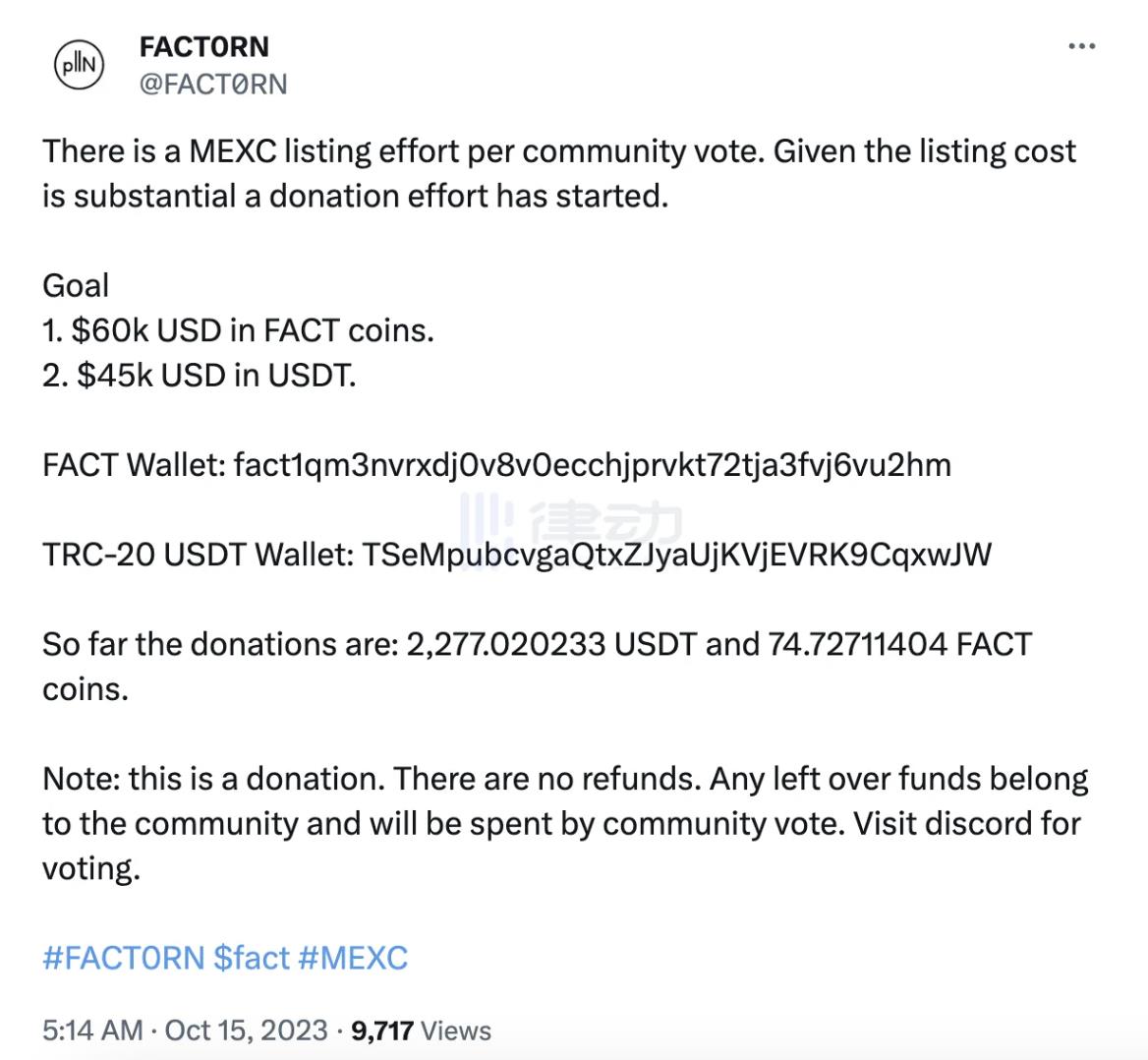
Listing on tier-two exchanges like MEXC has become a core consensus and fixed expectation within communities. In October, FACTORN (FACT), already listed on XeggeX, launched a donation campaign to crowdfund its MEXC listing fee—targeting 60,000 USD worth of FACT tokens plus 45,000 USD in USDT.
Getting listed on tier-two exchanges brings greater liquidity—not only providing early investors with an exit opportunity but also fueling further price appreciation. This path has become especially evident since November, as the “miner coin sector” entered a period of heightened enthusiasm.
OctaSpace (OCTA), which moved from SafeTrade to MEXC in August, surpassed $0.69 on November 17, gaining over 36.8% since listing, with MEXC accounting for 82.09% of trading volume during that period. Zephyr Protocol (ZEPH), listed on MEXC from XeggeX in September, broke $15 on November 1, up over 300% since listing, with MEXC contributing 96.65% of total trading volume.
In a 2019 WeChat article titled "The Fall of the 'Binance Effect,' the Rise of the 'MEXC Effect'", BlockBoundary discussed how MEXC initially served as a “miner coin headhunter”:
“Some projects view listing on MEXC as bullish—their goals surprisingly aligned. Step one: test the waters on a small exchange. Once timing is right, step two: prepare for listing on MEXC. Finally, consider aiming for Huobi or Binance.”
Not just platform tokens—many other projects reached their highest prices on MEXC, leading project teams to treat MEXC listings as positive catalysts. After speaking with several project founders, the editor found their strategies remarkably consistent: start on a small exchange, progress to MEXC when ready, then aim for Huobi or Binance.”

Source: BlockBoundary
Insiders told BlockBeats that behind the broad rally in the “miner coin sector,” there exists a mature and complete value chain, summarized below:
1. Project teams initiate and promote new projects;
2. Mining hardware manufacturers (often affiliated with the project itself) sell miners to recoup early capital;
3. Use part of the raised funds to absorb tokens sold by miners into the market—since revenue from selling miners far exceeds mining income, prices can be artificially inflated;
4. Tier-two exchanges notice price movements and consider listing the token, enabling project teams to sell tokens to retail investors via the platform;
5. Larger mining projects may periodically release new miners as difficulty increases, using fresh revenue and partner capital to further boost token prices, attracting attention from top-tier exchanges like Binance to achieve mainstream exposure and enhanced liquidity.

Compared to Ethereum, EVM-based ecosystems, or sectors like DeFi and NFTs, PoW mining and miner coin markets remain among the least-covered areas in crypto, with opaque supply chains and business models unknown to most. This relative “invisibility” and high-risk barrier create space for select participants along the mining value chain to continuously extract arbitrage opportunities.
Now, with Bitcoin ecosystems heating up, miner coins as a related narrative are gradually drawing attention from mainstream crypto markets. Binance’s listing of KAS futures marks the first successful打通 of a “value discovery path” from third-tier “PoW exchanges” to major platforms. Will the miner coin community seize this opportunity to bring sustained liquidity inflows?
Meanwhile, BlockBeats reminds readers that the multiple third-tier exchanges mentioned lack credible team backing, and many token projects exhibit characteristics of “Ponzi schemes,” warranting extreme caution and prudent investment decisions.
Join TechFlow official community to stay tuned
Telegram:https://t.me/TechFlowDaily
X (Twitter):https://x.com/TechFlowPost
X (Twitter) EN:https://x.com/BlockFlow_News
 BlockBeats











