









Hong Kong Government's Web3 Declaration Anniversary Reflection: "Hidden Risks" Amid Compliance Challenges
TechFlow Selected TechFlow Selected
Hong Kong Government's Web3 Declaration Anniversary Reflection: "Hidden Risks" Amid Compliance Challenges
Trading must be "on-chain," and compliance also needs to be "on-chain."
 Navigating Web3 tides with focused insights
Author: Bi Lianghuan, Research Institute of OKLink

On October 28, the "FT Innovation Dialogue #LinkWeb3.0 Security Salon," jointly hosted by FT Chinese and OKLink, with special support from the HKU Business School and HKU iCube, was successfully held. Guests from the technology industry, academia, and legal sectors discussed and analyzed Hong Kong's recent JPEX incident from multiple perspectives, engaging in deep discussions on topics such as investor protection.
Bi Lianghuan, Chief Researcher at OKLink, stated that over the past year since the Hong Kong government’s "Policy Statement on Development of Virtual Assets in Hong Kong," every step taken in the Web3.0 space has followed a steady and clear trajectory. However, two risks during the compliance process remain concerns worthy of attention from all stakeholders.
It has been a year since the release of the "Policy Statement on Development of Virtual Assets in Hong Kong." After analyzing regulatory policies and attitudes toward Web3 in several major global jurisdictions, our OKLink Research Institute remains optimistic about Hong Kong’s ambitious vision. However, given that recent Ponzi scheme-related financial crimes have extended into the Web3 domain, the Hong Kong government has recently placed greater emphasis on the topic of "investor protection"—a shift that appears to diverge from its original intentions one year ago.
At last week’s "LinkWeb3.0 Salon," co-organized by OKLink and FT Chinese, representatives from Hong Kong’s academic community, law firms, and virtual asset trading platforms (VATPs) came together to reflect on the past year’s developments and discuss key priorities for Hong Kong’s industry moving forward. Contrary to prevailing public opinion, we believe that Hong Kong—including its government—has consistently pursued a stable and well-defined path in the Web3.0 space.
However, addressing investor protection requires more than just implementing KYC measures at individual VATPs. Attention must also be paid to gaps in the current centralized VATP system, particularly at the point of fund inflow and outflow—especially when interacting on-chain with external Web3 wallets. Just as transactions go "on-chain," compliance must also go "on-chain."
Typically, Web3 wallets are built on blockchain technology and inherently possess anonymity features. Interactions involving these wallets may include transfers, deposits, and withdrawals—operations that could expose even KYC-compliant users to high-risk wallets (accounts) during fund movements. Without leveraging on-chain compliance tools like those provided by OKLink, Chainalysis, or Elliptic—which offer core labeling databases to detect and flag such risks—ensuring transaction legitimacy and investor fund security becomes one of the biggest compliance challenges.
Moreover, from a VATP perspective, it is essential to assess whether there is actual market demand under Hong Kong’s current regulatory framework, and whether institutional clients such as traditional financial institutions are willing to enter Web3 through VATPs rather than alternative instruments like ETFs. They must also evaluate how different financial tools impact transaction costs for traditional financial institutions. On this front, VATPs need deeper strategic thinking—not merely focusing on license applications. A license is only the beginning of compliance, a market entry permit; it does not shield against future risks.
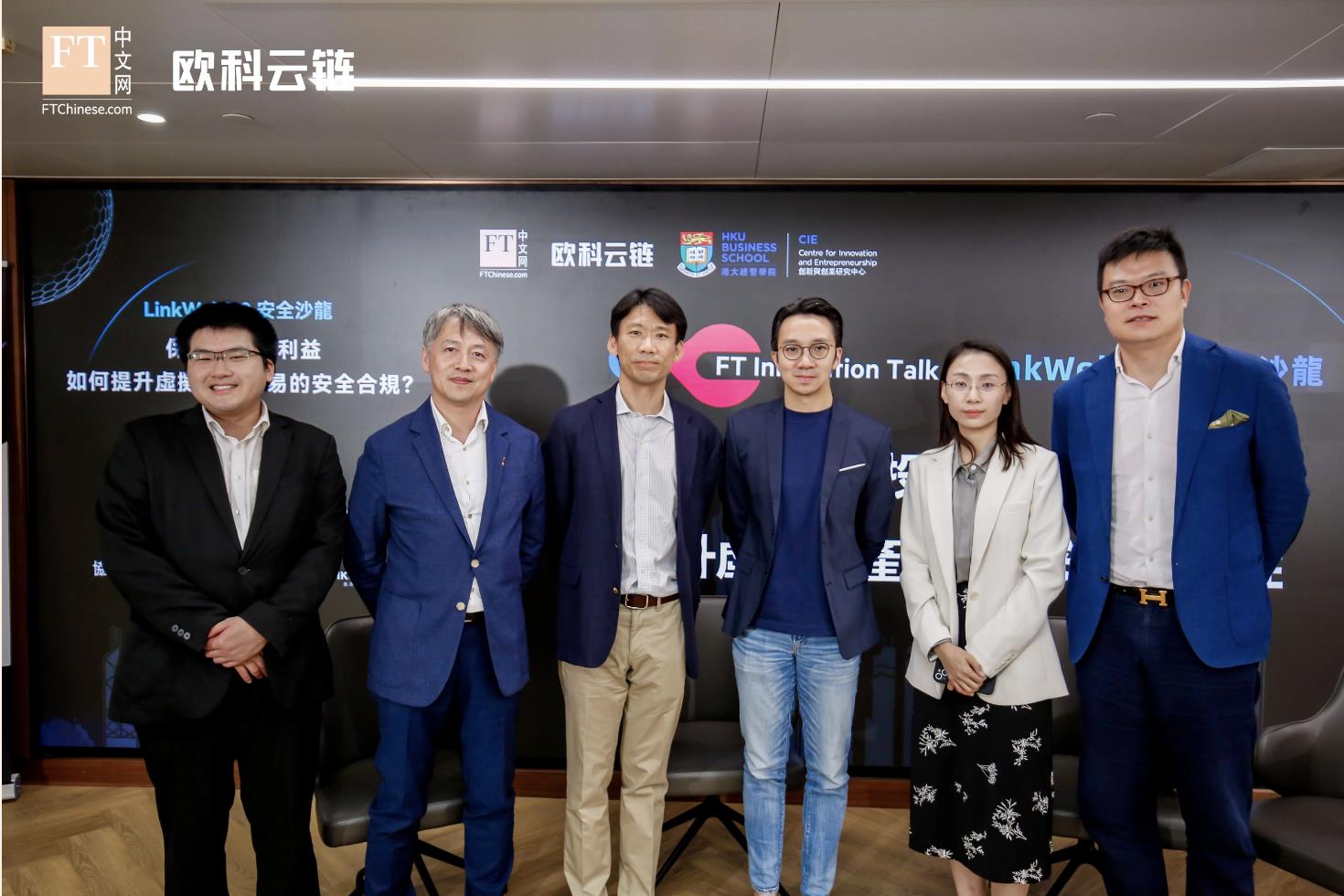
Guests at the FT Innovation Dialogue #LinkWeb3.0 Security Salon roundtable discussion, from left to right: Huang Yushun, Assistant Professor, Department of Philosophy, The University of Hong Kong; Chan Ping-hung, Deputy Director, Centre for Entrepreneurship, HKU Business School; Wang Feng, Editor-in-Chief, FT Chinese; Lok Chun-sing, Head of Compliance, HashKey Group; Bi Lianghuan, Chief Researcher, OKLink; Jiang Qian, Partner, Ashurst LLP
In conversations with Luo Zhensheng, Head of Compliance at HashKey Group, we identified another hidden risk in the compliance landscape. Currently, VATPs are the most proactive in communicating with regulators. However, neither regulators nor VATPs themselves have fully developed proprietary regulatory technology tools (RegTech and SupTech). As a result, discussions often revolve around past experiences and lessons learned, with other VATPs considering similar issues. Under these circumstances, whether to take the first bold step or wait further creates significant hesitation.
Therefore, we call for greater collaboration between compliance technology firms and VATPs, along with increased dialogue with regulators, to effectively advance the goal of investor protection. Additionally, at the LinkWeb3.0 roundtable, Jiang Qian, partner at Ashurst, suggested establishing an industry self-regulatory organization. In terms of investor protection, such self-regulatory bodies may prove more efficient than government or legal mechanisms alone. Establishing such cooperative and self-regulatory frameworks would help bridge technological and compliance gaps between regulators and VATPs.
Take HashKey as an example: they partnered with OKLink’s OKLink Onchain AML compliance solution to close this gap. As a VATP, it is extremely difficult to independently build an address label database comparable in scale to specialized RegTech firms. For instance, OKLink’s Onchain AML already includes over 3.5 billion labeled addresses, with more than 4.8 million blacklisted addresses and over 65 million graylisted ones. Such collaboration enhances HashKey’s on-chain compliance capabilities and reduces risks associated with money laundering violations.
Seeing is believing. Hong Kong has long served as a "super connector," overcoming one challenge after another at Hong Kong speed. Only by closing these two critical gaps can we eliminate underlying risks and propel Hong Kong’s Web3 ecosystem forward in great strides.
Join TechFlow official community to stay tuned
Telegram:https://t.me/TechFlowDaily
X (Twitter):https://x.com/TechFlowPost
X (Twitter) EN:https://x.com/BlockFlow_News
 @OKGResearch











