
Galaxy Digital: Why Bitcoin ETFs Are a More Ideal Solution Than Current Investment Tools?
TechFlow Selected TechFlow Selected
Galaxy Digital: Why Bitcoin ETFs Are a More Ideal Solution Than Current Investment Tools?
Funds flowing into ETFs, market narratives around the upcoming Bitcoin halving, and the possibility that interest rates have already peaked or will do so in the near term suggest that 2024 could be a significant year for Bitcoin.
 Navigating Web3 tides with focused insights
Author: Charles Yu, Galaxy Digital
Translated by: Colin Wu, Wu Shuo Real
The approval of a spot Bitcoin ETF under U.S. regulation will become the most influential catalyst in accelerating adoption of Bitcoin (and cryptocurrency as an asset class).
Significance of Bitcoin ETFs
Why Bitcoin ETFs Are More Ideal Than Current Investment Vehicles
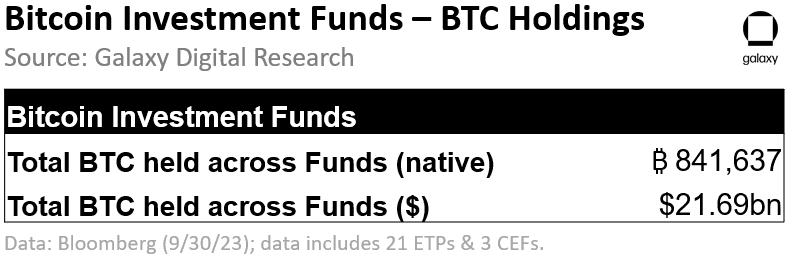
As of September 30, 2023, Bitcoin investment products (including ETPs and closed-end funds) held 842,000 BTC (approximately $21.7 billion).
These Bitcoin investment products have significant drawbacks for investors—beyond high fees, low liquidity, and tracking errors, they are inaccessible to broad investor populations representing the majority of wealth. Alternative options for gaining indirect exposure to Bitcoin (such as equities, hedge funds, futures ETFs) also face similar tracking inefficiencies. Many investors prefer not to own Bitcoin directly to avoid administrative burdens associated with self-custody, such as managing wallets/private keys and tax reporting.
Spot ETFs may suit any investor who wants direct exposure to Bitcoin but does not wish to own and manage it via self-custody. Compared to current Bitcoin investment products and options, spot ETFs offer numerous advantages:
● Improved efficiency through lower fees, higher liquidity, and better price tracking. Although Bitcoin ETF applicants have not yet disclosed fee structures, ETFs typically charge lower fees than hedge funds or closed-end funds, and intense competition among multiple applicants may drive fees even lower. Spot ETFs will also provide stronger liquidity as they trade on major exchanges and track Bitcoin’s price more accurately than futures-based products or proxies.
● Convenience. Spot ETFs can give investors access to Bitcoin exposure through a wider range of channels and platforms, including established providers already familiar to them. They offer easier entry points for both retail and institutional investors compared to direct ownership, which requires a certain level of self-education and incurs higher management costs.
● Regulatory compliance. Spot ETFs are likely to meet stricter regulatory requirements regarding custody arrangements, monitoring, and bankruptcy protection compared to existing Bitcoin investment products. Additionally, ETFs could offer greater price transparency and discovery for market participants, potentially helping to reduce Bitcoin's market volatility.
Why Bitcoin ETFs Matter So Much
Two primary factors make spot Bitcoin ETFs especially impactful for broader market adoption:
(i) Expanded accessibility across all wealth segments;
(ii) Greater legitimacy through formal endorsement by regulators and trusted financial services brands:
Accessibility
● Broader reach for both retail and institutional investors. Currently available BTC investment funds are limited in scope, primarily driven by wealth advisors or offered through institutional platforms. ETFs represent a more straightforward, regulated product that expands access to a much larger investor base—including retail and affluent individuals. ETFs can be accessed by a wider customer set, including directly through brokers or RIAs (Registered Investment Advisors), rather than relying solely on wealth managers.
● Distribution through additional investment channels. Without an approved Bitcoin investment solution like a spot ETF, financial advisors/trustees cannot include Bitcoin in their wealth management strategies. The wealth management sector controls massive capital pools but has been unable to access Bitcoin investments directly through traditional channels—approved spot ETFs would enable advisors to begin guiding their wealthy clients into Bitcoin.
● Access to greater wealth pools. Baby boomers and older generations (aged 59+) hold 62% of U.S. wealth, yet only 8% of adults over 50 have invested in crypto, compared to over 25% among adults aged 18–49 (Federal Reserve, Pew Research Center). Offering Bitcoin ETFs through familiar, trusted brands may help attract this older, wealthier demographic that has not yet participated.
Acceptance
● Formal validation from trusted brands. Numerous well-known financial firms have filed Bitcoin ETF applications—their mainstream endorsement can improve perceptions of Bitcoin/crypto as a legitimate asset class and drive broader acceptance. According to Pew Research, among the 88% of Americans who have heard of crypto, 75% lack confidence in current methods of investing, trading, or using it.
● Addressing regulatory and compliance concerns; regulatory clarity attracts more investment and development. As a regulated investment product with comprehensive risk disclosures, SEC approval of an ETF could alleviate many investor concerns around security and compliance. It would also provide long-sought regulatory clarity for operating within the crypto industry. A clearer regulatory framework would attract more investment and innovation, enhancing the competitiveness of the U.S. crypto sector.
● Portfolio benefits / recognition as an asset class. Bitcoin offers diversification benefits and higher returns within portfolios, regardless of which portion of the portfolio allocates to it. To support investment decisions, more retail investors and financial advisors are increasingly turning to model portfolios and automated solutions, which frequently incorporate ETFs and alternative asset classes to optimize risk-return profiles. A longer track record would strengthen the case for including Bitcoin in more investment strategies.
Estimating Capital Inflows from Bitcoin ETF Approval
Based on the above accessibility arguments, the U.S. wealth management industry represents the most accessible and direct market—and will gain the greatest net new accessibility from an approved Bitcoin ETF. As of October 2023, assets under management at broker-dealers ($27 trillion), banks ($11 trillion), and RIAs ($9 trillion) totaled $48.3 trillion.
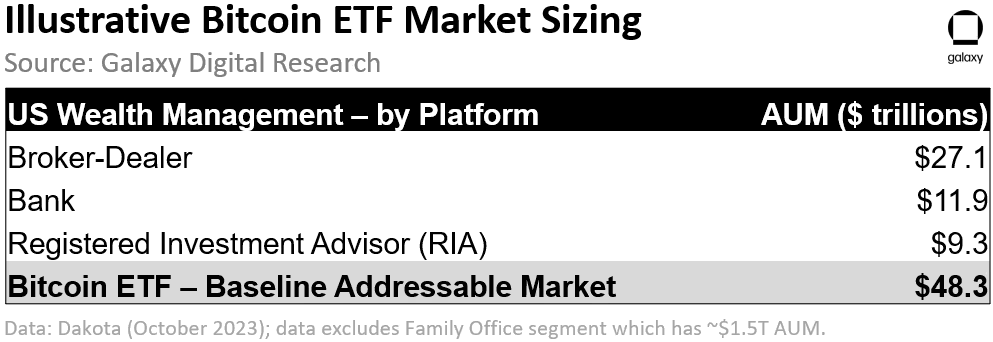
In our analysis, we apply the $48.3 trillion figure to selected U.S. wealth management aggregators as a baseline TAM (excluding the family office channel, which manages approximately $2 trillion). However, the addressable market for Bitcoin ETFs and the indirect impact of ETF approval may extend far beyond U.S. wealth management (e.g., international markets, retail, other investment products, and channels), potentially attracting even greater inflows into the spot Bitcoin market and related investment vehicles.
(Note: While we use a TAM-style analysis to estimate inflows into Bitcoin ETFs, we acknowledge that flows into Bitcoin ETFs could generate new net inflows rather than merely shifting existing allocations—therefore, applying percentage capture assumptions to an estimated TAM figure does not fully reflect our view on Bitcoin ETF adoption, as it fails to account for this incremental demand.)
With open channel access, the rollout of Bitcoin ETF availability across these segments may span several years. The RIA channel, largely composed of independent RIAs with complex structures, may allow earlier access compared to bank- and broker-dealer-affiliated advisors, giving it a larger initial share of accessibility in our analysis. For bank and broker-dealer channels, each independent platform will determine when to unlock access to Bitcoin ETF products—except in rare cases, affiliated financial advisors cannot offer/recommend specific investment products without platform approval. Platforms may impose specific requirements before offering new investment products (e.g., performance history >1 year, AUM thresholds, suitability assessments), affecting the timeline of access.
We assume the RIA channel will start at 50% accessibility in Year 1 and increase to 100% by Year 3. For broker-dealer and bank channels, we assume accessibility starts at 25% in Year 1 and steadily increases to 75% by Year 3. Based on these assumptions, we estimate the addressable market size for U.S. Bitcoin ETFs at approximately $14 trillion in the first year post-launch, $26 trillion in Year 2, and $39 trillion in Year 3.
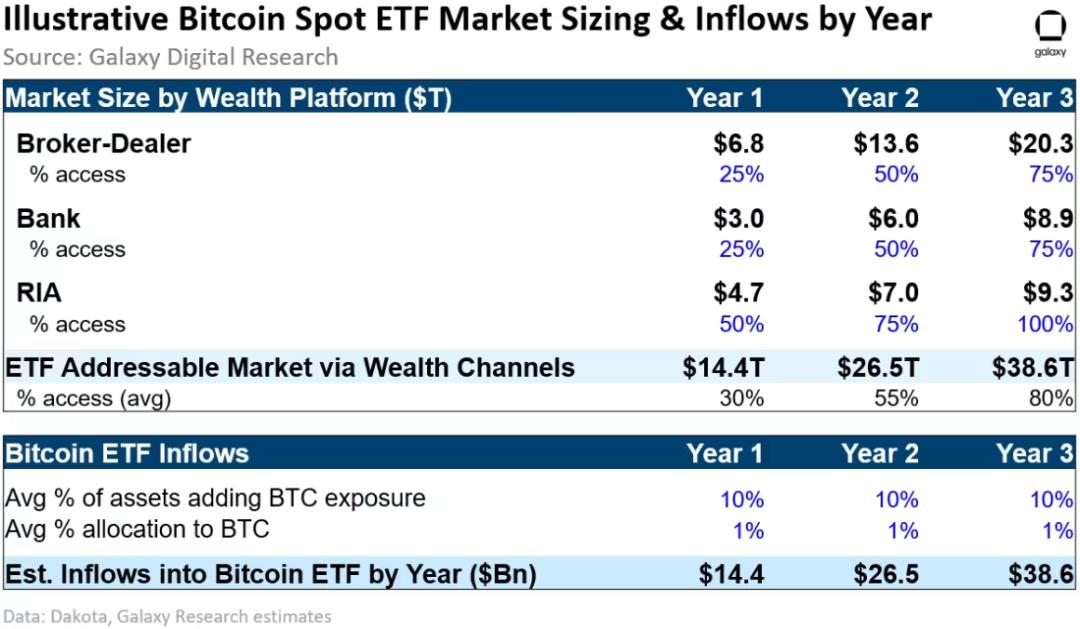
Bitcoin ETF Inflow Estimates: Based on these market size estimates, if we assume BTC is adopted by 10% of available funds across each wealth channel, with an average allocation of 1%, we estimate inflows into Bitcoin ETFs of $14 billion in the first year post-launch, rising to $27 billion in Year 2 and $39 billion in Year 3. Of course, if spot Bitcoin ETF approval is delayed or denied, our analysis would be constrained by timing and access limitations. Alternatively, if price performance is weak or other factors lead to slower-than-expected access or adoption, our estimates could prove too optimistic. On the other hand, we believe our assumptions on access, exposure, and allocation are conservative, so actual inflows could exceed expectations.
Potential Impact on BTCUSD
As of September 30, 2023, global gold ETFs held approximately 3,282 tons (AUM ~$198 billion), according to the World Gold Council, representing about 1.7% of total gold supply.
As of September 30, 2023, Bitcoin held in investment products (including ETPs and closed-end funds) totaled 842k BTC (AUM ~$21.7 billion), representing 4.3% of total issuance.
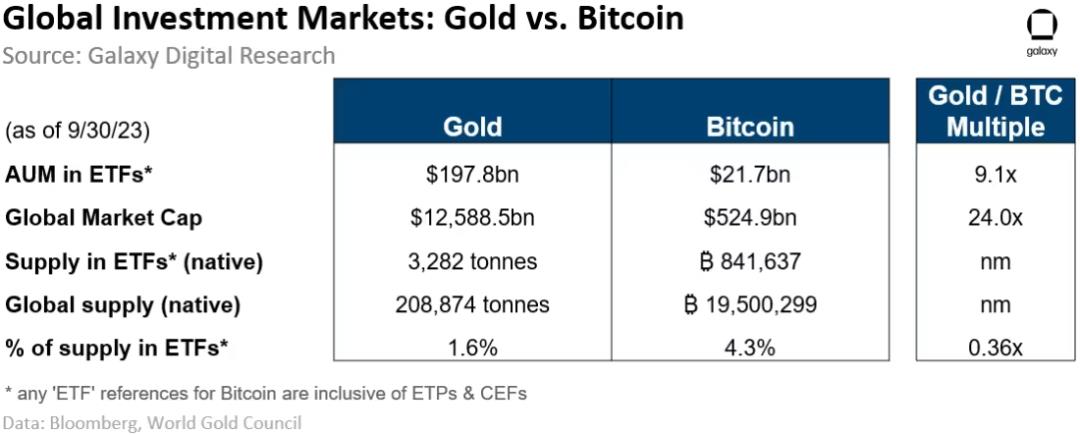
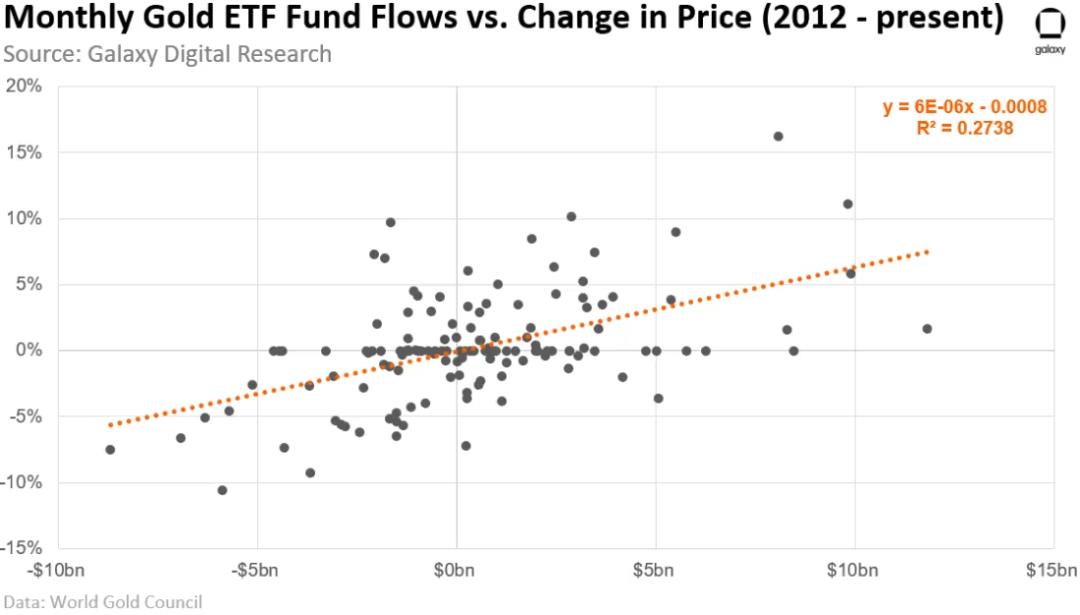
Given that gold’s market cap is roughly 24 times larger and its investment vehicle holdings are 36% smaller in proportion than Bitcoin’s, we assume equivalent inflows relative to gold would exert approximately an 8.8x greater impact on the Bitcoin market.
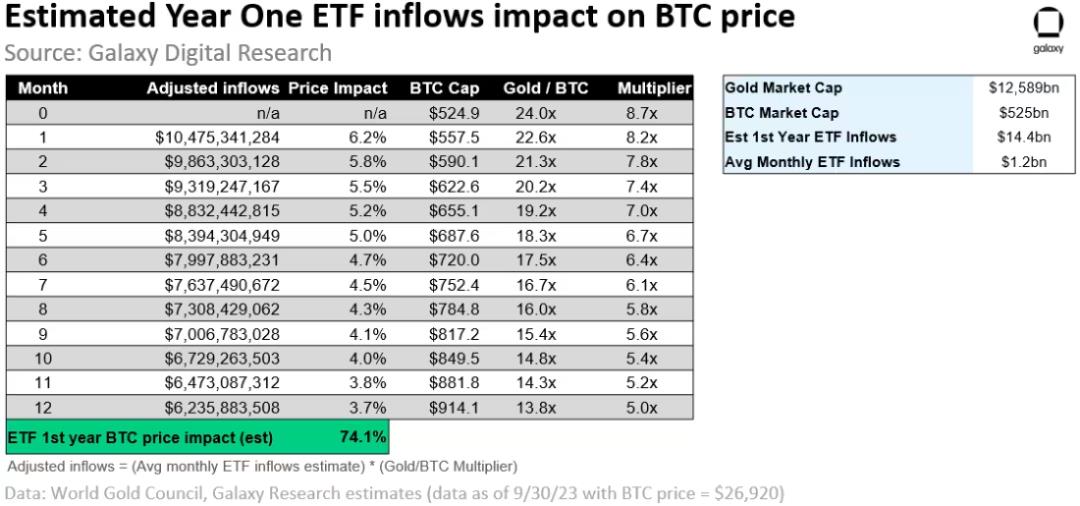
Applying our first-year inflow estimate of $14.4 billion (approximately $1.2 billion per month, or ~$1.05 billion after adjusting with our 8.8x multiplier) to the historical relationship between gold ETF flows and gold price movements, we estimate a +6.2% price impact for Bitcoin in the first month.
If inflows remain constant but the multiplier is adjusted monthly based on rising BTC prices relative to the BTC/gold market cap ratio, we might see the monthly impact gradually decline from +6.2% in the first month to +3.7% in the final month of the first year, resulting in an estimated +74% increase in Bitcoin’s price during the first year following ETF approval (using Bitcoin’s September 30, 2023 price of $26,920 as the starting point).
Broad Financial Impacts of ETFs on the Bitcoin Market
The above analysis estimates potential inflows into U.S. Bitcoin ETF products. However, second-order effects from Bitcoin ETF approval could have an even larger impact on BTC demand.
In the short term, we expect other global/international markets to follow the U.S. lead, approving and offering similar Bitcoin ETF products to broader investor bases. Beyond ETFs, other investment vehicles are likely to incorporate Bitcoin into their strategies (e.g., mutual funds, closed-end funds, private funds)—spanning various investment objectives and strategies. For example, alternative funds (currency, commodities, and other alternatives) and thematic funds (disruptive technology, ESG, social impact) may add Bitcoin exposure.
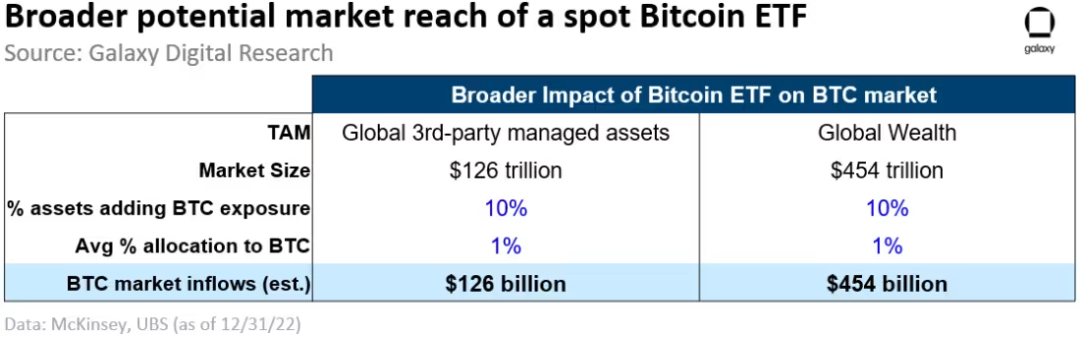
In the long run, the addressable market for Bitcoin investment products could expand further to include all third-party managed assets (approximately $126 trillion AUM, per McKinsey) and even more broadly to global wealth (approximately $454 trillion AUM, per UBS). Some argue that as Bitcoin becomes monetized, it will systematically reduce the monetary premium applied to other assets (like real estate or precious metals), significantly expanding Bitcoin’s TAM.
Based on these market sizes and maintaining our adoption/allocation assumptions (BTC adopted by 10% of funds, average allocation of 1%), we estimate that over a longer horizon, potential new inflows into Bitcoin investment products could range between $125 billion and $450 billion.
Summary and Conclusion
For a decade, applicants have sought to launch a spot Bitcoin ETF. During this time, Bitcoin’s market cap has risen from less than $1 billion to $600 billion today (peaking at $1.27 trillion in 2021). Ownership and usage of Bitcoin have surged globally, with numerous wallet types, crypto-native exchanges and custodians, and traditional market access tools emerging worldwide. Yet the world’s largest capital market—the U.S.—still lacks the most efficient market access tool for Bitcoin: a spot-based ETF. Expectations for a swift approval continue to rise, and our analysis suggests these products could see substantial inflows, primarily driven by the wealth management channel, which currently lacks scalable, secure, and efficient access to Bitcoin exposure.
Inflows from ETFs, market narratives around the upcoming Bitcoin halving (April 2024), and the likelihood that interest rates have peaked or will peak soon suggest that 2024 could be a pivotal year for Bitcoin.
Join TechFlow official community to stay tuned
Telegram:https://t.me/TechFlowDaily
X (Twitter):https://x.com/TechFlowPost
X (Twitter) EN:https://x.com/BlockFlow_News
 @galaxyhq