









Uniswap: The Most Successful American Internet Fintech Company Under the Web3 Boom
TechFlow Selected TechFlow Selected
Uniswap: The Most Successful American Internet Fintech Company Under the Web3 Boom
After the FTX collapse, Uniswap has become the most successful internet fintech company in today's Web3 world.
 Navigating Web3 tides with focused insights
Authors: Jack, Jaleel, BlockBeats
With support and influence from prominent VCs such as a16z and Paradigm, Uniswap has followed a distinct operational and management trajectory. Following the FTX collapse, Uniswap has emerged as the most successful Web3 fintech company in today’s internet landscape.
To date, Uniswap holds over 80% market share in the DEX space, achieving weekly trading volumes of up to $16 billion—far surpassing its competitors by multiples. After recently announcing the launch of front-end transaction fees, Uniswap's strategy of separating its team from the protocol has become even more evident, offering Web3 entrepreneurs a pragmatic and viable path forward.
Corporate-Style Team Operations: Compliance, Compliance, and More Compliance
As the undisputed leader in DeFi and a symbolic representation of Web3’s permissionless world, every move Uniswap makes influences the broader industry. Yet upon closer inspection, Uniswap does not resemble what is typically defined as a “Web3 team,” but rather functions like a U.S.-based internet startup.
Indeed, Uniswap’s true uniqueness in the Web3 space lies significantly in its corporate-style team operations and management approach.
“All-American Team”: Executive Appointments and Employee Management at Uniswap
From the executive appointments at Uniswap Labs, there is nothing that suggests this is a typical Web3 startup. With expertise spanning regulatory compliance to experience at major tech firms, Uniswap appears fully equipped for mainstream success.
On May 19, 2022, Uniswap officially announced via blog post that Salman Banaei would join as Head of Policy at Uniswap Labs.
Prior to joining Uniswap Labs, Salman served in public service at the U.S. Commodity Futures Trading Commission (CFTC), later leading public policy efforts at Chainalysis. During his time at the CFTC, he led the Dodd-Frank Act team in reforming the U.S. derivatives market after the financial crisis—an effort recognized by then-CFTC Chair Gary Gensler (yes, that one)—who awarded him the CFTC Chairman’s Award for Excellence.
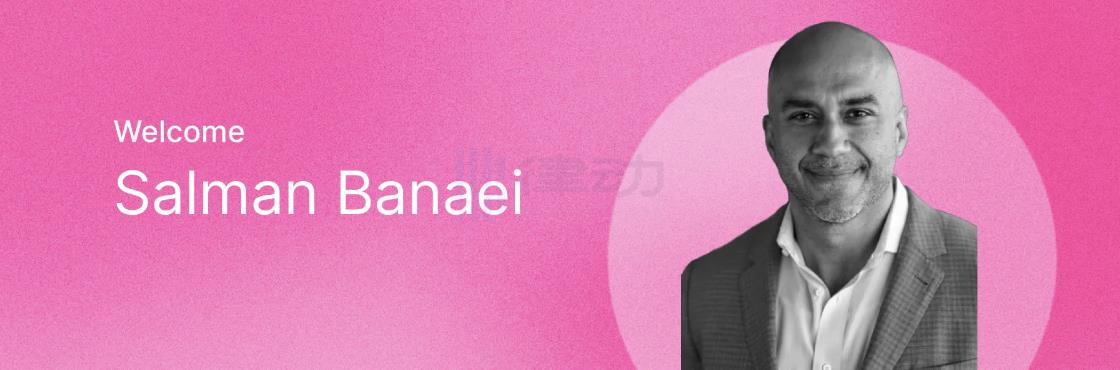
In his onboarding announcement, Salman wrote: "Uniswap Labs reflects both the Dodd-Frank Act’s goal of democratizing markets and Nakamoto’s vision of reducing friction in value transfer. The Uniswap Protocol is a breakthrough invention capable of achieving many of the Dodd-Frank reforms we worked toward at the CFTC. As with prior internet protocols, the full potential of this technology can only be realized through constructive and engaged public-sector leadership."
Earlier that year, in March, Uniswap brought on Chad DePue, former Senior Engineering Director at Snap Inc. (Snapchat’s parent company), to serve as Vice President of Engineering at Uniswap Labs.
At Snap, Chad led development of popular features including Snap Minis, Snap Kit, and PlayCanvas. He later served as CTO at Whisper App before holding VP engineering and developer tools roles at BlackBerry and Microsoft. At Uniswap, Chad’s primary mission is to bring his experience building simple, secure, and seamless products—including mobile applications—to the Uniswap Labs team.
Chad stated in his announcement: "Hayden [Adams] was a key reason I joined Uniswap. When you meet Hayden, you quickly realize he is among the rare few with the vision and wisdom needed to create massive impact... Strong leadership rooted in inclusivity and ethical commitment, as exemplified by Hayden and others, is crucial for Web3 to attract the next wave of users."
Then on July 21, Uniswap announced the high-profile appointment of Will Ruben as Vice President of Product.
Will previously led Web3 social experiences across Coinbase and its wallet app. Before Coinbase, he spent nine years at Meta (formerly Facebook), where he led Instagram’s Feed and Relevance teams, overseeing critical product launches such as content ranking algorithms and interest-based search.
In his announcement, Will shared: "After ten years in big tech, I’m drawn to the challenges and opportunities of leading a smaller, more entrepreneurial company with enormous growth potential over the next decade... Without simple, high-quality user experiences built atop web3 protocols, we cannot unlock universal ownership or make the global financial system more inclusive. Uniswap Labs sits at the heart of this work, and I’m excited to bring my experience building consumer products at scale—especially mobile—to this exceptional team."
Compared to most leading Web3 projects, Uniswap not only enjoys clear advantages at the executive level but also maintains rigorous and compliant processes in hiring and employee management.
According to BlockBeats, Uniswap currently employs over 100 people, with clearly defined departmental responsibilities. On Uniswap’s official careers page, visitors are greeted with the following message:
"The Uniswap Protocol is the largest decentralized exchange and automated market maker on Ethereum... The Uniswap Labs team are key contributors to the Uniswap Protocol and now focus on building a suite of products to support the Uniswap ecosystem. Our team is one of the most influential in crypto. We're headquartered in SoHo, NYC, and offer partial or full remote work depending on the role."
Currently, BlockBeats observes that Uniswap Labs primarily organizes into three departments: Engineering, Growth & Strategy, and Finance & Compliance. Engineering has the most openings, with seven active positions. Full-time employee benefits include:
1. Minimum annual salary of $180,000–$220,000, disclosed in accordance with New York City pay transparency laws;
2. Equity, tokens, and other compensation elements determined by position type;
3. Unlimited and encouraged vacation time, plus 16 weeks of paid parental leave;
4. Full medical coverage for employees and dependents;
5. 401(k) retirement plan;
6. $1,500 annual education stipend;
7. Home office setup allowance for remote workers; lunch provided for NYC office staff.
Additionally, Uniswap Labs is an EEO (Equal Employment Opportunity) employer, providing equal employment opportunities to qualified individuals with disabilities under U.S. law. According to their website, Uniswap Labs aims to have at least 7% of its workforce composed of individuals with disabilities. To achieve this, applicants must complete a detailed questionnaire when applying, which must be re-submitted every five years after onboarding.
However, accessing these attractive benefits requires being legally authorized to work in the United States, and “all benefits are subject to applicable taxes.”
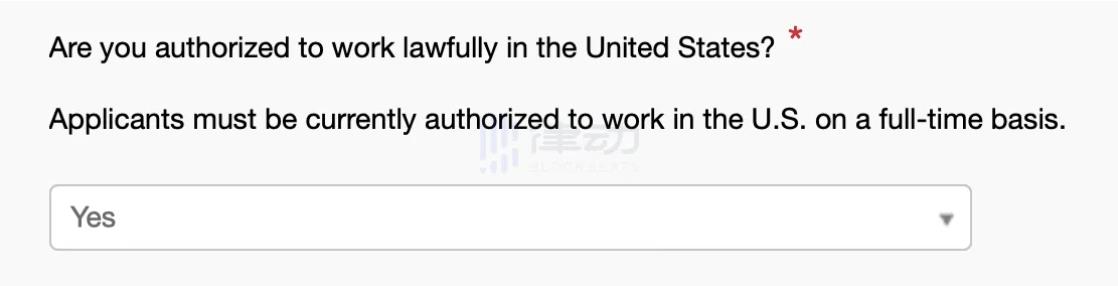
Uniswap job application questionnaire, image source: Uniswap.org
Previously, BlockBeats reported from Token2049 that Uniswap Labs CEO Mary-Catherine Lader stated during the event that while the team is based in the U.S. with a physical office in New York City, Uniswap’s products—including its wallet and web application—are globally accessible. She emphasized Uniswap’s focus on growth in Asian markets and its ambition to become a truly international brand.
Will Ruben, who joined in July of last year, is a native New Yorker. In his announcement, he wrote: "As a lifelong New Yorker, I can’t think of a better place than NYC to build this future—with Hayden, MC, Cal, Chad, and the talented team at Uniswap Labs."
Interestingly, many so-called decentralization-focused Web3 brands operate within a tight-knit “New York circle” of Web3 elites—the most notable being BanklessDAO.
BanklessDAO is also based in New York and maintains close ties with Uniswap Labs. A careful observer will notice that many Uniswap product launches—such as the major upgrade Uniswap V4—are broadcast through BanklessDAO’s media channels. But that’s another story.
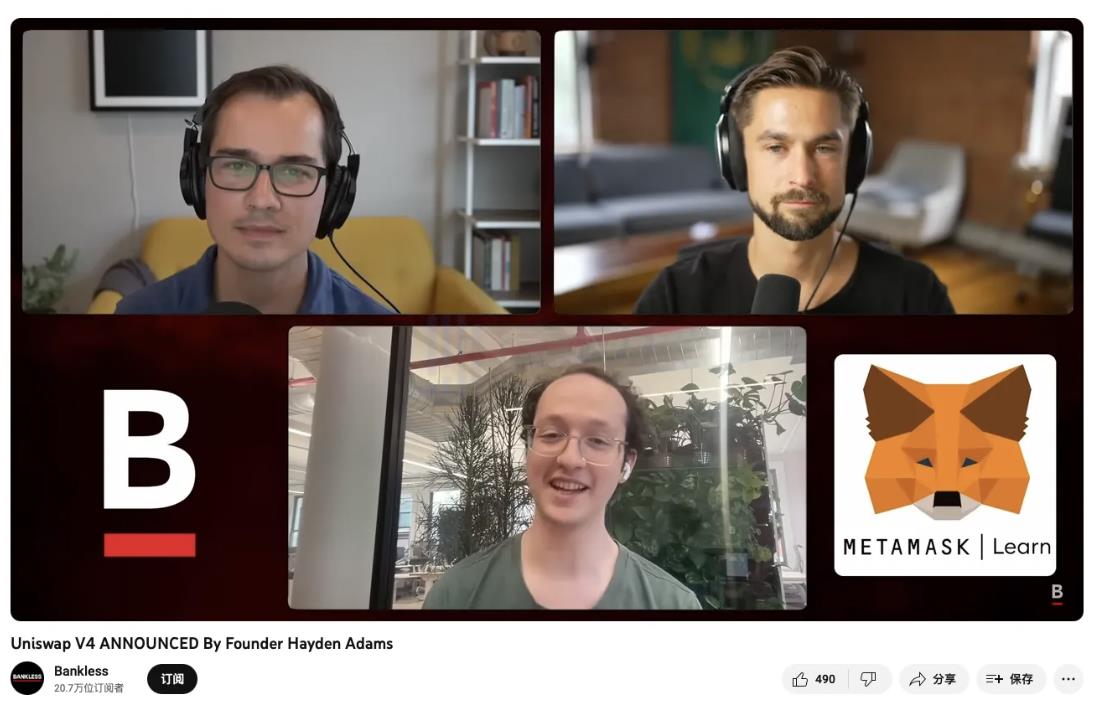
BanklessDAO founders and Uniswap founder Hayden (below) livestreaming the Uniswap V4 announcement, image source: YouTube
Separation of Team and Protocol: Uniswap Labs Becomes a Centralized Startup Building Open-Source Products
Following Uniswap’s recent announcement of front-end fee collection, many in the community believe Uniswap Labs is gradually distancing itself from the Uniswap Protocol. However, this strategy was actually outlined from day one.
On August 11, 2021, Uniswap issued an official announcement updating its logo to clearly distinguish between Uniswap Labs and the Uniswap Protocol. Today, users can find detailed logo trademark usage guidelines on the Uniswap website.
Uniswap Grants commissioned renowned designer Timothy Luke to create distinct logos for the Uniswap Protocol and Uniswap Labs, enabling visual differentiation and clarifying each entity’s functions, responsibilities, and governance roles.
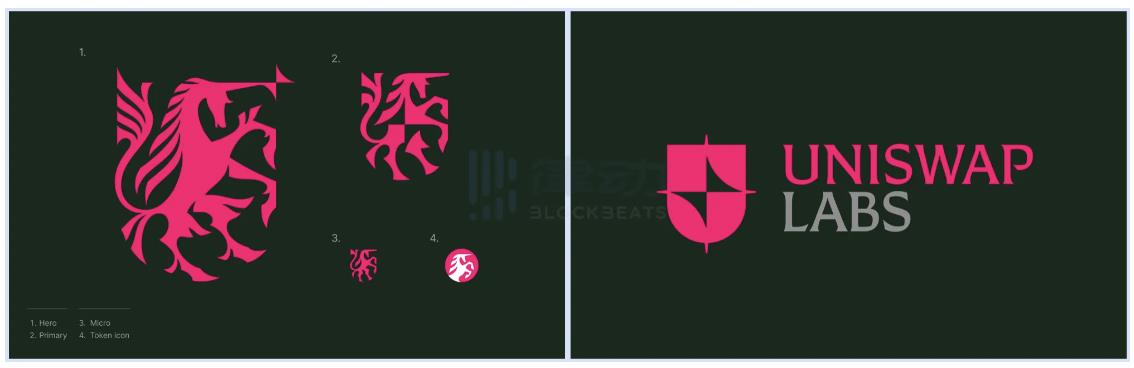
Uniswap logo update in 2021: left is the Uniswap Protocol logo, right is the Uniswap Labs logo, image source: Uniswap.org
The announcement stated: "These two entities are sometimes confused, but they are entirely different: The Uniswap Protocol refers to a set of on-chain, immutable smart contracts facilitating peer-to-peer trading, while Uniswap Labs refers to the software studio building and maintaining products commonly associated with the protocol. Uniswap Labs is one of hundreds of companies building atop the protocol and may one day build products far removed from it."
Then on April 11 the following year, Uniswap Labs officially launched Uniswap Labs Ventures, co-led by Teo Leibowitz and Chief Operating Officer MC Lader.
According to the announcement, Uniswap Labs Ventures aims to "support projects across all stages of Web3—from foundational infrastructure to developer tools and consumer-facing applications." It also actively participates in governance across multiple protocols. BlockBeats reports that since its launch in April last year, Uniswap Labs Ventures has invested in nine projects including Para Finance, WalletConnect, and Rain, and participated in governance for MakerDAO, Aave, Compound, and ENS.
The main purpose of establishing the Ventures division was to further clarify functional boundaries, separating Uniswap Labs’ economic activities and revenue streams from the broader Uniswap Protocol ecosystem. After launching Ventures, Uniswap established the Uniswap Foundation in the same year, operating independently from Uniswap Labs and other entities within the ecosystem.
According to its website, the Uniswap Foundation is a nonprofit organization incorporated in Delaware, USA, focused on supporting decentralized finance, decentralization, and sustainability. Funding comes from the Uniswap community via governance-approved proposals. It supports the DeFi community through three pillars—growth, innovation, and stewardship—and provides resources and initiatives to promote long-term sustainability in DeFi.
One major reason for separating the team from the protocol is to gain greater flexibility—or even advantage—in regulatory compliance.
As previously reported by BlockBeats, after the SEC labeled HEX as an unregistered security in its lawsuit against Richard Schueler and his project Hex, Uniswap immediately removed the HEX token from its trading interface. Today, on Uniswap’s list of unsupported tokens, HEX carries a general disclaimer stating the protocol blocks tokens that “violate trademarks, have been proven fraudulent, or raise other legal concerns.”

HEX token blocked on Uniswap web interface, image source: Uniswap.org
Moreover, in a class-action lawsuit in April this year, a judge in the U.S. District Court for the Southern District of New York dismissed claims against Uniswap, which founder Hayden called a “huge win.”
Court documents show that the Uniswap platform is capable of, and in many cases operates legally. Plaintiffs had no direct transaction with the Uniswap platform or protocol, and current securities law does not appear to hold DeFi protocols liable for fraud committed using their systems.
The judge ruled that plaintiffs were harmed by fraudulent token issuers who used Uniswap’s core contracts and relay to conduct pump-and-dump schemes. Uniswap merely provided the platform. Under U.S. securities law, this does not imply liability for resulting scams and damages.
This stands in stark contrast to the arrest of developers behind Tornado Cash, despite playing a similar protocol/platform development role—making this ruling particularly noteworthy.
Further reading: What Does the U.S. Court’s Friendly Ruling on Uniswap Mean for DeFi Regulation?
Uniswap’s recent ability to enable front-end fees stems directly from this separation model. As a protocol facilitating trading of tokens (or “unregistered securities”), Uniswap cannot legally generate revenue via transaction fees due to regulatory constraints. However, Uniswap Labs can build compliant front-end user products on top of this open protocol and monetize them.
If a token like HEX faces legal action from the SEC or other regulators, Uniswap can immediately halt its availability on the front end, thereby shielding the team and product from regulatory risk.
Roman Dualism in Governance: Being Friends with VCs
Hayden’s innovative and forward-thinking mindset created opportunities for Uniswap’s growth. However, early investors and capital have also exerted undeniable influence. While VC backing brought abundant resources and accelerated development, it also introduced new governance complexities and directional challenges.
Capital infusion has accelerated project growth and expanded the community, but it has also shifted power dynamics, raising concerns about undue control. Some community members argue that investors are no longer content being passive supporters—they now seek greater influence in decision-making, potentially threatening the project’s decentralization.
Drama with Early Investors
Ric Burton, former CEO of Balance.io, sparked widespread attention earlier this year with a public Twitter dispute involving Uniswap founder Hayden Adams. Ric presented internal messages and screenshots as evidence, attempting to expose discrepancies between his actual relationship with Hayden and the public narrative.
Looking back to 2018, Ric described a deep friendship with Hayden and their joint efforts to advance the cryptocurrency industry and the Uniswap project. At the time, Ric was CEO of Balance.io, a company focused on providing interface services for Ethereum-based dApps. Believing most dApps had significant room for improvement, he funded several projects, including WalletConnect, The Graph, and Uniswap.
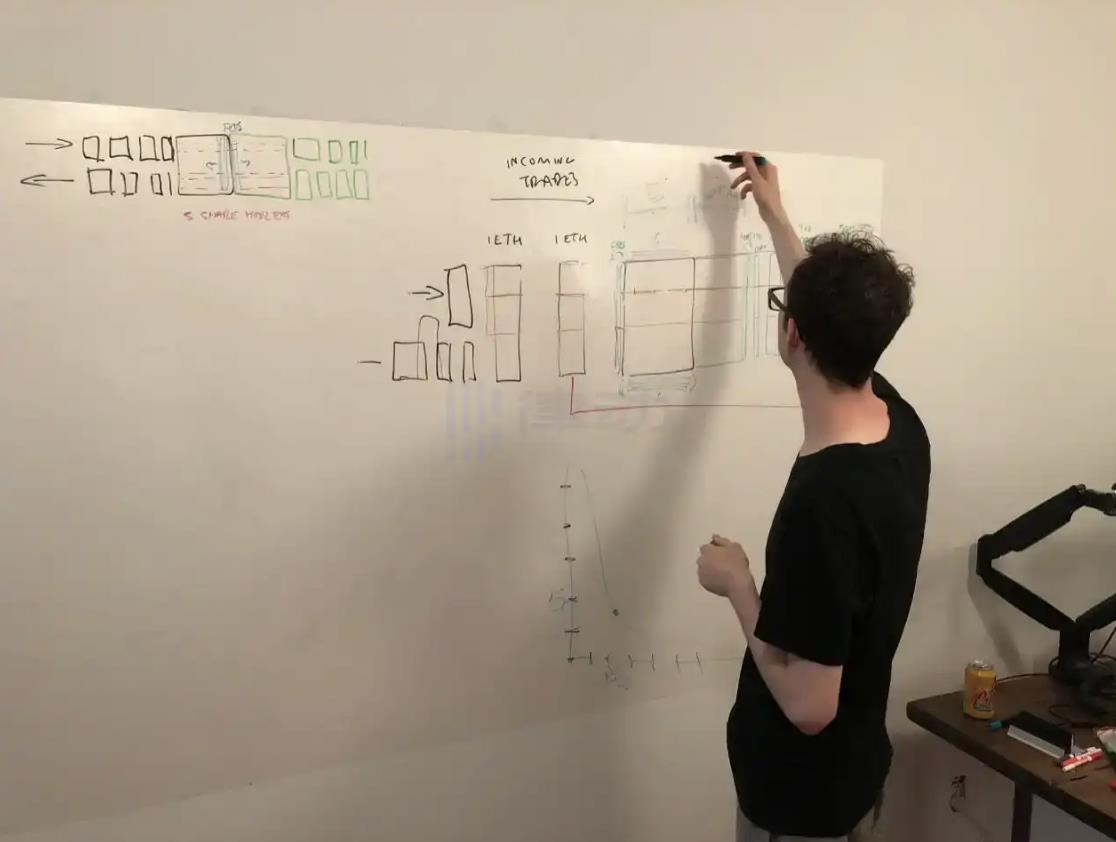
Hayden in early days, image source: Internet
Hayden’s unique insights into Automated Market Makers (AMM) and passion for the project intrigued Ric, prompting him to offer support. Their bond grew exceptionally strong—Ric once said he’d “take a bullet” for Hayden.
But things began to change over time, especially in March 2019. While attending his grandmother’s funeral, Ric received an email from a Balance co-founder informing him he must resign as CEO. Meanwhile, Uniswap’s fortunes were rising—Hayden successfully raised $1 million in funding. Ric expected to be involved, but Paradigm’s entry changed everything.
Feeling deeply betrayed after learning he wouldn’t receive any Uniswap equity, Ric remained silent until the UNI token distribution was announced. Only then did Hayden mention repaying him—but under the condition that Ric sign an NDA. Enraged, Ric decided to sue Hayden.
Hayden responded, calling Ric’s claims highly misleading and outright false: "Ric Burton did have the opportunity to invest in Uniswap. I sent him a Simple Agreement for Future Equity (SAFE) with the amount blank, so he could fill in his desired investment. But he chose not to, citing that his company Balance could only survive about one month at the time."
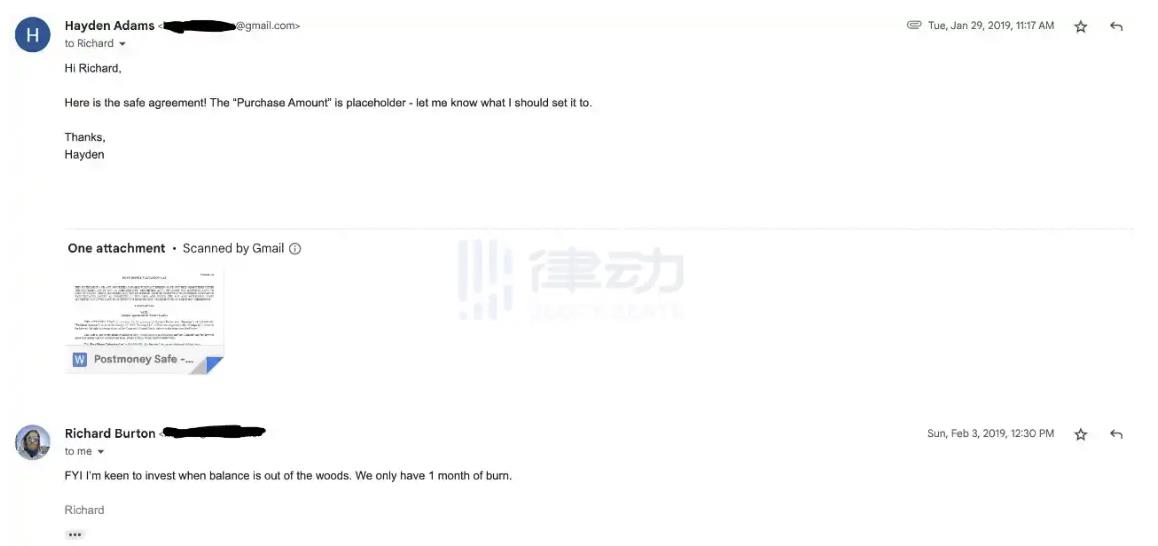
Chat logs between Hayden and Ric, image source: Internet
Eventually, both parties compromised. Hayden acknowledged Ric’s contributions to Uniswap’s early development and refrained from further comment.
To outsiders, this drama may have painted Hayden as someone combative with investors. But in reality, Uniswap operates more like a publicly traded company governed by a board of directors than any other Web3 team—and that board consists of the major VCs behind Uniswap.
"Major Shareholders" Take Over: Capital Support and Control over Uniswap
On August 6, 2020, SEC filings revealed that Universal Navigation Inc., Uniswap’s development company, completed an $11 million financing round on June 5, led by a16z with participation from USV, Paradigm, and Version. This marked the moment when elite Silicon Valley Web2 capital giants took control of Uniswap.
Within the grand scheme of Uniswap DAO governance, a16z is undoubtedly a pivotal player. Not only do they actively participate with 15 million votes worth of UNI, but they’ve also delegated governance rights for approximately 40 million additional UNI to external organizations. One memorable example occurred when deciding whether to deploy Uniswap V3 on BNB Chain: over 80 million UNI votes were cast—exceeding 50% of total eligible UNI voting power.
Uniswap initially planned to use Wormhole to integrate with BSC, but a16z unexpectedly voted against it, aiming to pave the way for LayerZero—a project they had invested in. Meanwhile, a16z’s rival Jump Trading explicitly supported Wormhole. In the end, Wormhole won due to superior UNI vote support, becoming the bridge for Ethereum-based Uniswap DAO governance on BNB Chain.
In absolute terms, Uniswap’s so-called “community” is insignificant. The real decision-makers behind Uniswap’s development remain the powerful capital backers.
According to DAO governance researcher @lurenbian observations, after major VCs entered the scene, participation in Uniswap DAO temperature checks surged from an initial 34,000 UNI votes to nearly 30 million in recent proposals. Official data shows 31 proposals submitted, 28 of which passed—indicating a 90% approval rate.
Among these, multi-chain deployment became the dominant theme, though voting patterns lacked consistency. In an interview, @lurenbian told BlockBeats that for operational decisions like chain expansion, VCs almost always get their way if the rationale is sound. For projects on target chains, gaining access to Uniswap liquidity is overwhelmingly beneficial—a win-win for VCs.
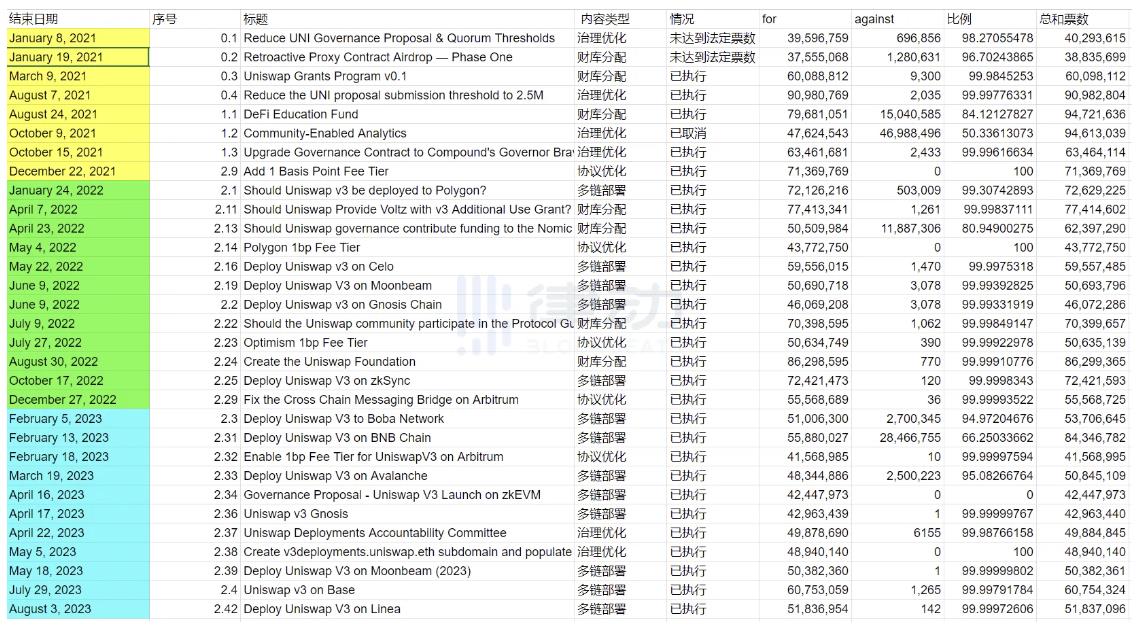
Uniswap governance proposal statistics, image source: @lurenbian
Another telling case is the Educational Fund controversy. After selling 500,000 UNI for 10.2 million USDC, a proposal regarding the DeFi Education Fund (DEF) sparked strong backlash. The proposal passed with 72.64% support, allocating 1 million UNI from the treasury to DEF, which promised to release a detailed budget within 90 days. But expectations weren't met—before the community understood how the funds would be used, DEF suddenly announced it had already sold half of the allocated UNI.
Some community observers questioned whether the proposal was likely driven by a16z, Uniswap’s main investor, suspecting a case of “self-proposing and self-voting.” Although all doubts vanished after Uniswap founder Hayden expressed support for DEF, the community gradually realized that in Uniswap DAO governance, only the “major shareholders and board members” truly hold sway.
Product Strategy Follows Web2 Logic: Ideological Purity Takes a Back Seat to Market Dominance
In pursuing market dominance, Uniswap clearly does not adhere strictly to traditional Web3 ideals of openness and decentralization. Instead, Uniswap Labs employs classic Web2 product strategies designed to rapidly acquire and retain users, ensuring its continued leadership in the competitive DEX landscape.
Commercial Licenses, Copying—Classic Internet Stories
In June this year, Uniswap announced its V4 version after nearly two years, shocking the community. While Hooks—a new feature dubbed a “DEX killer”—garnered attention, the extension of the BSL (Business Source License) from V3, now doubled in duration, drew even greater scrutiny.
The Business Source License seeks to balance open-source principles with commercial interests. During its validity period, third parties cannot use the source code for commercial purposes without permission. For Uniswap, this has become a second strategic weapon beyond technical innovation. Thanks to BSL protection, Uniswap V3 dominated its era. Only after V3’s two-year BSL expired did numerous V3 forks emerge.
Thus, Uniswap’s decision to apply the BSL license to V4 reignited controversy within the developer community.
Uniswap founder Hayden firmly believes BSL is the correct choice for the community. During ETH Paris, Hayden responded to BlockBeats’ inquiry: “It’s entirely up to governance.” He added that UNI holders who disagree can propose changes via governance votes. However, to most observers, “they” and Uniswap’s “VC shareholders” are effectively indistinguishable.
Interestingly, while the V4 licensing debate was still ongoing, Uniswap found itself embroiled in a plagiarism controversy.
On July 17, BlockBeats reported that Uniswap launched UniswapX, a non-custodial, Dutch auction-based protocol. According to official announcements and documentation, UniswapX aims to aggregate liquidity sources, resist MEV, and enable gasless trading—bringing DEXs closer to parity with CEXs.
UniswapX was met with high expectations. Paradigm researcher Dan Robinson praised it on social media: “I think UniswapX changes the game for decentralized exchange, MEV, and interoperability.”
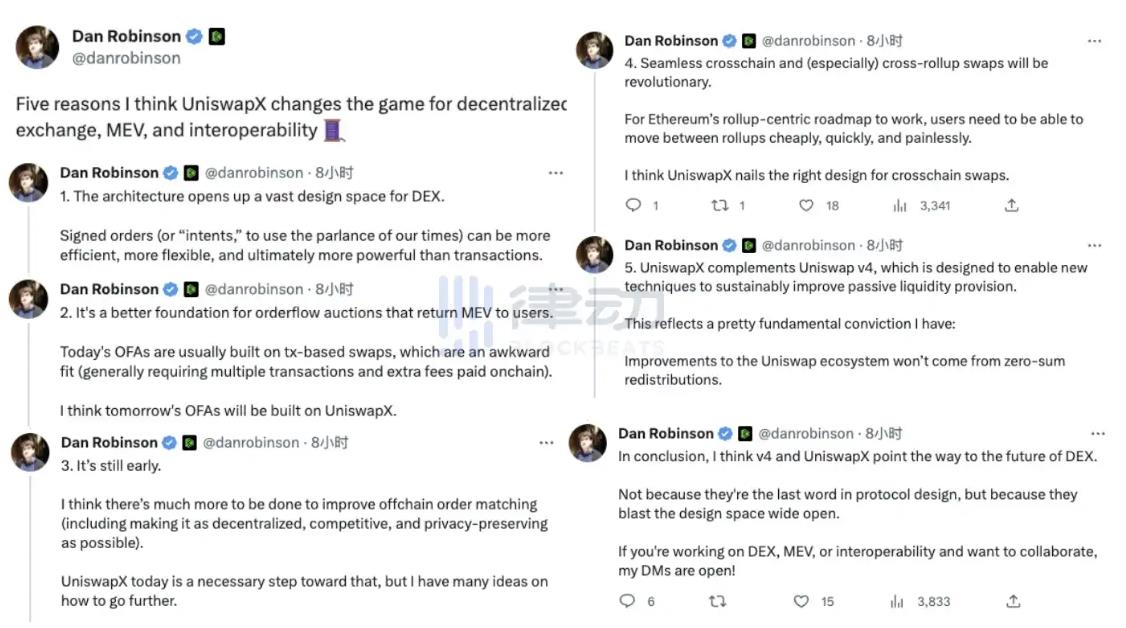
Soon after, the community pointed out that UniswapX copied CoWSwap’s mechanism, while V4 allegedly borrowed heavily from CrocSwap. Curve Finance responded via its official Twitter account: “Dan, with all due respect, the game was changed long ago—when 1inch first did high-quality aggregation, when CoWSwap launched the Solvers model. UniswapX is nice, but it’s neither the pioneer nor even the second mover.”
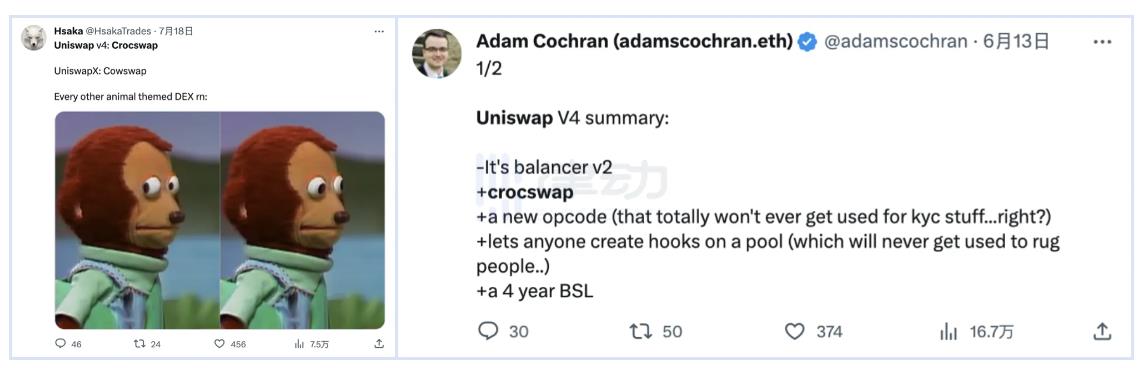
CoWSwap also posted multiple tweets welcoming Uniswap to “further validate their trade design,” sarcastically implying mimicry of their mechanism.
Further reading: Mixed Reviews: Is Uniswap Really the ‘Tencent of Crypto’?
Regarding accusations of V4 copying, a Uniswap Labs developer told BlockBeats that the team had been working on V4 for two years. While CrocSwap published its whitepaper earlier, its product development lagged significantly—only rushing to launch after Uniswap unveiled V4.
For Uniswap, open-source ideology and pure innovation aren’t ultimate winning formulas in Web3. What matters is product development and execution capability—just like any internet company. Once you have an idea and code, first secure copyright or BSL protection, then proceed with product development.
“We hope to see more original innovation instead of endless forking and copying,” a Uniswap Labs developer told BlockBeats. From this perspective, Uniswap’s strategy becomes clear: use BSL licenses to buy time for Labs’ innovations, capture as much market share as possible, and by the time the license expires, launch V5 or another superior product—by then, most new users will already be Uniswap users.
Meanwhile, projects like CrocSwap and CoWSwap, which uphold strict Web3 open-source values, lack the manpower and speed of Uniswap’s large team and progress slowly in product development. They may soon be reduced to just “publishing whitepapers,” losing all sustainable competitive edge.
Chasing Market Share: Analyzing Uniswap’s Product Lineup
From 2019 to 2023, Uniswap’s monthly trading volume data shows outstanding performance, consistently outpacing other DEXs. Despite suffering a vampire attack from SushiSwap early on, Uniswap’s market share has steadily climbed since inception, now commanding around 80% of the DEX market and solidifying its dominant position.
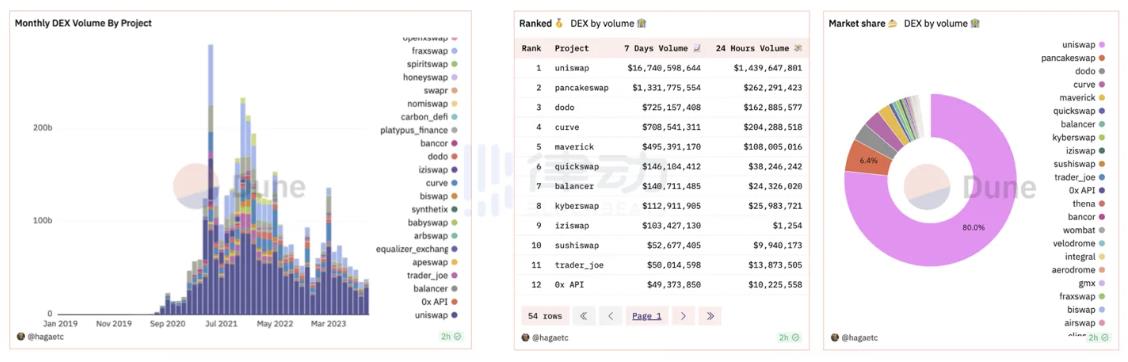
Uniswap trading volume and market share data, image source: Dune Analytics
Compared to V3, released two years earlier in May 2021, V4 offers greater composability and significantly reduces gas costs for liquidity provision and trading. A key enhancement in V4 is the introduction of Hooks—a smart contract mechanism enabling customizable logic insertion during or after swaps, greatly expanding developer flexibility.
With Hooks, developers no longer need to build new DEXs from scratch. By customizing liquidity and adding frontend interfaces and tailored features within Hooks, anyone can create specialized trading venues—like Lego blocks. Hence the community quip: “If you can’t beat them, join them—no need to build your own DEX anymore.”
Further reading: Farewell to Fork Swaps: Is Uniswap V4 Entering the 'Era of Infinite Hooks'?
Through continuous iterations from V2, V3, to V4, and the launch of UniswapX and Uniswap Wallet, Uniswap’s product suite has expanded to cover backend open protocols, third-party APIs, liquidity aggregators, and mobile user entry points—touching nearly every aspect of Web3 trading.
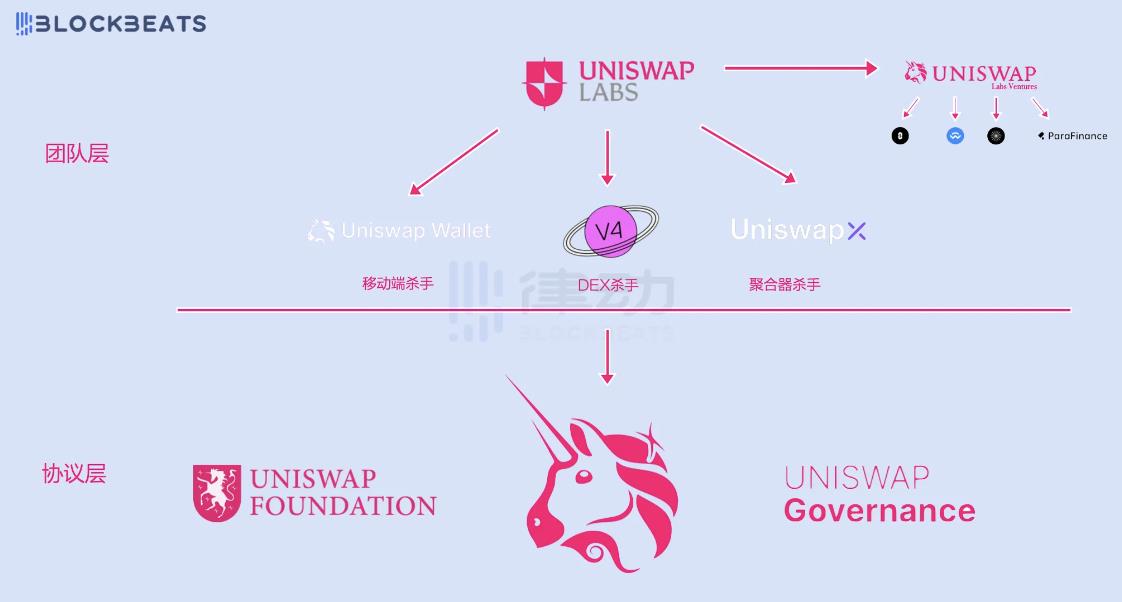
Uniswap product architecture
Beyond the open-source Uniswap protocol, Uniswap Labs currently dominates the Web3 trading market with three flagship products: the web-based trading app and mobile wallet, the V4 version featuring Hooks and Singleton functionality, and the off-chain matching liquidity aggregator UniswapX.
Through comprehensive upgrades to the open protocol and V4, Uniswap continues to squeeze competitors at the protocol and backend contract levels, moving toward full-scale monopoly. Additionally, UniswapX enables entry into the aggregator market, leveraging Uniswap’s overwhelming liquidity advantage to undercut competitors like 1inch and CoWSwap.
Further reading: Opinion: Can UniswapX Spark a New On-Chain Boom?
Moreover, users visiting Uniswap’s web interface are clearly directed to download its wallet app.
With the rollout of the mobile Uniswap Wallet, the team aims to attract both light Web3 users and Web2 audiences, compete with Web3 wallets offered by exchanges like OKX and Bybit, and generate substantial recurring revenue through front-end fees on both web and mobile platforms—all without regulatory risk. A triple win.
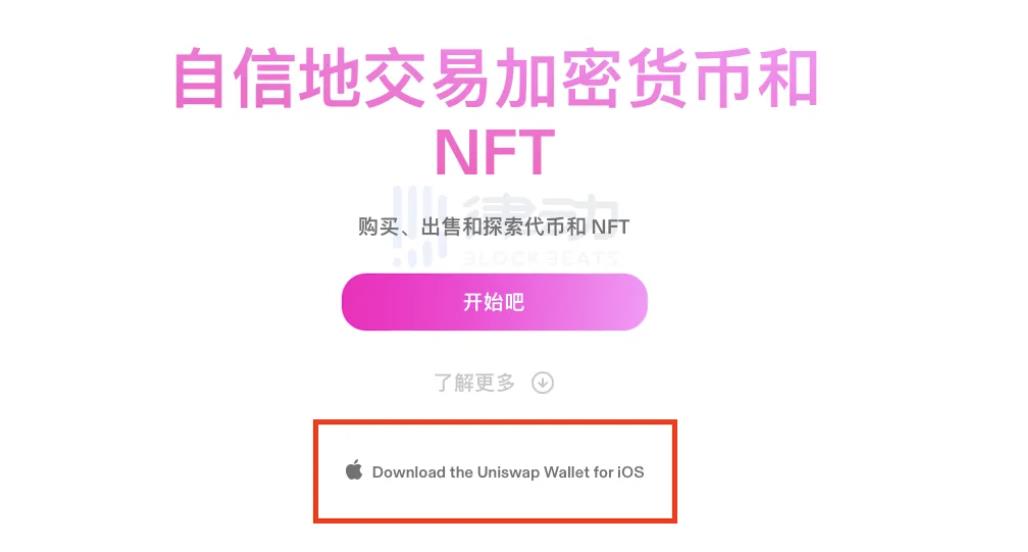
Uniswap web interface, image source: Uniswap.org
When asked about potential monopolistic concerns, a team member simply shrugged: “That’s not something we need to worry about.”
Does UNI Need Utility? Uniswap Charts a Path Forward for Web3 Startups
Join TechFlow official community to stay tuned Telegram:https://t.me/TechFlowDaily X (Twitter):https://x.com/TechFlowPost X (Twitter) EN:https://x.com/BlockFlow_News
 BlockBeats






