









Sequoia Capital Internal Sharing: The Tough Times Have Arrived—How Should We Prepare?
TechFlow Selected TechFlow Selected
Sequoia Capital Internal Sharing: The Tough Times Have Arrived—How Should We Prepare?
When a severe test arrives, the most important thing is to learn how to pause and think.
 Navigating Web3 tides with focused insights
Recently, major media outlets in both China and the U.S. have been intensely discussing topics such as a potential American recession. A Bloomberg survey previously indicated that most investors expect the U.S. economy to fall into recession before the end of 2024. When crisis strikes, how should we respond?
Below is a report titled "Adapting to Endure," jointly released last May by multiple partners at Sequoia Capital during a period of widespread uncertainty and rising anxiety. The report serves as a warning about today’s globally concerning economic conditions—and offers practical advice.
The following is the main text:
In May last year, during an internal meeting, Sequoia U.S. warned that harsh times had arrived:
The biggest shift over the past period has been that “capital” has gone from being free to becoming expensive. Assets that once performed best are now underperforming the most.
Simply put, the world is re-evaluating what business models are truly valuable when capital becomes costly.
When severe challenges arrive, the most important thing is learning to pause and reflect. Those who adapt most skillfully to change will survive.
Growth at all costs is no longer rewarded. The era of achieving returns through unchecked expansion is over. This recovery won’t be a V-shaped rebound—it will be a prolonged healing process.
Key highlights from the meeting:
As the venture capital firm behind Google, Apple, and Airbnb, Sequoia Capital has earned a reputation as tech industry’s “Cassandra” (a prophetess in Greek mythology known for foreseeing doom) due to its history of sharing candid presentations and memos with portfolio companies during economic downturns.
In a 52-slide deck titled “Adapting to Endure,” Sequoia listed turbulent financial markets, inflation, and geopolitical conflicts as key drivers of uncertainty and change. It advised founders not to expect a quick rebound like the one seen after the pandemic began, because “the monetary and fiscal tools that powered recovery have already been exhausted.”
At the same time, Sequoia urged founders to act swiftly—extending their cash runways and conducting thorough audits of any excess spending. “Don’t view ‘down rounds’ negatively—they’re a way to conserve cash and move faster, helping you go further.”
There Will Be No ‘V-Shaped Recovery’ This Time
Although the U.S. economy dipped in March 2020 due to the pandemic, it quickly bounced back—an economist term known as a V-shaped recovery. But Sequoia believes this scenario won’t repeat. The report notes that monetary and fiscal policy tools have been largely depleted, while persistent inflation and geopolitical tensions further constrain macro-level solutions.
To combat the pandemic, governments worldwide deployed massive fiscal and monetary stimulus to fill the enormous economic gap caused by lockdowns. These measures helped prevent a far worse depression—but came with serious consequences. This “money printing” was reflected in asset prices, particularly in stocks of remote work and e-commerce companies aligned with pandemic trends.
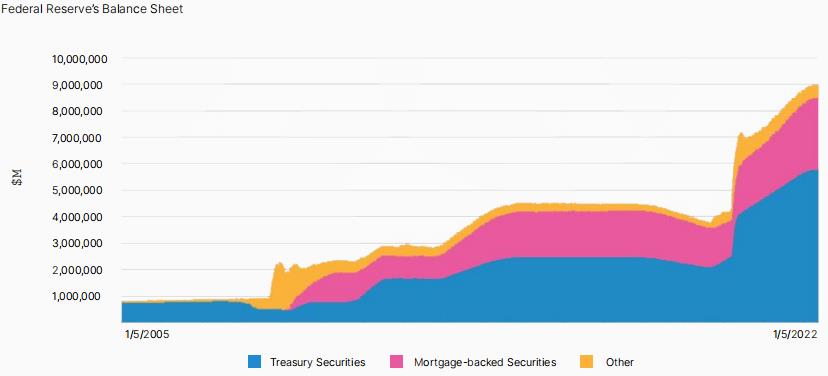
Federal Reserve balance sheet, image: Sequoia
Market downturns will impact consumer behavior, labor markets, supply chains, and more. This crisis will last much longer—though its duration can’t be predicted, preparation is essential. The Federal Reserve’s two core mandates are maximizing employment and maintaining price stability—but clearly, it hasn’t succeeded on either front. Sequoia isn’t alone in sensing trouble; prominent VC Lightspeed also stated in a blog post: “The decade of prosperity is unquestionably over.”
Who Will Survive?
1. So under these circumstances, who will survive?
The answer is survival of the fittest:
Ultimately, it’s not the strongest species that survives, nor the most intelligent, but the one most adaptable to change.
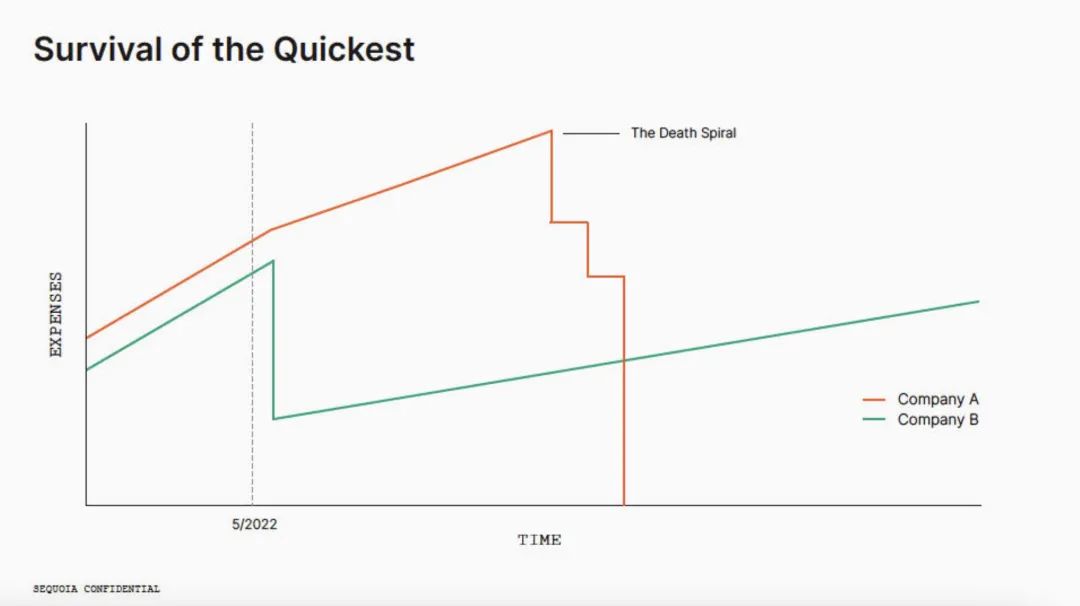
As shown in the diagram above, Company B, which responded fastest, has significantly more cash runway and is far less likely to spiral into death.
Therefore, we recommend calculating various cost-saving strategies—such as shutting down projects, halting R&D, reducing marketing spend, or others—not necessarily to act immediately, but to ensure you’re ready if needed within the next 30 days.
We’ve observed that in 2008, every company that cut costs early ended up stronger.
Don’t see cost-cutting as negative—see it as a way to preserve cash and accelerate forward.

Additionally, reflect on your current decisions versus the ones you wish you’d made earlier.
When you’re down to just six months of cash, focus and decision-making become extremely difficult. So regardless of your current runway, start thinking now.
Rainy Days Are Better for Overtaking
Crisis = Danger + Opportunity. Formula 1 driver Ayrton Senna once said: “You can’t overtake 15 cars on a sunny day, but you can in the rain.” For startups, recessions make hiring easier and reduce competition.

Thus, crises are also opportunities. You can treat this moment as a once-in-a-lifetime chance—those who survive will emerge stronger.
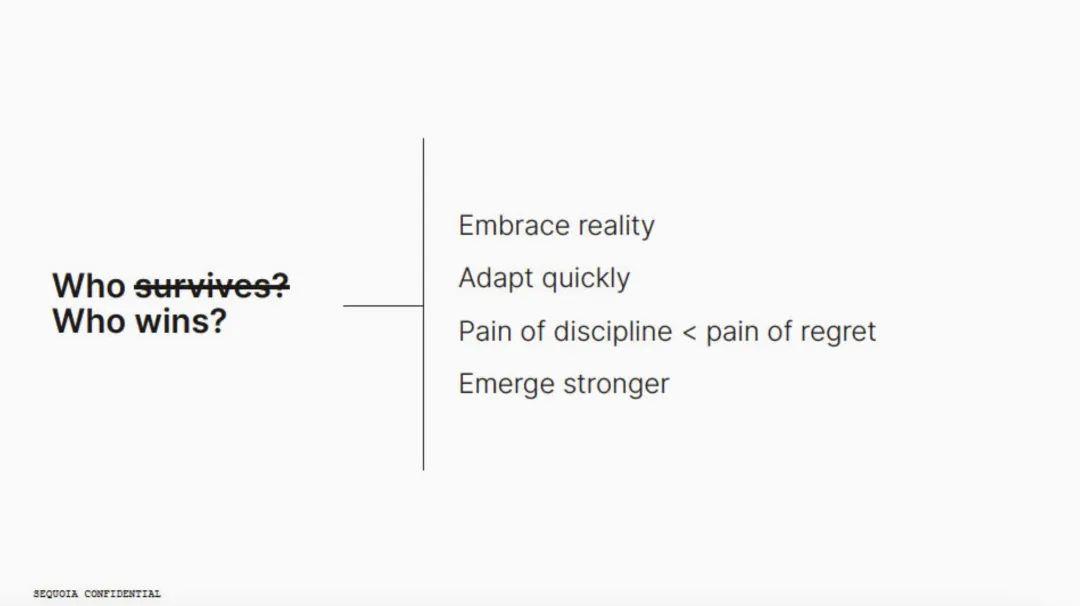
So who won’t just survive, but actually thrive?
Founders who face reality head-on, respond quickly, act with discipline and principle—not regret.
Moreover, hiring will get easier in the coming months, with fewer big tech firms competing against you.
So treat this moment as a rare opportunity, play your cards right, and ultimately grow stronger.
In such times of crisis, how do you become stronger? Opportunities only come to those who are prepared.

Founders must confront reality, overcome fear, and adjust promptly. Just as slower-growing yet profitable companies now enjoy financial flexibility, allowing them to pull ahead of cash-burning peers—the shift from growth stocks to value stocks signals a turning point. Crises often redefine everything.
History’s greatest companies were born in crisis: Amazon and Google after the 2001 dot-com bubble; Twitter, Uber, Airbnb, and Okta after the 2008 financial crisis. Sequoia believes the most exceptional, resilient startups over the next few years will rapidly capture market share despite adverse conditions.
How Should You Prepare?
We offer a framework—one that has been used successfully during past severe crises and refined over many years.
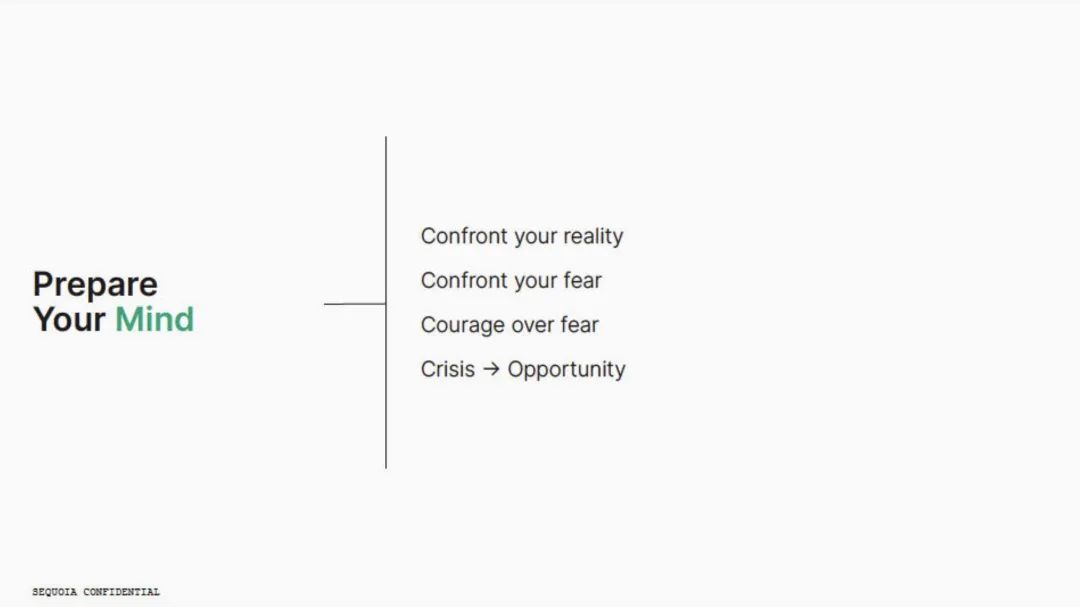
1. First, prepare mentally.
① Face reality: This first step is the hardest.
Every collapse begins when founders fail to confront the harshest truths. As a founder or CEO, you must face reality directly. Your team or board can only help so much.
② Face fear.
Now that you’ve faced reality, you must avoid falling into a negative spiral.
Only by breaking free from this cycle of negativity can you determine the real path out of crisis.
③ Choose courage over fear.
Courage is a choice—so choose to be courageous.
Whatever we face today won’t be worse than the uncertainty we confronted at the start of the pandemic. We will overcome it all.
④ Shift from crisis to opportunity.
The Chinese word for “crisis” consists of two characters—one meaning “danger,” the other “opportunity.” Literally, it means “a point of danger where change happens.” President John F. Kennedy famously referred to it as “danger + opportunity,” popularizing the phrase.
In fact, moments of crisis are precisely when transformative change becomes possible. With change comes the chance for the weak to grow strong, and the strong to falter.
Once-popular growth stocks are now being dumped, while value stocks are gaining attention. Slower-growing but profitable companies now have financial flexibility to pull ahead of cash-burning competitors.
If you clearly see the opportunity and are ready to seize it, this inflection point can become your new advantage.
2. Second, prepare your team.
① Start with “Why”—reaffirm your mission, vision, and values.
This is crucial for the true believers you’ve hired.
② Demonstrate leadership.
Understand your audience—customers, employees, investors. They all need reminding why they bought into your vision. They look to you for direction and decisive action.
③ Align your team—ask for commitment and contribution, or… politely ask them to leave and lighten the lifeboat.
3. Prepare your company.
Tightening capital markets increasingly favor profitability.
When liquidity was abundant, top performers were capital-intensive companies—especially tech and newly IPO’d firms. But now, markets are reassessing which business models hold value in tighter financial conditions. As liquidity dries up, these same companies have become the worst performers. Across software, internet, and financial firms, 61% now trade below their pre-pandemic (2020) valuations. The market has essentially erased two years of progress—even though most of these companies doubled their revenue and profits during that time.
Sequoia believes the key ways startups can survive the winter include:
-
Restructure your team: Reaffirm company mission, vision, and values; retain high-value employees
-
Focus on cash flow: Always monitor your runway
-
Increase profitability: Broaden revenue streams, improve unit economics, and if necessary, downsize
-
Raise funds or debt: Even if the cost is high
-
Focus investment on core business: Avoid undisciplined market pursuits. For example, Airbnb cut most of its products but increased investment in key areas like core hosting and long-term stays.
-
Innovate in mindset: Focus energy on solving problems better, not throwing money at them. Change is the only option.
This Is a Turbulent Era
Cisco after the 1987 financial crisis; Google and PayPal after the 2000 dot-com crash; Airbnb during the 2008 financial crisis; DoorDash during the 2020 pandemic.
But we also believe that success in the coming years will depend on whether companies can decisively make difficult choices—to face the uncomfortable challenges created by two years of inflated and distorted capital flows.
The primary goal of this presentation is to shift our mindset.
We are in a moment of profound uncertainty and necessary change. Your decisions during this difficult period will profoundly shape your company’s future.
This is a turbulent era. Managing change is everyone’s job and responsibility.
We are not gathering here to share anxiety. On the contrary, we believe the most talented, ambitious, and determined individuals will rise against the tide and build truly extraordinary ventures.
Join TechFlow official community to stay tuned
Telegram:https://t.me/TechFlowDaily
X (Twitter):https://x.com/TechFlowPost
X (Twitter) EN:https://x.com/BlockFlow_News












